

Questions Asked & Answered
Recent Questions Answered
Archived: 28th October 2026
Dry Island
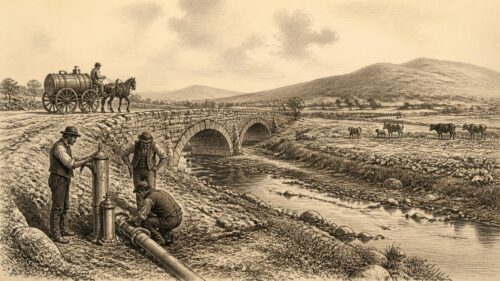
This article examines Ireland’s drought of 2026 as a historical test of systems built for a wetter national reputation but increasingly exposed to summer water scarcity. It places the event beside the dry years of the 1970s, 2018 and 2025, tracing the development of piped supply, drainage, irrigation and national water planning. Drawing on meteorological records, public infrastructure plans and environmental assessments, it distinguishes measured rainfall and supply evidence from political interpretation. The central argument is that drought reveals not an absence of Irish water, but the uneven timing, location, storage, treatment and distribution of it across communities, farms, rivers, towns and cities.
Archived: 28th October 2026
Remembering Ashling
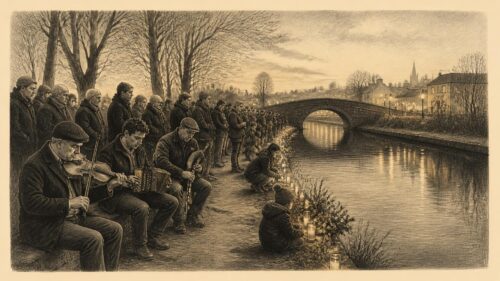
This article examines how the killing of Offaly teacher, musician and camogie player Ashling Murphy in January 2022 became an enduring act of public remembrance in Ireland. It traces vigils, mourning rituals, parliamentary debate, cultural tributes and the Ashling Murphy Memorial Fund, while placing them within longer Irish histories of women’s safety, gender based violence, community association and traditional arts. It separates established evidence from interpretation, avoids treating commemoration as proof of policy success, and considers the ethical difficulty of remembering a much loved individual without reducing her life to the manner of her death. The article follows remembrance through 2026 carefully.
Archived: 28th October 2026
Protest Traditions
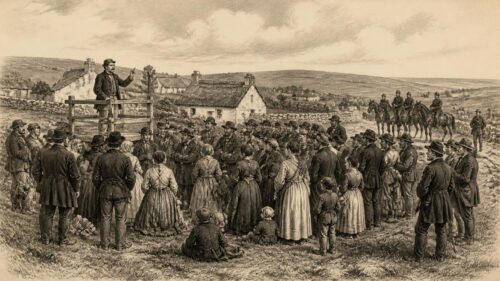
This article traces the changing repertoire of protest in Ireland, from eighteenth century agrarian combinations and Daniel O’Connell’s disciplined mass meetings to land agitation, labour struggle, suffrage activism, anti-conscription resistance and civil-rights marches. It examines how assemblies, petitions, boycotts, strikes, occupations, street demonstrations and referendums connected local grievances to national claims. Rather than treating protest as a single nationalist tradition, it restores conflicts over class, gender, religion, housing, bodily autonomy and public services. It also considers state responses, the line between non-violence and coercion, and the ways later memory has simplified complicated episodes. Evidence and uncertainty remain central throughout here.
Archived: 27th October 2026
Contested Learning
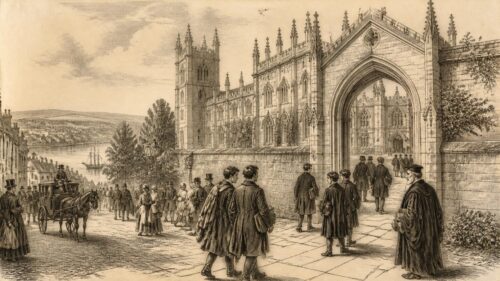
This article traces the and contested making of university education in Ireland, from medieval learning communities and Reformation upheaval to Trinity College Dublin, the Queen’s Colleges, Catholic initiatives, the National University of Ireland and Queen’s University Belfast. It examines universities as instruments of religion, empire, professional formation and civic identity, while following the enlargement of access across gender, class and region. Rather than treating institutional survival as inevitable, it stresses contingency, conflict and constitutional change. The result is an island wide history of competing educational visions and enduring debates over knowledge, authority, language, citizenship, and the public purpose of higher learning.
Archived: 27th October 2026
Shannon Citadel
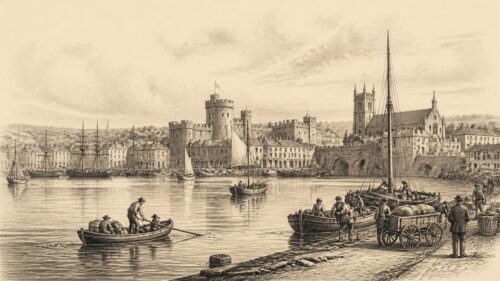
Limerick developed where the Shannon narrows around King’s Island, a setting that made it a settlement, port, fortress and contested gateway. This article follows evidence from archaeology, annals, civic records, surviving buildings, maps and museum interpretation to trace the city and county’s long history. It examines Viking urbanism, Anglo Norman conquest, medieval commerce, sieges, the Treaty of Limerick, Georgian expansion, famine, migration, labour unrest and revolution. It also considers Lough Gur and the rural county, and separates legend from documentary record. Limerick emerges not as a fixed inheritance, but as a place repeatedly remade by river, trade, power and people alike.
Archived: 27th October 2026
Island Histories
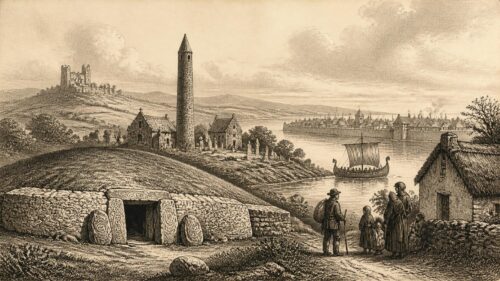
This survey traces Ireland’s long and contested history from prehistoric settlement and monumental landscapes through early Christian learning, Viking towns, lordship, conquest, plantation and union. It examines the Great Famine, constitutional nationalism, revolution, partition and the difficult creation of two states on the island. It emphasises that evidence changes by period: archaeology illuminates deep time, while annals, manuscripts, archives and testimony illuminate later centuries. Documented evidence is distinguished from interpretation and folklore throughout. Ireland emerges not as a timeless, homogeneous nation, but as an Atlantic island of changing communities, unequal power, cultural exchange, trauma and continuing debate over identity, sovereignty, memory and coexistence.
Archived: 27th October 2026
Radical Curate
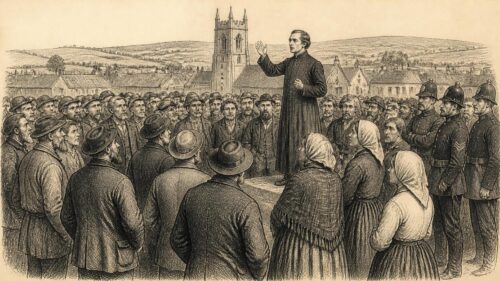
Eugene Sheehy, the Limerick priest remembered as the ‘Land League priest’, moved through nearly five decades of Irish political and cultural change. Imprisoned in Kilmainham during the Land War, he campaigned in America, supported the Ladies’ Land League, promoted Gaelic cultural activity, quarrelled with ecclesiastical authority, and retained ties to advanced nationalist circles. His ministry at Bruree influenced local political memory, including that of the young Éamon de Valera. This article separates secure archival evidence from retrospective recollection, examining Sheehy as a contentious cleric whose career linked parish life, agrarian protest, Irish America, cultural revival and revolution.
Archived: 27th October 2026
Distant Witnesses
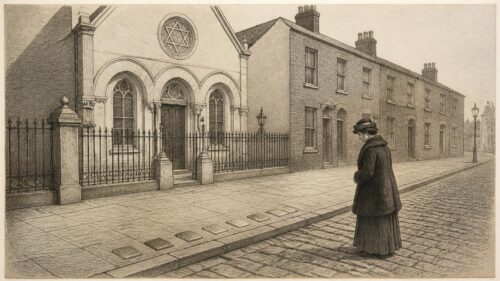
This article traces how Holocaust remembrance developed in Ireland: from wartime distance, restrictive refugee policy and the experiences of Irish born victims, to survivor testimony, civic commemoration, education and memorials. It examines the Jewish community’s central role, postwar arrival of displaced children and survivors, importance of Mary Elmes, and the State’s later acknowledgement of its failures. Particular attention is given to the national ceremony, the Stolpersteine in Dublin, museums, schools, archives and literature. The article argues that Irish remembrance is strongest when it combines historical precision, named individuals, survivor voices and scrutiny of neutrality, exclusion, antisemitism and responsibility.
Archived: 27th October 2026
Civic Shelter
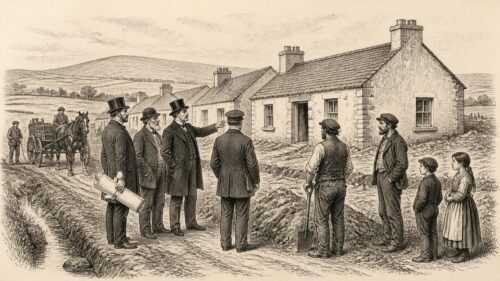
This article traces how housing, planning and local government became intertwined in Ireland from nineteenth century sanitary reform to plan led state. It examines poor law institutions, town commissioners, elected county councils, labourers’ cottages, slum clearance, municipal estates, suburban expansion and planning. It argues that Irish housing policy was never a story of bricks: it distributed political power, defined health responsibilities and reshaped the countryside and city alike. The account distinguishes legal evidence from retrospective interpretation, while acknowledging experiences of tenants, ratepayers, officials and communities. It ends by locating contemporary planning institutions within this long, contested administrative inheritance.
Archived: 27th October 2026
Irish Houses
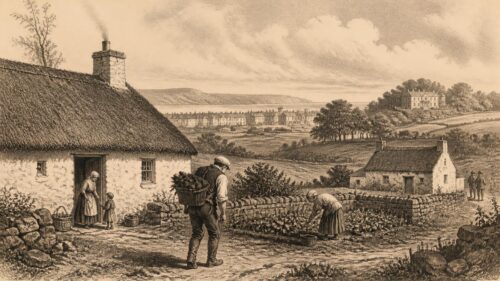
This article traces the long history of dwelling across Ireland, from excavated prehistoric timber structures and enclosed early medieval settlements to vernacular cottages, elite townhouses, estate houses, tenements and public housing. It examines what archaeological remains, surveys, census returns and surviving fabric can securely reveal, while separating documentary evidence from interpretation and folklore. Houses emerge not merely as styles but as working environments shaped by kinship, farming, colonial power, urban inequality and state policy. It considers both jurisdictions on the island and emphasises material variation, social division, adaptation and conservation. It argues ordinary homes, no less than monuments, record Ireland.