Cathasach of Druimthorraid957 CE
In 957, Irish annals chiefly record deaths of important royal and ecclesiastical office-holders rather than warfare or major events. During Domnall ua Néill’s early reign, following Congalach’s violent death, Máel Fothartaig, king of Caisel, and Máel Coluim ua Canannáin, king of Cenél Conaill, died, opening significant regional successions. Cathasach of Druimthorraid, successor of Patrick and learned bishop, also died, leaving Armagh’s influential Patrician institution without its head. Flann ua hAedacáin, superior of Glendalough, Colmán, successor of Mo-Laise, and other figures were likewise commemorated. The sparse record reveals interconnected political, religious and local authority, while obscuring ordinary lives and succession processes.
Dateline
For Ireland, 957 is best understood not as a year of a single recorded battle or royal assembly, but as a year in which several important offices changed hands through death. The surviving annals are terse, and their notices overwhelmingly concern kings and ecclesiastical leaders. Yet the pattern is revealing. Within a recently altered political order, the deaths of the king of Caisel, the king of Cenél Conaill, the successor of Patrick at Armagh and the superior of Glendalough touched four regions whose influence reached far beyond their immediate territories.
Dating a Sparse Year
The Annals of Ulster explicitly place their entry in “AD 956 alias 957”: an annalistic complication arising from the medieval systems used to reckon years. For the purposes of a calendar-year account, its 957 entry is the firmest anchor. Chronicon Scotorum preserves a closely corresponding sequence of deaths, but its chronology is known to be offset in this period; it confirms the tradition rather than independently fixing the modern date. The seventeenth-century Annals of the Four Masters, meanwhile, places Cathasach’s death beneath 957 but also groups other events under headings that do not always coincide with the dating of earlier annals. Those discrepancies matter. They are a reason not to transfer every event listed under a later annalistic year-label into 957 without qualification.
What can responsibly be said is narrower, but substantial. The annals record no major campaign, treaty, harvest failure or natural phenomenon for this year. That silence cannot demonstrate peace or prosperity: annals select what their compilers considered memorable, and ordinary people rarely appear. Instead, 957 survives as a moment of succession, in which authority had to be renewed in Munster, north-west Ulster, Armagh and Glendalough.
After the Change at Tara
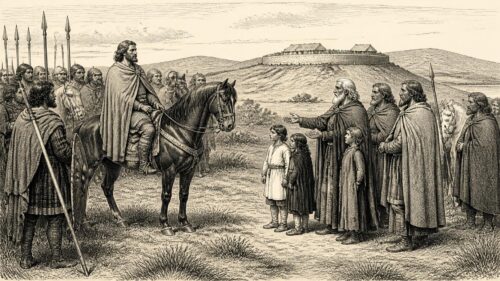
The political setting had changed abruptly just before this year. Under the preceding annal, Congalach son of Máel Mithig, described as king of Ireland, was killed at Tech Giurann in Leinster by forces from Dublin and Leinster; Áed son of Aichid, king of Tethba, also fell. The same record then states simply that Domnall began to reign. Thus 957 belonged to the opening phase of Domnall ua Néill’s rule, following a violent break at the centre of Irish overkingship.
“King of Ireland” did not mean the ruler of a united state with fixed institutions or a permanent capital. Authority rested on kinship, military capacity, clientage, tribute and the taking of hostages, and it could be challenged continually. Domnall’s accession nevertheless provided a focal point in a landscape of provincial and local kings. The deaths recorded in 957 should be read against that background: each could open a contest within a dynasty, alter obligations between neighbouring peoples, or require a newly installed ruler to seek recognition from more powerful kings.
The most consequential southern death was that of Máel Fothartaig, king of Caisel. Caisel was a principal royal centre of Mumu, or Munster, and its king stood within the long-established but increasingly contested political world associated with the Eóganachta. The annal provides no cause of death and no named successor. It would be irresponsible to supply either. What it does show is that the Munster kingship changed hands while Domnall was still consolidating his wider position. In such circumstances, a royal death was never merely private: it raised questions about control of people, land, cattle, churches and alliances across the province.
Deaths Across the Provinces
In the north-west, the death of Máel Coluim ua Canannáin, king of Cenél Conaill, removed the leading figure of a major northern Uí Néill people. Cenél Conaill’s homeland lay principally in what is now Donegal, but its political connections reached across Ulster and into the broader competition among northern dynasties. Again, the annals do not narrate the succession. Their economy of words is itself instructive: an obituary establishes that the ruler’s tenure had ended, while leaving the subsequent bargaining, rivalry or accommodation unrecorded.
The entry also notes Eochu son of Anluan, king of Loch Cál, and names Colmán son of Congal, successor of Mo-Laise, Scannal son of Luachdub, described as coarb of Liss Críst, and Mochta son of Gormacán. These notices are reminders that political Ireland was not arranged simply as a hierarchy of a high king and provinces. Smaller kingdoms, local ecclesiastical communities and inherited offices all possessed standing. Their leaders were significant enough to be entered in a chronicle, even when the circumstances of their deaths were not.
Such brief notices should also temper modern expectations of biography. We know the names and ranks of several men who died in 957, but not what their households ate, how many dependants they commanded or how their successors were chosen. The record preserves power at its most formal: king, successor, superior and bishop. It gives much less direct access to women, tenants, craftspeople, herders, sailors or enslaved people whose labour sustained the communities governed by those office-holders.
Cathasach and Patrick’s Successorship
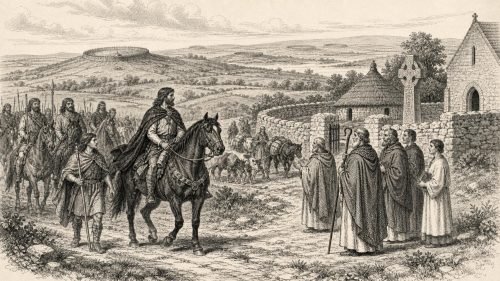
The year’s most striking ecclesiastical obituary concerns Cathasach son of Duiligén of Druimthorraid. The Annals of Ulster call him comarba Pátraic, successor of Patrick, and a learned bishop of the Irish; Chronicon Scotorum similarly calls him a wise bishop of the Gaels. This was not a casual devotional compliment. The successor of Patrick headed the Armagh-centred ecclesiastical familia whose prestige derived from association with Ireland’s foremost saint. Cathasach’s death therefore created a vacancy in an office whose holder could exercise religious authority, preserve learned traditions and command considerable social and material resources.
It is important not to project a later diocesan structure backwards. Tenth-century Irish Christianity was organised through powerful churches and their networks, often described as saintly “families”, alongside bishops, abbots and hereditary or kin-linked ecclesiastical offices. A comarba was a successor in the institutional inheritance of a saint, not necessarily a successor in the modern sense of a parish priest or diocesan bishop. Cathasach’s combined designation as successor and bishop makes his obituary especially emphatic, but it does not allow us to reconstruct the precise mechanics of his appointment or succession.
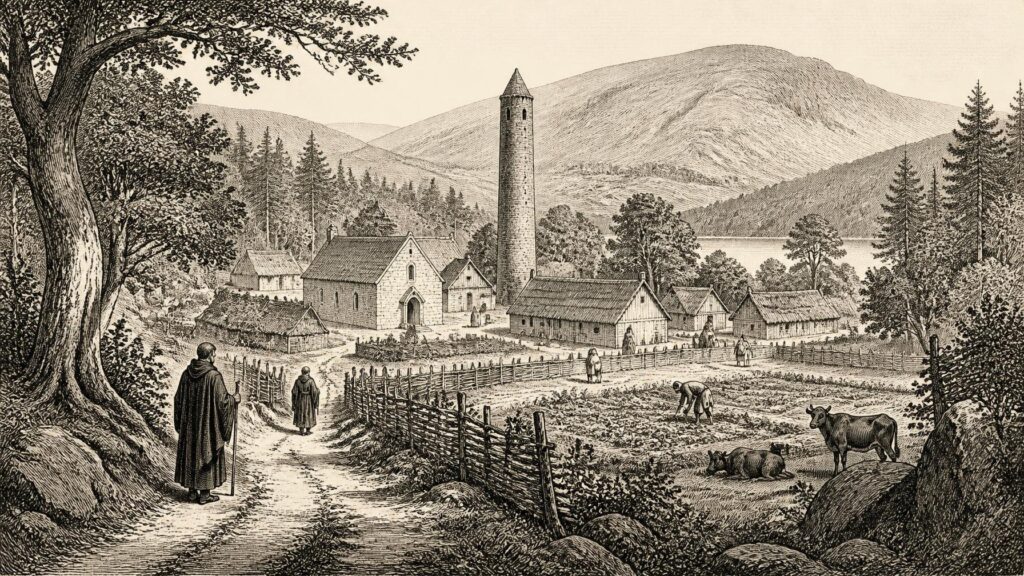
Two further deaths show the geographical reach of ecclesiastical authority. Flann ua hAedacáin, superior of Glenn dá Locha, died in 957. Glendalough, set among the lakes and valleys of Wicklow, was an important religious settlement with churches, residences, burial grounds and agricultural land. The office of superior connected spiritual leadership with the management of a substantial community. Colmán, successor of Mo-Laise, belonged to another saint’s institutional lineage. Taken together with Cathasach’s death, these notices show religious leadership changing across Ireland rather than being confined to Armagh alone.
Communities Behind the Obituaries
Although no annal describes everyday life specifically in 957, the offices named that year point to the kind of society in which they operated. Major Irish churches were places of worship, learning, craft production and exchange. Their precincts could contain churches and graves, but also workshops, stores, dwellings, cultivated ground and grazing. Cattle remained central to wealth and payment, while monasteries depended on the labour of religious and lay communities alike. Scribes copied texts; metalworkers and stoneworkers made and repaired valued objects; farmers and herders maintained food supplies.
Glendalough’s landscape also cautions against imagining a wholly isolated monastic retreat. Its valley location shaped movement and settlement, yet its superior was recorded in a national annalistic tradition because the community participated in networks of patronage and authority. Similarly, Armagh’s Patrician inheritance and Caisel’s royal standing joined religious prestige to political competition. In tenth-century Ireland, churches could be beneficiaries of royal protection, targets of exactions or raids, and holders of resources worth controlling. That is the wider setting in which the deaths of 957 mattered.
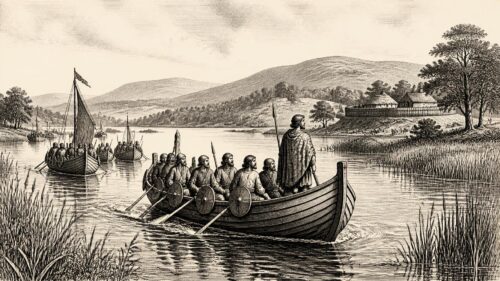
Dublin’s Scandinavian-founded settlement remained another element in this political world. Its forces had helped kill Congalach in the previous year, demonstrating that the Hiberno-Scandinavian towns were neither external spectators nor a separate realm beyond Irish affairs. They were military and commercial centres whose rulers could ally with Irish kings against other Irish kings. Nothing in the securely dated record permits a particular Dublin action in 957, but its recent intervention formed part of the unsettled inheritance faced by Domnall and the provincial rulers.
A Year of Institutional Renewal
957 was therefore a hinge-year rather than a year of spectacle. Its securely dated annalistic record is a concentrated list of deaths, but that list reaches from Armagh to Glendalough, from Caisel to Cenél Conaill. It reveals an Ireland in which royal and ecclesiastical offices were deeply embedded in regional communities, kin groups and saintly institutions. The successors who followed those named in the annals inherited more than titles: they inherited claims, dependants, property, obligations and vulnerabilities.
The surviving evidence cannot tell us how each succession unfolded, nor should the gaps be filled with invented battles or ceremonies. What it does permit is a clear conclusion. In the first full year after a violent change in the kingship of Ireland, several of the island’s most important regional and ecclesiastical offices were simultaneously opened by death. That accumulation made 957 a year of transition at the very points where political power, sacred authority and local society met.
Primary Sources
- The Annals of Ulster, Year U957
- The Annals of Ulster
- CELT Project: The Annals of Ulster
- Chronicon Scotorum, Annal CS957
- Chronicon Scotorum
- CELT Project: Chronicon Scotorum
- Annals of the Four Masters, 916–1015
- CELT Project: Annals of the Four Masters, 916–1015
- Annals of the Four Masters: Background Details and Bibliographic Information
- Irish Texts at CELT
- List of Published Texts at CELT
- The Annals of Tigernach
- CELT Project: The Annals of Tigernach
- Annals of the Kingdom of Ireland, Volume II
- Early Christian Monasteries
- Early Irish Monasticism
- Viking Traders and Craftsmen
- Viking Dublin
- Glendalough and its Churches
- Glendalough: Monastic Ireland
- Genealogical Tables: Éoganacht Chaisil
- Medieval Irish Chronicles Reveal Persistent Volcanic Forcing of Severe Winter Cold Events, 431–1649 CE