Cennétig and Clonmacnoise951 CE
Annals for 951 record a Munster foray by Cellachán and Donnchadh against Clonfert and Clonmacnoise, illustrating monasteries’ religious and political importance. They also note the death of Cennétig son of Lorcán, Dál Cais ruler and Cashel claimant, whose loss altered north Munster’s balance without ensuring his descendants’ ascendancy. Differently aligned annals associate the period with Dublin-led raids in Meath, captivity, disease among Dublin’s foreigners and bee mortality, but chronology remains uncertain. Congalach remained high king amid fragmented authority. The records portray Ireland as a contested network of dynasties, churches and Scandinavian forces, where violence, wealth, belief and environmental disruption intersected.
Dateline
The evidence for 951 CE is unusually revealing, but it must be handled with care. The Annals of Inisfallen, whose entries are arranged under the calendar year 951, record a Munster foray that struck both Clonfert and Clonmacnoise, and the death of Cennétig son of Lorcán, a leading ruler of north Munster. Other annals preserve closely related material under differently aligned year-headings. The Annals of Ulster, for example, explicitly label their U951 section “AD 950 alias 951”. They cannot therefore be treated as proof that every event placed there occurred within the modern calendar year 951. This article distinguishes the securely year-labelled notices from such associated evidence, rather than manufacturing a false precision which the sources do not possess.
A Foray on the Shannon
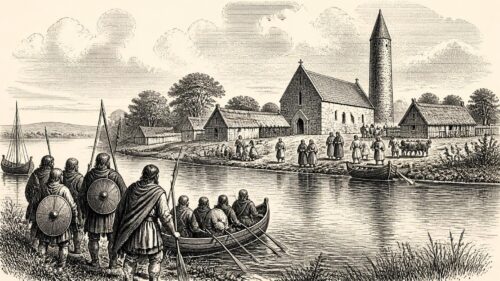
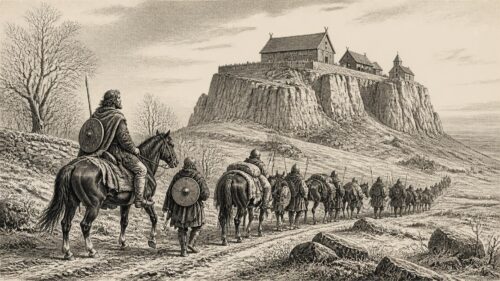
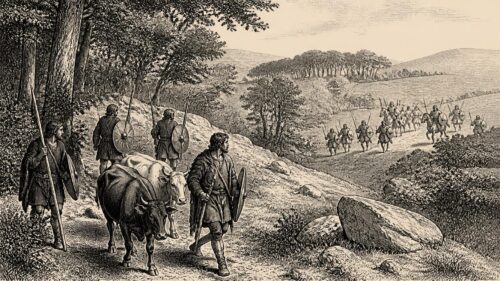
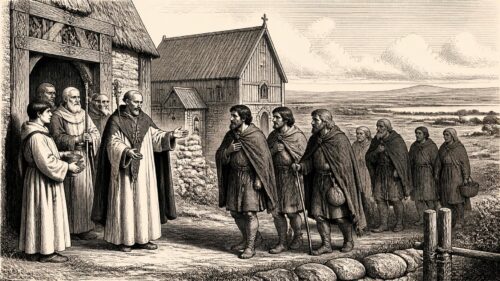
The clearest conflict notice in the Annals of Inisfallen is stark: Cellachán and Donnchadh made a foray and plundered Clonfert and Clonmacnoise. No month, route, casualty total or inventory is supplied. Nor does the annalist identify which Donnchadh accompanied Cellachán. It would be unsafe to turn the compact entry into a fully mapped campaign. Yet the places named show the scale of its ambition. Clonfert, in the Shannon region, and Clonmacnoise, farther north on the great river and esker route through the island, were not isolated chapels. They were major ecclesiastical settlements with dependent lands, personnel, storehouses, livestock and portable wealth, as well as religious standing.
A later annalistic tradition, the Annals of the Four Masters, places under 951 the plundering of Clonmacnoise by “the men of Munster” accompanied by the Danes of Limerick. This may preserve another version of the same destructive episode, but the difference in names and detail means that the two notices should not simply be fused as though they were eyewitness reports. What can responsibly be said is that Clonmacnoise was remembered as having been plundered in this period, and that Munster forces figured prominently in the tradition. The Limerick contingent in the later account is important evidence of the political and military usefulness of Scandinavian settlers within Irish conflicts; it is not evidence that all people described as Danes acted apart from, or against, Irish rulers.
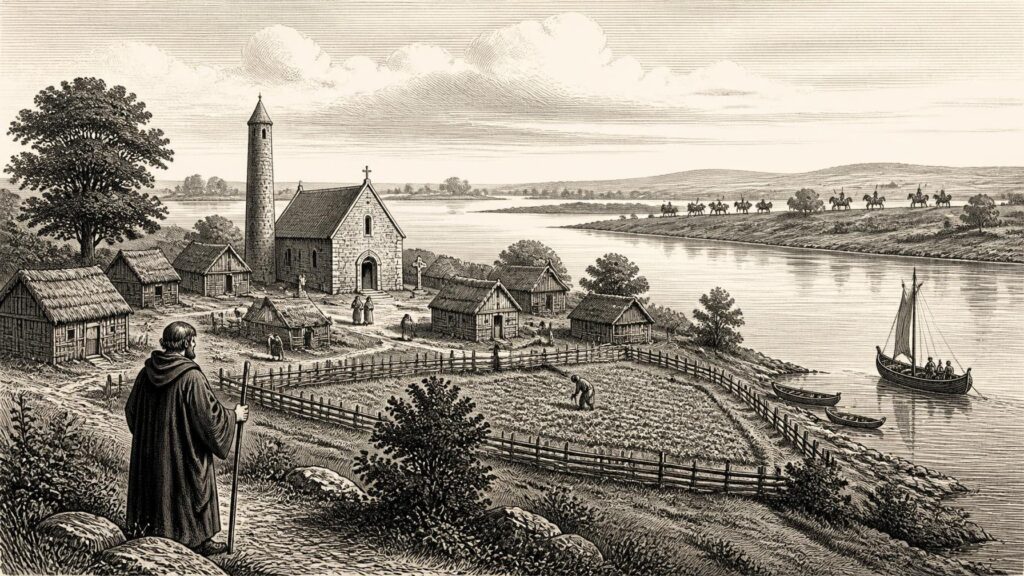
For the people of Clonmacnoise, plunder meant more than damage to a church. The settlement stood at a crossing of the Shannon’s north–south waterway and the east–west route along the eskers. Its community included clergy, craftspeople, tenants, labourers, travellers and dependants. A raid could strip food supplies, animals and valuables, interrupt cultivation and river traffic, and expose people to killing, flight or capture. The word “plundered” does not allow us to specify which of these things occurred on this occasion. It does, however, explain why an annalist regarded the attack as an event of national consequence: a powerful community at Ireland’s communications crossroads had been violated.
Cennétig’s Death
In the same year-heading, the Annals of Inisfallen record the death of Cennétig son of Lorcán and call him rígdamna of Caisel: a royal heir or claimant associated with Cashel. The terminology matters. It does not make him king of all Munster, still less king of Ireland. It does show that the annalist considered his place in Munster’s hierarchy substantial enough to define him through royal eligibility. A parallel notice in Chronicon Scotorum, under its own 951 entry, styles Cennétig king of Dál Cais; the Annals of Ulster call him king of Tuadmumu, north Munster, in their chronologically ambiguous U951 section. Taken together, these descriptions locate his power in the Dál Cais heartland of north Munster while acknowledging a wider claim upon the kingship centred on Cashel.
Cennétig’s death was therefore a significant change in the regional balance of power. It did not, by itself, decide Munster’s future. Cellachán remained an important Cashel-based ruler in the record, and the annals do not offer a neat account of a single succession settlement. Later generations would know Cennétig as the father of Mathgamain and Brian Bóruma, but that later prominence should not be projected backwards as an accomplished outcome in 951. At this point, the evidence establishes the loss of a Dál Cais ruler and claimant, not the inevitable rise of his descendants.
The juxtaposition of Cennétig’s death with a Munster raid on two major churches should not be read as proof that he ordered it, opposed it, or died because of it. Medieval annals commonly group disparate events beneath an annual heading. Still, the combination conveys the unsettled political world in which his death occurred: rulers and claimants competed for resources, prestige and leverage, while wealthy ecclesiastical centres could be targets in contests that were as Irish as they were Scandinavian.
Churches as Communities and Prizes
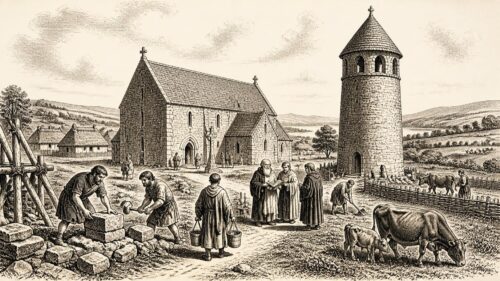
Clonmacnoise and Clonfert were religious institutions, but they also belonged to the practical infrastructure of early medieval Ireland. Monastic settlements offered worship and burial, cultivated land, received guests, organised skilled work and maintained learned traditions. Their churches housed relics and liturgical objects; their schools and scribes preserved texts; their estates generated food and render. Attacking them could yield wealth, but could also communicate dominance over the territories and dynasties connected with them. Raiding a monastery was thus neither inexplicable sacrilege nor merely an economic crime. It was a form of coercive politics, although the annalists’ language also makes clear that it was morally charged.
The religious record for the year is not confined to violence. The Annals of Inisfallen also note the death of Ailill, abbot of Cork. This brief obituary is a reminder of a dense network of communities whose leaders mattered beyond their own enclosures. Other annals place a large cluster of deaths of bishops, abbots, priests, lectors, anchorites and learned men under their own 951 headings, though their differing chronological systems prevent each from being dated firmly to this one calendar year. The pattern nevertheless illuminates the kind of society producing the record: ecclesiastical office, literacy, scholarship and pilgrimage were woven into public life, and the passing of a lector or abbot could be judged worthy of permanent notice.
Dublin, Meath and Captivity
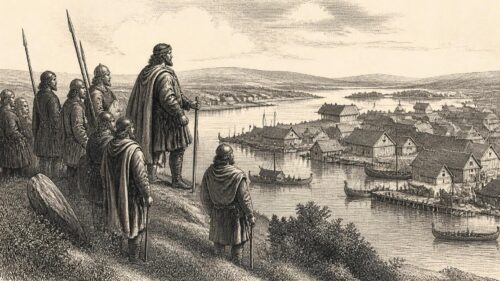
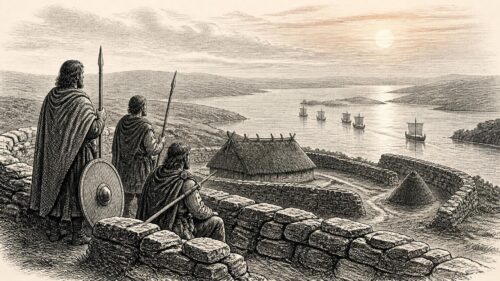
A related but less securely calendar-fixed group of notices shows how exposed the eastern midlands remained. Under U951, the Annals of Ulster report that Gothfrith son of Sitriuc, with the foreigners of Áth Cliath, plundered Cenannas (Kells), Domnach Pátraic, Ard Brecáin, Tuileáin, Cell Scíre and other churches. The annalist says that more than 3,000 people were taken captive from Kells, along with cattle, horses, gold and silver. Chronicon Scotorum, in its 951 entry, repeats much of the list, says Gothfrith took Dublin, and adds that he died shortly afterwards as divine retribution. The Ulster chronology’s “950 alias 951” warning means the raid cannot be assigned to 951 CE with complete confidence; it belongs, however, immediately alongside this year in the annalistic record.
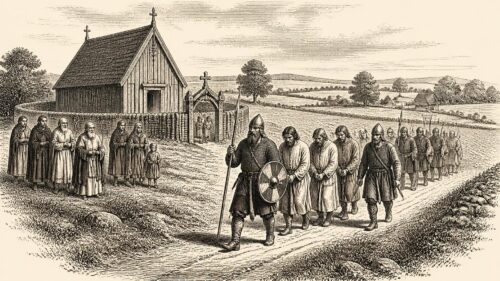
The claimed number of captives is enormous and should be reported as the annalist’s figure, not converted into a modern census. Even if rhetorical, it identifies human seizure as central to the raid. Captivity was a brutal but economically meaningful outcome of warfare in the Irish Sea world. So too were cattle and horses, both movable wealth and instruments of agricultural and military life. Kells was particularly valuable as an ecclesiastical centre associated with the Columban tradition and prestigious books. The raid’s named targets trace a corridor through Meath’s rich and politically contested churchlands, showing that ships and mounted or foot forces could connect Dublin to inland targets with alarming speed.
The account of Gothfrith’s swift death is not a medical report or proof that a particular illness killed him. It is an annalist’s providential interpretation: the plunder of churches invited God’s vengeance. That judgement nevertheless tells us something important about the values of the record. Wealth, armed force and slavery appear beside an insistence that sacrilege had consequences beyond immediate political success.
Illness, Bees and Uncertain Prosperity
The U951 notices also record “a mortality of bees” and a great outbreak described as leprosy, together with dysentery, among the foreigners of Dublin. These reports belong to the same chronologically qualified annal section as the Meath raid. They should not be treated as securely dated diagnoses for 951 CE, nor linked causally to the raid. Medieval “leprosy” was a broad and culturally loaded label, not a clinical identification in modern terms; dysentery likewise names a symptom complex rather than an organism. The entries do establish that illness in Dublin’s Scandinavian-associated population was serious enough to enter the historical record.
The bee mortality is equally terse, but its inclusion is striking. Bees supplied honey and wax: honey was a valued sweetener and ingredient, while wax was essential for church candles and useful in elite and domestic settings. A widespread loss could touch households, religious observance and local exchange alike. The annalist provides no cause, no geography and no measure of loss. It is wiser to see the notice as evidence of perceived environmental disruption than to diagnose weather, disease or agricultural collapse from one sentence.
Authority Without Unity
Congalach son of Máel Mithig remained high king in 951, but the year’s evidence demonstrates the limits of any island-wide sovereignty. The Annals of the Four Masters call this his ninth year; in the parallel chronology, he was able to grant the “freedom” of Clonard, protecting it from demands for billeting or exactions by kings and princes. That grant is placed under 951 by Chronicon Scotorum but earlier by the Four Masters, so its exact calendar position remains disputed. Its substance is clear: royal authority could be displayed not only through hosting and war, but through public protection for a church.
Other notices surrounding the year report the death or killing of regional rulers and heirs, including Áed son of Máel Ruanaid, described in Chronicon Scotorum as heir designate of Tara, and Bécc, king of Tethba. Such deaths underline the fragility of succession. Ireland was not a single centrally administered kingdom but a landscape of overkings, provincial rulers, local dynasties, church federations and Dublin’s maritime power. In 951, conflict at Clonmacnoise, the loss of Cennétig, and the nearby annalistic memory of raids and sickness together reveal an island in which authority was constantly asserted, negotiated and exposed to sudden reversal.
Primary Sources
- The Annals of Ulster: Year U951
- Chronicon Scotorum: Annal CS951
- Annals of the Four Masters: Annal M951
- Annals of Inisfallen: Annal AI951
- Annals of Inisfallen: Irish Text, Annal I951
- Annals of Inisfallen: Bibliographical and Editorial Information
- Annals of the Four Masters, Volume 2
- CELT: List of Published Texts
- CELT: Irish Texts, Historical and Annalistic Sources
- Clonmacnoise Visitor Guide
- Clonmacnoise Monastic Site Highlights
- Kells Monastic Site
- Irish School of Illumination, c. 650–1100
- Early Christian Monasteries
- Early Irish Monasticism
- Viking Dublin
- Viking Ireland
- Early Medieval Ireland: Archaeological Excavations 1930–2009
- Vikings in Ireland
- Viking Activity in Ireland by County in the Annals
- Vikings in Early Medieval Ireland: Church-Raiding, Politics and Kingship
- Nosema apis and Acarapis woodi in Relation to Isle of Wight Bee Disease
- What's Killing American Honey Bees?