Lough Neagh’s Broken Fleet945 CE
In 945, annals recorded an exceptional frost that froze lakes and rivers, altering travel without proving famine. Domnall son of Muirchertach and Flaithbertach killed the Scandinavian-associated force on Lough Neagh and destroyed its fleet, ending the last clear record of such lake-based power. In Dublin, Blacair yielded rule to Amlaíb Cuarán, whose alliance with Congalach of Brega defeated followers of Ruaidrí Ua Canannáin in Conaille. Deaths included ecclesiastics Máel Tuile and Máel Dúin, prior of Armagh, and Aurchad, king of western Connacht. These notices reveal interconnected regional dynasties, churches, waterways and maritime centres amid shifting power across the Irish island.
Dateline
For Ireland, 945 is a year best approached through a small but unusually revealing group of annalistic notices: a hard freeze, the destruction of a Scandinavian fleet on Lough Neagh, a change of ruler in Dublin, a clash involving the leading claimant to wider Irish kingship, and the deaths of rulers and churchmen. The evidence is concise and its chronology requires care. The Annals of Ulster place these reports under their annal U945, though their heading itself gives “AD 944 alias 945”; other annal compilations sometimes shift related events by a year or more. No source supplies dates within the year. What can responsibly be said is that these developments belong to the political season conventionally assigned to 945, rather than to a sequence of precisely dated campaigns.
Ice Across the Waters
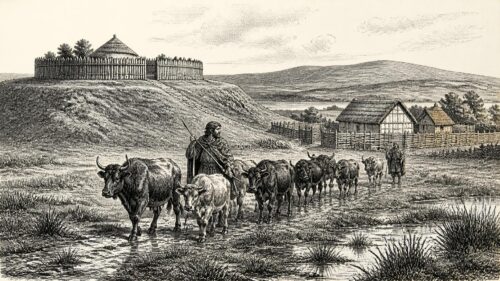
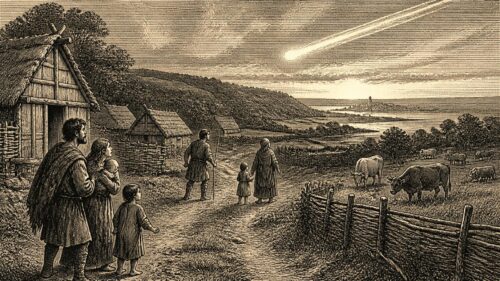
The year opened, or was remembered, for an “abnormally severe frost”, so intense that lakes and rivers could be crossed on foot. This is one of the clearest notices of weather in tenth-century Irish records. It should not be inflated into a claim of island-wide famine or a known harvest failure: the annalist records frozen water, not its duration, casualties or later agricultural consequences. Yet the observation matters. Rivers and lakes were principal routes of movement, communication and transport; their freezing would have altered everyday travel as well as military calculation. People, livestock and goods that usually depended on boats, fords or ferries faced a transformed landscape, while ice could make normally difficult crossings possible on foot.
For rural households, winter was already the season when fodder, stored food and the condition of cattle mattered most. A severe frost was therefore not simply striking scenery. It placed extra pressure on people whose wealth, diet and obligations were closely tied to livestock and seasonal farming. But the annals offer no licence to reconstruct individual hardships in detail. Their spare sentence preserves the exceptional cold, and nothing more certain. Its importance lies partly in showing that the natural environment was recorded alongside kings, fleets and church offices as an event capable of shaping the year.
The Last Lough Neagh Vikings
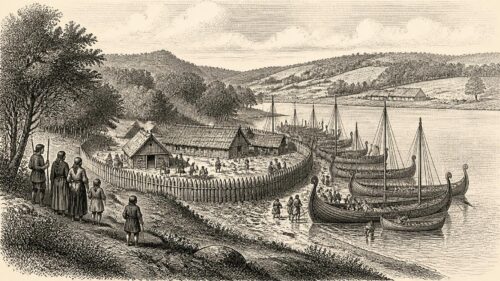
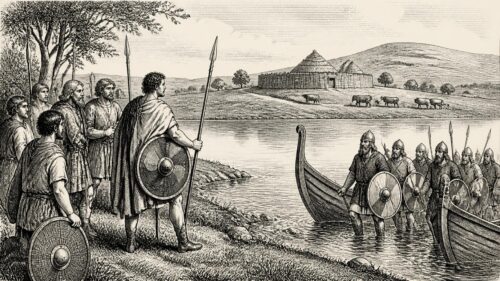
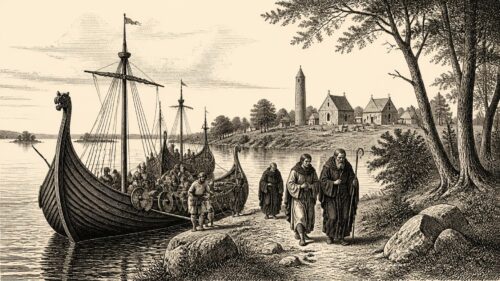
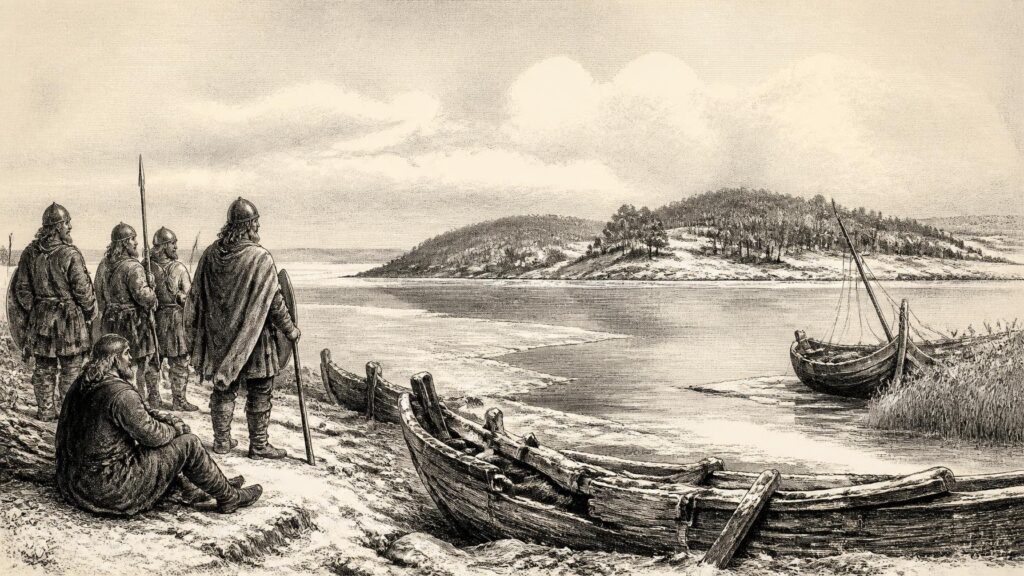
The most decisive military notice concerns Loch nEchach, modern Lough Neagh. The Annals of Ulster state that its “foreigners” were killed by Domnall, son of Muirchertach, and by his kinsman Flaithbertach, and that their fleet was destroyed. “Foreigners” was the annalist’s category, usually applied in this context to Scandinavian or Hiberno-Scandinavian groups; it should not be read as a description of a single uniform people or a wholly separate society. By the mid-tenth century Scandinavian-speaking settlers, raiders, traders and dynasts had long been enmeshed in Irish politics.
Lough Neagh had been a serious Scandinavian theatre since the ninth century. Its waters and connected river routes offered access through much of northern Ireland, while annals from earlier decades associate groups based there with raids on churches and communities. Archaeological finds around the lough and River Bann are few compared with Dublin’s immense urban evidence, but they support the possibility of longer-lived Scandinavian activity in the region. The 945 defeat is the final clear annalistic report of a Scandinavian force on Lough Neagh. It therefore marks an important regional change: not the disappearance of Scandinavians from Ireland, but the ending of this recorded northern lake-based power.
The destruction of a fleet was especially significant. Ships made it possible to raid, carry captives and livestock, move armed men rapidly, and retreat along waterways. Their loss reduced more than immediate fighting strength. It damaged the mobility and supply system that made a lake-centred force viable. The record does not name the battlefield, describe the vessels or specify whether ice played a tactical part. Any attempt to picture a battle on frozen water would be speculation. Nevertheless, the pairing of severe frost with the fleet’s destruction gives the year a distinct northern character: environmental disruption and armed conflict unfolded in the same waterways.
Domnall and Flaithbertach acted in the unsettled aftermath of the killing of Domnall’s father, Muirchertach mac Néill, by Dublin forces in 943. Muirchertach had been a formidable Cenél nÉogain ruler, and his death had weakened an established northern leadership at precisely the moment when claims to supremacy in Ireland were being contested. The victory at Lough Neagh showed that northern dynastic interests could still organise an effective response. It did not, however, restore a simple or uncontested Uí Néill order.
A New Ruler in Dublin
At Dublin, known in the annals as Áth Cliath, Blacair “gave up” authority and Amlaíb Cuarán succeeded him. The phrasing is restrained. It does not describe a siege, a battle or an expulsion, and none should be invented. Blacair had led Dublin through a violent period. He had helped inflict major reverses on Irish rivals, including the killing of Muirchertach in 943; in 944, however, Congalach of Brega and Bróen of Leinster had plundered Dublin. Against that immediate background, the transfer to Amlaíb was a change at the head of a pressured but still powerful port-town.
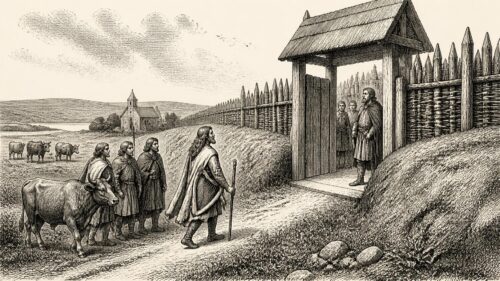
Dublin was no mere raiders’ camp. By the tenth century it was Ireland’s largest and most internationally connected settlement, a defended riverine town whose ships, craftsmen, markets and political leadership linked Irish Sea routes with Ireland’s interior. Excavated material from Viking-age Dublin includes houses, workshops, streets and waterfront structures, as well as scales, weights, silver, imported objects and tools. Such evidence complicates the old image of an opposition between “Irish” countryside and alien Vikings: Dublin’s prosperity depended on exchange, labour and connections with Irish communities even as its rulers repeatedly used force against them.
Amlaíb Cuarán’s accession thus mattered well beyond the Liffey. Control of Dublin meant command of a military fleet, access to wealth and a place within networks reaching Britain and the wider Scandinavian world. Yet rule was precarious. Its rulers could bargain with Irish kings, fight them, shelter rivals, or become allies in their disputes. The events of 945 demonstrate all of that volatility without allowing us to reduce the city’s population to its royal family or its warfare.
Congalach’s Necessary Alliance
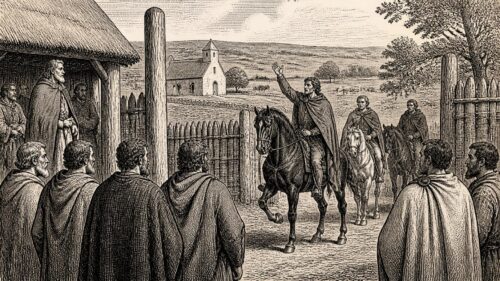
One further notice makes the new arrangement immediately political. A band of followers of Ua Canannáin was killed in Conaille by Congalach son of Máel Mithig and Amlaíb Cuarán. Congalach, based in Brega, had succeeded Donnchad Donn in 944 as the principal Southern Uí Néill claimant to the kingship of Tara. His chief competitor was Ruaidrí Ua Canannáin of Cenél Conaill in the north-west. The killing in Conaille, a district in the north-east, was only a limited encounter in the wording of the annal, but it reveals an important alignment: Congalach and Dublin’s new ruler could cooperate against Ua Canannáin’s following.
This was diplomacy expressed through violence, not an enduring national alliance. The following years brought further campaigns, reversals and changing partnerships among Congalach, Ruaidrí and Dublin. Still, 945 shows why kingship in Ireland cannot be told as a struggle between a single “high king” and subordinate provinces. Authority was negotiated through kinship, hostages, tribute, raids and alliances that crossed cultural and linguistic boundaries. Amlaíb’s partnership with Congalach was politically useful because Dublin was a formidable military and economic resource; Congalach’s standing was useful because an Irish overking could protect or threaten Dublin’s interests inland.
Church Offices and Connacht Succession
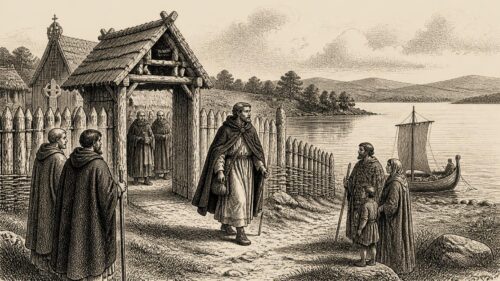
Three deaths record the institutional texture beneath the year’s conflicts. Máel Tuile son of Dúnán, described as successor of Tigernach and Cairnech, died “an untroubled death”. The phrase is an annalistic commendation rather than a biography, but it identifies him as holder of a prestigious ecclesiastical succession associated with the saints Tigernach and Cairnech. Such offices joined spiritual authority, learned tradition, landholding and local influence. Their holders stood at the centre of communities that preserved books, educated clerics, received dues and maintained inherited claims.
Máel Dúin son of Gairbíth, prior of Armagh, also died. Armagh was the foremost Patrician church in Ireland, and its prior belonged to an institution whose religious prestige had political value across the island. His death followed only two years after the plundering of Armagh by the Dublin force that killed Muirchertach. The annal does not connect the two facts causally, but their proximity is a reminder that ecclesiastical centres endured recurrent political violence while remaining indispensable places of authority and memory.
Finally, Aurchad son of Murchad, king of western Connacht, died. The Annals of Inisfallen independently preserve his death, calling him king of Uí Briúin. Neither source supplies the cause of death or a succession narrative. The notice nonetheless matters because it records a change in the ruling order of Connacht at a moment when the island’s most visible conflicts lay in the north and east. Ireland in 945 was not governed from one centre. It was a landscape of competing regional kingships, church federations, rural communities and maritime towns, all affected by developments on water as much as on land.
The year’s surviving record is brief, but its pattern is clear. Ice altered the routes of an island bound together by rivers and lakes; the Lough Neagh fleet was broken; Dublin passed from Blacair to Amlaíb; Congalach found common cause with the new Dublin ruler; and local political and ecclesiastical successions continued. Rather than a settled kingdom facing an outside threat, 945 reveals an Ireland in which northern lake routes, the Dublin port, saintly institutions and rival dynasties were tightly connected—and in which power could change hands quickly.
Primary Sources
- The Annals of Ulster
- TEI Header for The Annals of Ulster
- Annals of Inisfallen
- CELT Project: Annals of Inisfallen
- Chronicon Scotorum
- CELT Project: Chronicon Scotorum
- Part 5 of Annals of the Four Masters
- Blacair (Blakkr) | Dictionary of Irish Biography
- Congalach Cnogba | Dictionary of Irish Biography
- The Vikings in Ulaid
- The Vikings in Ninth-Century Ireland: Sources and Settlements
- The Vikings in Ninth-Century Ireland: Sources and Settlements
- The Kings of Aileach and the Vikings AD 800–1060
- Kings of Aileach and the Vikings, AD 800–1060, by Darren McGettigan
- Viking | National Museum of Ireland
- The Viking Age in Ireland | National Museum of Ireland
- 950–1450: Vikings, Normans and Medieval Mints | National Museum of Ireland
- Early Medieval Ireland: Archaeological Excavations, 1930–2009
- The Chronology and Sources of the Early Irish Annals
- Home Page for Dr Daniel P. McCarthy
- Exploring the Irish Annals