Congalach at Áth Cliath944 CE
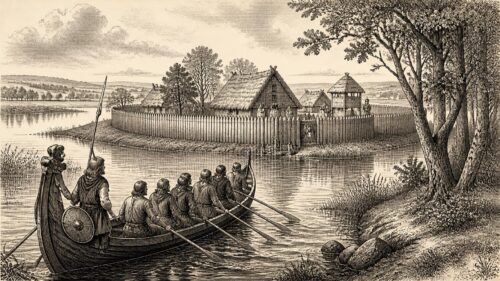
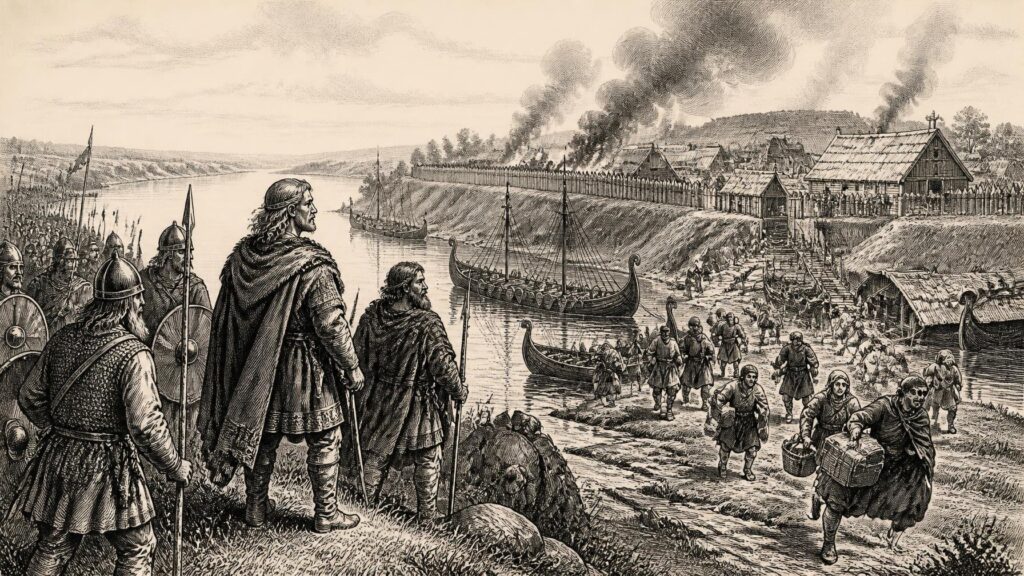
In 944, Donnchad Donn’s death after twenty-five years as king of Tara opened a contested struggle for Uí Néill supremacy. His nephew, Congalach of Brega, allied with Braen of Leinster to plunder Dublin, taking treasure, booty and possibly captives; one annal also alleges burning and four hundred deaths. The raid demonstrated Dublin’s vulnerability but did not establish conquest or end its political importance. Its wealth reflected its role as a Hiberno-Norse port within Irish Sea trade. Elsewhere, Cellachán of Cashel defeated northern Munster rivals, while local killings and ecclesiastical deaths then reveal persistent regional conflict and institutional continuity across Ireland.
Dateline
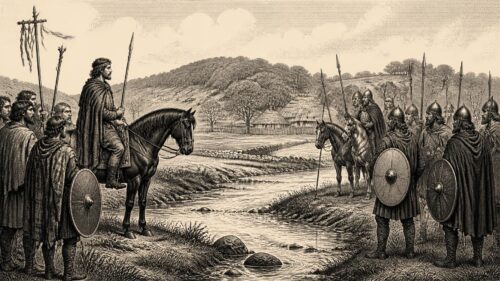
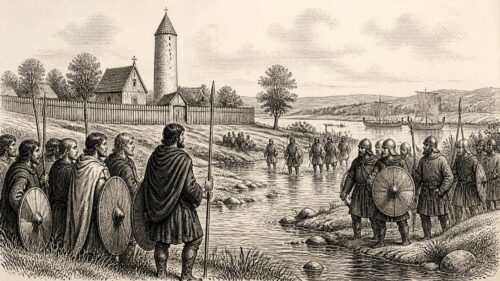
In 944, a changing of rulers at Tara coincided with a forceful attack on Dublin. The two developments were closely connected. Donnchad Donn, king of Tara and the leading figure among the Southern Uí Néill for a generation, died after twenty-five years of rule. In the same annal-year, Congalach son of Máel Mithig of Brega, allied with Braen son of Máel Mórda, king of Leinster, plundered Áth Cliath, the settlement known in Old Norse as Dyflinn and later as Dublin. The annals present these events compactly, but together they reveal a country in which claims to lordship, access to portable wealth, and command of routes through Leinster and the Irish Sea were inseparable.
What the Sources Record
The strongest contemporary-style testimony is annalistic, though the surviving manuscripts and compilations are later. The Annals of Ulster place the death of Donnchad and the plundering of Áth Cliath in their entry headed 944; the Annals of Inisfallen independently record Donnchad’s death and the plundering of the town by the Uí Néill and Leinstermen. Chronicon Scotorum gives the fullest version, naming Congalach and Braen, saying that the attackers burned the fortress and carried off treasures and captives, and adding that four hundred ‘foreigners’ fell during its taking. That number, and the assertion of burning, should be treated as the claim of one annalistic tradition rather than as an independently verified tally. The Annals of Ulster, more cautiously, say only that valuables, treasure and much booty were taken.
The chronology itself deserves care. The Ulster entry is marked ‘AD 943 alias 944’, an indication of the calendar difficulties that arise in medieval Irish annals. Modern historical reference works conventionally place Donnchad’s death, Congalach’s advance, and the Dublin attack in 944. No source supplies a day or month for the raid. It is therefore responsible to identify the year, but not to assign an exact season, duration, route of march, or sequence within the campaign.
Donnchad’s Death and the Tara Succession
Donnchad Donn was of Clann Cholmáin, a Southern Uí Néill dynasty rooted in Mide. The Annals of Ulster styles him king of Temair, or Tara, and says that he died after twenty-five years as king. Tara was no longer a permanently occupied capital in a modern sense, but its royal title retained immense political value. To be king of Tara was to claim precedence within the Uí Néill and, potentially, a wider supremacy over Ireland. That supremacy depended on alliances, hostage-taking, military success and the recognition of other kings; it was not the rule of a unified territorial state.
Donnchad’s death created a particularly dangerous opening because the wider Uí Néill order had already been shaken. In 943 Muirchertach mac Néill, king of Ailech and a leading Northern Uí Néill contender, had been killed by men from Dublin. Congalach, king of Brega and Donnchad’s nephew through his mother Lígach, was exceptionally well placed to move into the resulting gap. Chronicon Scotorum makes the succession explicit: after recording Donnchad’s death, it states that Congalach ruled. Yet this was a claim to be established, not a peaceful inheritance. Ruaidrí Ua Canannáin of Cenél Conaill also possessed the standing and ambition to contest pre-eminence among the Uí Néill.
Congalach’s position depended on Brega, the rich and politically resonant region north of the lower Boyne, including the landscape of Knowth and other ancient monuments. His own kindred, Síl nÁedo Sláine, had long been eclipsed in the kingship of Tara by rival Uí Néill branches. The events of 944 therefore represented more than a personal succession: they offered Brega’s ruling lineage a chance to recover a central place in Irish politics.
The Plundering of Dublin
Congalach acted with Braen son of Máel Mórda, whom the Annals of Ulster calls king of Leinster. Their partnership was strategically logical. Dublin lay within Leinster’s political orbit, while its harbour and settlement offered access to seaborne connections reaching across the Irish Sea. Braen gained an opportunity to strike a powerful neighbour; Congalach gained a dramatic demonstration that he could assemble an interprovincial force and seize wealth from Ireland’s foremost Hiberno-Norse port.
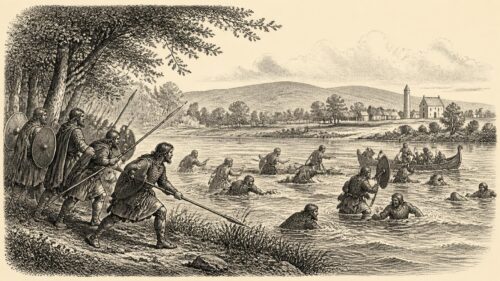
The language of the annals is revealing. The raid was an orgain, a plundering or devastating assault, rather than evidence for a settled conquest. The attackers removed valuables, treasure and booty. Chronicon Scotorum also says that prisoners were taken. Captives were a grim but ordinary component of early medieval warfare: they could be ransomed, incorporated into households, or sold. The attack was consequently not simply a clash between abstract ‘Irish’ and ‘Viking’ sides. It was a struggle among rulers and armed followings for people, movable wealth, status and leverage.
Blacair, son of Gofraid, was the Dublin king most closely associated with the city at this point. He had recently killed Muirchertach mac Néill and had plundered Armagh after that victory. The assault of 944 reversed his immediate fortunes. However, it would be misleading to describe Dublin as annihilated or permanently captured. The annals do not say that Congalach installed a governor, occupied the settlement, or ended its kingship. The political and commercial community of Dublin remained significant, while the episode showed that its defences and leadership could be badly exposed when Leinster and a powerful Uí Néill claimant combined against it.
A Port Worth Fighting For
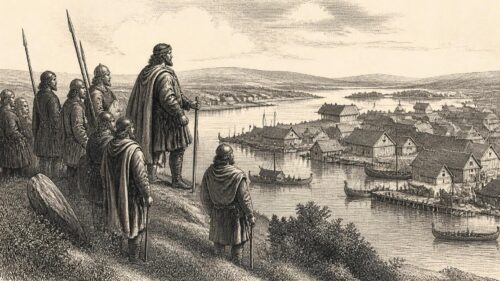
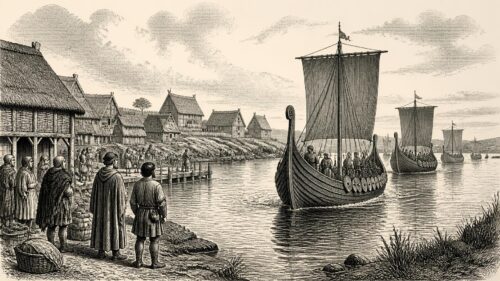
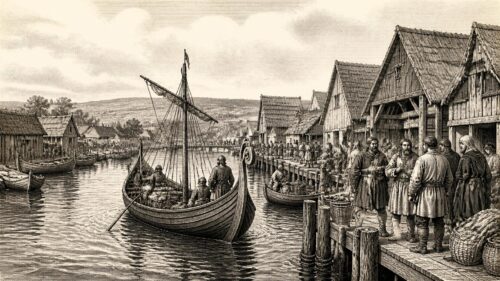
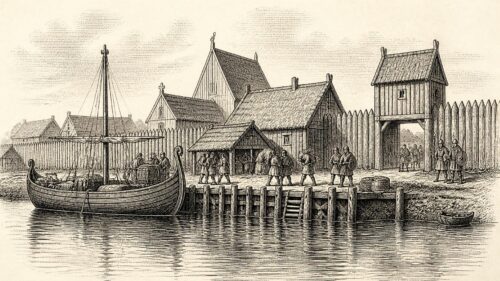
Archaeology explains why plunder from Dublin mattered so greatly, even though excavated evidence cannot be tied to this single raid. By the tenth century Dublin was a substantial settlement of houses, workshops, property boundaries and waterfront activity. Its inhabitants included people of Scandinavian, Irish and mixed backgrounds, and the town’s economy joined local craft production to Irish Sea exchange. Excavations have produced evidence for woodworking, metalworking, textile and leather production, antler-working, fishing, shipping and the handling of silver. Such finds make the annals’ references to treasure and booty more concrete: portable precious metal, imported goods, weapons, livestock and captives could all be politically valuable.
The word ‘foreigners’ in the annals reflects the vocabulary of Irish writers, not a simple ethnic description of every person in the town. Dublin’s rulers belonged to a Norse-Gaelic dynasty with connections to York, the Isles and northern Britain, while relationships with neighbouring Irish dynasties shifted rapidly. In 944 the city was an opponent and prize. It was also a place through which Irish kings could seek maritime resources and participate in wider networks of trade and warfare.
Conflict in Munster
Events in Munster show that 944 was not defined solely by the midlands and Dublin. The Annals of Ulster reports that Cairpre son of Máel Pátraic, king of Uí Liatháin in east Cork, and Finn son of Mután, king of Corcu Láigdi in south-west Munster, were killed by the men of Mag Féine. These brief notices give no secure explanation of the conflict, but they demonstrate that local and regional rivalries could be lethal at the same time as major kings competed for Tara and Dublin.
The same source records a victory by Cellachán of Cashel over Tuadmumu, or Thomond, at Gort Rottacháin, with many falling. Chronicon Scotorum gives a related account, naming Cellachán’s opponent as Cennétig son of Lorcán and locating the encounter at Mag Dúine. The differing place-names and formulations caution against reconstructing the battle in detail. What can safely be said is that Cellachán, the Éoganacht overking of Munster, defeated opponents in the north of his province during 944. His success helped him to reassert authority at a moment when the death of Donnchad weakened the capacity of Tara’s king to intervene elsewhere.
Churches, Learning and Continuity
The year’s entries also preserve the quieter work of religious institutions. The Annals of Ulster notes the death of Máel Féichene, successor of Finnia, and of Dúngal son of Cathán, described as having ‘fallen asleep in Christ’. The Annals of the Four Masters, compiled much later from earlier materials, assigns further ecclesiastical deaths to 944, including abbots of Ferns Mór, Tuaim Finnlocha and Devenish, as well as a priest of Clonmacnoise. Such notices cannot tell us what ordinary worshippers did on a particular day, but they do show a dense ecclesiastical geography. Churches and monasteries were centres of prayer and learning, custodians of relics and manuscripts, landholders, employers and places whose leaders mattered enough to be remembered in national historical records.
For communities exposed to raiding and warfare, their institutional continuity was important. Dublin’s seizure of treasure was a reminder of the mobility of wealth; the recorded successions and deaths of churchmen point to other forms of continuity, maintained through office, memory and local patronage.
A Year of Opportunity and Violence
944 did not create a new, stable order. Rather, it exposed the fragility of the old one. Donnchad Donn’s death ended a long reign at Tara; Congalach’s alliance with Braen and assault on Dublin announced his capacity to act; Cellachán’s victory marked continuing competition within Munster. Across Ireland, rulers relied on kinship, alliances and armed force, while towns and churches remained both sources of wealth and targets in conflict. The year is best understood as a moment when a contested succession at the centre of Uí Néill politics made Dublin’s riches and Leinster’s allegiance especially consequential.
Primary Sources
- The Annals of Ulster: Year U944
- Chronicon Scotorum: Annal CS944
- Annals of Inisfallen: Annal AI944
- Annals of the Four Masters: Annal M944
- Chronicon Scotorum: CELT Edition and Manuscript Details
- Congalach Cnogba
- Donnchad Donn
- Cellachán Caisil
- Blacair (Blakkr)
- Amlaíb (Óláfr) Cuarán
- Muirchertach na Cochall Craicinin
- Ua Néill, Domnall
- The Circuit of Ireland by Muircheartach mac Néill
- Cathréim Cellacháin Caisil
- Vikings in Early Medieval Ireland
- Agenda, Methodology, Interpretation and Sources
- Exile, Return and the Dublin-York Axis: The Context of Church-Raiding, 914–941
- The Irish Sea and the Atlantic Trade in the Viking Age
- Re-clothing the Inhabitants of Tenth-century Dublin Based on Archaeological Evidence
- Viking
- Exploring the Irish Annals
- Getting to Know Dublin