Flann’s Gabrán Ravaging906 CE
In 906 Flann Sinna, king of Tara, led a major campaign into Munster, apparently with Cerball of Leinster, ravaging territory described as stretching from Gabrán to Limerick. Annalistic evidence confirms the expedition but provides no precise route, battles, captures or settlement. The raid demonstrated Tara’s capacity to project force, while exposing the contested nature of Irish overlordship. Munster, led by Cormac of Cashel, remained powerful and retaliated in 907; conflict culminated in Cormac’s defeat and death in 908. Deaths of northern rulers, Ciarmac of Uí Fhidgeinte, and Bangor’s abbot Indrechtach also marked the year, illustrating intertwined political and ecclesiastical change.
Dateline
The most consequential securely dated Irish event of 906 was a southern campaign led by Flann Sinna, king of Tara. Chronicon Scotorum records that Flann and Cerball son of Muirecán, king of Leinster, led a hosting against the people of Mumu, or Munster, and “harried from Gabrán to Luimnech”. The Annals of Ulster likewise records Flann’s expedition against Munster and its devastation from Gabrán to Limerick, though it does not name Cerball as a co-leader. The agreement between these independent annalistic traditions makes the campaign firm; the difference is a useful warning that the surviving records are compressed and not identical.
The annalists provide no day, season, battle-site or treaty. Nor do they identify Gabrán precisely enough to map the army’s route with confidence. “From Gabrán to Luimnech” should therefore be understood as a statement of extensive ravaging across a substantial stretch of Munster, not as a modern itinerary. Nothing in the entry warrants claims that Flann captured Limerick, besieged Cashel, or won a pitched battle. Its significance lies instead in the scale of royal force and in its place within a sharpening contest for supremacy between Tara, Leinster and Munster.
A King of Tara in Munster
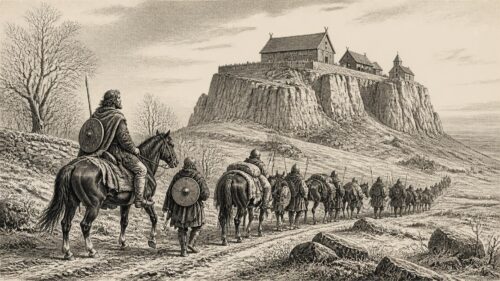
Flann Sinna, of Clann Cholmáin of the southern Uí Néill, had been king of Tara since 879. “King of Tara” was an imposing title, but Ireland was not a single centrally governed kingdom. Flann’s authority rested on personal rule in Mide, the capacity to assemble client kings and fighting men, control of tribute and hostages, dynastic alliances, and influence at important churches. Beyond his core territories, supremacy had continually to be demonstrated. A great hosting into Munster in 906 was thus both an act of war and a political declaration: Tara could still carry armed power far into the south.
Cerball son of Muirecán’s participation, as supplied by Chronicon Scotorum, matters greatly. Cerball was king of Leinster, the province between Flann’s midland power-base and Munster. Their cooperation joined two rulers whose interests were closely aligned against the growing reach of Cashel. Leinster also had its own political weight: it had helped expel the Scandinavian rulers from Dublin in 902, an event that had temporarily removed the greatest Viking power from Ireland’s east coast. In 906 Cerball was therefore not a minor auxiliary but a valuable partner, able to connect the political ambitions of Tara with military action south of the Barrow and the Slaney.
The target was Mumu, the Irish Munster of the annals, rather than a unified territorial state with fixed frontiers. It contained numerous dynasties and subject peoples, among them the Eóganacht rulers associated with Cashel, the kings of Osraige, the Déisi, the Uí Fhidgeinte and many others. Its dominant king in these years was Cormac son of Cuilennán, king of Cashel. Cormac had gained the Munster kingship in 901 and was remarkable even by the standards of Irish royal culture: later annalistic language presents him as a bishop, scholar and celibate as well as a king. In 906, however, his religious standing did not separate him from the obligations and risks of secular kingship.
Harried, Not Conquered
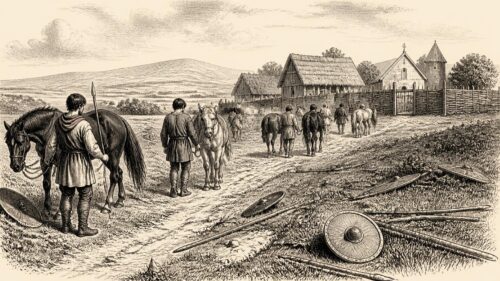
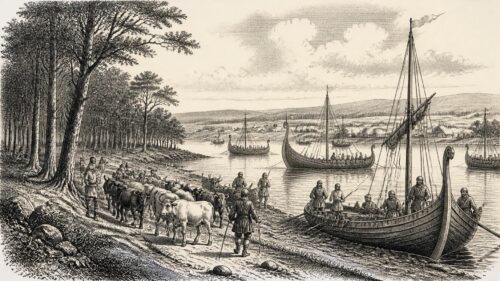
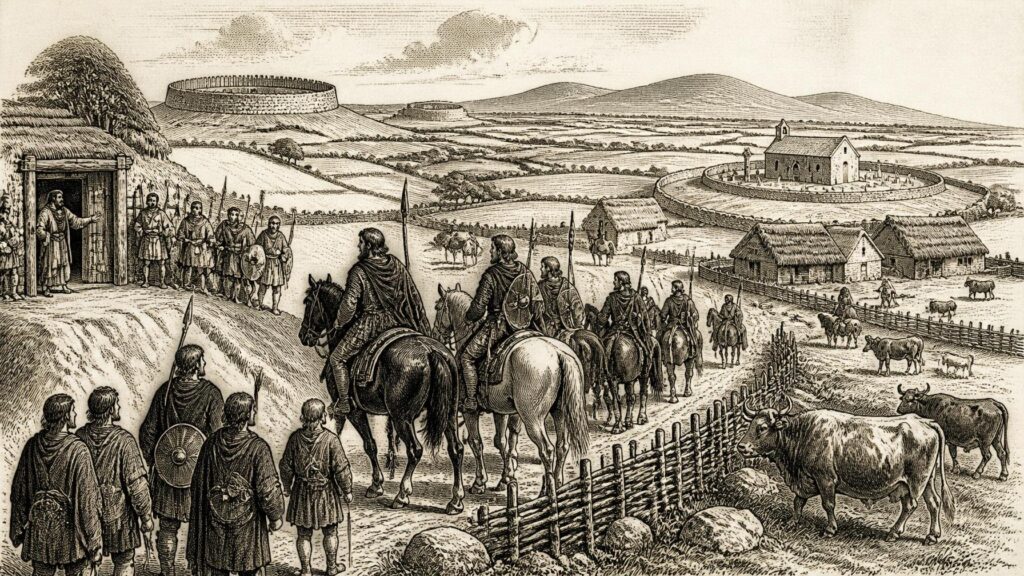
The word translated as “harried” is important. Early medieval armies often sought less to hold territory than to compel submission through speed, intimidation and the destruction or seizure of resources. Cattle, horses, food stores, portable wealth and captives could be taken; crops, dwellings and installations might be damaged; and a ruler unable to protect dependants suffered politically even if he remained in possession of his royal site. The annals do not itemise what Flann’s army took or destroyed in 906, so such particulars cannot be assigned to this campaign. Yet the formula itself makes plain that the expedition was punitive and materially disruptive, not ceremonial.
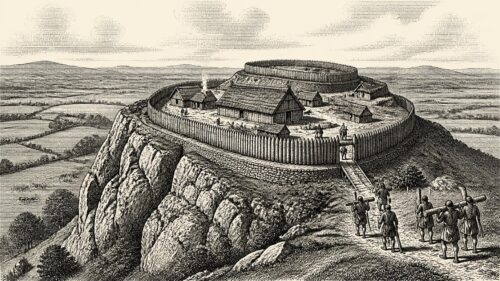
For communities caught along its path, a hosting threatened the rhythms on which survival depended. Most people lived in dispersed rural settlements, many centred on enclosed farmsteads now known as ringforts or raths. These held houses, byres, storage spaces and livestock within banks, ditches or stone walls. Cattle were especially important as food, wealth, status and a means of rendering dues, while cereal cultivation had become increasingly significant by this period. A raid across Munster therefore touched more than royal prestige: it endangered herds, seed grain, labour, transport and the ability of local lords to meet obligations to their superiors.
That wider picture is securely appropriate to early tenth-century Ireland, but it must not be mistaken for a detailed record of one village in 906. No contemporary source lets us follow a particular household, name a burned ringfort, or calculate the losses caused by Flann’s force. The history of the year is strongest where the annals are strongest: a large campaign occurred, it extended across Munster, and it formed part of a contest among powerful provincial kings.
Cormac’s Challenge
Flann’s attack did not settle the southern question. The following year, 907, annalistic sources place Cormac and his close associate Flaithbertach son of Inmainén at the head of a Munster army at Mag Léna. There they faced forces of Leth Cuinn, the northern half of Ireland in the conventional political geography of the period, assembled under Flann. Chronicon Scotorum says that Leth Cuinn was defeated. It also records a further Munster expedition against the Uí Néill and Connacht, the taking of Connacht hostages, and plundering from a fleet on Lough Ree. Those later events should not be folded into 906, but they illuminate the immediate result of Flann’s ravaging: Cormac’s regime remained able to retaliate vigorously.
The campaigns of 906 and 907 were preludes, rather than isolated outbreaks. In 908 Flann and Cerball, joined by Cathal son of Conchobar of Connacht, defeated Munster at Belach Mugna in what is now County Carlow. Cormac was killed, along with Cellach son of Cerball, king of Osraige, and other leading men of Munster. The date and outcome of that battle belong emphatically to 908. Its relevance here is explanatory: the alliance visible in 906 was not accidental, and Flann’s raid was an early stage in the confrontation that culminated two years later.
This sequence also corrects a tempting but mistaken image of a smooth “high kingship”. Flann could lead a devastating expedition into Munster in 906 and still be challenged successfully the next year. His authority was real, but it was negotiated through warfare, alliances, church connections and repeated public displays of capacity. Cormac’s ability to answer the attack demonstrates that a provincial overking could mobilise considerable resources and pursue ambitions reaching far beyond his own province.
Northern Successions
The annals for 906 also preserve two deaths in the north. Flann son of Domnall, described as heir designate of the North, died; so did Éicnechán son of Dálach, king of Cenél Conaill. The first title signals succession within the northern Uí Néill world, while the second concerned Cenél Conaill, the principal northern dynasty based in much of present-day Donegal. Neither notice supplies the circumstances of death, a successor, or an immediate conflict. They should not be inflated into a northern crisis. Nonetheless, the loss of an heir and a reigning king in the same year underscores how unstable political relationships could be, even without a recorded battle.
These northern notices belong beside, rather than beneath, the Munster campaign. Ireland’s political order consisted of overlapping regional kingships, and developments in one area could change the calculations of another. Flann’s southern expedition occurred while the north was experiencing changes among the Cenél nÉogain and Cenél Conaill. The record does not allow us to say that the deaths caused the campaign, or that Flann exploited them. It does show a kingdom of competing dynasties in which no ruler could take succession, loyalty or military cooperation for granted.
The Annals of Ulster also date the death of Ciarmac, king of Uí Fhidgeinte, to its 906 entry, and record the death of Indrechtach, abbot of Bangor. Ciarmac’s kingdom lay in the Munster sphere, in the region later associated with west Limerick and north Kerry, so his death came during a year when Munster was under severe external pressure. There is no evidence that he died in Flann’s campaign. Indrechtach’s death at Bangor, in present-day County Down, offers a different reminder: ecclesiastical communities were spread across the island and their heads were important figures in religious, educational and economic life.
Churches, Learning and Caution
Monasteries and churches were not remote from politics. They held land and livestock, received patronage, housed clerics and scholars, preserved books, and could offer ideological support to rulers. Important ecclesiastical sites were also places of production and exchange, connected by roads, rivers and maritime routes. Cormac’s double identity as churchman and king illustrates that sacred and secular authority could overlap in one person, while the notice of Bangor’s abbot reveals the regularity with which annalists marked the passing of religious leaders.
Yet 906 itself supplies no securely dated new church, manuscript, law-text, commercial measure or artistic commission. The year should not be made artificially richer than the evidence allows. Its cultural importance lies in the sources themselves: annals compiled and preserved within learned ecclesiastical milieus judged a royal hosting, royal deaths and an abbatial death worthy of record. Their brief entries were not neutral reports in a modern sense, but they preserve the framework through which power, loss and public order were understood.
A Year of Escalation
In 906, Flann Sinna and Cerball of Leinster carried the contest for supremacy into Munster. Their ravaging from Gabrán to Luimnech was a major assertion of allied power, but not a conclusive conquest. Cormac of Cashel remained in command of a formidable Munster, and the response of 907 showed that the conflict had intensified rather than ended. At the same time, deaths among northern royal lines and at Bangor reveal the ordinary turnover of political and ecclesiastical leadership that underpinned every larger struggle. The year stands as a moment when one hard-edged expedition exposed the limits as well as the reach of Tara’s authority.
Primary Sources
- The Annals of Ulster
- Chronicon Scotorum: English translation
- Chronicon Scotorum, Annals CS905–CS908
- Chronicon Scotorum: Irish and Latin text
- Annals of Inisfallen
- Annals of Inisfallen: Irish text
- Annals of the Four Masters
- Annals of the Four Masters, Part 1
- Annals of Tigernach
- Cormac
- Flann Sinna
- Niall Glúndub
- Agriculture, settlement and society in Early Medieval Ireland
- Early Medieval Farming and Food Production: A Review of the Archaeobotanical Evidence from Archaeological Excavations in Ireland
- Early Medieval Ireland: Archaeological Excavations, 1930–2009
- Early Medieval Dwellings and Settlements in Ireland, AD 400–1100, Vol. 1: Text
- The Economy of Early Medieval Ireland
- The Vikings in Ninth-Century Ireland: Sources and Settlements
- Vikings in Early Medieval Ireland: Church-Raiding, Politics and Kingship
- Ringforts
- Early Medieval Farmsteads
- Ringforts / Ráthanna
- Early Christian Monasteries
- Patrician and Early Christian Architecture