

A Northern Reckoning1078 CE
In 1078, northern Ireland experienced interconnected but largely local political upheavals. Conchobar Ua Briain, a Munster prince ruling at Telach Óc, was treacherously killed with his wife, weakening Uí Briain influence in Cenél nÉogain. Airgialla’s overking Lethlobar Ua Laidcnén also died violently, while conflicts involved Fernmag, Uí Chremthainn, Conaille, Uí Méith and other northern groups. Donn Sléibe Ua hEochada was deposed in Ulaid and sought Tairdelbach Ua Briain’s protection. Tairdelbach’s wide but limited supremacy rested on alliances, hostages and dependants. Ecclesiastical deaths and evidence of farming, trade and recent scarcity reveal the social foundations beneath dynastic violence and political rivalry.
Dateline
The surviving chronicles make 1078 unusually visible in northern Ireland. They record no single invasion or decisive battle capable of defining the whole year. Instead, they describe a chain of killings, defeats and disputed successions stretching from Ulaid and Cenél nÉogain to Airgialla, Conaille and Conmaicne. Together these entries reveal a political landscape in which provincial kingship depended upon alliances among smaller peoples, and in which even eminent rulers could be removed suddenly.
The evidence is nevertheless uneven. Most events are known only through terse annalistic notices, sometimes copied or reorganised centuries later. The Annals of Ulster, Annals of Inisfallen, Annals of Tigernach, Annals of Loch Cé, Chronicon Scotorum and Annals of the Four Masters broadly agree on the year’s most prominent deaths, but differ over titles and circumstances. Firmly dated entries can therefore be separated from reasonable interpretation, while exact days, troop movements and motives usually remain unknown.
The Reach of Tairdelbach
The most powerful king in Ireland was Tairdelbach Ua Briain, grandson of Brian Bóruma and ruler of Munster. By 1078 his authority extended far beyond his Dál Cais homeland. Following the death of Diarmait mac Maíl na mBó in 1072, Tairdelbach had taken hostages in Leinster and Osraige and accepted the kingship of Dublin. In 1075 he placed his son Muirchertach over that wealthy Hiberno-Norse port. Ruaidrí Ua Conchobair, king of Connacht, had entered his house and accepted a stipend in 1076, while Tairdelbach intervened again in Leinster during 1077.
These earlier developments form essential context rather than events of 1078 itself. They explain why displaced rulers now looked towards Tairdelbach’s court and why members of the Uí Briain dynasty appeared in northern politics. His supremacy was extensive but not equivalent to government by a central state. It rested upon hostages, stipends, military expeditions, family appointments and personal submissions. Local kings retained their own followings and could rebel, change sides or be killed without the overking’s permission.
A Munster Prince at Telach Óc
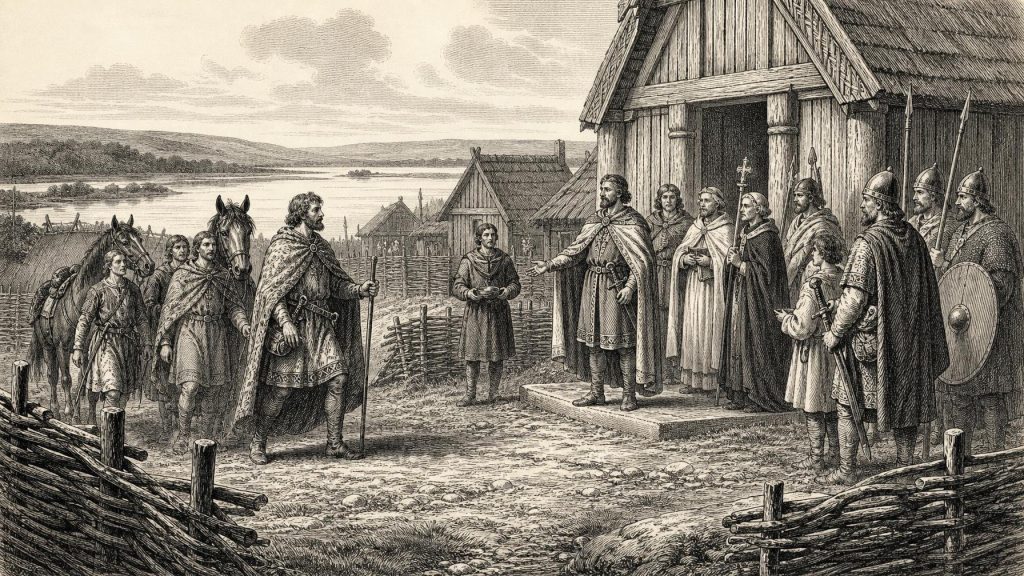
The year’s most consequential death was that of Conchobar Ua Briain. The northern annals style him king of Telach Óc and heir-designate of Ireland, while other chronicles call him king of Cenél nÉogain. Telach Óc, modern Tullaghogue in County Tyrone, was the principal inauguration place of Cenél nÉogain. That a member of the Munster Uí Briain could obtain its kingship demonstrates the weakness or fragmentation then affecting the dynasty’s native leadership.
The Annals of Inisfallen say that Conchobar was treacherously killed after taking the kingship. The Annals of Ulster add that his wife died with him and identify their attackers as the Cenél Binnigh of Glenn, a branch of Cenél nÉogain. No reliable exact date is preserved. Inisfallen further reports that the killer was immediately executed and that Conchobar’s brother Cennétig succeeded him.
This was more than a family tragedy. Conchobar was a kinsman of Tairdelbach but also a potential rival whose northern kingship offered an independent route towards wider authority. His death removed an unusually placed southern prince and left Cennétig attempting to preserve the family’s position. The succession did not create lasting Uí Briain control of Cenél nÉogain. Within a few years the rise of Domnall Ua Lochlainn would restore formidable native leadership in the north.
The inclusion of Conchobar’s wife is also significant. Annalists rarely recorded women unless their lineage, marriage, religious standing or manner of death carried political importance. Her killing suggests that the attack was directed against the ruler’s household, not merely against an isolated warrior on campaign.
War Across the North
Conchobar’s death formed only part of a wider pattern of violence. Lethlobar Ua Laidcnén, described as overking of Airgialla, was killed by Ruaidrí Ua Ruadacán. Airgialla was not a compact modern-style territory but a grouping of kingdoms occupying much of what is now Counties Monaghan and Armagh and neighbouring districts. The fall of its overking probably opened opportunities for local rivals, although the annals do not explain Ruaidrí’s motives.
The men of Fernmag defeated the Uí Chremthainn at Sliab Fuait, with Goll Cláraigh and others among the dead. Fernmag centred upon the later barony of Farney in County Monaghan, while Sliab Fuait belonged to the upland frontier around southern Armagh. The encounter shows conflict within the broader Airgiallan world following, or perhaps accompanying, Lethlobar’s death. It cannot securely be described as one coordinated war.
The Annals of Ulster also record a slaughter of the Conaille by the Uí Méith, in which a son of Ua Treodán, king of Conaille, fell. Elsewhere, Cathal son of Domnall, king of Cenél Énna, was killed by the Cenél nÉogain of Inishowen in what the same source calls the defeat of Mag Leine. Domnall, grandson of Tigernán and king of Conmaicne, was killed or died—the sources differ—and Conchobar Ua Donnchada, an heir-designate of Cashel, is included among the year’s dead.
These notices should not be merged into a single campaign. Their cumulative message is nonetheless clear: much warfare was local and dynastic. Armed followings fought over tribute, cattle, succession, subordinate peoples and strategic corridors. Victory might strengthen a kindred for a generation, while the death of a ruler could immediately reopen competition.
Exile from Ulaid
A different form of political upheaval occurred in Ulaid. The Annals of Inisfallen state that Donn Sléibe Ua hEochada was deposed and went to the house of Tairdelbach Ua Briain. A rival called In Méránach Ua hEochada then took the kingship. Donn Sléibe belonged to Dál Fiatach, the dynasty associated with eastern Ulster and its royal centre at Dún Dá Lethglas, now Downpatrick.
The entry provides a rare glimpse of exile as a political instrument. A deposed king was not necessarily finished. By entering Tairdelbach’s household, Donn Sléibe gained protection and potentially the resources needed for restoration; the Munster ruler acquired a dependent claimant through whom he might influence Ulaid. No record proves that Tairdelbach immediately sent troops north in 1078, so the episode should be understood as asylum and patronage rather than a documented invasion.
Donn Sléibe did later recover the kingship, confirming that his displacement was temporary. For contemporaries, kingship belonged not only to the man occupying a royal seat but to an eligible dynasty whose members could seek allies, stipends and military backing across provincial boundaries.
Churches and Learned Authority
Political turmoil did not halt religious life. At Imlech Ibair, now Emly in County Tipperary, Coibdenach Ultach died. Inisfallen calls him a venerable senior and the most pious man in Ireland; other sources describe him as the community’s confessor or spiritual adviser. Such praise reflects the prestige of ascetics, teachers and anamchairde, or soul-friends, within Irish Christianity.
The Annals of Ulster record the death of Dub Esa, daughter of Amalgaid, wife of the king of Airthir and styled successor of Patrick. The precise nature of her authority is difficult to reconstruct, and the title should not be equated automatically with the later office of archbishop. It does, however, show a high-status woman associated with a Patrician ecclesiastical succession while also embedded in a royal marriage alliance.
Cormac Ua Beáin, successor of Crónán at Tuamgraney, is recorded by the Four Masters, while Cenn Fáelad Ua Dungalaig, king of Múscraige Tíre, also died. Ecclesiastical settlements remained places of worship, burial, teaching, manuscript culture and political negotiation. No particular book, poem or work of metalwork can be securely assigned to 1078, but the recording of the year itself arose from learned communities maintaining calendars, genealogies and institutional memory.
Work, Trade and Survival
The chronicles concentrate on elites, leaving ordinary life largely unrecorded. Archaeology supplies the broader setting. Most people lived in dispersed farmsteads, ringforts, crannógs and settlements clustered around churches. Cattle were central to diet, wealth, rents and political exchange, while households also raised sheep and pigs and cultivated oats, barley and wheat. Grain required harvesting, drying and grinding; dairying converted perishable milk into butter and cheese.
Conditions may have been difficult at the opening of 1078. Munster annals report that cattle and some people suffered a swelling disease in 1077, followed by a violent autumn wind that damaged the corn crop. The Four Masters also describe scarcity in that preceding year. These notices do not prove a famine throughout Ireland in 1078, but damaged grain and unhealthy livestock could have reduced reserves and made communities more vulnerable to tribute demands and raiding.
Dublin, ruled for Tairdelbach by Muirchertach Ua Briain, remained Ireland’s leading port and mint. Its inhabitants worked wood, leather, bone, antler, textiles and metal, while merchants connected Ireland with Britain, the Isles and continental Europe. Silver pennies circulated alongside weighed silver, livestock and payments in kind. No specific shipment or market transaction is dated to 1078, yet control of Dublin mattered precisely because its ships, craftsmen, revenues and trading contacts increased the power of an ambitious king.
A Fragmented Balance
The events of 1078 did not transform Ireland at a stroke. Tairdelbach remained dominant, Dublin stayed under his son, and no rival yet established undisputed authority in the north. Nevertheless, the deaths of Conchobar Ua Briain and Lethlobar Ua Laidcnén, the fighting among northern peoples and the expulsion of Donn Sléibe exposed a region in transition.
The year illustrates both the reach and the limitations of overkingship. Tairdelbach could receive exiles, install sons and reward subordinate rulers, but he could not prevent local dynasties from pursuing their own wars. Beneath the annals’ catalogue of kings and killings lay farming communities, ecclesiastical centres and trading towns whose labour sustained every royal ambition. Their quieter continuity formed the enduring background to a year remembered chiefly for northern reckoning.
Primary Sources
- The Annals of Ulster: Year U1078
- Annals of Inisfallen
- The Annals of Tigernach: Annal T1078
- Annals of the Four Masters: Annal M1078
- Chronicon Scotorum: Annal CS1078
- Annals of Loch Cé: Annal LC1078
- CELT Project: The Annals of Ulster
- CELT Project: Annals of Inisfallen
- CELT Project: Chronicon Scotorum
- Ua Briain, Tairdelbach
- Ua Briain, Muirchertach
- Ua hEochada, Donnchad
- Niall
- Ua hÉnna, Domnall
- Ua Lochlainn (Mac Lochlainn), Domnall
- Diarmait (Diarmait mac Maíl na Mbó)
- Pre-Norman Dublin: Capital of Ireland
- Viking
- 950–1450: Vikings, Normans and Medieval Mints
- Early Medieval
- The Economy of Early Medieval Ireland
- Early Medieval Ireland: Investigating Social, Economic and Settlement Change, AD 400–1100
- Martin of Tours, Monasticism and Ecclesiastical Renewal in Twelfth-Century Ireland