Domnall’s Killing in Leinster884 CE
In 884, Domnall mac Muirecáin, king of the Leinstermen and member of the Uí Fháeláin branch of Uí Dúnlainge, was killed by his associates in circumstances unrecorded by the annals. His death destabilised Leinster’s contested overkingship; Muiredach mac Brain succeeded briefly, while Domnall’s brother Cerball later gained power. Cairpre mac Dúnlaing, ruler of western Life, also died, though no connection is known. Scannlán, bishop of Kildare, died, affecting a major ecclesiastical institution. These changes occurred amid pressure from Osraige, Tara and Dublin’s Scandinavian power. The sparse records reveal political vulnerability but provide no evidence for a wider campaign or conspiracy.
Dateline
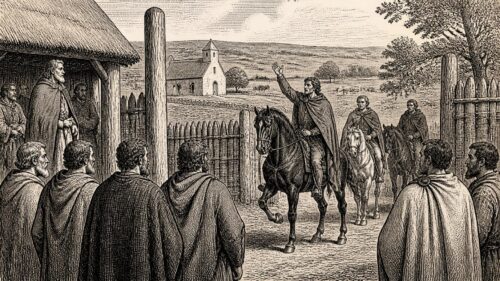
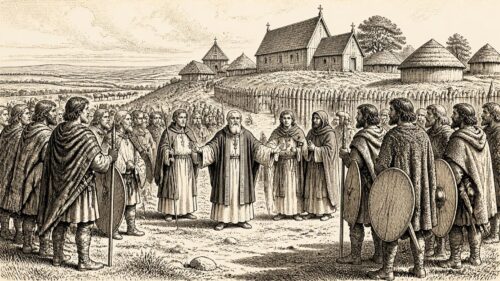
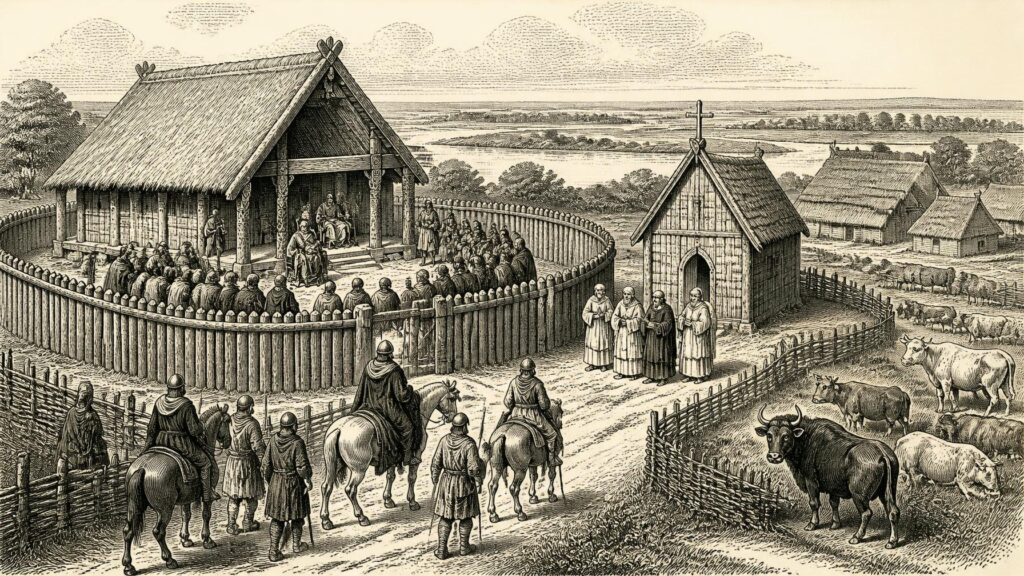
The clearest Irish political event securely connected with 884 is also one of the least explained. Domnall mac Muirecáin, styled king of the Leinstermen, was killed by his own associates. The wording is stark: it identifies neither the place of death nor the men responsible, and gives no motive. Yet the killing mattered far beyond one ruler’s household. It struck at Leinster’s fragile overkingship, at a time when authority in the province was disputed among related branches of the Uí Dúnlainge dynasty, constrained by the ambitions of neighbouring Osraige, and exposed to the influence of the king of Tara and of Scandinavian power around Dublin.
For contemporaries, the death was not simply a private murder. A king’s household, client network, church connections and capacity to command military service were all political assets. Domnall’s removal therefore created a dangerous interval in a province whose leading dynasties had long shared, contested and sometimes violently exchanged authority.
A Date with a Difficulty
Three important annalistic traditions preserve Domnall’s death. Chronicon Scotorum and the Annals of Inisfallen put it under 884, while the relevant Annals of Ulster entry is headed U884 but carries an internal chronological notation equivalent to AD 883. Such discrepancies are a familiar hazard in ninth-century Irish annals: year headings were copied, recalculated and sometimes displaced in different textual traditions. Modern reference scholarship nevertheless places Domnall’s fall in 884. It is responsible, therefore, to treat the killing as the year’s central event, while avoiding a fabricated day, season or location.
The sources also provide a useful warning about historical scale. Annals are not diaries of ordinary life, nor do they enumerate every raid, harvest, exchange or local dispute. They select deaths, killings, ecclesiastical successions and exceptional occurrences. Silence in the record does not prove peace across Leinster in 884. Equally, it would be wrong to turn a sparse entry into an imaginary campaign, battle or palace coup. What can be said firmly is that Domnall died violently at the hands of people presented as his own associates.
The King and His Kindred
Domnall belonged to the Uí Fháeláin, one of the principal branches of Uí Dúnlainge. This dynasty dominated the kingship of Leinster for generations, but its power was neither unitary nor secure. Rival Uí Dúnlainge branches possessed their own territories, followers and claims to provincial precedence. Domnall was a son of Muirecán, ruler of Nás and Airther Liphi, the eastern Liffey plain. Muirecán had himself been slain by Norsemen in 863. The family’s political memory was thus marked by violence from outside Leinster as well as rivalry within it.
The description of Domnall as rex Laginensium, king of the Leinstermen, should not be read through the lens of a later centralised state. Leinster comprised many lesser kingdoms and lordships, while a provincial king depended on negotiated allegiance, hostages, tribute, ecclesiastical patronage and armed backing. The death of an overking could quickly alter these balances. Domnall’s killing is accordingly described by the Dictionary of Irish Biography as an intra-dynastic squabble, a concise judgement that fits the annals’ phrase about his associates but does not pretend to recover details that the evidence has lost.
Another Death on the Liffey Plain
The Annals of Ulster also record the death of Cairpre mac Dúnlaing, king of western Life or Iarthar Liphi, in the same annal. This was a second significant loss among Leinster’s ruling kindreds. Cairpre’s father Dúnlaing had been a major Uí Muiredaig ruler, another branch of the Uí Dúnlainge, and the western Liffey plain was a politically valuable zone between the heartlands of Leinster and the midlands. Cairpre’s death is not described as violent, and the sources do not say that it was connected to Domnall’s killing. The coincidence must not be converted into a claim of a single conspiracy. Nevertheless, two changes among elite rulers in or around the Liffey region made 884 a consequential year for Leinster’s political geography.
The immediate provincial succession illustrates both continuity and competition. Muiredach mac Brain of the rival Uí Dúnchada branch became Domnall’s immediate successor, but died in 885. Domnall’s brother Cerball later emerged as a powerful king of Leinster. Thus 884 did not install a stable new order; it opened a short, unsettled sequence of rulership. The pattern is important: family membership supplied a claim to kingship, but did not guarantee peaceful inheritance or effective control.
Kildare’s Ecclesiastical Weight
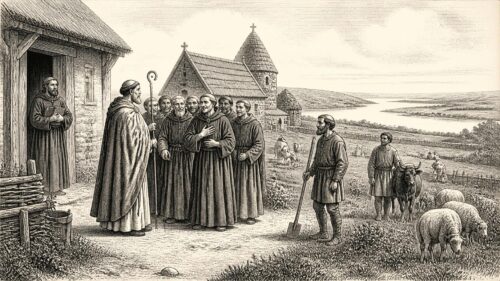
Religion and politics were deeply interwoven in this world. Chronicon Scotorum records in 884 the repose of Scannlán, bishop of Cell Dara, Kildare. The brief notice offers no biography, but the bishop’s appearance beside the death of a provincial king is a reminder of Kildare’s standing within Leinster. Its community was a major ecclesiastical centre associated with Brigit, holding religious prestige, land, dependants and connections across the province. Offices at such places were not marginal to political life: they could carry resources, literacy, legal influence and relationships with royal families.
That importance had practical consequences for ordinary communities. Churches and monasteries were places of worship, burial, hospitality, food production, craftwork, teaching and record-keeping, as well as spiritual authority. The evidence from Irish archaeology cautions against imagining every ecclesiastical settlement as a town in the modern sense; scholars continue to debate the usefulness of the term ‘monastic town’. But Kildare, Armagh and Clonmacnoise are among the major sites for which substantial economic and social functions have been proposed. In 884, the death of Kildare’s bishop marked a change in the leadership of an institution embedded in Leinster’s political landscape.
Life Beyond the Annals
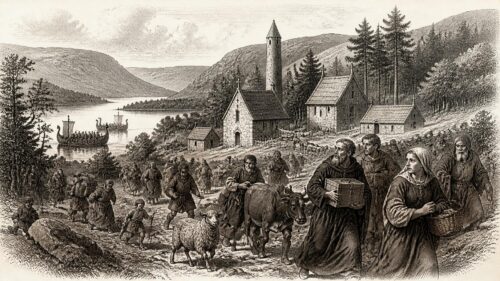
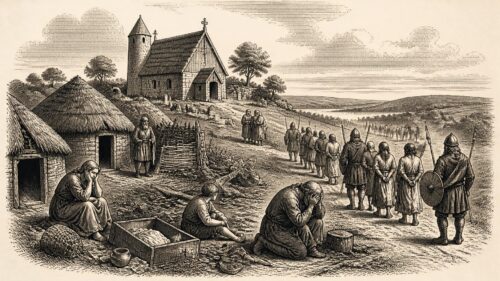
Most people in Leinster were not kings, bishops or named in chronicles. Their lives centred on dispersed rural settlements: enclosed farmsteads, small habitations, fields, pasture, woodland and routes linking local territories. Archaeological synthesis shows the variety of early medieval Irish dwellings and settlement enclosures, alongside agricultural, craft and industrial activity. Cattle remained central to wealth and status, but households also relied on grain, dairy produce, pigs, fishing, fuel, textiles and the labour of kin and dependants. Travel followed rivers, ridgeways and established roads as much as later mapped routes.
Political instability could reach these communities through demands for food-renders, cattle, labour, escorts and military service. A royal death might require local leaders to choose sides, safeguard stock, provide men or renegotiate obligations. Yet no surviving source permits a precise reconstruction of the impact of Domnall’s killing on a particular village, estate or church. The safer conclusion is that succession crises mattered because kingship was sustained by local resources and personal ties, not because the annals tell us of a general mobilisation in 884.
Dublin and the Wider Pressure
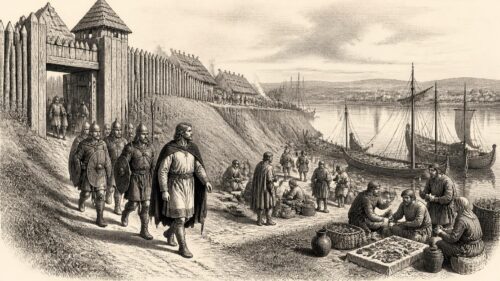
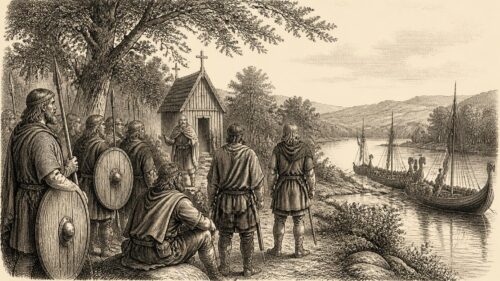
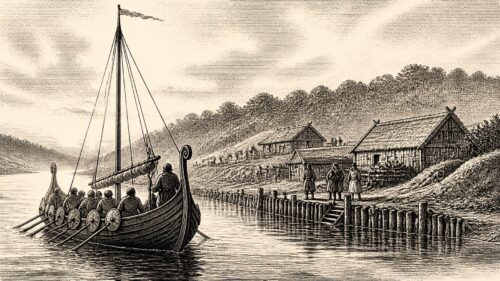
Leinster’s internal politics cannot be detached from the Scandinavian presence in eastern Ireland. Dublin was already an established Hiberno-Scandinavian power and a maritime gateway to the Irish Sea world. Norse activity had affected Domnall’s own family: his father Muirecán was killed by Norsemen in 863. The years immediately before and after 884 also contain records of raids and conflict involving Scandinavian forces and Irish rulers, though those events should not be shifted into this year merely to give it more drama.
Nor were ‘Irish’ and ‘Viking’ political worlds always separate camps. Later ninth-century evidence shows raiding, alliance-making and competition among Scandinavian groups and Irish dynasties. For Leinster’s rulers, Dublin was at once a threat, a source of armed power and an unavoidable neighbour. Domnall’s killing came within that wider environment of armed and shifting politics, but the annals do not attribute his death to Dublin or to any Scandinavian leader.
A Province Between Powers
Over Leinster stood the larger ambitions of Flann Sinna, king of Tara from 879 and the leading ruler of the southern Uí Néill. Flann spent the early part of his reign consolidating his position, while Leinster faced pressure also from Cerball mac Dúngail of Osraige, an exceptionally forceful neighbouring king. These are broader conditions rather than events demonstrably undertaken in 884. They help explain why the Leinster succession was important: control of the province affected access to the Liffey plain, Kildare’s ecclesiastical networks, routes towards Dublin, and the balance of power between the midlands, Osraige and the Irish Sea coast.
884 therefore stands as a year of recorded rupture rather than a year of fully documented warfare. Domnall mac Muirecáin was killed by associates; Cairpre mac Dúnlaing died in western Life; and Scannlán, bishop of Kildare, died. Those notices are small in number, but together they reveal a Leinster in which royal and ecclesiastical leadership were continually renewed, contested and vulnerable. The annals leave the murder unexplained. Their restraint is itself part of the history: it preserves the fact of a king’s violent removal, while reminding us how much of the human story behind it remains beyond recovery.
Primary Sources
- The Annals of Ulster, Year U884
- Chronicon Scotorum, Annal CS884
- Annals of Inisfallen, Annals AI880–AI889
- Annals of the Four Masters, Annals M880–M886
- The Annals of Ulster
- Annals of Inisfallen
- Chronicon Scotorum
- Cerball
- Dúnlaing
- Flann Sinna
- Gormlaith
- Vikings in Early Medieval Ireland: Church-Raiding, Politics and Kingship
- Reassessing the Irish ‘Monastic Town’
- Early Medieval Dwellings and Settlements in Ireland, AD 400–1100, Vol. 1: Text
- Early Medieval Ireland: Archaeological Excavations 1930–2009
- Traveling Monastic Paths: Mobility and Religion at Medieval Irish Monasteries
- Aspects of Leinster Archaeology
- Residence, Ritual and Rulership: A State-of-the-Art for Royal Places in Early Medieval Ireland
- How Did Early Church Sites Differ From One Another?: A Comparative Approach Within the Kingdom of Fir Maige, Ireland
- Castledermot Town Walls Conservation and Management Plan
- Dunmanoge Church and Graveyard, Co Kildare
- South Dublin County Heritage Plan 2010–2015
- Cooke: The Early History of the Town of Birr, or Parsonstown
- Clonfert Conservation Plan