Mag Eitir’s Hostages882 CE
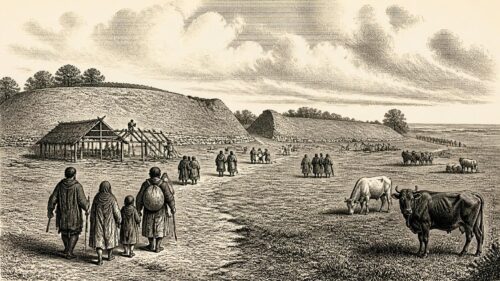
In 882, annalistic sources record Flann Sinna, king of Tara, asserting authority through campaigns, alliances and hostage-taking. With a mixed Irish and Scandinavian army, he entered northern Fochla, camped at Mag Eitir dí Glais, invaded Armagh and reportedly secured hostages from Cenél Conaill and Cenél nEógain. He also raided Munster and took hostages there. Elsewhere, the Conaille defeated the Ulaid, killing King Ainfíth and other nobles, while Scannlán of Dún Lethglaise was killed. Deaths included Connacht’s king Conchobor and several prominent churchmen. The records portray fragmented politics, where military power, ecclesiastical prestige and shifting alliances shaped rule across Ireland broadly.
Dateline
A Year in the Annals
The evidence for 882 is unusually revealing, but it requires careful handling. The principal contemporary-style notices are brief annal entries, not a narrative written by an eyewitness. Chronicon Scotorum groups a northern expedition by Flann son of Máel Sechnaill, a battle in Ulaid, the death of a Connacht king, and a raid into Munster beneath its annal for 882. The Annals of Ulster preserve much the same cluster under U882, although their internal year-note reads AD 881; the later Annals of the Four Masters place several of the same events under 879. Such offsets are familiar problems in medieval Irish chronology. The responsible conclusion is not that every movement occurred on a known day or in a known order, but that this connected body of events belongs securely to the calendar year conventionally treated as 882.
At its centre stood Flann Sinna, king of Tara and leading ruler of the southern Uí Néill. He had come to prominence after the death of Áed Findliath in 879, but his authority was neither automatic nor uncontested. Irish overkingship depended on continually renewed relationships: hosting armies, receiving submissions, taking hostages, rewarding allies and demonstrating the capacity to punish opponents. The events associated with 882 show Flann doing all of these things. They also show the limits of any simple picture of a united Ireland. The island was made up of many kingdoms, church communities and dynasties, each with its own interests and capacity for violence.
Flann’s Northern Expedition
The largest recorded action was Flann’s expedition into Fochla, broadly the northern part of Ireland. The annals state that his force included both Goidil, Irishmen, and Gaill, foreigners. In this period that word normally referred to Scandinavian groups active in Ireland, but the entry does not name their leader or specify the terms of their alliance. Its importance lies precisely in this mixed army. Scandinavian power was not an outside force acting separately from Irish politics: foreign warbands could be allies, employers, rivals and enemies of Irish kings, while Irish rulers could use them in contests with other Irish rulers.
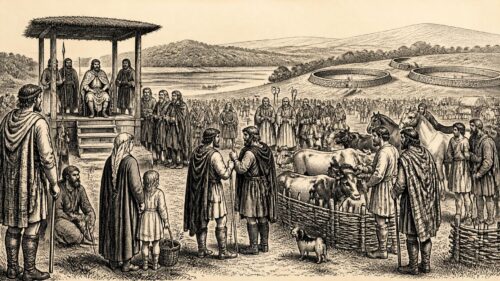
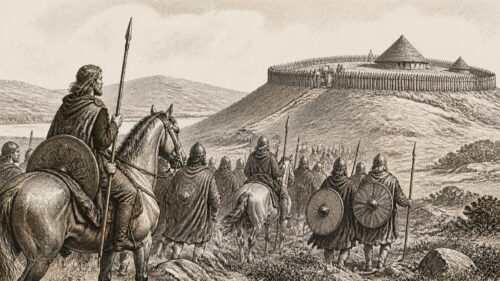
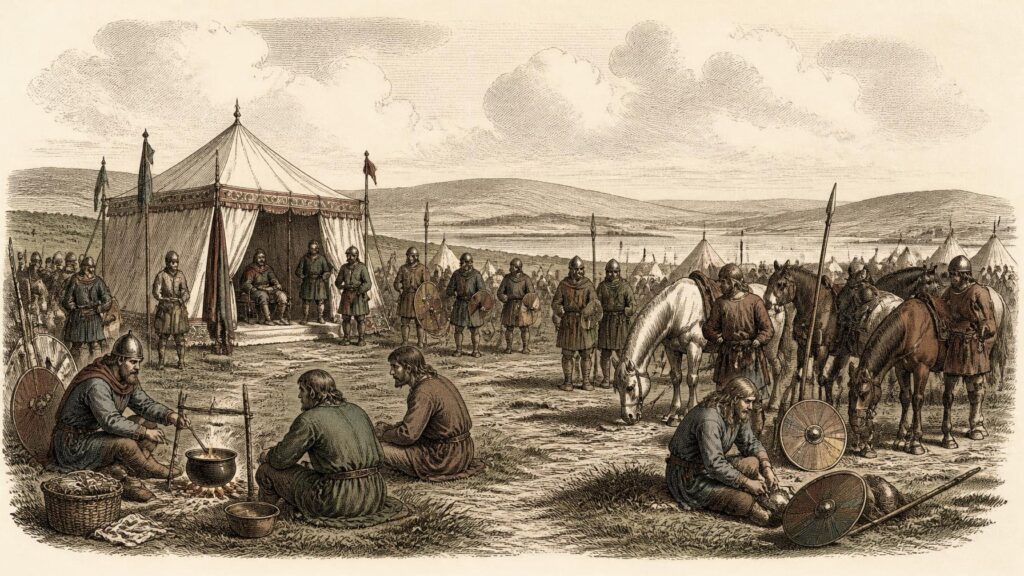
Flann’s host camped at Mag Eitir dí Glais. The location is named but the annal does not provide a route, an exact site for the camp, the size of the army, or a duration for the expedition. It does say that Ard Macha, Armagh, was invaded. Chronicon Scotorum adds a crucial detail omitted from the corresponding Ulster notice: Flann took the hostages of Cenél Conaill and Cenél nEógain. These were the leading northern Uí Néill peoples. Hostages were not casual prisoners. They were instruments of political security, often people of high status whose custody guaranteed a settlement, obedience or tribute. Their taking advertised a temporary but tangible superiority.
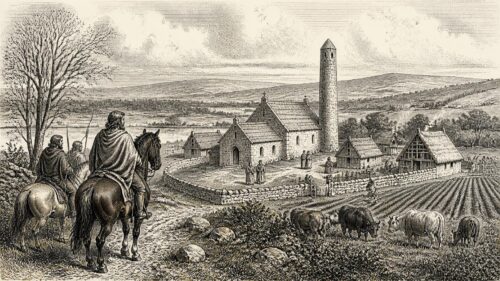
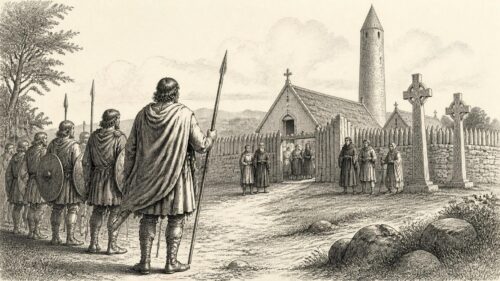
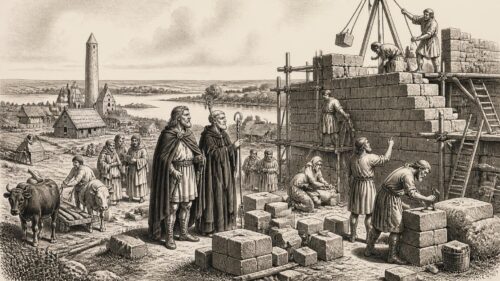
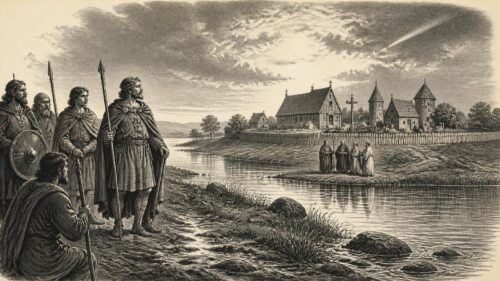
Armagh was therefore not simply a convenient place to plunder on a military march. It was the principal church of Patrick, an exceptionally important ecclesiastical centre within the northern political landscape. To enter or ravage it was to strike at resources, prestige and sacred authority together. Yet the sources offer no detailed account of destruction, no tally of captives and no description of buildings damaged in 882. It is better to say that Flann’s force invaded Armagh than to embellish the event into a fully described sack. The campaign’s political point was clear enough: an overking from Mide had brought a combined Irish and Scandinavian force into the northern heartland, compelled hostages, and made Armagh feel the reach of his power.
War Within Ulaid
Other entries reveal that northern affairs were not defined only by Flann’s advance. A battle or skirmish took place between the Conaille of Muirthemne, centred around the district south of Carlingford Lough, and the Ulaid. Ainfíth son of Áed, described as king of Ulaid, was killed, as was Conallán son of Máel Dúin, king of Coba. Other nobles fell, while the Conaille were named as victors. This was a significant local success, but it should not be turned into a claim that the kingdom of Ulaid ceased to exist. Medieval Irish kingship was frequently shared, disputed or divided among branches of ruling kindreds; the death of a king could rearrange power without settling it.
The annals also record that Scannlán, superior of Dún Lethglaise, was killed by the Ulaid. Dún Lethglaise, later Downpatrick, was a major church settlement. The killing underlines how closely ecclesiastical institutions could be drawn into regional conflict. Its superior was not merely a secluded religious figure: leadership of a prominent church involved land, dependants, learned personnel, ritual standing and relations with secular rulers. The record gives no explanation for Scannlán’s death, and no safe reconstruction of motive is possible. What can be said is that violence in 882 touched royal and ecclesiastical elites alike.
Deaths and Successions
Several deaths recorded in the year matter because institutions were personal as well as territorial. Conchobor son of Tadc, king of the three Connachta, died “after a long life” in the wording of the annals. The phrase conveys an old ruler’s natural end rather than a battlefield killing, but it also marks a succession in Connacht at a moment when Flann was actively projecting authority in several directions. The sources do not identify a successor in the same notice, nor do they show Flann directing Connacht’s political transition. It would be unsafe to invent a connection merely because both appear in the year’s record.
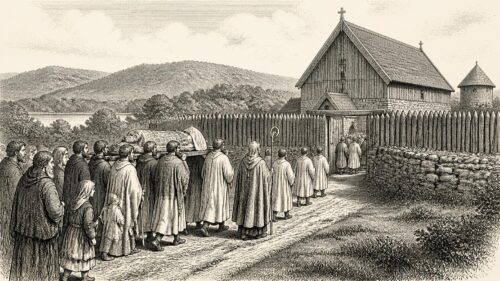
Church offices likewise changed hands. Muirchertach son of Niall, abbot of Daire Calgaig, modern Derry, and of other churches, died. His title indicates authority extending beyond one community, a reminder that religious office could link several sites through patronage, property and personnel. The Annals of Ulster also note the deaths of Cormac son of Ciarán, prior of Clonfert and superior of Tuaim Dá Gualann; Aedán, superior of Clonard; and Dub Inse, superior of Inis Caín Dega. These short notices do not tell us how their communities chose successors, but they demonstrate the wide geographical network of influential churches: from the northern coast and midlands to the Shannon region.
The Munster-centred Annals of Inisfallen, meanwhile, place the deaths of Rudgal son of Fíngal, abbot of Imlech Ibuir, and Flann son of Cellach, abbot of Scelec, in 882. Imlech Ibuir, Emly, was an important inland ecclesiastical centre, while Scelec evokes the monastic world of the south-western seaways. These notices are small, but they are a useful corrective to a history written only around kings and armies. Religious communities endured through changing leadership, and their abbots could be sufficiently important for their deaths to be entered into annalistic memory.
Munster and the Price of Authority
Chronicon Scotorum further records that Flann raided Munster and carried away its hostages. The entry does not say whether this action preceded or followed the northern expedition, whether the same army took part, or which Munster rulers submitted. It nevertheless makes the year’s wider pattern unmistakable. Flann’s campaigning was not confined to one frontier. His rule was being asserted through mobile force and hostage-taking in both north and south, across a landscape where royal authority had to be physically performed.
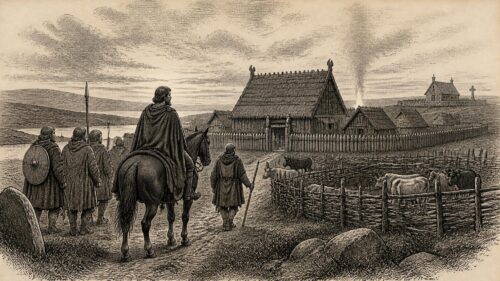
For ordinary people, such campaigns meant more than the drama of kings. An army needed food, animals, boats where waterways were crossed, guides, smithing, transport and places to camp. A raid could take cattle and other movable wealth, disrupt seasonal work, and impose demands on communities whether they supported the host or lay in its path. The annals of 882 do not quantify such burdens, so neither a famine nor a general economic collapse can be claimed. Yet the repeated emphasis on hostages, armies and invasions shows that political power rested on the ability to command people and resources over distance.
Church, Learning and Record
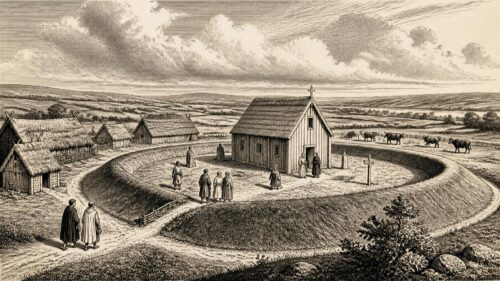
The church was not outside this world. Armagh’s invasion, Scannlán’s killing, and the deaths of abbots and superiors make that plain. Major monasteries were centres of worship and burial, but also landholding communities embedded in dynastic society. They employed and supported clergy, dependants and craftspeople; preserved liturgical and legal learning; and served as places where royal legitimacy could be displayed or contested. Their prominence helps explain why annalists noted their leaders so consistently. The surviving notices do not allow us to describe a particular school lesson, market day or manuscript workshop in 882, but they do show institutions whose religious, cultural and political lives could not be neatly separated.
The year’s sources also warn against treating “Irish” and “Viking” as fixed, opposing camps. Flann’s army combined Irish and foreign contingents against northern Irish rivals. The political landscape was one of shifting interests, not a single national struggle. Nor should Armagh’s invasion be detached from that setting: it was an action by an Irish overking, aided by foreigners, against a northern sphere bound closely to the rival northern Uí Néill. In 882, alliances were practical and often temporary; religious prestige, hostages and armed mobility were all currencies of rule.
A Demonstration, Not a Settlement
What emerges from 882 is a year of forceful assertion rather than permanent settlement. Flann Sinna demonstrated reach by penetrating Fochla, invading Armagh and, according to the fuller chronicle, obtaining northern hostages. He was also credited with taking hostages in Munster. But the killings in Ulaid, the death of Connacht’s king, and the succession of church leaders show a country of many centres of power. No annal claims that Flann had made Ireland politically uniform. His achievement was more immediate: to make opponents and allies reckon with the strength he could assemble. Mag Eitir dí Glais, briefly named as an army camp, became the point from which that message was sent across Ireland.
Primary Sources
- The Annals of Ulster: Year U882
- The Annals of Ulster: English Translation
- The Annals of Ulster: Original Irish and Latin Text, Year U882
- Chronicon Scotorum: English Translation
- Chronicon Scotorum: Original Text, Annal CS882
- Annals of the Four Masters: Annal M879
- Annals of the Four Masters: English Translation
- Annals of Inisfallen: Annal AI882
- The Annals of Inisfallen (MS. Rawlinson B. 503)
- Vikings in Irish Chronicles, 794–902: Data
- Flann Sinna
- The Vikings in Ninth-Century Ireland: Sources and Settlements
- Vikings in Early Medieval Ireland: Church-Raiding, Politics and Kingship
- Reassessing the Irish ‘Monastic Town’
- The Primatial Claims of Armagh, Kildare and Canterbury
- Exploring the Irish Annals
- Annals of Inisfallen to Go on Public Display in University College Cork
- High Crosses
- Innisfallen Augustinian Abbey
- Sceilg Mhichíl Visitor Guide