Aed of In tAilén881 CE
In 881, the Annals of Inisfallen record the death of Aed of In tAilén, described as bishop and confessor of Ireland, though his church and byname remain uncertain. Corrected annalistic chronology also places Flann Sinna’s northern expedition in this year. Leading Irish and Scandinavian forces, he camped at Mag Eitir dí Glais, invaded Armagh, and received hostages from Cenél Conaill and Cenél nEógain, asserting overlordship through military pressure and negotiation. The evidence highlights churches as influential, vulnerable centres of learning and wealth, Scandinavian participation in politics, and the limits of medieval records, which reveal no securely dated crises or conditions.
Dateline
A Sparse but Certain Record
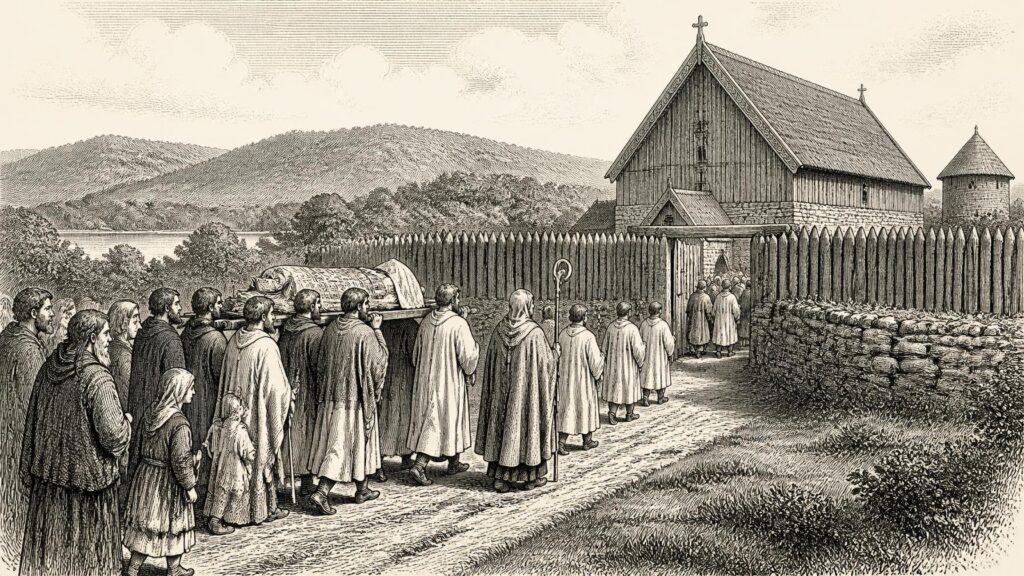
The most secure Irish notice for 881 is brief, but it deserves to be taken seriously. The Annals of Inisfallen records the repose of Aed of In tAilén, styling him “bishop and confessor of Ireland”. Nothing in the surviving entry provides a date within the year, identifies his church with certainty, or explains the geographical byname In tAilén. It would therefore be unsafe to turn Aed into the head of a known diocese, to assign him a particular monastery, or to imagine the manner of his death. Yet the language used for him shows that his standing was considerable: a bishop was a leading ecclesiastical figure, while “confessor” marked a holy churchman distinguished by religious life rather than by martyrdom.
Aed’s death is the year’s firm landmark, rather than a doorway to a lost biography. Medieval Irish annals were deliberately compressed records. They preserve names, ranks, killings, successions, raids and unusual natural signs, but rarely offer the explanatory narrative that modern readers expect. A single obituary can consequently be more reliable than a colourful story supplied by much later interpretation. In 881, the honest historical picture is not one of a fully documented national crisis but of an important churchman leaving the record in a politically divided and ecclesiastically interconnected Ireland.
Why the Date Requires Care
The year also illustrates a basic difficulty of Irish medieval chronology. The surviving annal collections descend from related records, but their year-headings and later compilations do not always align neatly. The Annals of Ulster, for example, place material under headings that are commonly one year earlier than the modern corrected date in this period. The seventeenth-century Annals of the Four Masters preserve further material drawn from older sources, but their chronological arrangement can diverge substantially from the earlier annals. These are not trivial editorial details: they determine whether an event belongs in 881 or several years later.
This is particularly important because the Four Masters has a long list beneath its heading for 881: ecclesiastical deaths, the killing of Domnall son of Muirecán, king of Leinster, and other regional losses. Comparison with the Annals of Ulster shows that this cluster corresponds principally to material placed there under U884, whose corrected date is 883. Those occurrences must not be presented as events of 881 merely because a later compilation numbers them so. Likewise, a northern campaign by Flann Sinna which appears in an Ulster annal headed 882 belongs, after the normal correction, to 881; however, the source itself does not supply an exact day or season.
Flann Sinna’s Northern Expedition
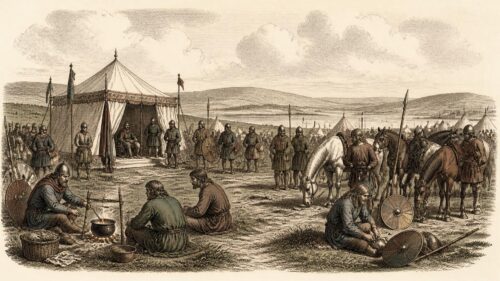
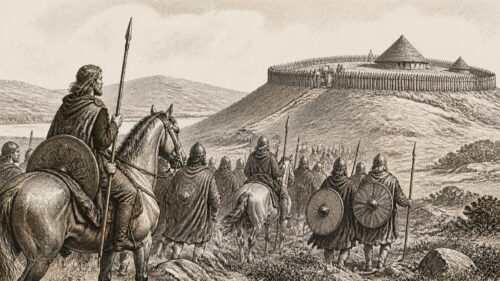
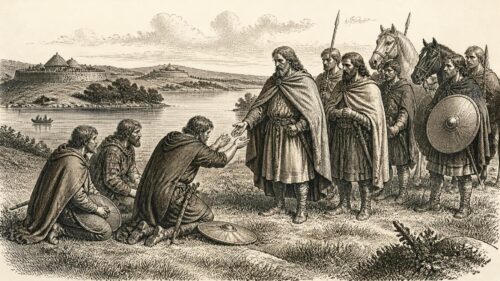
One major development can responsibly be connected with the calendar year. In the corrected chronology, Flann Sinna, king of Tara and claimant to Ireland-wide overkingship, led an army north. The force was strikingly mixed: the annalist says it included both Irish and “foreigners”, the usual contemporary term for Scandinavian groups. It camped at Mag Eitir dí Glais; during the expedition Armagh was invaded, and the kings or political communities of Cenél Conaill and Cenél nEógain gave hostages to Flann. The wording does not allow us to reconstruct every movement, battle or negotiation, but it records an unmistakable assertion of power in the north.
Hostages were central to the practical politics of ninth-century Ireland. They were not simply prisoners seized after fighting. The surrender or exchange of high-status people could guarantee agreements, signal submission, bind rulers to an overlord, and provide leverage if an alliance failed. Flann’s northern expedition thus amounted to more than a raid for livestock or plunder. It sought public recognition of his authority from the principal northern Uí Néill dynasties, Cenél nEógain and Cenél Conaill. The campaign also demonstrates that claims to a high kingship of Ireland were made through movement, military display and negotiated coercion, rather than through a permanent central government.
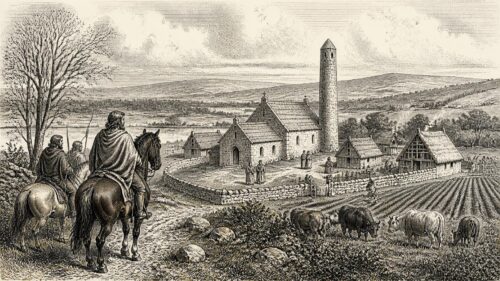
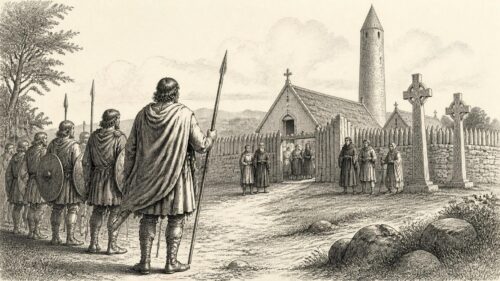
The invasion of Armagh gives the expedition a particularly troubling edge. Armagh was not a neutral backdrop: it was a wealthy ecclesiastical centre whose prestige rested on its association with Patrick, its learned clergy, dependent churches and landed resources. An army’s presence endangered food stores, livestock, portable valuables and the security of non-combatants, whether or not a formal assault on the principal church was intended. The annalist’s phrasing that Armagh “was invaded” is more restrained than later dramatic retellings, but it confirms the vulnerability of even Ireland’s foremost church to royal campaigning.
Irish and Scandinavian Power
Flann’s use of “foreigners” is a reminder that Scandinavian settlers and warbands were by 881 participants in Irish politics, not an entirely separate force acting only from the sea. Dublin had emerged from the longphort world of the ninth century as a strategically valuable settlement on the Liffey. Scandinavian leaders could raid, trade, demand tribute, enter alliances with Irish kings, and supply ships and fighters to Irish political contests. Their involvement in Flann’s northern hosting should not be read as evidence of peaceful integration, nor as a simple conflict of Irish against Viking. It shows expediency: a powerful Irish king could recruit or cooperate with Scandinavian military interests when it served his purposes.
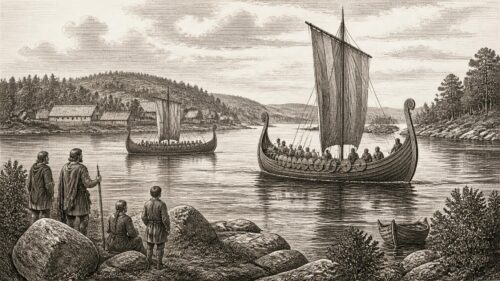
That political usefulness rested on maritime mobility. A ship-based force could carry armed men, goods and captives along coasts and through navigable river systems, while coastal bases connected Ireland to the Irish Sea and wider Scandinavian networks. Archaeology and annalistic evidence caution against treating every longphort as an identical “Viking fortress”. Such sites could combine anchorage, temporary camp, repair place, trading point and defended settlement. Nevertheless, their existence had changed the strategic map. The threat and opportunity of seaborne power shaped the calculations of Irish rulers, churches and local communities in 881.
Churches, Learning and Authority
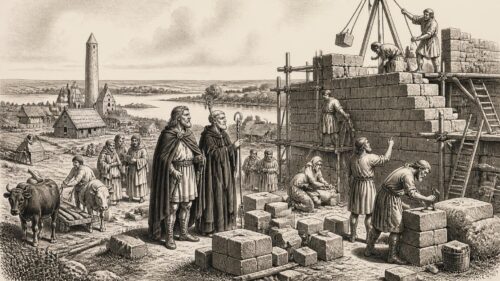
Aed’s obituary and the Armagh invasion belong to the same wider world. Irish churches were spiritual communities, but they were also holders of land, livestock, books, metalwork and legal privilege. Their leading offices were connected to powerful kindreds, and senior clerics could influence regional politics. Monasteries and church settlements supported craftsmen, farmers, servants, students and travellers as well as priests, monks and nuns. A bishop’s death could therefore matter beyond the immediate religious community: it could entail a vacancy in leadership, a reordering of patronage, and renewed competition for influence or resources.
Learning remained one of the church’s most durable forms of authority. Schools associated with major churches trained clerics in Latin literacy, scriptural study, computation and the inherited traditions of Irish law and genealogy. The annals themselves were products of this literate environment. Their clipped notices are not evidence that life was simple or uneventful; rather, they reflect the selective interests of writers who judged dynastic violence, ecclesiastical office and exceptional events worthy of preservation. Aed of In tAilén is remembered precisely because a learned church community considered his passing worth entering into the annual record.
What 881 Does Not Reveal
The surviving evidence provides no securely dated harvest failure, epidemic, weather event, building project, synod or major battle for Ireland in 881. Nor does it describe the ordinary routines that sustained most people: tending cattle and crops, fishing, milling grain, maintaining houses and enclosures, travelling to seasonal gatherings, or producing cloth and tools. Those activities certainly continued, but certainty about their existence is not permission to invent a particular hard winter, prosperous market or local catastrophe. The absence of an annalistic entry is not proof that nothing happened; it is a limit on what can be claimed for this year.
Even the northern campaign should be kept in proportion. It reveals high politics—the hosting, the camp, the incursion into Armagh and the taking of hostages—but says little about how long the army remained, what terms were agreed, or how communities on its route experienced the passage. The annals offer a headline, not a campaign diary. Their testimony is strongest when retained at that scale.
A Year of Ecclesiastical Loss and Royal Reach
Seen through its firm evidence, 881 joins two apparently different developments. Aed of In tAilén’s repose records the loss of a churchman honoured across Ireland. Flann Sinna’s northern hosting reveals an overking using an army of Irish and Scandinavian allies to press his authority upon rival Uí Néill powers, even at the expense of Armagh’s security. Together they show the intertwined character of ninth-century Irish life: religious institutions were centres of devotion and learning, but also influential and exposed political places; kings sought dominance through hostages and armed display, while Scandinavian maritime power had become part of the island’s political repertoire.
The year’s record is limited, but not empty. It preserves the death of Aed, the vulnerability of Armagh, and the reach of Flann’s ambitions. It also supplies a useful discipline for historical writing. Ireland in 881 should not be made artificially dramatic. Its surviving sources instead allow a more valuable conclusion: power was mobile, negotiated and often violent; churches remained essential to public life; and the written memory of the year was shaped by the people and institutions able to keep a record.
Primary Sources
- Annals of Inisfallen: Annal AI881
- CELT Project: Annals of Inisfallen Bibliography and Text
- The Annals of Ulster: Year U881
- The Annals of Ulster: Year U882
- The Annals of Ulster: Year U883
- The Annals of Ulster: Year U884
- The Annals of Ulster: Year U885
- The Annals of Ulster: Year U886
- The Annals of Ulster: Year U887
- Annals of the Four Masters: Annals M877–M886
- Annala Uladh: Annals of Ulster Otherwise Annala Senait
- Exploring the Irish Annals
- The Dating of the Irish Annals
- Home Page for Dr Daniel P. McCarthy
- Chronological Synchronisation of the Irish Annals
- Ireland in the Viking Age
- The Longphort Phenomenon in Early Christian and Viking Ireland
- Woodstown in the Irish Annals
- Raiding and Warring in Monastic Ireland
- Vikings in Irish Chronicles, 794–902: Data
- The Annals of the Four Masters
- Annals of Inisfallen to Go on Public Display in University College Cork