Loch Foyle’s Broken Longphuirt866 CE
In 866, Áed Findliath, king of Tara, attacked Scandinavian longphuirt in Cenél nÉogain and Dál Araidi, defeated their forces at Lough Foyle, seized livestock and claimed 240 deaths. The campaign damaged northern maritime bases connected to wider Irish Sea networks, though its scope remains uncertain. Meanwhile, Dublin-associated rulers Amlaíb and Auisle raided Pictish Fortriu, taking hostages. In the west, jarl Tomrar plundered Clonfert, exposing monastic vulnerability despite later miraculous accounts of his death. Ecclesiastical notices underline church institutions’ importance. These events portray Ireland as a politically fragmented, interconnected maritime society, where warfare, trade, religious centres and agricultural resources shaped power.
Dateline
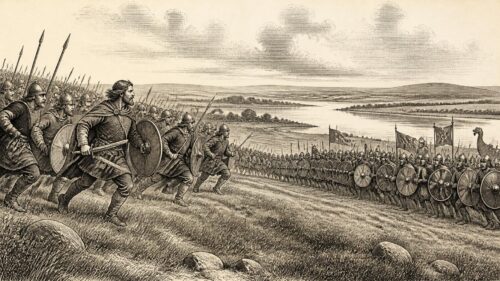
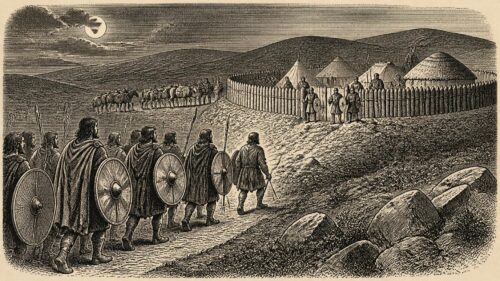
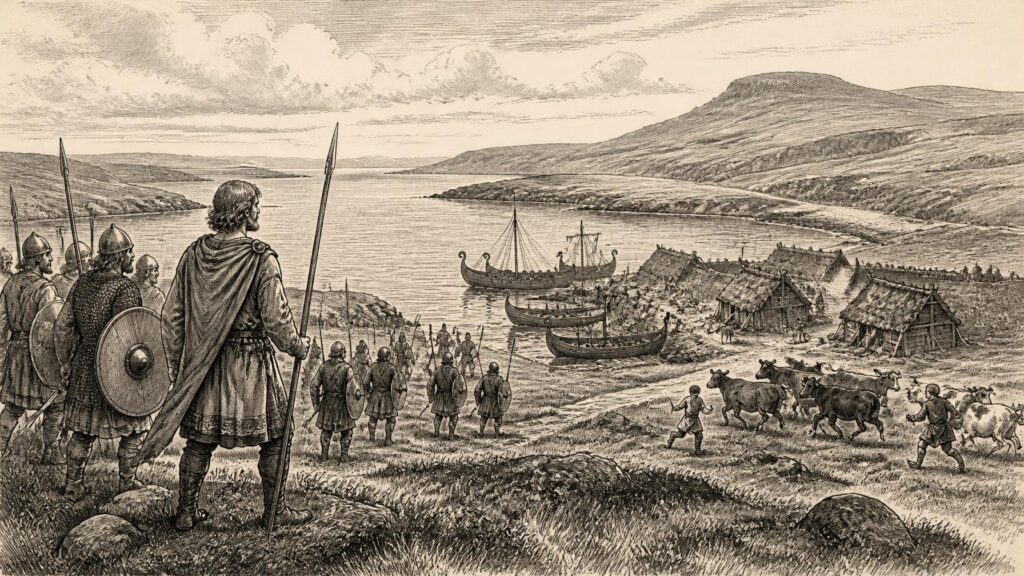
The year 866 saw a striking reversal on Ireland’s northern seaways. Áed Findliath, king of Tara and leading ruler of the Northern Uí Néill, attacked the Scandinavian strongholds established along the northern coastlands. The Annals of Ulster record that he plundered all the foreigners’ longphuirt—fortified ship-camps—in Cenél nÉogain and Dál Araidi, and then defeated their occupants at Loch Febail, Lough Foyle. The annal gives no date within the year, but its scale is unambiguous: it claims that 240 heads were taken after the victory, and that flocks and herds were removed from the camps.
This was not simply an episode of coastal raiding. It was an attack on bases which connected the Irish north to the wider Irish Sea world, and it demonstrated that Scandinavian groups in Ireland could be settled, supplied and economically embedded as well as mobile. At the same time, Irish annals link 866 to a major overseas expedition by Amlaíb and Auisle, rulers associated with Dublin. Together, these events reveal a political geography in which sea-lanes, fortified landing places, ecclesiastical centres and cattle-rich hinterlands were inseparable.
Áed’s Northern Offensive
The central Irish event securely associated with 866 is Áed Findliath’s destruction of northern longphuirt. The annal specifies that these lay in the territories of Cenél nÉogain and Dál Araidi. Cenél nÉogain, Áed’s own dynastic heartland, stretched across much of what is now Tyrone and Derry; Dál Araidi occupied an important part of north-east Ulster. The wording implies more than one camp. It also indicates that the installations contained livestock—“flocks and herds”—and people or property substantial enough to be described collectively as the foreigners’ possessions.
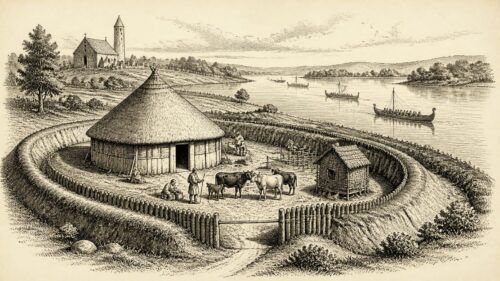
A longphort was not necessarily a town in the later sense. It was a defended waterside base where ships, crews, captives, supplies and plunder could be protected, and from which riverine and coastal expeditions could be launched. Yet the seizure of animals matters. Cattle, sheep and other livestock were fundamental stores of food and wealth in early medieval Ireland. Their presence suggests that at least some Scandinavian groups had access to grazing, exchange networks and provisions beyond what could be carried in ships. Áed’s campaign therefore struck both military capacity and local resources.
The victory at Lough Foyle has often been understood as an attempt to recover control of the northern littoral. That is a reasonable interpretation, but it should not be made more precise than the evidence permits. The annal does not name every camp, identify their leaders, or say whether all were permanently occupied. Nor does it give a battlefield location beyond Loch Febail. What can safely be said is that Áed attacked Scandinavian positions across a broad northern zone, won a battle at the Foyle, and secured a conspicuous victory which strengthened his standing as king of Tara.
The record’s tally of 240 enemy dead should be read as an annalistic claim, not as a modern battlefield census. Medieval writers often used numbers to convey the magnitude of a defeat and the prestige of the victor. Even so, the entry preserves an important fact: the fighting was serious enough to be remembered as a major blow against the foreigners. The later Fragmentary Annals of Ireland presents Áed as the foremost scourge of the Norwegians that year, a rhetorical judgement which reflects the political value of the campaign.
Dublin, Scotland and the Northern Route
Áed’s success occurred against a wider crisis and opportunity in the Irish Sea. The Annals of Ulster report that Amlaíb and Auisle went with the foreigners of Ireland and Scotland into Fortriu, plundered the Pictish country and took hostages. Fortriu was a major Pictish kingdom in northern Britain. The expedition belongs directly in Irish history because its leaders and part of its force were based in, or closely connected with, Dublin.
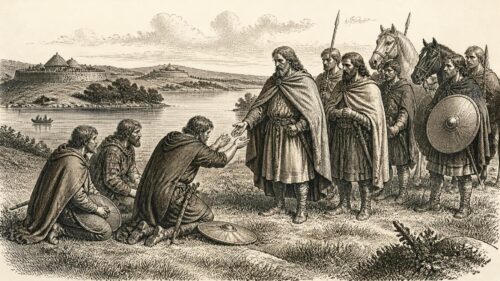
The campaign shows that Dublin was already more than an isolated raiding station. It was a node in a network extending through Scotland and across the Irish Sea, able to join forces from both islands. Hostages were instruments of political domination: their surrender signalled submission and could help guarantee tribute or future obedience. The Fragmentary Annals adds that tribute continued to be paid by the Picts for a long time afterwards. That detail may preserve a real political consequence, though the duration and terms of any payment cannot now be recovered.
The chronology is important. Modern discussion generally places the Fortriu expedition at the opening of 866, notwithstanding the complicated year-numbering of surviving annal manuscripts. Its timing may help explain Áed’s northern offensive. With a substantial Scandinavian force campaigning overseas, the longphuirt along the north coast may have been more vulnerable. This is an inference rather than a statement made by the annals themselves, but it fits the simultaneous evidence for Scandinavian mobility between Dublin, north-east Ireland and northern Britain.
It would nevertheless be mistaken to portray 866 as a straightforward Irish expulsion of “the Vikings”. Áed’s relationships with Scandinavian rulers were pragmatic. Before becoming king of Tara, he had allied with Dublin’s rulers in struggles against Irish rivals, and family ties linked Irish royal houses with the Dublin dynasty. Warfare in this period did not divide neatly into Irish and foreign sides. Kings sought allies wherever advantage lay; Scandinavian leaders competed among themselves and made use of Irish territories; local communities endured the consequences.
Clonfert Under Threat
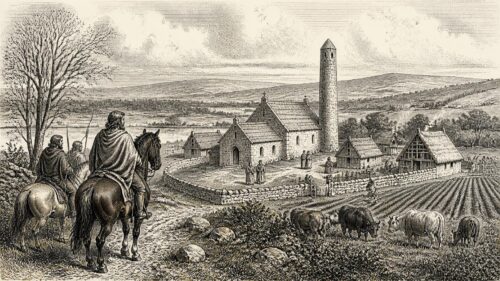
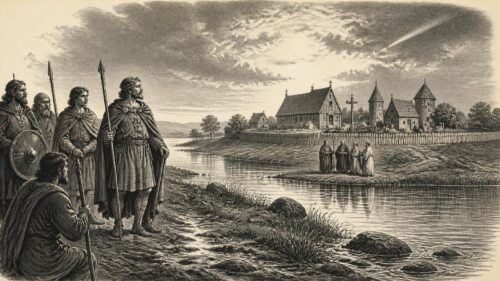
In the west, 866 brought danger to Clonfert, the important church beside the Shannon associated with St Brendan. The Annals of Inisfallen tersely records that Tomrar, styled a jarl, plundered Clonfert. The fuller but later Fragmentary Annals says that Tomrar came from Limerick seeking great spoils, that warning allowed many people to flee by boat or into marshes, and that those found in the enclosure and graveyard were killed.
Both accounts agree on the raid and its target, making the attack itself secure. Their treatment of Tomrar’s fate is less straightforward. The Inisfallen annal says that Brendan killed him on the third day after he reached his camp, while the Fragmentary Annals says he died of madness within a year, crediting the saint’s intervention. Such statements are valuable evidence for the religious interpretation of violence, but not for reconstructing a medical cause of death or an exact sequence. The certainty lies in the plundering of Clonfert; the miraculous punishment belongs to the commemorative language through which church communities explained survival and loss.
For people living around Clonfert, the immediate realities were more practical: warning, flight, access to boats, knowledge of wetlands and the vulnerability of an ecclesiastical enclosure holding portable valuables, food and people. Monasteries were centres of worship and learning, but they also possessed land, livestock, skilled personnel and stores. Their riverside locations connected them to travel and exchange, while exposing them to fleets. The Clonfert raid therefore illuminates everyday insecurity along the Shannon rather than merely a clash between pagans and saints.
Churches, Learning and Succession
The year’s annalistic notices also reveal the dense institutional landscape of Irish Christianity. The Annals of the Four Masters, compiled much later from earlier materials, place several ecclesiastical deaths in 866. Connmach, abbot of Clonmacnoise, is said to have died on 1 January; Dainél is named as abbot of Glendalough and Tallaght; other dead include abbots, a scribe and an anchorite. Individual dates and placements in this late compilation must be handled cautiously, but the cluster reflects a society in which major churches depended on learned office-holders and on continuity in local leadership.
These establishments were not detached from secular affairs. A king’s reputation rested partly on relations with churches, whose clerics could preserve political memory in annals, genealogies and verse. The report that Áed’s northern victory was followed by the taking of livestock makes clear that royal warfare touched the same agricultural resources on which churches and lay settlements depended. Meanwhile, Clonfert’s vulnerability showed that saintly patronage, however confidently expressed in later narrative, did not remove the need for boats, warning systems and escape routes.
A Year of Connected Shores
Some later annalistic compilations assign further dramatic conflicts to 866, including a major battle involving Áed and the rulers of Brega and Leinster. Comparison with the Annals of Ulster and modern chronological study places that battle in 868, not 866. It should therefore not be used to enlarge this year’s story. This caution is essential: medieval Irish chronicles preserve exceptional detail, but their year systems and later rearrangements sometimes differ.
What remains after that caution is still consequential. In 866, a Dublin-linked force projected power into Pictland; Áed Findliath shattered Scandinavian strongholds in the Irish north and won at Lough Foyle; and Tomrar’s raiders struck Clonfert on the Shannon. Ireland was neither isolated nor politically unified. Its kings, church communities and seaborne groups operated in a shared maritime world, where control of a lake shore, an estuary or a monastic landing place could shape power far beyond the immediate locality.
Primary Sources
- The Annals of Ulster, Year U866
- The Annals of Ulster, Year U867
- CELT Project: The Annals of Ulster
- Fragmentary Annals of Ireland, Part 17
- CELT Project: Fragmentary Annals of Ireland
- Annals of Inisfallen, Annal AI866
- CELT Project: Annals of Inisfallen
- Annals of the Four Masters, Annal M866
- CELT Project: Annals of the Four Masters
- Áed Findliath, Dictionary of Irish Biography
- Vikings in Ireland and Scotland
- The Vikings in Ninth-Century Ireland: Sources and Settlements
- Vikings in Early Medieval Ireland
- The Mid-Ninth-Century Crisis: Laithlinn, ‘Fair Foreigners’ and ‘Black Foreigners’
- The Economy of Early Medieval Ireland
- Early Medieval Ireland: Archaeological Excavations, 1930–2009
- Early Medieval Dwellings and Settlements in Ireland, AD 400–1100, Volume 1
- Early Medieval Archaeology Project Report 2.1
- Viking Woodstown
- Exploring the Irish Annals
- Vikings in Irish Chronicles, 794–902: Data
- The Irish Sea and the Atlantic Trade in the Viking Age
- Getting to Know Dublin