Amlaíb’s Claim on Ireland853 CE
In 853, Amlaíb, son of the king of Laithlind, arrived in Ireland, where Scandinavian groups submitted to him and tribute was extracted from Irish communities. Although often linked with Norway, Laithlind’s location remains uncertain, and the annals do not establish a unified foreign conquest. The year also saw Norsemen kill Cathmal, co-king of Ulaid; Echtigern of south Leinster murdered in an internal struggle; and Áilgenán, king of Cashel, die. Local Munster successions and deaths of prominent clerics reflected Ireland’s multiple political and ecclesiastical centres. Annalistic dating varies, while evidence chiefly records elites, violence and exceptional events, leaving ordinary life obscure.
Dateline
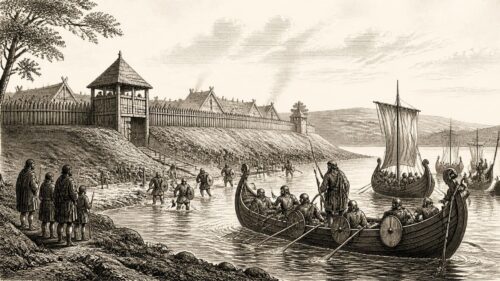
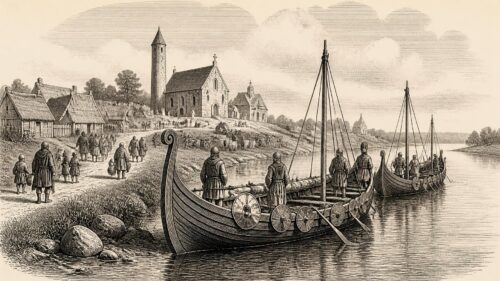
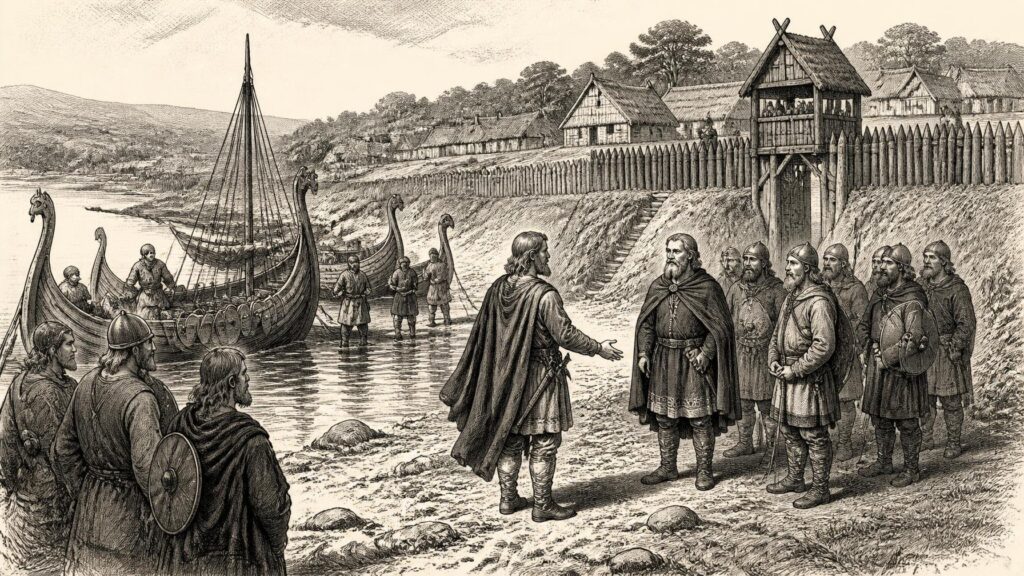
In 853, a newcomer called Amlaíb arrived in Ireland and was recognised by the annals as the son of a king of Laithlind. The terse notice is among the most consequential in ninth-century Irish history: the foreigners already in Ireland submitted to him, and tribute was taken from the Irish. It does not give a landing-place, a month, a battle, or the mechanism by which obedience was won. Yet it records a striking claim to authority over a dispersed Scandinavian presence that had been raiding, wintering and establishing bases around Ireland for more than a decade.
The same year also brought killings and deaths across the island: a co-king of Ulaid was slain by Norsemen; a south Leinster ruler was murdered in an internal political attack; the king of Cashel died; and several important churchmen passed from the record. These notices do not amount to a single national crisis directed from one centre. Rather, they reveal an Ireland of overlapping lordships, ecclesiastical communities and seaborne powers, in which authority could be asserted broadly but was lived and contested locally.
What the Year’s Dating Can and Cannot Tell Us
The events are conventionally placed in 853, but medieval annals should not be read like a modern daily chronicle. Their year-headings began at different points and later compilers sometimes shifted material by one or more years. The Annals of Ulster and Chronicon Scotorum preserve the arrival of Amlaíb under 853; the much later Annals of the Four Masters place matching material under 851. That discrepancy is a feature of annalistic transmission, not evidence that Amlaíb necessarily arrived in two different years. There is no securely recorded day or season for his coming.
The surviving sources are selective. They chiefly notice kings, clerics, violence, tribute and exceptional deaths. They do not describe an average household’s harvest, diet, clothing, market exchange or weather in 853. Responsible reconstruction must therefore distinguish the firmly recorded incidents from the broader setting in which they mattered. The evidence is strongest for political and ecclesiastical change, weaker for the daily experience of ordinary people.
Amlaíb and the Foreigners
The central notice states that Amlaíb, son of the king of Laithlind, came to Ireland; the foreigners of Ireland submitted to him; and tribute was taken from the Irish. In the Irish of the Annals of Ulster, the land-name is Laithlind. Later texts commonly give Lochlann, and the Fragmentary Annals render it as Norway. Those names have encouraged identifications with Norway, western Scotland, the Isles, or a wider Scandinavian maritime world. The precise location and character of Laithlind remain debated. It is safest not to turn the annal’s restrained description into a firm statement that Amlaíb sailed directly from Norway.
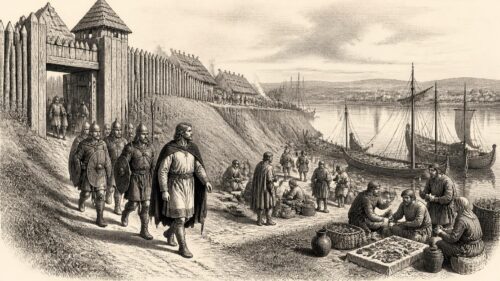
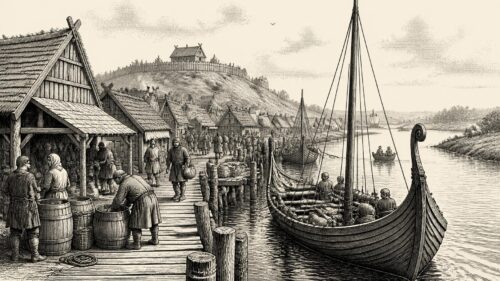
Nor should “submission” be mistaken for the creation of a united Irish kingdom under a foreign monarch. The annalist says that the foreigners in Ireland submitted: this concerns Scandinavian groups, not the Irish provinces. Its importance lies in coordination. Since the early 840s, Scandinavians had operated from defended waterside bases, commonly called longphuirt, and Dublin was one such strategically placed settlement. Control over ships, crews, landing places and followers could make a leader formidable without giving him direct command of every district. Amlaíb’s arrival signals an attempt, successful enough to be noticed, to place existing Viking forces under a recognised superior.
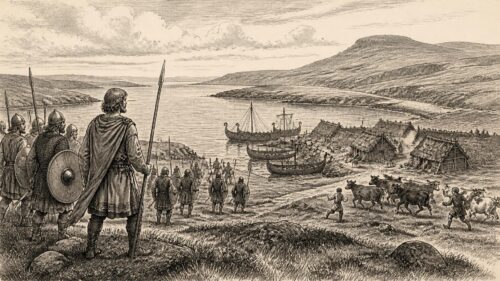
The tribute clause reaches beyond Scandinavian politics. It indicates that Irish communities were being made to yield wealth or payments to the new leadership. The annal does not specify whether this consisted of silver, livestock, food-renders, captives or other exactions, nor does it name the Irish rulers compelled to provide it. It nevertheless shows that maritime armed power had become tied to systematic extraction, not merely occasional plunder. For churches, farmers and secular rulers near navigable coasts and rivers, the presence of an organised fleet could reshape calculations about defence, alliance and the safeguarding of movable wealth.
This was not an uncontested Scandinavian world. The years immediately before 853 had seen fierce conflict among groups called “fair” and “dark” foreigners in the annals, including fighting around the north-east and the Irish Sea approaches. Amlaíb’s submission of the foreigners belongs in that unsettled context. It should not be assumed that every Scandinavian band was permanently obedient, but it suggests that he emerged after a period of division with an authority broad enough to demand recognition.
Violence in Ulaid and Leinster
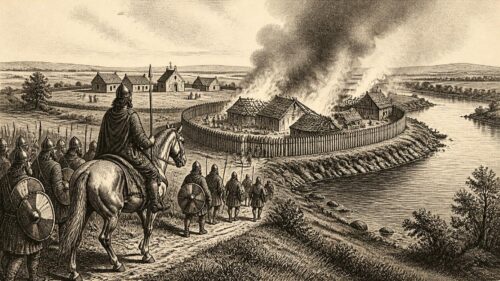
In the north-east, Cathmal son of Tomaltach, described as one of the two kings of Ulaid, was killed by Norsemen. Chronicon Scotorum calls him Cathal, but agrees on his office and manner of death. “One of two kings” is a useful reminder that Ulaid was not governed by a single uncomplicated crown. Kingship could be shared, divided among dynastic branches, or expressed through layers of local and regional lordship. The source gives no location, battle, raiding party or link to Amlaíb. His death can be placed in the year, but assigning it to a particular expedition would be invention.
The killing of Cathmal shows that Scandinavian violence remained an immediate political fact in Ulster even as Amlaíb’s authority was being proclaimed. A king’s death could unsettle claims to land, tribute and military leadership within his people. Yet the annals do not tell us who succeeded him or whether his death changed Ulaid’s relationship with the newcomers. Their silence is important: a recorded killing does not automatically permit a fully documented story of aftermath.
South Leinster experienced a different, explicitly internal kind of violence. Echtigern son of Guaire, king of Laigin Desgabair, was treacherously killed by Bruatur son of Áed and Cerball son of Dúngal. Bruatur was then killed by his own associates. Here the sources preserve an unusually sharp judgement: deceit is part of the report, not merely a modern inference. The Annals of Ulster place Bruatur’s death eight days after Echtigern’s; Chronicon Scotorum says forty-seven days. The fact of rapid retaliation is clear, while the precise interval is not.
This episode should not be treated as a Viking attack simply because it occurred in a year dominated by Amlaíb’s arrival. Leinster kings and aristocrats pursued their own rivalries. The sequence instead demonstrates the fragility of regional rule: a ruler could be removed by fellow Irish elites, and one assassin could in turn be abandoned or killed by his associates. In 853, political insecurity had more than one source.
Munster’s Narrow Successions
The death of Áilgenán son of Donngal, king of Cashel, was recorded in both northern and Munster-centred annals. He had taken the kingship only shortly beforehand, making his tenure notably brief in the surviving record. His death mattered because Cashel stood at the heart of the Eóganacht kingship of Munster, but the evidence does not identify a cause of death or permit a dramatic account of succession. It would be unsafe to presume assassination, illness or foreign attack.
The Annals of Inisfallen, whose interests are especially valuable for Munster, also record that the Ciarraige Luachra made Congal grandson of Lachtna their king, and that Talamnach son of Áed, king of Corcu Baiscinn, died. These were smaller but significant regional polities in the south-west and west of Munster. Their appearance beside the king of Cashel illustrates how the province was made up of several political communities, each with its own leadership. A change at Cashel did not erase these local structures; nor did local kingship make them independent of wider provincial pressures.
Churches, Learning and Loss
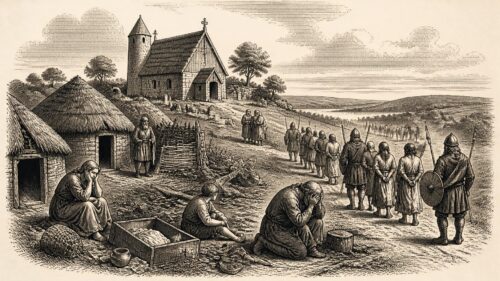
Ecclesiastical deaths give 853 another, quieter dimension. Ailill son of Robartach, superior of Lusk; Flann son of Rechtabra, abbot of Liath Mancháin; and Flaithnia, abbot and bishop of Birr, all died according to the Annals of Ulster. Later and parallel compilations add Carthach, abbot of Tír dá Glas, and Aindle, described as a learned man there. Such offices were not merely devotional appointments. Major churches were centres of worship, education, manuscript culture, estates, tenants and political relationships. The departure of an abbot or bishop could therefore involve institutional as well as spiritual change.
The notices also show the geographical spread of learned and ecclesiastical life: Lusk in the east, Birr in the midlands, Liath Mancháin in the central region, and Tír dá Glas on the Shannon. Despite the pressure of raiding and tribute, the annals continue to measure the year partly through the passing of church leaders. This does not prove that monastic life was undisturbed; rather, it reveals institutions resilient enough to remain central to how educated record-keepers ordered the past.
An Island of Many Powers
For Ireland, 853 was not simply the year “the Vikings took over”, nor was it a year in which Irish politics disappeared behind a foreign threat. Amlaíb’s arrival is firmly dated to the annalistic year and marks an important consolidation of Scandinavian authority. His collection of tribute from the Irish suggests a new reach for that authority. But the same year’s evidence insists on a more complicated picture: a Norse killing in Ulaid, a treacherous Irish political murder in Leinster, a royal death and local successions in Munster, and the loss of leading clerics in several regions.
What emerges is an Ireland connected by sea-routes, river systems, church networks and rival dynasties. Dublin and other Scandinavian bases were becoming enduring elements in that landscape, but power still depended on local submission, negotiated payment, followers and force. Amlaíb’s claim was consequential precisely because it entered this crowded political world rather than replacing it.
Primary Sources
- The Annals of Ulster: Year U853
- Chronicon Scotorum: Annal CS853
- Annals of Inisfallen: Annals AI850–AI859
- Fragmentary Annals of Ireland: Annals FA255–FA260
- Annals of the Four Masters: Annal M851
- Vikings in Irish Chronicles, 794–902: Data
- Vikings in Scotland and Ireland in the Ninth Century
- Vikings in Early Medieval Ireland: Church-Raiding, Politics and Kingship
- The Mid-Ninth-Century Crisis: Laithlinn, ‘Fair Foreigners’ and ‘Black Foreigners’
- Church-Raiding and Politics in the Era of Amlaíb and Ímar
- The Vikings in Ninth-Century Ireland: Sources and Settlements
- The Vikings in Ninth-Century Ireland: Sources and Settlements (full thesis)
- The Vikings in Ulaid
- The Norway to Be: Laithlind and Avaldsnes
- High-Kings, Vikings and Other Kings
- Vikings in Early Medieval Ireland: Church-Raiding, Politics and Kingship (review)
- Vikings in Early Medieval Ireland: Church-Raiding, Politics and Kingship (review)
- CELT Project: The Annals of Ulster
- CELT Project: Annals of Inisfallen
- CELT Project: Chronicon Scotorum
- CELT Project: Annals of the Four Masters, Volume 1
- Irish Texts at CELT