Aignig and Tailtiu831 CE
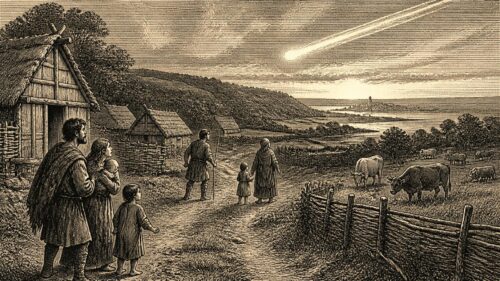
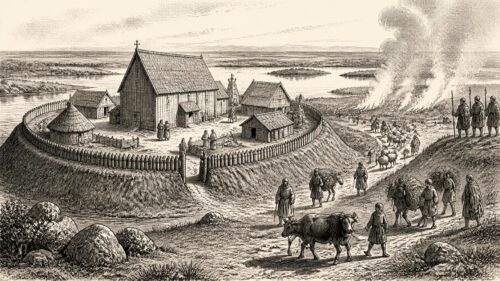
In annalistic 831, Ireland faced converging religious, political and maritime crises. At Tailtiu, dissension over Mac Cuilinn’s shrine and Patrick’s relics caused deaths during the royal fair. Scandinavian raiders defeated Armagh’s community at unidentified Aignig, taking many captives, and seized Conaille’s king Máel Brigte and his brother for removal by ship. Armagh also suffered royal coercion under Conchobor of Tara. Conchobor plundered Life, while Feidlimid of Cashel advanced against Brega with Munster and Leinster forces. Ecclesiastical deaths and relic movements underline church networks. The fragmented annals reveal contested authority, linking sacred prestige, warfare, captivity and seaborne travel across the island.
Dateline
The annalistic record conventionally assigned to 831 CE presents Ireland as an island under several pressures at once: a great royal gathering at Tailtiu ended in deadly disorder; raiders captured a local king and his brother and took them to their ships; the ecclesiastical community of Armagh suffered defeat and mass captivity; and the leading rulers of Mide and Munster pushed armed claims across the midlands. None of these notices supplies a day or month. They are, however, unusually revealing when read together. They show that shrines, fairs, churches, royal households and coastal sea-lanes were not separate worlds. They were interwoven sources of wealth, authority and danger.
The evidence needs careful handling. The principal contemporary-style record is the entry sequence known as Annals of Ulster 831, supported in part by Chronicon Scotorum and later compilations. Medieval Irish annals were compiled and copied over generations, and their year-numbering does not always align neatly with a modern January-to-December calendar. The events discussed here are therefore securely attached to the annalistic year conventionally identified as 831, but almost none can be assigned a more precise date.
A Deadly Fair at Tailtiu
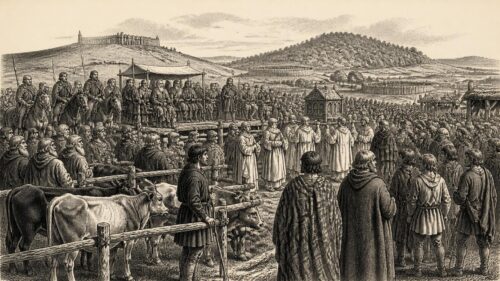
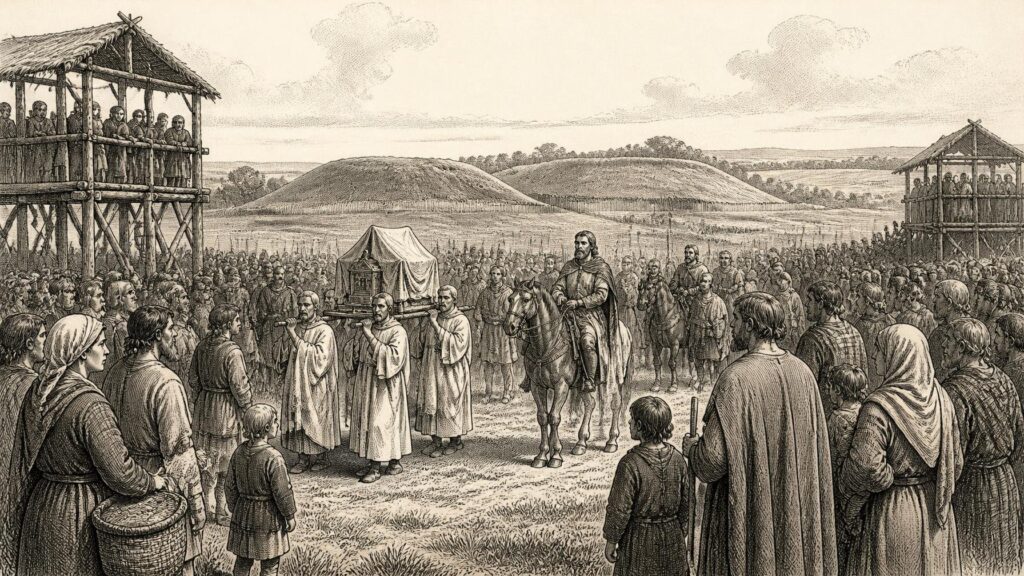
The most striking domestic event was a violent disruption of the fair of Tailtiu, at modern Teltown in the Blackwater valley of County Meath. The annalist says that the fair was disturbed “at the platforms” because of dissension over the shrine of Mac Cuilinn and the relics of Patrick, and that many people died. The wording is terse, but its implications are large. Tailtiu was one of the major assemblies associated with the kings of Tara and the Uí Néill political order. It was a place where rulers and their entourages could meet, legal matters could be aired, alliances displayed, goods exchanged and public standing affirmed.
The dispute was specifically about sacred objects. A shrine and relics were not merely devotional possessions: they embodied the prestige, claims and remembered rights of the churches that held them. Patrick’s relics carried exceptional political as well as religious authority, particularly in the northern and midland regions where Armagh promoted its Patrician primacy. The record does not tell us who opposed whom, whether the relics had been brought to Tailtiu for ceremonial display, or what sparked the confrontation. It would be unsafe to invent a procession, a theft or a planned assault. Yet the reported deaths show that a disagreement involving ecclesiastical claims became a serious public crisis within the fair’s precincts.
This disturbance also qualifies any picture of early medieval fairs as peaceful markets or athletic festivals alone. Tailtiu could bring together people who otherwise lived in separate petty kingdoms and church territories. That concentration created opportunity for trade, negotiation and ritual, but also for confrontation. The platforms mentioned by the annalist evoke a deliberately organised gathering-place rather than an accidental crowd. In 831, the mechanisms through which royal Ireland staged order instead became the setting for disorder.
Armagh Under Attack
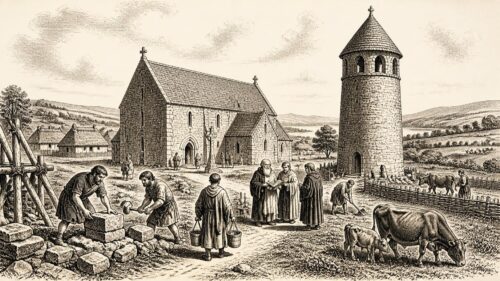
Armagh appears repeatedly in the year’s record. Cernach son of Dunchú, described as a scribe, learned man and priest of Armagh, died. His obituary is brief, but its language matters: literacy, learning and priestly office were recognised distinctions worth preserving in the annals. He belonged to an ecclesiastical centre whose authority rested on a community of clerics, dependants, estates and sacred possessions, not simply on a single church building.
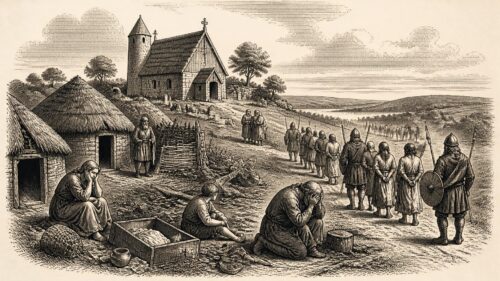
That wider community was then defeated by Scandinavian raiders, termed “heathens” by the annalist, in a battle at Aignig. Great numbers were captured. Aignig has not been securely identified, and the annal gives neither the size of the raiding force nor the identities of the captives. Nor should “community of Armagh” be reduced to monks alone: an early Irish church community could include clergy, tenants, servants, clients and armed followers. The entry nevertheless records a major reverse. Captivity was an immediate human loss and could also become a means of ransom, forced labour or sale across the Irish Sea; the annal does not specify the captives’ eventual fate.
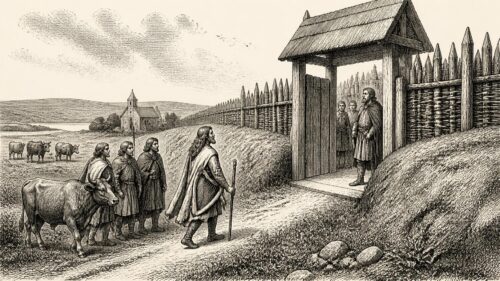
Armagh’s difficulties were not solely caused by overseas raiders. Eógan of Mainister, its abbot, was “dishonoured” in connection with a legal judgement by Conchobor son of Donnchad, king of Tara; Eógan’s followers were seized and his horses taken. The translator’s question mark over the legal wording is appropriate, and the details of the case are lost. What survives makes clear that a king’s intervention in an ecclesiastical dispute could be coercive. Horses were valuable transport, prestige goods and military resources. Their seizure, together with the detention of Eógan’s men, was a tangible humiliation of the abbot’s household.
These linked notices warn against imagining church and kingship as opposed fixed blocs. Armagh could be a focus of learning and relic-cult, a landed institution with its own following, a target for raiders, and an arena in which powerful secular rulers exerted pressure. Its vulnerability in 831 was therefore political as well as military.
Captives from Conaille
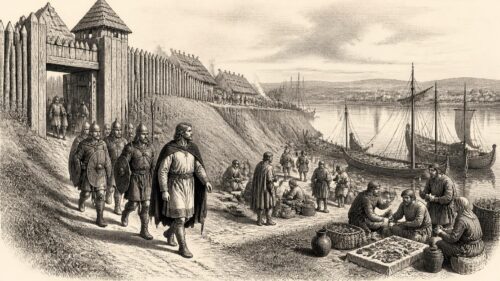
Another raiding party invaded Conaille, probably the coastal kingdom of Conaille Muirthemne in the wider Dundalk region, although early medieval territorial names do not correspond exactly to modern county boundaries. The raiders captured Máel Brigte, described as Conaille’s king, and his brother Canannán, and carried both men away to their ships. Chronicon Scotorum independently preserves the same essential report.
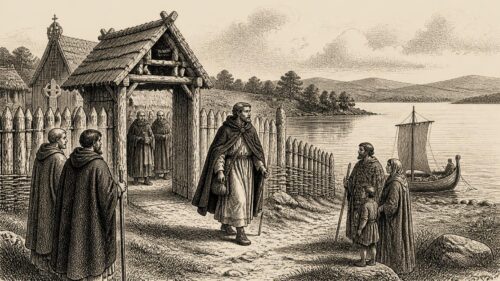
This was more than a seizure of portable wealth from a shoreline settlement. The capture of a ruler and a close kinsman struck at the continuity of local government and kinship leadership. It may have been intended to secure ransom or tribute; it may also have fed the wider traffic in captives around the Irish Sea. The sources do not allow a choice between these possibilities. What they do establish is that raiders could reach and remove politically important people, using ships not only for surprise but as mobile prisons and a route out of Ireland.
The episode belongs to an escalating pattern of attacks during the early ninth century, but 831 should not be treated as the beginning of permanent Scandinavian towns in Ireland. The famous fortified longphuirt at Dublin and Linn Duachaill are first recorded a decade later, in 841. In this year the evidence is for seaborne raiding and captivity, not for an established Dublin-based kingdom. The distinction matters: the threat was already grave, but its institutional form was still changing.
Rival Kings in the Midlands
While the north-east faced raiding, Irish rulers pursued their own conflicts. Conchobor son of Donnchad, of Clann Cholmáin, was king of Tara. His authority was substantial but not equivalent to rule over a unified nation-state. The annals record his plundering of Life, the Liffey plain in Leinster. Such a campaign was a statement of dominance as well as an acquisition of cattle, foodstuffs, valuables and hostages. It also placed pressure upon Leinster at a time when royal control there was contested.
Conchobor’s position was challenged from the south by Feidlimid son of Crimthann, king of Cashel. Feidlimid came with an army drawn from Mumu and Laigin to Fiambur in order to plunder the men of Brega. The location of Fiambur is uncertain, but the political geography is plain enough: a Munster king had assembled support that included Leinster and had carried war into the territory north of the Liffey, near the heartland of Uí Néill power. The notice records a campaign, not a formal alliance treaty, and it does not prove that all Leinster followed Feidlimid willingly. Even so, the combined force demonstrates the scale of his ambition.
Feidlimid was both a king and a cleric of strict religious reputation, a combination that made his interventions in church affairs especially consequential. His presence in Brega in 831 should be understood within his larger contest with the Uí Néill for influence beyond Munster. Conchobor’s plundering of Life and Feidlimid’s advance against Brega were not isolated acts of local banditry; they were rival performances of overkingship across the island’s most politically charged corridor.
Churches, Learning and Connection
The year also recorded the death of Muirenn, abbess of Kildare, and the drowning of Airmedach, superior of Mag Bile, the great monastery of Movilla in County Down. Their obituaries demonstrate the prominence of both women and men in the governance of major ecclesiastical houses. Kildare, Armagh and Mag Bile were nodes in a dense religious landscape whose communities held land, maintained churches, educated clergy and participated in regional politics.
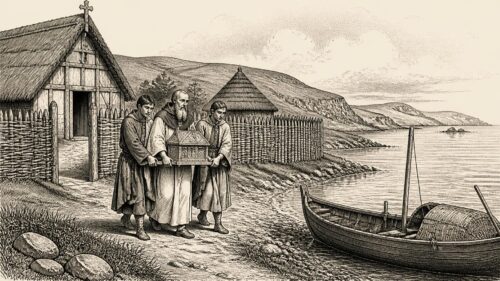
A quieter entry records Diarmait’s return to Ireland from Scotland with the sacred objects of Colum Cille. This was not an incidental voyage. Columba’s cult linked Irish churches with Iona and Gaelic Scotland, while the movement of relics shows that Irish Sea travel also conveyed sacred authority, clerics and institutional connections. In the same year that raiders used ships to remove captives from Conaille, churchmen used the sea to return holy objects associated with one of Ireland’s most revered saints. Maritime movement was thus neither wholly foreign nor wholly violent.
No contemporary notice for 831 describes harvests, weather or prices, so the year cannot responsibly be given an invented environmental story. Its surviving record instead illuminates the social consequences of conflict: a fair’s business and ceremony were interrupted; church households lost people and animals; local kings could disappear into ships; and communities had to respond to armed forces moving across their territories. For ordinary cultivators, traders, craftsmen and dependants, these events would have altered obligations, security and access to powerful patrons even where their own names were not written down.
An Island of Contested Authority
What makes 831 distinctive is not one decisive battle or a change of ruler, but the convergence of crises around authority. At Tailtiu, relics associated with local and Patrician claims became the centre of lethal dissension. At Aignig and in Conaille, raiders converted military success into human captives. At Armagh, royal interference exposed the limits of ecclesiastical independence. In Brega and Life, Feidlimid and Conchobor demonstrated that Ireland’s most powerful rulers remained preoccupied with one another even as maritime violence intensified.
The annals preserve these events in fragments, leaving silences about motives, numbers and aftermaths. Those silences should remain visible. But the surviving fragments are enough to show a society in which sacred prestige, political power and control of people were inseparable. In 831, the fairground, the monastery, the royal raiding route and the ship were all places where Ireland’s competing authorities were tested.
Primary Sources
- The Annals of Ulster
- Annals of the Four Masters
- Chronicon Scotorum
- Annals of Inisfallen
- Annals of Tigernach
- Fragmentary Annals of Ireland
- Vikings in Irish Chronicles, 794–902: Data
- Vikings in Irish Chronicles, 794–902: Introduction
- The Vikings in Ninth-Century Ireland: Sources and Settlements
- Viking Activity in Ireland by County in the Annals
- Niall Caille
- Conchobar
- Fedelmid (Feidlimid)
- Social and Ceremonial Places in Later Prehistory
- The Fair of Tailtiu and the Feast of Tara
- Vikings in Ireland and Scotland
- Vikings in Early Medieval Ireland
- The Annals of Ulster: CELT Edition Background and Bibliography
- Exploring the Irish Annals
- Part 79 of The History of Ireland