Dún Cuair’s Two Muiredachs805 CE
In 805, Áed Oirdnide, king of Tara, led a hosting to uncertainly located Dún Cuair and divided Leinster between Muiredach son of Ruaidrí and Muiredach son of Bran, asserting northern Uí Néill overlordship. The settlement favoured rival Leinster dynasties, limiting consolidation against Tara, though not ending provincial independence. Annalistic dating is problematic, but modern scholarship associates the intervention with 805. That year also saw the death of Ólchobar, a Munster royal heir, without recorded succession details. Churches wielded land, learning and political influence amid rural farming society. A possible pestilence is chronologically uncertain; no securely recorded Viking raid occurred there.
Dateline
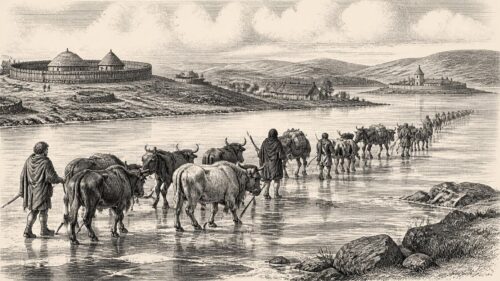
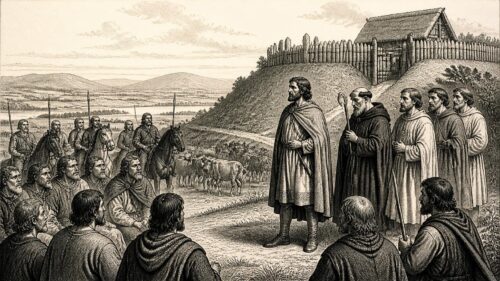
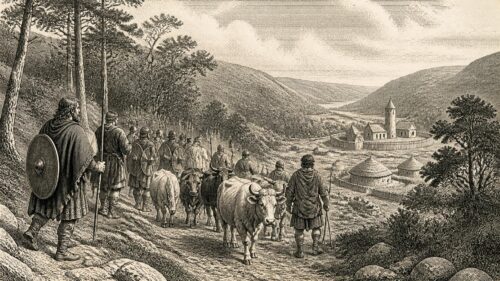
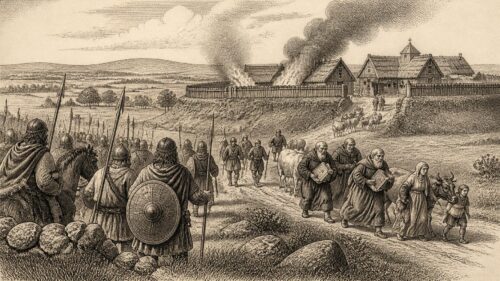
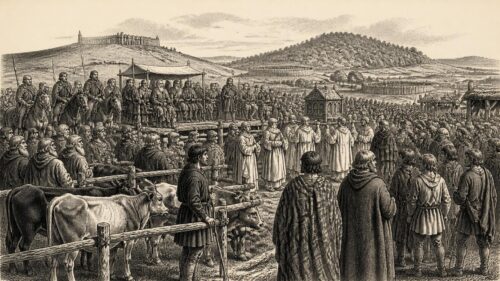
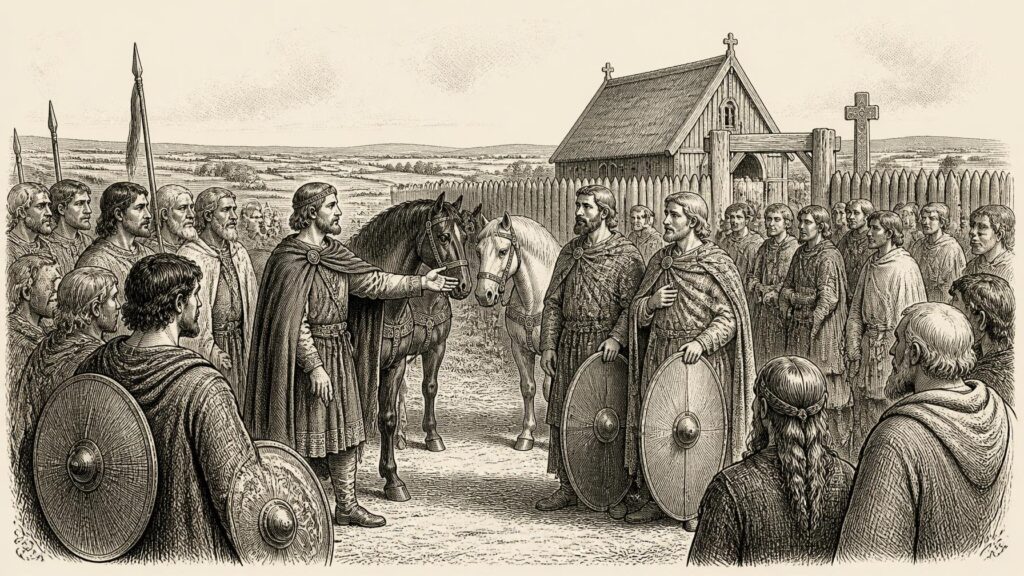
For Ireland in 805, the clearest political story is not a pitched battle but a royal rearrangement. Áed Oirdnide, king of Tara and head of the northern Uí Néill, led a hosting to Dún Cuair and, according to the Annals of Ulster, divided Leinster between two men both named Muiredach: Muiredach son of Ruaidrí and Muiredach son of Bran. The entry is exceptionally compressed. It says neither how long the expedition lasted nor whether fighting occurred at Dún Cuair, and it gives no formal treaty. Yet its language records an unmistakable assertion of overlordship: an external king had arrived with an army and apportioned authority within Leinster.
A Date That Needs Care
805 must be handled with unusual precision. The relevant Annals of Ulster entry appears under its annal-heading U805, but the manuscript’s accompanying AD label reads 804; early Irish annalistic chronologies do not always align neatly with modern calendar years. Modern biographical scholarship nevertheless places Áed’s Leinster intervention in 805, describing it as the deposition of Fínshnechta Cetharderc and the installation of rulers from rival Leinster lineages. The Annals of Inisfallen, whose sequence independently records the death of Ólchobar son of Dub Indrecht in 805, provides a firmer contemporary-year anchor. Thus the Leinster settlement can responsibly be connected with 805, but neither its day nor season can be recovered.
Dún Cuair itself is not securely identified, though it is often placed near Rathcore in modern County Meath. The uncertainty matters. It prevents the scene being turned into a confidently mapped royal council or battlefield. What is secure is the political geography. Áed operated from the northern and midland heartlands of Uí Néill power and projected force south-eastwards into Leinster. The two beneficiaries represented the Uí Fháeláin and Uí Muiredaig, competing branches within Leinster’s ruling elite. Dividing rule between them was therefore not neutral arbitration. It reduced the chance that one Leinster king could quickly consolidate opposition to Tara.
Áed Oirdnide’s Southern Reach
Áed had been king of Tara since 797 and had spent much of his reign making military authority visible across Ireland. His power was real, but it was not the government of a unitary state. Ireland consisted of many kingdoms, lordships and kindreds, whose rulers negotiated, resisted, submitted, raided and allied according to immediate advantage. A hosting was both an army and a political performance: it showed that a king could summon followers, feed them, move them overland and compel rivals to acknowledge the result. The division of Leinster in 805 belongs to this world of personal dominance, hostages, clientage and shifting dynastic advantage rather than to a permanent administrative partition.
The settlement also reveals Leinster’s importance. The province lay beside the Irish Sea, contained rich agricultural districts and controlled approaches to the midlands and the southern coast. A strong king there could obstruct a Tara king’s access to tribute and military prestige. Conversely, a divided Leinster made a useful southern counterweight to other powerful regions. Áed’s intervention did not end Leinster’s political independence; later annals show its kings resisting him again. But in 805 he was able to impose a settlement sufficiently striking for the annalist to record it in a single, emphatic sentence.
An Heir Dies in Mumu
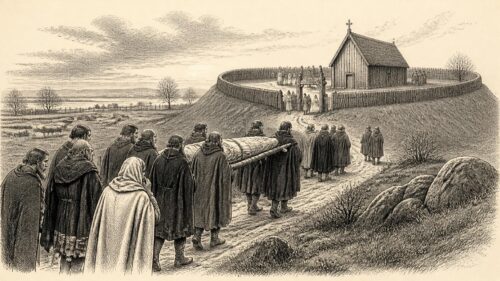
In the same calendar year, the Annals of Inisfallen note the death of Ólchobar son of Dub Indrecht, calling him rígdámna, “royal heir”, of Mumu or Munster. This is the year’s most direct southern datum. The title should not be translated into a modern crown-prince in the strict sense. Irish succession did not normally proceed automatically from father to eldest son. Kingship was contested within a limited royal kin-group, and a rígdámna was a recognised candidate for rule, not an assured future king. Ólchobar’s death therefore removed a significant claimant, but the annal does not tell us who benefited, whether a dispute followed, or even how close he had been to securing Munster’s kingship.
That brevity is historically valuable. It shows how much political meaning could be carried by status and genealogy. Munster was not a passive southern province beneath Tara’s command. Its leading dynasties and ecclesiastical centres had their own resources, alliances and traditions of kingship. The loss of a royal heir in 805 mattered because competition at that level shaped future access to land, tribute, military followers and the patronage of churches. It should not, however, be inflated into a recorded succession crisis. The evidence establishes a death and a rank; everything beyond that remains possible rather than proven.
Churches, Learning and Power
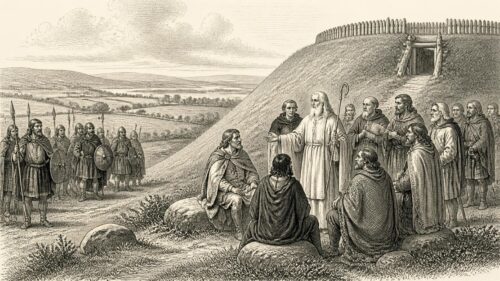
Political life in 805 was inseparable from ecclesiastical institutions. Ireland’s major churches were not secluded bodies standing apart from secular affairs. They possessed land, livestock, dependants, learned personnel and revered saints’ relics; their abbots and senior clergy could be drawn from elite families and could intervene in royal politics. Áed’s recent career illustrates the connection. In the preceding annal-year, he was credited with freeing the clergy of Ireland from compulsory attendance on military expeditions and hostings, at the request of Fothad “of the Canon”. That measure cannot safely be presented as a reform enacted in 805, but it forms immediate context for a year in which Áed again led a major southern expedition.
The same annalistic sequence records the deaths of abbots and other church leaders at places including Leithglenn, Monasterboice, Lusk, Kildare, Clonard and Baislec. Because of the chronological issue noted above, these notices should not all be assigned unqualifiedly to the calendar year 805. They nonetheless illuminate the institutional landscape around it: religious communities formed a dense network across the island, and their heads were important enough to enter historical record alongside kings. Literacy was concentrated in such centres. Annals, legal learning, biblical study, genealogies and Latin scholarship depended on the labour of scribes, teachers and communities supported by agricultural estates.
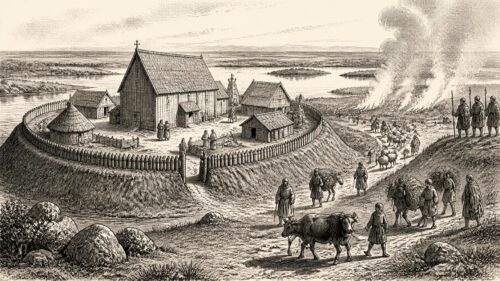
Most churches and monastic buildings were still principally of timber, earth and thatch, within enclosed settlements that also contained houses, workshops, stores, gardens, grazing and cultivated ground. A monastery was not simply a retreat for prayer. It was a community of clerics, tenants, craftspeople, guests and labourers, connected by roads, rivers, obligations and exchange. The burning of Cell Achaid’s new oratory, recorded in the same Ulster annal sequence, is a reminder of the vulnerability of such construction, though its exact calendar placement should likewise remain cautious.
Fields, Herds and Uncertain Health
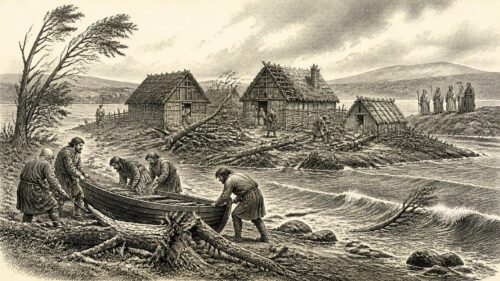
For most people, the year was governed less by dynastic settlements than by the seasonal demands of farming. Early medieval Ireland was overwhelmingly rural. Cattle remained central to wealth, status and compensation, but archaeology shows that cereal production had become increasingly important by the eighth and ninth centuries. Hulled barley and oats were staple crops, while wheat, flax, peas and beans appeared more variably. People lived in dispersed farmsteads, including earthen raths, stone cashels and lake-set crannógs, alongside ecclesiastical settlements of very different scale. Herding, ploughing, sowing, harvesting, dairying, milling, spinning and repairs to houses and boundaries structured everyday work.
The Annals of Ulster place “a great pestilence” in Ireland under the following annal-heading, U806, whose supplied AD label is 805. This has tempted straightforward dating, but the difficulties of the annal’s chronology make certainty impossible. It is best described as an outbreak associated by that source with 805, not as a securely dated epidemic beginning in a known month. No symptom, locality, mortality figure or modern diagnosis is supplied. Even so, the notice conveys a stark reality: disease could disrupt households, food production, travel and the obligations owed to kings and churches alike.
Between Raids and Records
By 805, overseas raiding was already part of the wider horizon. Attacks by “foreigners” had been recorded in Ireland from the 790s, and churches with portable treasures, food stores and coastal or island locations were vulnerable. Yet no surviving Irish annal securely records a Viking raid in this particular calendar year. It would be wrong to manufacture one simply because later ninth-century violence is familiar. The evidence for 805 instead centres on Irish political intervention in Leinster, the death of a Munster royal heir, and the institutional resilience and exposure of a rural, church-rich society.
The year therefore offers a sharp view of how authority worked before the later transformation brought by sustained Scandinavian activity and the growth of towns. Áed’s army could redraw a provincial balance without creating a unified kingdom; Ólchobar’s death could alter the field of royal possibility without producing a narrated succession; and ordinary life continued through labour on land whose surplus sustained kings, churches and learned culture. 805 is a year of qualified evidence, but not an empty one: at Dún Cuair, power was actively redistributed.
Primary Sources
- The Annals of Ulster
- Annals of Inisfallen
- Annals of the Four Masters
- On Reconstructing Medieval Irish Chronicles
- Áed Oirdnide
- Áed Oirdnide mac Néill: (d. 819), High-King of Ireland
- The Annals of Tigernach
- Agriculture, Settlement and Society in Early Medieval Ireland
- Early Medieval Farming and Food Production: A Review of the Archaeobotanical Evidence from Archaeological Excavations in Ireland
- The Economy of Early Medieval Ireland
- Early Medieval Dwellings and Settlements in Ireland, AD400–1100, Vol. 1: Text
- Early Medieval Ireland: Archaeological Excavations, 1930–2009
- Early Medieval Rural Settlement Archaeology in Ireland and the Impact of Large Infrastructural Developments
- Settlement Patterns and Socio-Economic Change in the Diocese of Tuam c.AD 400–1000
- Legal Position and Living Conditions of Peasants and Commoners in Early Medieval Ireland, c.680–c.1170
- Appendix: The Chronicles as a Record of Literacy, 797–1002
- An Ecclesiastical Institution in Medieval Munster: A Study of Emly to c.1100
- Contributions Towards the Political History of Munster, 450–800 A.D. (Concluded)
- Early Christian Monasteries
- Early Monastic Churches
- Exchange and Trade in Early Medieval Ireland
- Isle of the Saints: Monastic Settlement and Christian Community in Early Ireland