Muirgius Takes Connacht791 CE
In 791, Muirgius son of Tommaltach defeated and killed rival claimant Cináed son of Artgal at Sruth Cluana Argait, establishing his reign over Connacht. Both belonged to competing Uí Briúin lineages, and a further defeat of the Uí Ailello, with several regional rulers killed, suggests wider consolidation. The annals date the entry under U792 but identify the year as 791. Muirgius’s victory strengthened Uí Briúin Aí, though provincial authority remained contested and dependent on tribute, followers and land. The year also recorded deaths of rulers and churchmen, notably Máel Ruain of Tallaght, influential monastic reformer. No Viking raid is recorded.
Dateline
A Year of Connacht’s Decision
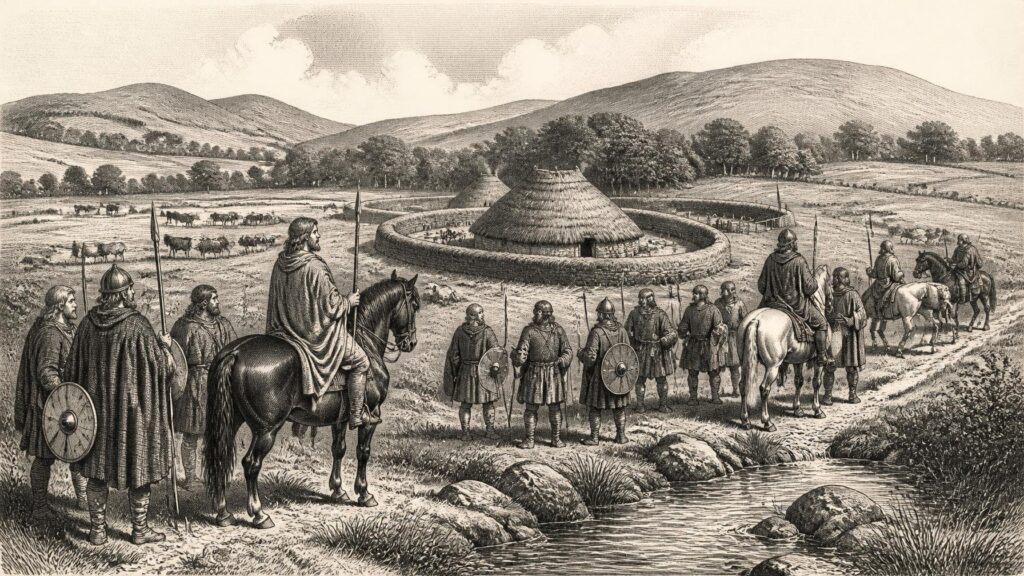
In 791, the most consequential recorded development in Ireland lay in Connacht, where a struggle between rival dynastic groups produced a new provincial overking. The Annals of Ulster record that Muirgius son of Tommaltach defeated and killed Cináed son of Artgal at Sruth Cluana Argait, and add a pointed conclusion: this was “the beginning of his reign”. The phrase makes the encounter more than an isolated killing. It marks the point at which Muirgius was recognised, or at least successfully asserted himself, as king over Connacht.
The surviving evidence is concise and presents its own chronological caution. The event occurs in the Annals of Ulster under the annal-number U792, but the calendar rubric attached to that section identifies it as AD 791. Modern reference works consequently sometimes describe the battle as occurring in 792. There is no surviving day, month or season. It is safest to connect the battle firmly with the annalistic year 791 while avoiding an invented precise date.
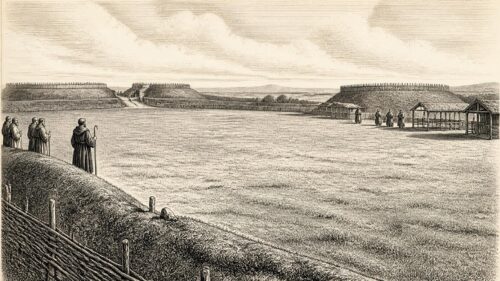
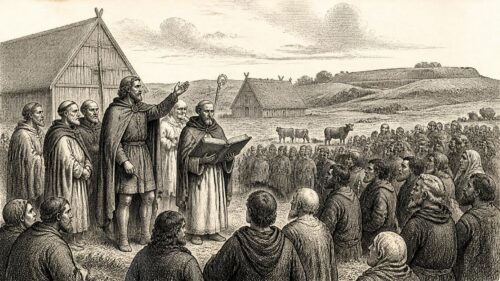
This was not an event involving a united Irish kingdom. Ireland was divided among numerous kingdoms and peoples, with kingship exercised at several overlapping levels. A provincial ruler such as the king of Connacht depended upon the allegiance, submission or defeat of lesser rulers and powerful kindreds. The accession of Muirgius therefore mattered most immediately in the west, but it belonged to the wider political pattern of early medieval Ireland: authority was won and maintained through kinship, clientship, tribute, military followings and the ability to command recognition at assemblies and churches.
Sruth Cluana Argait
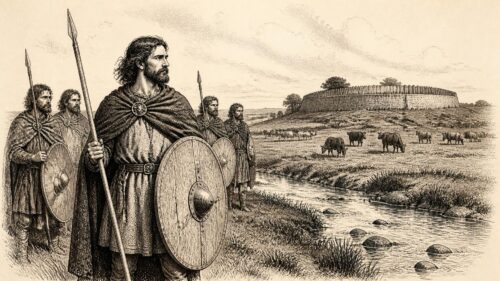
Muirgius belonged to the Uí Briúin Aí, a branch of the Connachta associated with Síl Muiredaig and the fertile plain of Mag Aí, spanning parts of modern north-east Galway and north Roscommon. His father, Tommaltach, had been a local ruler in Mag Aí. Cináed, the man killed in 791, is identified by modern historians as a rival claimant associated with Síl Cathail, another Uí Briúin lineage. The contest was thus not simply between “Connacht” and an outside enemy. It was a civil war within the political world of Connacht, in which different branches of leading families, and the smaller kingdoms attached to them, competed for precedence.
The battle-site name is not wholly secure in the manuscript tradition: the annalist itself signals uncertainty over the first word. It is generally identified with Cloonargid in County Roscommon, in or near the parish of Tibohine. That identification is plausible rather than absolute. Even so, the likely setting is revealing. The conflict was fought in the core territory from which Muirgius’s Uí Briúin Aí kindred drew much of its strength, not at some distant frontier. Cináed’s death removed a direct competitor in the heartland of the struggle.
The annal gives neither numbers nor tactics. We do not know how large either force was, whether the battle followed a raid, a muster or a negotiated breakdown, or how long the fighting lasted. It would be wrong to picture massed national armies or to assign particular weapons and manoeuvres without evidence. Yet a killing of a royal claimant was politically decisive. In a society where rulership rested on a limited pool of eligible dynasts, the death of one contender could rapidly alter the calculations of allies, foster-kin, churchmen and subordinate kings.
A Second Defeat
The same annalistic section reports another battle, at Ard Maic Rími, in which the Uí Ailello were overthrown. Conchobor and Airechtach, grandsons of Cathal, were killed, as were Cathmug son of Flaithbertach, king of Cairpre, and Cormac son of Dub dá Crích, king of Bréifne. The exact location is uncertain, although it has been suggested that Ard Maic Rími lay in the later barony of Tireragh or Tirerrill in north-west Connacht. The named dead demonstrate that the repercussions reached beyond one local feud. Cairpre and Bréifne represented neighbouring political interests, while the Uí Ailello were an older Connacht people with their own regional standing.
The juxtaposition of these entries strongly suggests a campaign of consolidation, although the annals do not explicitly narrate one. The first victory destroyed Cináed’s claim; the second struck a coalition or network of rivals. Modern scholarship accordingly treats Muirgius’s rise as the product of a prolonged period of Connacht instability, involving Uí Briúin branches alongside older dynasties such as Uí Fhiachrach and Uí Ailello. The year did not create every one of those rivalries, but it delivered an outcome in Muirgius’s favour.
His achievement should not be mistaken for uncontested control of all Connacht. Provincial kingship was an aspiration that needed continual enforcement. Later entries show Muirgius campaigning again within Connacht and beyond it. Nonetheless, the annalist’s decision to date his reign from this victory is important evidence that contemporaries, or the record behind the annals, regarded 791 as a genuine turning point.
Rule, Land and Livelihood
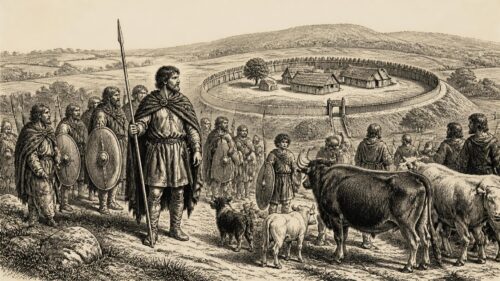
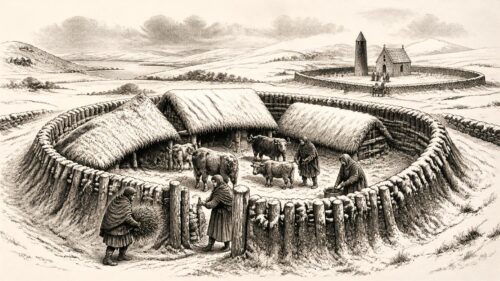
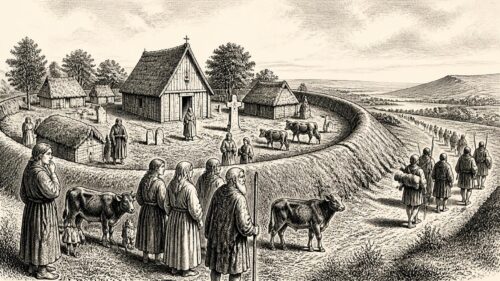
For most people, the year’s battles were experienced at a distance, through demands placed on households and local communities. Early medieval Ireland remained overwhelmingly rural. People lived in dispersed farmsteads, commonly enclosed by earthen banks or, in stonier districts, by stone cashels. These were working homesteads rather than castles: places for homes, livestock, storage and the routines of kin-based agriculture. Archaeology and environmental evidence show an economy in which cattle remained a principal measure of wealth and a medium of payment, alongside the growing importance of cereal cultivation.
Political success had material consequences because kingship drew upon food-renders, cattle, labour services and military obligations. A rising king required followers; followers expected protection, status and reward. Control of good grazing, cultivated land, river crossings and routes between local territories was therefore inseparable from political power. The sources do not say that Muirgius redistributed land, imposed a new tribute, or devastated a particular district in 791. Such claims would exceed the evidence. They do show why the contest for Connacht’s overlordship could matter to communities far beyond the men who fought at Sruth Cluana Argait.
Nor is there evidence for an Irish town at this date. Settlement remained rural before the Viking-age development of longphuirt and urban centres. Exchange certainly existed, including movement of agricultural produce, livestock, crafted goods and ecclesiastical objects, but there is no safely dated record of a commercial transaction in Connacht for this particular year. The proper picture is not of an economically isolated west, but of a rural province whose wealth was expressed through land, animals, produce and relationships of dependence.
Deaths in the Church
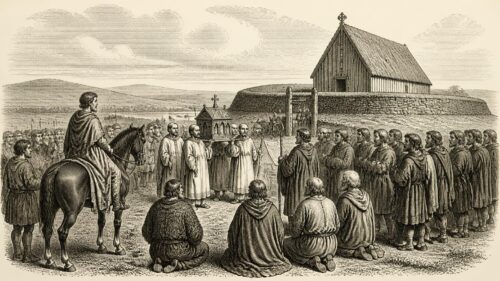
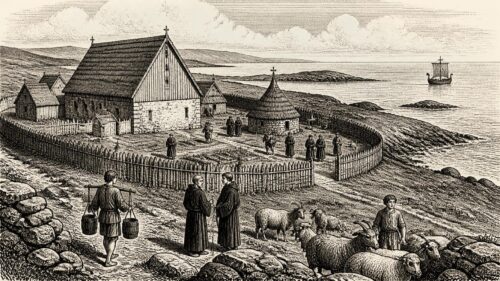
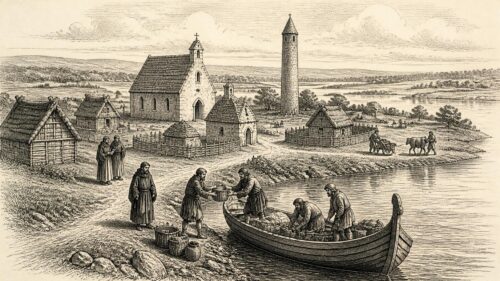
The annals also preserve a striking group of ecclesiastical deaths. Máel Ruain of Tallaght, Aedán of Rahen and another Aedán, grandson of Cú Chumbu, are called bishops and “soldiers of Christ”; Saermug of Enach Dub is also recorded as dead. The formula is brief, but Máel Ruain’s death was especially significant. He had founded the monastery of Tallaght, south-west of modern Dublin, in 774 and was a leading advocate of an austere monastic discipline later associated with the Céli Dé reform.
Tallaght was not a remote retreat cut off from society. Its discipline stressed prayer, celibacy, manual labour and strict penitential practice, while its founder attracted disciples and was consulted by other religious figures. The community became associated with important devotional and literary traditions, including the Martyrology of Tallaght and texts preserving Máel Ruain’s teaching. Those texts survive in later forms and their final compilation cannot responsibly be assigned to 791. What can be said is that his death removed a formative teacher from a monastic network whose influence would remain important into the ninth century.
The same annal records the deaths of rulers and churchmen in several regions: Bresal son of Flaithrí, king of Dál nAraidi; Máel Bresail, king of Uí Fhiachrach; Dorm Corci, king of Dál Riata; Cathmug, king of Calraige; and Téróc, superior of Corcach Mór. This list does not prove a shared catastrophe. Medieval annals often grouped deaths at year’s end. It does, however, offer a reminder that Irish political and religious life was composed of many centres of authority, from north-eastern Ulster and Dál Riata to Connacht and the southern church.
What 791 Did—and Did Not—Change
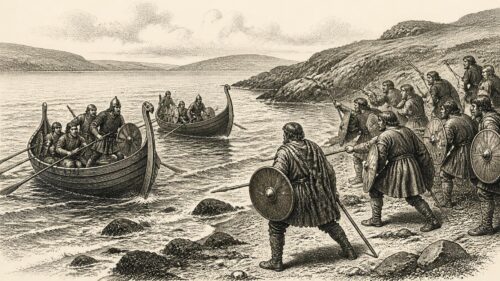
There is no recorded Viking raid on Ireland in 791, and the year should not be read backwards through the better-known attacks of the following decade. Its central story is internal Irish politics: a Connacht dynastic struggle, resolved for the time being through violent victory. Muirgius’s accession strengthened the Uí Briúin Aí and began a reign that would last until his death in 815. His descendants and collateral relatives remained central to Connacht’s political history, while later dynasties such as the Uí Conchobair traced their standing through the wider Síl Muiredaig kindred.
For Ireland as a whole, 791 was not a single national watershed. For Connacht, it was a year in which one battle removed a rival, a second defeat weakened opposing interests, and Muirgius emerged as provincial king. Alongside that hard political change, the death of Máel Ruain marked the passing of a major monastic reformer. Together, these sparse but powerful notices show the two institutions that most visibly shaped the surviving record of early medieval Ireland: kingship, secured through people and land, and the church, sustained through disciplined communities, learning and commemoration.
Primary Sources
- The Annals of Ulster, Year U792 (AD 791)
- The Annals of Ulster
- Muirgius
- Máel-Ruain
- Chronicon Scotorum
- Chronicon Scotorum, Annals 815–819
- Annals of the Four Masters
- Annals of Inisfallen
- A Poem on the Kings of Connaught
- Lebor na Cert
- Settlement Patterns and Socio-Economic Change in the Diocese of Tuam c.AD 400–1000
- The Connacht Project
- Early Medieval Ireland, AD 400–1100: The Evidence from Archaeological Excavations
- Agriculture, Settlement and Society in Early Medieval Ireland
- The Archaeology of Livestock and Cereal Production in Early Medieval Ireland, AD 400–1100
- Irish Field Monuments
- The Rural Settlement Pattern
- Farming and Archaeology
- Kingdoms, Communities, and Óenaig: Irish Assembly Practices in their Northwest European Context
- The Martyrology of Oengus the Culdee
- The Martyrology of Tallaght in CELT’s Irish Literature List
- Tallaght: County Dublin Urban Archaeological Survey