

Unfinished Apologies
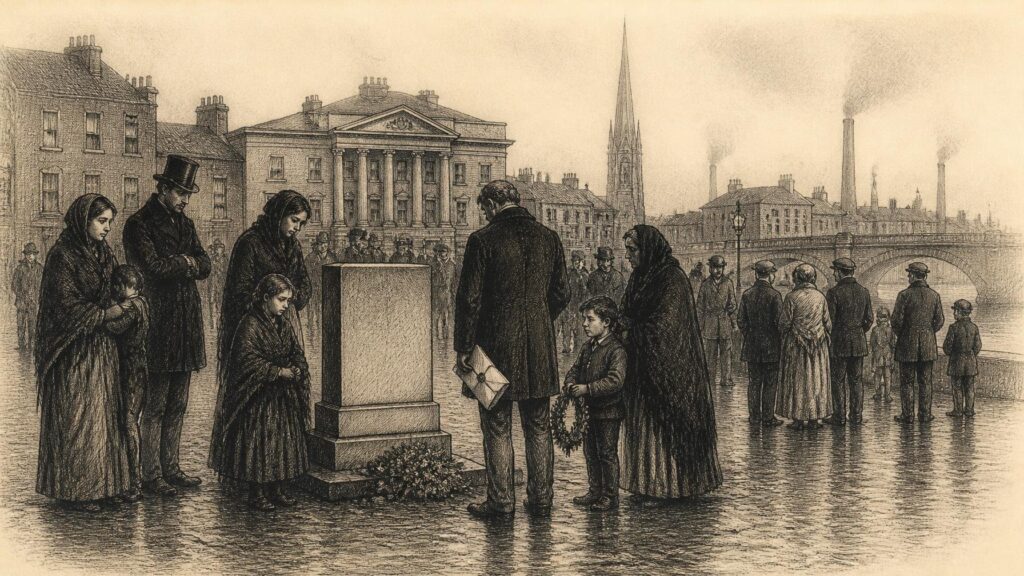
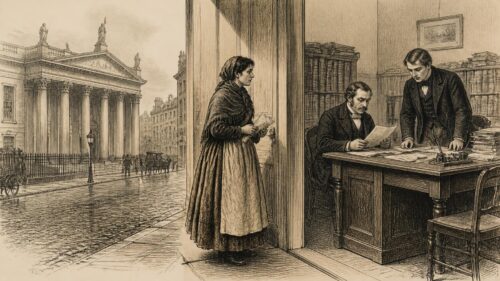
AI generated historical illustration, not a contemporary photograph.
At a Glance
The legacy of the Troubles cannot be reduced to a ledger of deaths, inquiries, prosecutions or political speeches. It is also a history of names restored, allegations tested, official language changed, and bereaved families refusing to allow the dead to be described by others. In Northern Ireland, an apology is rarely merely ceremonial. It may be sought as recognition of innocence, as an admission of institutional responsibility, as a correction to a public record, or as one step towards truth. It can also be rejected when it appears to substitute remorse for accountability. The long argument over apologies therefore belongs to the wider, unfinished argument about how Ireland and Britain should address a conflict whose formal political settlement did not settle the past.
Historical Setting
The term “the Troubles” is useful but imperfect. It gathers together a conflict of overlapping causes and actors: the constitutional division of Ireland, unequal power within Northern Ireland, civil-rights mobilisation, sectarian discrimination, republican and loyalist paramilitarism, British military intervention, policing, intelligence operations, and the fears held by people whose political identities were grounded in very different understandings of the state. Violence was not confined to one place or one community. It reached across Northern Ireland, the Republic, Great Britain and farther afield. Its victims included civilians, members of the security forces, prisoners, political activists and combatants. The CAIN Sutton Index records 3,532 conflict-related deaths between 1969 and 2001, while other projects employ somewhat different dates and methodologies. The divergence in totals is itself a reminder that historical counting requires definitions, evidence and judgement.
The statutory definition later used by the Northern Ireland Troubles (Legacy and Reconciliation) Act 2023 placed the Troubles between 1 January 1966 and 10 April 1998. That legal framing gives a useful administrative boundary, but no date can contain the human aftermath. A person injured in 1972, a widow whose husband was killed in 1989, or a child who grew up amid an unresolved accusation may live with consequences long after 1998. The past is not simply an archive of concluded events. It persists in family testimony, disputed police files, memorials, inquests, political language and the ordinary absence at a kitchen table.
Apology became especially fraught because the conflict produced rival narratives as well as rival political programmes. Republican families could confront official claims that their relatives were armed or dangerous. Unionist families could hear attacks upon relatives who had served in the police or armed forces. Families bereaved by republican or loyalist violence could find that public commemoration was filtered through political arguments about the legitimacy of armed campaigns. People harmed by the state could face secrecy, delay and the authority of official accounts. In each case, an apology could appear to be a demand that one version of events yield to demonstrated fact. Yet the word could also alarm those who feared collective blame, legal liability, political humiliation or a rewriting of the conflict in which only one form of suffering counted.
Unequal Memories
There is no single victims’ experience of the Troubles. That is not an evasion of responsibility; it is a basic historical fact. A family whose relative was killed by the IRA, one whose loved one was killed by loyalists, and one whose relative died during a security-force operation may all seek truth and recognition while disagreeing fundamentally about the conflict’s causes and character. Survivors of bombing, shooting, torture, intimidation and bereavement have not had identical needs. Nor have they always wanted the same institutions, the same legal outcomes or the same forms of remembrance.
The distinction between victimhood and political interpretation is essential. The suffering of a civilian killed in a republican bombing does not become less real because another family seeks justice for a death caused by soldiers. The suffering of a soldier’s family does not cancel the right of civilians to challenge an unlawful killing. A victim-centred approach must resist the temptation to rank grief by community, allegiance or public acceptability. It must also recognise that an individual may have held political commitments or belonged to an organisation without making false official claims about the circumstances of that individual’s death permissible.
Folklore, rumour and partisan memory have shaped many local accounts. Such testimony is historically important: it tells scholars how communities experienced fear, exclusion and loss. It is not, however, automatically proof of what occurred. The same caution applies to official records. A military statement, police report or intelligence assessment may preserve evidence, but may also be incomplete, self-protective or mistaken. The strongest historical method neither romanticises personal memory nor treats the state archive as beyond challenge. It compares accounts, tests chronology, identifies gaps and makes uncertainty plain.
Peace Promise
The Belfast, or Good Friday, Agreement of 10 April 1998 did not create a comprehensive truth commission or a settled scheme for dealing with every historic death. Its achievement lay elsewhere: it established constitutional principles, new institutions and a framework through which former antagonists could pursue politics without violence. Yet its section on reconciliation and victims of violence carried a moral proposition of lasting importance. The participants recognised that the suffering of victims should be acknowledged and addressed as a necessary element of reconciliation.
That language was deliberately broad. Its strength was that it did not reserve compassion to one constituency. Its limitation was that it did not determine how acknowledgement would occur, who would provide it, or how truth, justice and information should be balanced. The Agreement also contained measures that some victims found grievous, notably the early-release arrangements for qualifying prisoners. For bereaved relatives, the political necessity of stabilising peace could look painfully close to the state asking them to bear an exceptional burden. The peace settlement ended much violence, but it did not give every family an answer, a prosecution, or an apology.
This unresolved character helps explain why legacy has remained so difficult. Governments and parties could agree in principle that victims deserved respect while disagreeing over records, disclosure, investigations, immunity, prosecutions, inquests and the role of the Irish Government. The search for a comprehensive mechanism repeatedly foundered on questions that were at once legal and emotional: what can be disclosed without endangering lives or methods; whether old cases can be investigated fairly; whether information without punishment is acceptable; and whether institutions implicated in past wrongdoing can be trusted to investigate themselves.
Public Apologies
An apology has several possible components. At its most substantial, it identifies a wrong, acknowledges harm, accepts responsibility, rejects prior justifications and commits the speaker to meaningful repair. It may be personal, institutional or governmental. It may follow a judicial finding, an inquiry, an inquest, an internal investigation or a political negotiation. It may be made by a person who directly caused harm, by an organisation which authorised or facilitated it, or by a later office-holder speaking for an institution that endured after individuals had gone.
These distinctions matter in Northern Ireland. A prime minister may apologise on behalf of a government for the conduct of soldiers, yet cannot decide criminal guilt. A coroner may find that a person was innocent of wrongdoing, but cannot alone create an agreed public memory. A paramilitary organisation may express regret for particular victims, but its words may be regarded as incomplete if it withholds names, locations or the fate of the disappeared. An apology can be valuable precisely because it signals a break with denial; it becomes inadequate where it is used to close inquiry rather than enable it.
There is also a difference between acknowledgement and forgiveness. Acknowledgement asks an institution or offender to see and state what was done. Forgiveness is a moral decision that belongs, if it belongs anywhere, to those harmed. Neither government nor community can demand it. Reconciliation is broader again. It may mean coexistence, the rejection of violence, practical cooperation, or deeper mutual recognition. It should not be confused with an instruction that victims must relinquish claims to truth or justice for the convenience of a shared future.
Official Language
Public language has unusual force after conflict because words can preserve an injury. Terms such as “gunman”, “terrorist”, “rioter”, “collateral damage” or “security incident” may have been employed in immediate official accounts before evidence was properly tested. Sometimes they were accurate; sometimes they were not. When an inquest or inquiry later corrects the record, an apology can recognise not only death or injury but the additional wound of stigma. For many relatives, this correction is not symbolic in a trivial sense. Reputation is part of what they believe has been taken from the dead.
That does not mean history should be reduced to the pursuit of morally satisfying language. Inquiry findings must be treated according to their scope. A tribunal may establish facts without determining criminal liability. A coroner’s inquest may decide how a person died without assigning civil or criminal responsibility in the fullest sense. A government statement may accept moral responsibility without disclosing every document. Careful prose is therefore not evasive. It is a form of respect for evidence and for the distinct tasks of courts, historians, investigators and politicians.
Bloody Sunday
The best-known modern British apology connected with the Troubles followed the publication of the Saville Inquiry on 15 June 2010. The inquiry examined the killing of thirteen people by British soldiers in Derry on 30 January 1972; another man died later from injuries sustained that day. Bloody Sunday had long been an open wound in nationalist Ireland and an international emblem of the conflict. The earlier Widgery Tribunal had been widely rejected by relatives and many others as inadequate. The Saville Inquiry, established in 1998, was lengthy, expensive and deeply contested, but its findings transformed the official account.
David Cameron’s statement to the House of Commons accepted that what occurred was “unjustified and unjustifiable”. He said that some soldiers had acted wrongly and that the Government, ultimately responsible for the conduct of the armed forces, was deeply sorry. The statement mattered because it did not simply express sympathy for bereavement. It repudiated the prior justification of the killings and accepted governmental responsibility in language that families and many observers understood as unambiguous.
The value of the apology was inseparable from the inquiry that preceded it. It drew authority from a detailed evidential process, not merely from the office of the speaker. Saville found that none of those shot by Support Company was posing a threat of causing death or serious injury; it also rejected claims that the civilian casualties had justified the shootings. Cameron’s words did not resolve every question arising from Bloody Sunday, and they did not settle criminal liability. But they changed the public status of the dead. This is why the episode remains a reference point whenever later governments are urged to apologise for state wrongdoing.
It would be a mistake, however, to regard Bloody Sunday as a simple template. Its scale, visibility, long campaign and formal inquiry gave it a singular place. Not every family can obtain a public tribunal lasting years. Nor should access to truth depend on a case becoming internationally famous. The lesson is not that every death requires an identical process; it is that credible acknowledgement normally rests on credible investigation, transparent reasoning and a willingness to revise official narratives when evidence requires it.
Ballymurphy Findings
The Ballymurphy inquest demonstrated both the importance and the limits of official acknowledgement. Between 9 and 11 August 1971, during the period surrounding the introduction of internment, ten people were killed in west Belfast in incidents involving soldiers of the Parachute Regiment. For decades, relatives challenged allegations that the dead had been gunmen or otherwise implicated in violence. In May 2021, the coroner found that all ten were entirely innocent of wrongdoing and that the use of force was without justification.
The Secretary of State for Northern Ireland, Brandon Lewis, acknowledged the terrible hurt caused to the families, paid tribute to their long campaign, and stated that those who died were entirely innocent of wrongdoing. The statement was significant, especially because it came after nearly fifty years in which relatives had sought correction and clarity. But debate immediately turned to whether its form and delivery amounted to an adequate apology. In the Northern Ireland Assembly, representatives noted the contrast many families drew with the clear prime-ministerial apology after Saville.
This difference illuminates a central feature of legacy politics. The words “sorry” cannot be assessed independently of speaker, setting, evidence and timing. A statement from a secretary of state may carry governmental weight, but a family may reasonably feel that a case involving the British Army demands an apology from the prime minister. Acknowledgement of innocence may be welcomed but still be judged incomplete without a fuller acceptance of unjustified killing. These are not merely disputes about protocol. They concern whether the state has listened to the family’s account of the harm, including the decades in which reputation was contested.
Ballymurphy also illustrates why historical comparison must be cautious. It is tempting to call it “another Bloody Sunday”, particularly because the same regiment was involved and because both cases concern civilians shot by soldiers. Yet each event has its own chronology, evidence and legal history. Comparison can reveal recurring questions about force, accountability and official denial; it must not collapse distinct victims and circumstances into a single political symbol.
Paramilitary Responsibility
Apologies are not solely a question for the British state. Republican and loyalist organisations caused immense harm. Their victims include people killed because of identity, occupation, location or supposed association; people injured in bombings and shootings; families displaced or intimidated; and communities subjected to fear. A historical account that discussed state accountability alone would fail those victims and distort the conflict.
There have been statements of regret, acknowledgements and apologies from political and paramilitary-linked actors, sometimes directed towards particular families or categories of victim. Their reception has varied sharply. Words may have special significance where a family has waited for recognition that a killing was wrong, mistaken or avoidable. They can be especially important when they correct an allegation against the dead or disclose information about an unmarked grave. But general expressions of regret can be seen as evasive when detached from detail, responsibility or a willingness to assist information recovery.
The issue of the disappeared gives this distinction particular force. Families who do not know where a relative is buried are denied ordinary practices of mourning and commemoration. Information that enables recovery of remains is not a replacement for justice, but it may answer an urgent human need. The Independent Commission for the Location of Victims’ Remains, created through British-Irish cooperation, reflects the practical recognition that recovering the dead may require confidential information and legal protections. This is an example of information recovery serving a purpose that no public apology can fulfil on its own.
It is also necessary to avoid a false symmetry in which every actor’s wrongdoing is treated as identical in form or capacity. States possess armed forces, laws, archives, prisons and powers of investigation. Paramilitary organisations operated illegally and clandestinely. Loyalist and republican groups had differing structures, campaigns and relationships with communities. Yet moral complexity must not become moral evasion. The fact that state responsibility may carry special legal obligations does not lessen the wrong done by paramilitaries. Conversely, the reality of paramilitary violence does not relieve the state of its obligations when its agents acted unlawfully or when credible allegations of collusion arise.
Victims Voices
Victims and survivors have repeatedly resisted being treated as a single political constituency. Some want prosecutions wherever evidence permits. Some prioritise access to withheld files. Some seek an inquest, a public inquiry, a corrected record, financial support, a memorial, or simply an honest meeting with those responsible. Some do not wish to engage with formal processes at all. Trauma can make participation difficult, while media attention and political contest may compound distress.
The language of a victim-centred process is therefore meaningful only if it permits choice. A family should not be compelled to choose between truth and justice where both remain possible. Nor should a person who seeks information be assumed to have abandoned a claim to accountability. The emphasis in the 2014 Stormont House Agreement on victim-centred processes was an attempt to build legacy institutions around these realities. It proposed a Historical Investigations Unit, an Independent Commission on Information Retrieval, an Oral History Archive and an Implementation and Reconciliation Group, alongside reforms intended to improve legacy inquests.
That architecture recognised that different questions demand different methods. Criminal investigation seeks admissible evidence and possible prosecution. Information recovery may obtain an account unavailable through ordinary investigation. Oral history preserves experience but is not a substitute for fact-finding. Reconciliation work can explore patterns and shared consequences, but should not dictate a single authorised narrative. The failure to implement the full Stormont House design did not make those distinctions disappear. It merely ensured that later proposals would have to confront them again.
Legacy Machinery
The Northern Ireland Troubles (Legacy and Reconciliation) Act 2023 attempted to create a single principal institution, the Independent Commission for Reconciliation and Information Recovery, or ICRIR. The Act gave the Commission functions concerning reviews of deaths and serious harm, information recovery, records, oral history and memorialisation. It also introduced conditional immunity provisions and curtailed routes through which many historic cases had been pursued. The legislation was opposed by every main Northern Ireland political party, by the Irish Government and by many victims’ groups. Opposition did not necessarily imply agreement on an alternative; rather, it showed the depth of concern about replacing existing legal avenues with a new and contested mechanism.
The Commission’s work has included a stated commitment to support families, recover information, require cooperation and publish findings where possible. Its own material describes powers to compel information from public authorities and individuals, as well as the use of investigative powers in appropriate cases. Those powers are important, but power alone cannot manufacture confidence. A legacy institution must persuade families that it is independent, that it will not permit secrecy to determine outcomes without scrutiny, and that it understands the difference between information supplied for institutional convenience and information genuinely responsive to a family’s questions.
In July 2024, the UK Government abandoned its appeal against declarations of incompatibility made by the Northern Ireland High Court in relation to elements of the 2023 Act, including the conditional immunity provisions. It said it would repeal and replace the legislation. In September 2025, the British and Irish Governments published a Joint Framework grounded in principles associated with Stormont House: reconciliation, rule of law, acknowledgement of suffering, information recovery, justice and human-rights compliance. In October 2025, the UK Government introduced a Northern Ireland Troubles Bill intended to repeal and replace the earlier Act. On 19 October 2026, it announced proposed amendments intended to strengthen truth and accountability provisions while adding protections for veterans. The final practical effect of that legislative course depends upon enactment and implementation, not announcements alone.
Legal Conflict
The legal argument over legacy is not a technical dispute separate from apology. It asks whether a state can acknowledge suffering while closing paths to investigation, inquest or litigation. The European Convention on Human Rights has played a major role because Article 2 requires effective investigation where state responsibility for a death may be engaged, while Article 3 is relevant to serious ill-treatment. The European Court of Human Rights and the Council of Europe’s Committee of Ministers have repeatedly scrutinised shortcomings in investigations of conflict-related deaths in Northern Ireland.
The Irish Government’s interstate application against the United Kingdom, lodged in January 2024, challenged aspects of the 2023 Act under several Convention articles. The Council of Europe had already expressed grave concern that conditional immunity and the ending of pending inquests risked undermining effective investigation, justice and public confidence. These interventions do not mean every historical case can now be solved or prosecuted. Evidence decays, witnesses die, memories alter and fair-trial rights remain real. They do mean that reconciliation cannot be defined simply as administrative finality.
A legal process can disappoint a family; so can an apology. Yet law provides procedures for testing evidence and challenging executive power that political statements cannot replicate. The most durable apologies tend to acknowledge this. They do not claim to determine guilt where a court must do so, and they do not invite the bereaved to exchange their rights for a phrase of remorse. Historical truth and legal truth are related but distinct. A historian may establish a persuasive account from cumulative evidence; a criminal court must meet a far higher threshold before conviction. Responsible public language should respect both standards.
Irish Dimension
The legacy question is inseparable from the Irish dimension. The Troubles involved violence and political organisation across the border, attacks in the Republic, the presence of victims living outside Northern Ireland, and two governments whose cooperation was central to the peace process. The Good Friday Agreement itself was a British-Irish settlement as well as a Northern Irish one. The Government of Ireland has consequently maintained that legacy arrangements must meet human-rights standards and command confidence among those affected.
British-Irish cooperation has been most effective where it accepts that neither state can resolve the past alone. The arrangements for locating victims’ remains are an obvious example. The 2025 Joint Framework likewise recognised reciprocal cooperation and the need to rebuild damaged trust. Such cooperation should not be mistaken for a simple harmony of national narratives. Both governments possess records, responsibilities and political interests. Both have been asked difficult questions about what they knew, what they did, and what they can disclose. A mature historical culture does not demand that one government become sole penitent while the other becomes a detached observer.
For Irish history, this matters because the conflict cannot be confined to a narrow provincial story. It was shaped by partition, citizenship, competing national allegiances, migration, British-Irish diplomacy and the constitutional evolution of both states. Its bereaved include people in Belfast and Derry, Dublin and Monaghan, London and Birmingham, as well as families dispersed elsewhere. Any meaningful legacy policy must therefore be capable of hearing claims that cross jurisdictional and communal boundaries.
Historical Judgement
What, then, can be said with confidence about apologies and the Troubles? First, they matter. The public repudiation of a false or unjust official account can restore dignity and alter the historical record. Bloody Sunday demonstrates the power of apology grounded in exhaustive investigation. Ballymurphy demonstrates the importance of recognising innocence and the continuing debate over what adequate governmental responsibility sounds like. Families of victims of paramilitary violence are equally entitled to recognition that their losses were not political abstractions but human wrongs.
Second, apology is not a universal solvent. It cannot recreate a lost life, guarantee forgiveness, resolve disputed evidence or replace a prosecution where one remains possible. It cannot by itself disclose hidden records or identify every person responsible. Where it is used as a substitute for inquiry, it may deepen mistrust. Where it follows evidence, accepts responsibility and opens rather than closes the path to truth, it can form part of repair.
Third, historians should resist the pressure to turn the past into a morality play with one innocent community and one guilty community. The evidence records republican, loyalist and state violence; it records courage and cruelty, rescue and collusion, institutional failure and personal integrity. Interpretation is unavoidable, but it must be separated from demonstrable fact. Folklore can reveal how a place remembers; it cannot settle every contested event. Official accounts can preserve vital records; they cannot be exempted from scrutiny. This discipline is not coldness. It is one way of respecting those whose lives are too often used as symbols.
Future Demands
The most honest conclusion is that there will be no single final apology for the Troubles. There were too many events, actors, institutions and injuries. Nor would one national ceremony satisfy the distinct needs of every family. The work is necessarily plural: investigations where evidence permits; inquests where law requires; responsible disclosure; information recovery; support for survivors; accurate memorialisation; access to archives; and apologies that are specific enough to mean something.
There is a danger in calling this work “closure”. The word can imply that bereaved people ought to finish grieving on an official timetable. Better language is acknowledgement, answer, remedy and, where possible, accountability. Some questions will remain unresolved, not because they are unimportant but because time, secrecy and human mortality have narrowed what can be proved. Institutions should say so plainly rather than manufacture certainty. They should also recognise that delay is not neutral. Each year can make truth harder to obtain and deepen the sense that victims have been asked to wait for a peace they helped to make possible through their endurance.
Unfinished apologies are therefore not simply failures of eloquence. They are evidence of unfinished relationships between citizens and the institutions that claimed to protect them, between communities with competing memories, and between Britain and Ireland. The historical task is neither to forget nor to demand that every person narrate the past in the same way. It is to insist that suffering be neither denied nor monopolised, that evidence be pursued with care, and that public remorse carry the weight of truth. Only then can apology become more than a word spoken over an unquiet grave.
The article highlights a difficult tension: apologies can restore dignity by correcting damaging official language, yet they may feel hollow when truth, accountability or practical remedy remain incomplete. Bloody Sunday suggests that an apology gains force from a thorough evidential process, whereas Ballymurphy raises questions about whether the speaker, timing and form of acknowledgement shape its meaning for bereaved families. The discussion also resists treating all cases as identical, despite recurring concerns about stigma and state responsibility. How should future legacy arrangements balance consistent recognition for victims with processes sufficiently tailored to the evidence, needs and expectations surrounding each death?