

Rights Adjudicated
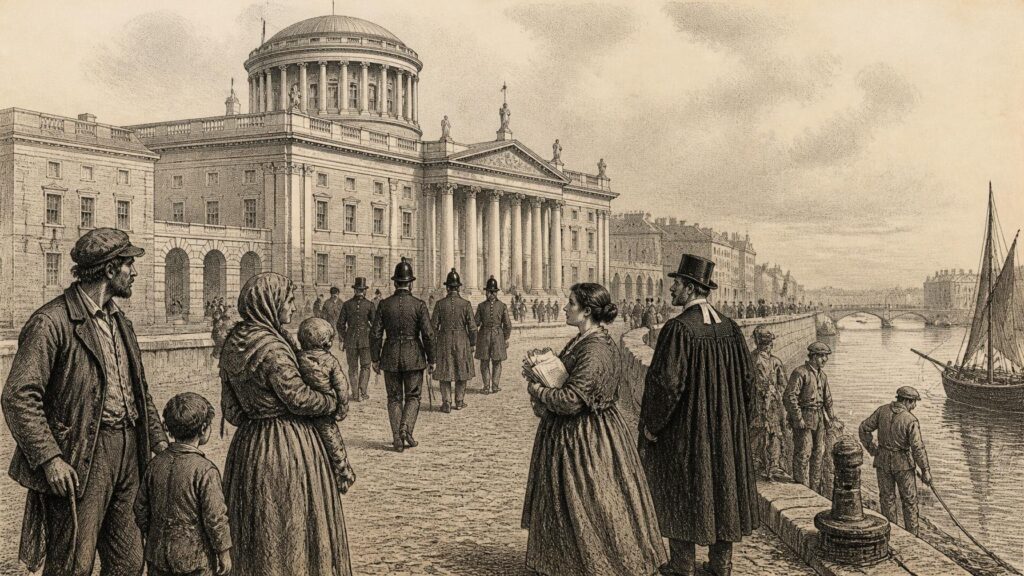
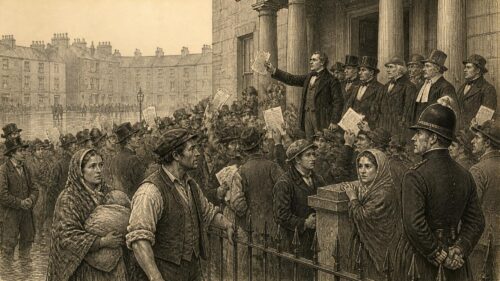
AI generated historical illustration, not a contemporary photograph.
At a Glance
Irish courts have never been merely neutral rooms in which rules were mechanically applied. They have been places where property, poverty, family life, religious authority, citizenship and personal freedom met the coercive power of the state. Yet the history of social rights in Ireland is not a simple story of courts progressively rescuing disadvantaged people from injustice. It is a record of changing institutions, uneven access to law, bold constitutional reasoning and persistent judicial restraint, especially when a claim required the public authorities to spend money or reorder social provision.
Colonial Foundations
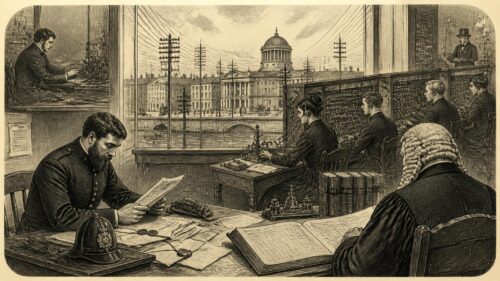
To understand the relationship between Irish courts and social rights, it is necessary to begin before the independent state. For much of the nineteenth century Ireland was governed within the United Kingdom, and its legal institutions were organised accordingly. The superior courts sat in Dublin, while assizes, quarter sessions and a dense network of local jurisdictions carried law into towns and rural districts. The legal vocabulary was principally that of property, contract, crime and public order rather than of enforceable social rights. A person might possess rights recognised by common law or statute, but there was no constitutional guarantee requiring government to secure housing, healthcare, income or education at an adequate standard.
The ordinary experience of justice was often local and summary. Petty sessions developed into the lowest tier of the court system and were formally regularised in the nineteenth century. They dealt with minor criminal offences, licensing, debts, family disputes and the administrative business generated by everyday regulation. Their surviving registers are therefore unusually revealing historical sources. They record not simply spectacular crimes but quarrels between neighbours, breaches of labour arrangements, poverty-related offences, domestic conflict and disputes arising from the unequal ownership of land. The National Archives and historians of petty-session records rightly caution against treating such documents as transparent accounts of ordinary life: they are records produced by officials, structured by offences selected for prosecution, and shaped by the authority of magistrates.
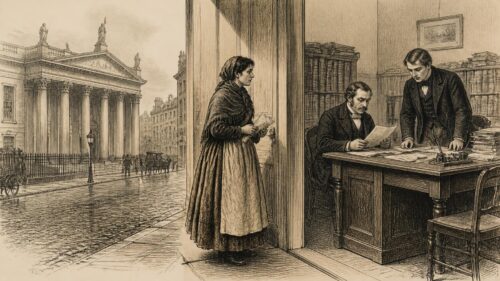
Access to justice was correspondingly unequal. Local justices were frequently drawn from property-owning classes, while poorer litigants faced travel costs, legal expense, language barriers and the practical risks of challenging employers, landlords or local authorities. This did not mean that poorer people were silent or legally passive. They petitioned, defended charges, brought debt claims and used legal procedures when opportunity allowed. But the institutional balance of power mattered. Courts could offer remedies within the law while also enforcing a social order founded upon unequal ownership and political influence.
It is tempting to describe every hardship brought before a magistrate as a denied “social right”. That would be anachronistic. Nineteenth-century people certainly expressed claims to fairness, subsistence, security and protection from arbitrary treatment, but they did not ordinarily have a modern constitutional mechanism by which to demand those things from the state. The better historical interpretation is that courts formed one part of a wider apparatus through which social need was managed, classified and, at times, disciplined.
Land Justice
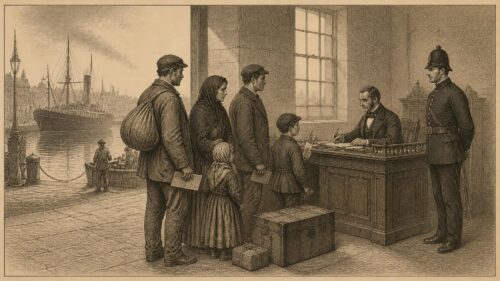
Land made the social character of law especially visible. In a predominantly rural society, access to a holding was frequently access to livelihood, home and local standing. The law of landlord and tenant could therefore never be merely private law in its consequences. During the nineteenth century, eviction, arrears, rents and estate management brought large questions of social survival into legal and administrative settings. The famine decades and their aftermath exposed the harsh limits of legal protection where occupation depended upon insecure tenure and poverty constrained tenants’ capacity to resist.
Courts were not the sole institutions involved. Grand juries, poor-law boards, workhouses, estate offices, constabulary authorities and later elected local bodies all exercised powers bearing upon welfare and social discipline. Still, litigation and legal process were central to eviction and debt enforcement. The law could transform an economic crisis into a formal order for possession, while the presence of police or court officers made the authority behind that order plain. In this sense, the history of land law is indispensable to any history of social rights in Ireland: it shows how strongly the security of home and livelihood could depend on rules designed chiefly around ownership.
The Land War of the late nineteenth century changed the political context. Tenant organisation, boycotting, agitation, parliamentary action and alternative community mechanisms challenged the assumption that land relations were simply matters of private bargain. Land legislation gradually altered tenure and facilitated transfer from landlord ownership towards occupying proprietorship. Courts and specialised legal procedures had roles in that transformation, but they did not originate it alone. Political mobilisation was decisive. The episode remains an important corrective to a court-centred view of rights: judicial remedies may matter greatly, but legislative reform often follows pressure that develops beyond the courtroom.
Contemporary accounts and later nationalist memory have sometimes portrayed informal tribunals and popular enforcement during agrarian conflict as a wholly democratic substitute for official justice. The evidence supports a more cautious conclusion. Such bodies could express real local grievances and provide forums that official courts were thought unable or unwilling to supply. They could also be coercive, especially where community pressure hardened into intimidation. They belong to the history of resistance and legitimacy, not to a simple ancestral tradition of benevolent social rights.
State Formation
The revolutionary years created a striking, if short-lived, challenge to the authority of established courts. Republican institutions associated with the First Dáil developed arbitration and court structures during the War of Independence. These Dáil courts were part of a larger claim that Irish political authority could administer justice independently of British institutions. Their work included civil disputes, particularly disputes over land and debt, as well as efforts to maintain order. Their existence demonstrates that courts could be instruments of state-building as well as adjudication.
It is important not to romanticise them. Their operation varied by locality and changed under wartime pressure. Their authority relied on political allegiance, voluntary compliance and, in some settings, coercive enforcement. The documentary record is also incomplete. The destruction of the Public Record Office at the Four Courts in June 1922 was a profound archival loss, although surviving Dáil papers, local material and later administrative records allow historians to reconstruct parts of the legal transition. What can be said with confidence is that the new state did not emerge from a legal vacuum. It inherited personnel, buildings, procedures and a powerful expectation that courts would provide orderly justice.
The Courts of Justice Act 1924 reorganised the system of the Irish Free State, replacing several earlier jurisdictions with a new hierarchy including the District Court, Circuit Court, High Court and Supreme Court. The change from petty sessions to district courts was institutional as well as symbolic. A national state was now claiming responsibility for the administration of justice in its own name. That institutional inheritance still shapes modern legal practice, even where the social and constitutional assumptions of the new state later changed.
Partition must also be kept in view. The history considered here chiefly concerns the courts of the Irish Free State and, after 1937, Ireland under Bunreacht na hÉireann. Northern Ireland developed within a different constitutional and judicial framework after 1921, though many social questions—housing, employment, equality, policing and civil liberties—remained deeply connected across the island. Treating “Irish courts” as though a single legal system governed the entire island after partition would obscure an essential historical fact.
Constitutional Text
The Constitution of the Irish Free State, which came into force in December 1922, placed rights within the foundational law of the new state. It contained protections for liberty, inviolability of the dwelling, freedom of conscience, expression, assembly and association. It also declared a right to free elementary education. These guarantees were significant, particularly in a state emerging from revolution and civil war. They did not, however, create a general judicial duty to secure material equality or social provision across society.
The 1922 settlement matters because it reveals an early constitutional recognition that education, religion and political participation were not merely administrative matters. Yet rights on paper depended on legislation, public finance and institutional capacity. The promise of free elementary education, for example, did not settle disputes about the quality, duration, language, religious character or resources of schooling. Courts could interpret constitutional provisions, but they could not themselves build a comprehensive welfare system.
Bunreacht na hÉireann, approved by plebiscite in 1937 and operative from 29 December that year, supplied the framework that remains central to Irish constitutional law. Its rights provisions combined liberal protections of personal liberty, expression, religion, family and property with language of human dignity, social order and the common good. Article 40.1 states that citizens are to be held equal before the law, while Article 40.3 requires the state in its laws to respect and, so far as practicable, defend and vindicate the personal rights of the citizen.
The wording was capacious but not unlimited. Article 40.3 was later to become the principal basis for recognising personal rights not expressly listed in the Constitution. At the same time, the text reflected social and religious assumptions of its period. Its provisions on the family and women in the home have generated enduring controversy. They show that constitutional recognition may protect an ideal of social life while also entrenching a particular understanding of gender, marriage and dependency. Courts interpreting social rights have therefore worked with a text that was at once protective, aspirational and historically situated.
Social Principles
Article 45 is the clearest constitutional expression of social aspiration. It directs the state towards a social order informed by justice and charity, speaks of an adequate means of livelihood, and calls for particular care for weaker sections of the community, including the infirm, widows, orphans and the aged. In a broad historical sense, Article 45 is Ireland’s most explicit constitutional statement that economic life should serve human welfare rather than merely private accumulation.
Its decisive limitation appears at the beginning. The principles are intended for the general guidance of the Oireachtas; their application in making laws is entrusted exclusively to the Oireachtas; and they are not cognisable by any court. This was not an accidental omission or a technical detail. It was a deliberate constitutional choice. A person cannot ordinarily enter court and obtain an order compelling the state to provide a job, a dwelling, a specified welfare payment or a particular medical service simply by invoking Article 45.
That division has shaped almost every later controversy over social rights. Those favouring stronger judicial enforcement argue that dignified life, education, shelter and access to essential services are hollow if left entirely to political discretion. Those defending judicial restraint answer that such questions require choices about taxation, competing needs, staffing and the distribution of finite resources—choices for elected representatives rather than judges. Article 45 did not end that argument; it established its constitutional terrain.
The provision was not wholly irrelevant to legal development. Lawyers and scholars have treated it as part of the Constitution’s moral and interpretative setting. But its nonjusticiable character placed a barrier before attempts to translate its broad social language into directly enforceable claims. This distinction between a constitutional value and a judicial remedy is one of the most important features of Irish legal history. It explains why Irish constitutional rhetoric can sound socially generous while judicial orders in housing, welfare and healthcare cases are often cautious.
Rights Discovery
From the 1960s, the Supreme Court developed one of the most distinctive features of Irish constitutional law: the doctrine of unenumerated personal rights. In Ryan v Attorney General, decided in 1965, the courts recognised bodily integrity as a personal right protected by Article 40.3. The case arose from a challenge to the fluoridation of public water supplies. The ultimate outcome did not invalidate fluoridation, but the reasoning was historically consequential. It established that the personal rights guaranteed by the Constitution were not confined to those expressly named in its text.
This development gave courts a more creative role in the protection of individual autonomy and dignity. It was neither a free licence to constitutionalise every desirable interest nor a declaration that social rights were fully enforceable. Rather, it provided a method for identifying rights thought inherent in the constitutional order. The doctrinal language drew upon ideas of the human person and, in some judgments, natural rights. Later generations have debated whether that method was principled, too open-ended or necessary to keep a written constitution responsive to changing society.
McGee v Attorney General in 1974 showed the reach of this approach. Mary McGee challenged a legal restriction that prevented her from obtaining contraceptives, notwithstanding medical advice that another pregnancy could endanger her health. The Supreme Court recognised a constitutional right to marital privacy and found the restriction incompatible with that right. The decision did not establish a broad judicial power over health policy. It did, however, demonstrate that a court could invalidate legislation where intimate family decision-making was unjustifiably constrained.
In historical terms, McGee is important for more than contraception. It illustrates how social questions can become constitutional questions when legislation regulates bodily autonomy, family life and access to medical means. It also demonstrates that litigation rarely acts alone. Feminist organising, public debate, parliamentary reform and changing social attitudes formed the wider setting in which the case was understood. The later Health (Family Planning) legislation altered the statutory landscape, though cautiously and incrementally.
Equality Claims
Equality before the law has also supplied a route by which courts influenced social structures. The formula in Article 40.1 is not an absolute command that all people be treated identically. The Constitution itself permits the state to have due regard to differences of capacity, physical and moral, and social function. Courts therefore examine whether a distinction has a legitimate constitutional basis rather than requiring identical treatment in every circumstance.
De Burca and Anderson v Attorney General, decided in 1976, became a landmark in this field. Máirín de Burca and Mary Anderson challenged provisions that effectively confined jury service to a restricted, property-based class and excluded women in practice. The Supreme Court found the arrangements unconstitutional. The case mattered procedurally because juries are part of the administration of justice; it mattered socially because it confronted a legal institution whose membership reflected inherited property and gender assumptions.
The ensuing Juries Act 1976 broadened eligibility and liability for jury service. Here, as in other fields, judicial decision and legislative response worked together. Courts identified a constitutional defect, but the detailed reconstruction of the system required legislation. This pattern is characteristic of Irish rights history. Judicial declarations can unsettle entrenched rules and make reform unavoidable, but durable social change often depends upon the Oireachtas, public administration and civic action.
Equality litigation has not eliminated structural inequality. A formal guarantee can be difficult to use where a claimant lacks money, information, legal representation or a stable home. Legal aid, advice centres, advocacy organisations and public-interest lawyers have therefore been important to the practical history of rights. The right to equal legal status does not automatically create equal capacity to litigate. That gap between legal principle and access is itself a social-rights question.
European Influence
Ireland’s relationship with European human-rights law added another dimension. The state ratified the European Convention on Human Rights in 1953. For many years, however, the Convention was principally an international obligation rather than a directly incorporated domestic standard. Applicants could ultimately seek judgment at Strasbourg after exhausting domestic remedies, and the European Court of Human Rights supplied an external forum capable of scrutinising Irish law.
Norris v Ireland is the best-known example. David Norris challenged laws criminalising consensual sexual acts between adult men. The Irish Supreme Court had rejected his constitutional challenge in 1983. In 1988, the European Court of Human Rights held that the continued criminalisation breached Article 8 of the Convention, which protects private life. The decision was historically significant because it exposed a gap between a domestic constitutional outcome and an international human-rights judgment. Ireland subsequently decriminalised consensual homosexual conduct in 1993.
The importance of Norris should not be reduced to a narrative in which Strasbourg simply imposed modernity upon Ireland. Irish activists, lawyers and public figures had sustained the issue domestically; the case itself was the product of long civic campaigning. But the judgment showed that external legal commitments could strengthen claims that had failed at home. It also helped establish sexual orientation as a major field of rights discourse in Irish public life.
The European Convention on Human Rights Act 2003 later required Irish courts, so far as possible and subject to rules of law, to interpret and apply statutes and common-law rules compatibly with Convention obligations. The Act did not give the Convention superiority over the Constitution. Nevertheless, it made Convention principles more visible in domestic legal reasoning and contributed to a wider culture in which courts, public bodies and legislators assessed state action through the language of human rights.
Social Limits
The sharpest controversy concerned claims that required positive state action and public expenditure. O’Reilly v Limerick Corporation, decided by the High Court in 1989, arose from the living conditions of members of the Traveller community in Limerick. The plaintiffs sought redress connected with the failure to provide adequate serviced halting sites and argued for a constitutional entitlement to minimum material conditions consistent with dignity and freedom.
The court did not accept that it could determine such a claim as a constitutional right requiring the distribution of communal resources. Its reasoning distinguished between justice in a corrective sense—addressing a wrong between identified parties—and distributive justice, involving the allocation of public resources among competing groups. The latter, it held, belonged chiefly to political institutions. The case has since become a central authority in accounts of Irish social-rights law, both for its influence and for the criticism it has attracted.
Critics argue that the distinction can leave people without meaningful remedies precisely where deprivation is most severe. Defenders answer that a judge cannot decide housing priorities without making budgetary choices for which courts lack democratic mandate and administrative expertise. Historical evidence does not compel one answer. It does show, however, that O’Reilly became a turning point: claims framed as rights to accommodation, welfare or a minimum living standard faced a significantly more sceptical judicial environment.
The issue returned in Sinnott v Minister for Education and TD v Minister for Education, both decided by the Supreme Court in 2001. Sinnott involved a severely autistic man and arguments over the constitutional duty to provide free primary education. The Court recognised the importance of the state’s educational obligation but limited the relevant constitutional entitlement in a way that did not create an open-ended right to primary education throughout adulthood. TD concerned children in need of secure care placements and the appropriateness of mandatory orders directing the executive to provide facilities.
These decisions are often read as affirming caution about judicial management of social policy. The judgments were not identical, and their legal reasoning should not be compressed into a single slogan. Yet their historical effect was clear: courts signalled strong reluctance to recognise broad, unenumerated socio-economic rights or to make orders that would effectively supervise executive spending and service provision. The constitutional protection of personal rights remained real, but it did not become a general judicial guarantee of housing, health or welfare.
Changing Membership
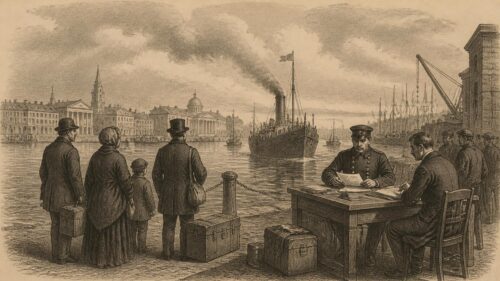
Rights litigation has nevertheless continued to enlarge the class of people whose interests courts must take seriously. The Constitution often speaks of “citizens”, creating uncertainty about the protection available to non-citizens. In NHV v Minister for Justice and Equality in 2017, the Supreme Court considered the position of an asylum seeker who had been prohibited from seeking employment while his protection claim remained unresolved. The Court held that the absolute statutory ban, in the circumstances before it, was unconstitutional.
NHV is important both for work and for constitutional membership. The claimant was not an Irish citizen, but the Court treated constitutional protection as connected to the inherent dignity of the human person rather than citizenship in a narrow formal sense. The ruling did not create a universal constitutional right to employment on whatever terms an individual might choose. It did establish that people seeking international protection could invoke fundamental constitutional interests when state rules imposed a blanket and prolonged exclusion from work.
The case illustrates a broader point about social rights. They often emerge at the boundary between a negative liberty and a positive entitlement. A court may be more willing to strike down an absolute prohibition on work than to order the state to create employment. The difference is legally substantial, even if both outcomes concern livelihood. Irish courts have commonly been more comfortable preventing disproportionate interference than prescribing a detailed programme of social provision.
This pattern should not be mistaken for irrelevance. A declaration that the state cannot impose a particular barrier may have serious consequences for the lives of those affected and may force legislative redesign. But it remains different from a judicially enforceable guarantee that everyone will receive an adequate income, home or service. The distinction explains both the achievements and limits of rights-based litigation in Ireland.
Democratic Revision
Some of the most consequential developments in Irish rights history have occurred not through judicial invention but through constitutional amendment approved by referendum. The constitutional regulation of abortion provides the clearest illustration. The Eighth Amendment, added in 1983, inserted Article 40.3.3 and recognised a right to life of the unborn with due regard to the equal right to life of the mother. Subsequent litigation, including the Attorney General v X case in 1992, revealed the profound legal and human difficulties created by that wording.
Courts interpreted the amendment, but they could not simply replace it. Referendums in 1992 addressed travel and information, while the Thirty-sixth Amendment in 2018 repealed the former constitutional provision and authorised legislation regulating termination of pregnancy. This history is a reminder that constitutional courts operate within a democratic structure in which the people possess the formal power to amend the fundamental law. Litigation may expose tensions, define possibilities and accelerate public argument; it does not displace the referendum process.
The same is true of family and equality questions more generally. Judicial decisions, European judgments, statutory reforms, advocacy and referendum campaigns have interacted rather than proceeded in isolation. The constitutional recognition of children’s rights in the Thirty-first Amendment of 2012 and marriage equality in the Thirty-fourth Amendment of 2015 are examples of major changes made through popular vote and subsequent legislation. The courts remain essential interpreters, but the historical record resists the notion that they alone create social rights.
Historical Verdict
The history of Irish courts and social rights is therefore best understood as a history of contested authority. Nineteenth-century courts frequently enforced a property-centred social order while also providing local forums in which ordinary people appeared, argued and occasionally obtained remedies. The revolutionary period made courts part of the struggle over who possessed legitimate governmental power. The independent state then embedded rights in written constitutions, but it also confined the most explicit social-policy principles to the political sphere.
From Ryan and McGee onwards, Irish judges proved willing to identify important unenumerated personal rights. They protected bodily integrity, privacy and equality in ways that could unsettle inherited legislation. De Burca and Anderson showed that the administration of justice itself could not be insulated from gender and property inequality. Norris demonstrated the value of European supervision where domestic constitutional litigation had failed. NHV confirmed that constitutional protection could reach people who were not citizens and whose precarious status made exclusion from work especially serious.
Yet the courts have generally declined to become managers of distributive justice. O’Reilly, Sinnott and TD mark the limits of judicial readiness to convert human dignity into enforceable duties to provide housing, care, welfare or education at a specified level. Whether that restraint is a constitutional necessity or an avoidable narrowing of rights remains a live question among lawyers, historians and advocates. It cannot be resolved by pretending that judicial power is either insignificant or all-powerful.
For historical purposes, the central lesson is more modest and more useful. Rights become effective through institutions, and institutions are shaped by politics. Courts can articulate principles, invalidate laws, protect a claimant from state intrusion and require public bodies to act lawfully. They cannot by themselves cure social exclusion, nor are they detached from the social assumptions of their age. Ireland’s legal history shows rights as arguments carried between courtroom, legislature, administration and public campaign—arguments whose outcome has depended not only on constitutional text, but on who had the power to make a claim heard.

Article 45’s contrast with the courts’ willingness to recognise unenumerated personal rights is especially revealing. The article suggests that Irish constitutional law can protect bodily integrity, privacy and equal participation while remaining cautious when remedies would direct public spending on housing, welfare or healthcare. This distinction may preserve democratic control over scarce resources, yet it also leaves socially vulnerable people dependent upon legislative priorities and capacity. The history of land reform implies that litigation achieves most when combined with political mobilisation and statutory change. How should Ireland balance judicial protection of dignity with the Oireachtas’s responsibility for allocating resources today?