Niall at Drumain Ua Casáin701 CE
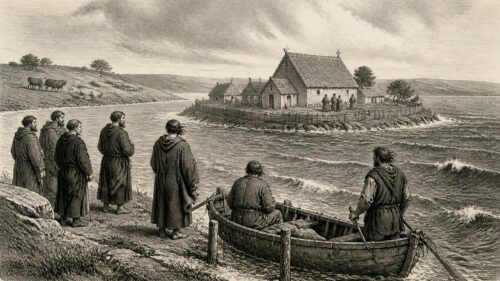
In 701, Niall son of Cernach was killed at the uncertain site of Drumain Ua Casáin by Írgalach, intensifying rivalry between branches of the southern Uí Néill in Brega. Later Columban tradition portrayed the killing as a violation of sanctuary linked to Kells and Írgalach’s death as retribution, though contemporary annals give no details. The year also recorded cattle mortality, threatening wealth, food production, tribute and rural livelihoods. In Munster, Ailill, king of Mumu, and Conall of Uí Fidgente died, prompting uncertain political transitions. Colmán ua hOrc, abbot of Clonard, also died, highlighting ecclesiastical institutions’ religious, economic and political influence.
Dateline
In 701 CE, a killing within the southern Uí Néill transformed an existing dynastic rivalry into a question of sanctuary, legitimacy and control in the Irish midlands. Niall son of Cernach was slain at Drumain Ua Casáin by his kinsman Írgalach, a member of the rival Uí Chonaing branch of Síl nÁedo Sláine. The annals give no description of the encounter beyond the killing itself, and the exact location of Drumain Ua Casáin is uncertain. Yet the event can securely be placed in 701 and was consequential enough to remain embedded in both annalistic and later Columban tradition. It is the clearest political event attributable to the year. Alongside it, the record notes a mortality among cattle, the death of Ailill, king of Munster, the death of Conall, ruler of Uí Fidgente, and the passing of Colmán ua hOrc, abbot of Clonard. Taken together, these notices offer a sharply limited but revealing view of Ireland: a country of competing royal kindreds, agriculturally vulnerable households, and wealthy ecclesiastical centres tied closely to secular power.
A Killing in Brega
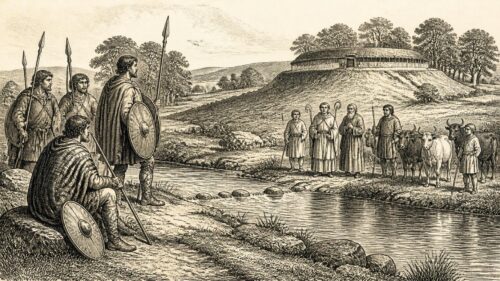
Niall and Írgalach belonged to Síl nÁedo Sláine, the powerful southern Uí Néill dynasty whose interests lay principally in Brega, the broad region around the Boyne and its approaches. This was not a unitary kingdom with a fixed capital or bureaucracy. Authority was exercised through kinship, clientship, tribute, military following and control of strategically placed churches and estates. Rival branches within the same dynasty could co-operate when facing outsiders, but they also competed fiercely for local kingship and for influence over the wider Uí Néill world. By 701, the supremacy claimed by the northern Cenél Conaill ruler Loingsech did not remove such competition in Brega. It provided another prize and another pressure upon it.
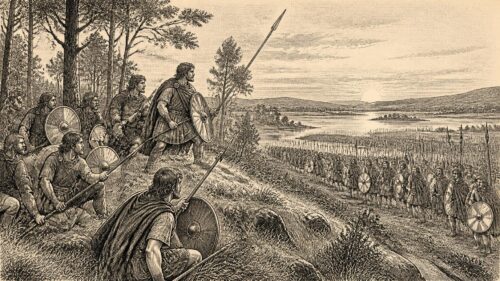
The killing of Niall appears to have been a move in that contest. Írgalach was the grandson or son of Conaing, depending on the source, and his opponent belonged to Clann Chernaig Sotal. Later evidence identifies Niall’s son Fogartach as an important claimant to Uí Néill and eventually Tara-based kingship, which underlines the standing of the family struck in 701. It would be wrong to present the death as the outcome of a known battle or a settled succession war: the contemporary-style annal merely records the slaying. Nevertheless, the elimination of Niall removed Írgalach’s principal rival within their shared dynasty and altered the balance of power in Brega.
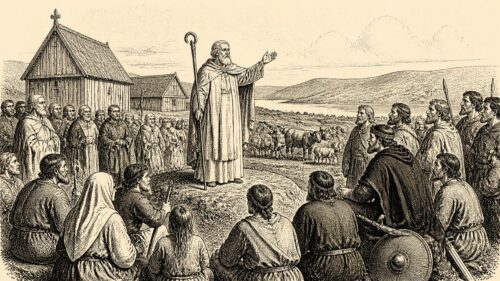
The episode had a religious and political afterlife. Both Niall and Írgalach had been among the rulers associated in 697 with Cáin Adomnáin, the law promoted by Adomnán of Iona for the protection of women, children and non-combatants in warfare. That earlier act did not make Irish politics peaceful, but it shows that leading lay rulers could publicly support ecclesiastical initiatives and accept religiously framed restraints on violence. Later Columban tradition treated Niall’s death as a breach of the protection owed to someone connected with Kells and represented Írgalach’s own violent death in 702 as a divinely foreshadowed consequence. Such stories cannot be read as a verbatim account of 701. They do, however, preserve how church communities remembered the killing: not as an ordinary private feud, but as violence with implications for sanctuary and sacred patronage.
Cattle Mortality and Material Insecurity
The annals also place a mortality of cows in this year. Their wording is strikingly brief. It does not identify the disease, its geographical range, its duration, the number of animals lost, or whether it affected every district. No responsible account can turn that notice into a quantified national catastrophe. Even so, the record deserves serious attention. In early medieval Ireland cattle were not simply food animals. They were an essential form of movable wealth, a means of rendering tribute and compensation, a source of milk and dairy produce, and part of the productive capital of farms and monastic estates. Legal writings of the period repeatedly reckon wealth and obligations in livestock; cattle were central to the language as well as the practice of economy.
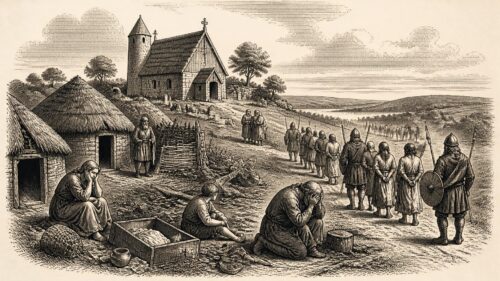
A cattle mortality therefore threatened more than meat supplies. It could reduce dairy yield, diminish herds available for breeding, weaken a household’s ability to meet dues, and constrain the resources available for hospitality or political gift-giving. For poorer families, the loss of even a small number of animals could be particularly severe; for kings and churches, it could diminish the surplus on which retainers, tenants, guests and dependants relied. The annals had already preserved notices of hunger and pestilence in the immediately preceding years, but they do not demonstrate that the cattle disease of 701 was caused by, or prolonged, that earlier distress. The prudent conclusion is narrower: contemporaries considered the livestock mortality sufficiently unusual or damaging to enter in their chronicle.
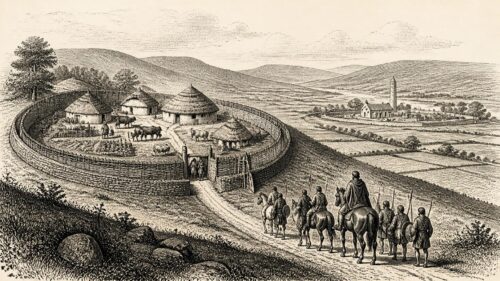
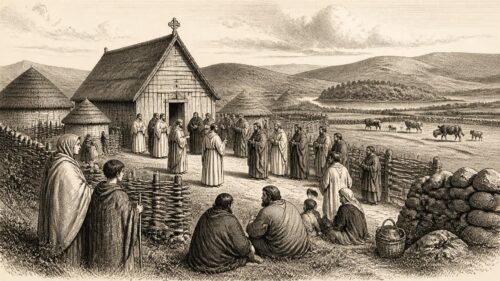
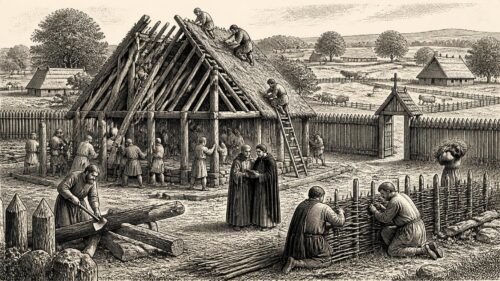
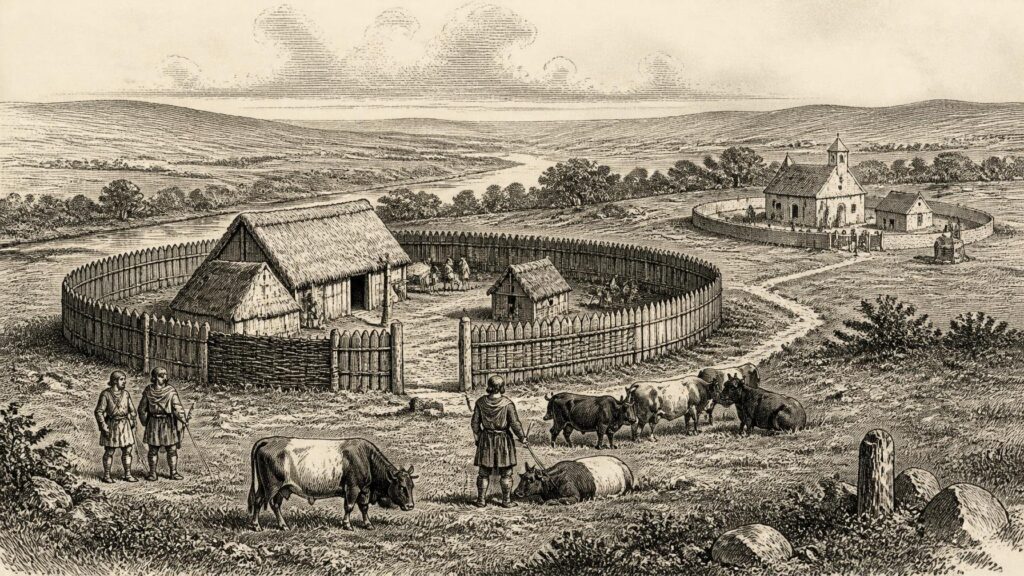
The material setting helps explain why. Most people lived in dispersed rural communities, often in or near enclosed farmsteads now known as ringforts or raths. Fields, pasture, woodland, wet ground and routes to seasonal grazing formed the practical landscape of daily life. Grain cultivation mattered, but cattle underpinned household wealth in an economy without regular coinage. Monasteries, too, maintained outer lands and herds as well as churches and burial grounds. A loss of cattle could thus be felt across the social scale, from small farming households to the estates of kings and saints.
Munster’s Uncertain Transition
In Munster, the annalistic record marks the death of Ailill son of Cú Cen Máthair, styled king of Mumu. Modern prosopographical scholarship accordingly places his death around 701. Ailill belonged to the Éoganacht Glendamnach, one of the leading branches of the Munster royal dynasty. His death mattered because provincial kingship in Munster depended on negotiation and rivalry among related Éoganacht branches, as well as on relations with subordinate peoples and regional rulers. It was not automatically inherited by a single eldest son according to a simple rule.
The same year’s record also gives the death of Conall son of Doinennach, ruler of Uí Fidgente, a major people of the Shannon-side and south-western Munster world. The juxtaposition should not be mistaken for proof that the two deaths were connected; the sources provide no such explanation. But it does show that 701 saw changes in leadership both at the level of Munster’s overkingship and among an important regional population. An uncertain annalistic notice concerning Cormac son of Ailill should not be used to manufacture a neat succession in this year. The evidence does not securely establish who immediately exercised effective authority after Ailill, nor does it describe an inauguration, conflict or settlement. What can safely be said is that political relationships in Munster had to be renegotiated after the loss of rulers whose status rested on lineage, landholding and armed followings.
Clonard and Ecclesiastical Authority
The death of Colmán ua hOrc, abbot of Clonard, adds another dimension to the year. Clonard, in the Boyne valley region, was already an important ecclesiastical institution, associated in tradition with Finnian and with an older reputation for learning. The annal calls Colmán its abbot; another record also styles a Colmán among the ecclesiastical dead of the year as bishop. The duplication and variation of titles are reminders that early Irish church offices do not map neatly onto later diocesan structures. Abbots often headed communities that were religious, landed and politically connected establishments, while bishops performed sacramental functions within a landscape of monasteries, churches and kin-based ecclesiastical families.
An abbatial death was therefore not merely an internal matter for monks. It could affect the management of property, the custody of books and relics, relationships with local rulers, and the standing of a church among its neighbours. The surviving notice tells us nothing about Colmán’s successor, Clonard’s buildings, or the routine of its inhabitants in 701. Yet its inclusion in the annals reflects the prominence that ecclesiastical leadership had acquired in Irish public life. Communities such as Clonard were places of prayer and teaching, but also centres where Latin learning, vernacular legal culture, landholding and aristocratic patronage met.
An Island of Connected Rivalries
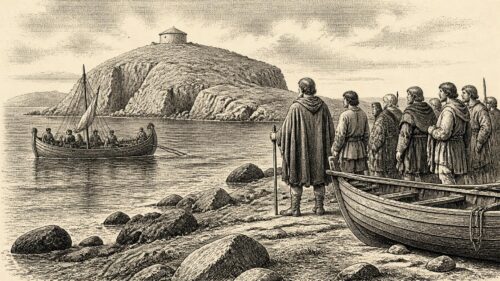
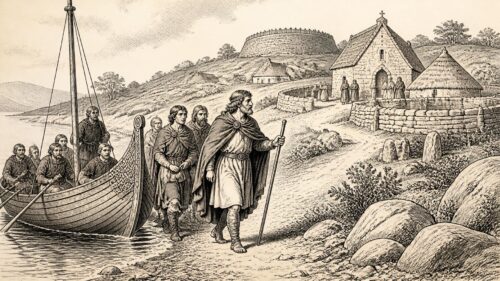
The year should not be treated as though Ireland were isolated or politically uniform. Irish kings and churchmen operated within a network extending across the Irish Sea, to Iona, Britain and the wider Latin Christian world. The record of 701 itself is dominated by Irish affairs, and it does not supply evidence for a particular embassy, trading voyage or overseas campaign from Ireland in that calendar year. Still, the arguments later attached to Niall’s killing show the continuing reach of Columban connections between Brega, Kells and Iona. Written annals, Latin literacy and ecclesiastical law gave political violence a wider audience than the immediate place of a killing.
For most inhabitants, however, 701 was experienced locally: through the safety of herds, the demands of a lord, the authority of a church, the seasonal work of cultivation and dairying, and the security or insecurity created by rival kindreds. The surviving sources preserve kings, abbots and disasters more readily than ordinary families. Their silences are important. They do not permit imagined speeches, battles or ceremonies. But the year’s compact record still captures a real conjunction of pressures: a lethal dynastic act in Brega, leadership losses in Munster, a change at Clonard, and a cattle mortality whose consequences could have reached deeply into everyday rural life.
Primary Sources
- The Annals of Ulster
- The Annals of Tigernach
- Part 11 of The Annals of Tigernach
- Annals of the Four Masters, Part 53
- Annals of Inisfallen, Part 26
- Fragmentary Annals of Ireland, Part 8
- CELT Project: Fragmentary Annals of Ireland
- Írgalach
- Fogartach
- Cináed Cáech
- Cathal Cú Cen Máthair
- Cathal
- Marriage in Early Ireland
- Women and the Law in Early Ireland
- The Triads of Ireland
- Early Christian Monasteries
- Managing Ancient Monuments in Grassland
- High Crosses
- Exploring the Irish Annals
- CELT Project: Annals of Tigernach
- The Annals Attributed to Tigernach
- The Annals of Tigernach /