Crónán Becc at Clonmacnoise694 CE
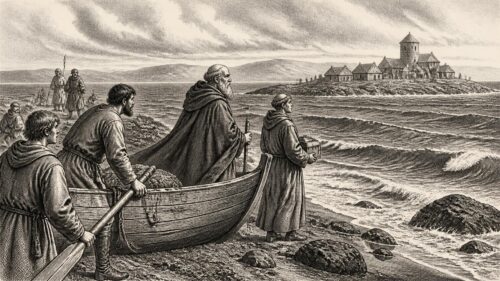
In 694, Crónán Becc, abbot of Clonmacnoise, died, an event securely associated with the year in several Irish annalistic traditions. His obituary reflects the importance of Clonmacnoise as a religious, economic and strategic centre on the Shannon, then largely built of timber. Other notices record the deaths of churchmen including Crónán of Balla, Bishop Bec Fhola and Uidréne of Mag Bili, alongside the killing of the Uí Néill king Cerball and a siege at Dún Foither. Domnall of Alt Clut also died. These sparse, chronologically uncertain records portray a politically fragmented but interconnected Ireland, linked by churches, kinship, waterways and Irish Sea contacts.
Dateline
In 694 CE, the clearest securely associated Irish event was the death of Crónán Becc, or Crónán “the Little”, abbot of Cluain Moccu Nóis—Clonmacnoise—on the River Shannon. It is a modest record beside the spectacular battles and royal killings that often dominate the annals, but it offers an unusually useful view of Ireland’s real centres of gravity. An abbot’s death mattered because a major monastery was not simply a retreat for prayer: it was a religious community, a landholder, a place of learning and writing, a destination for visitors, and a point at which regional politics met the wider Irish world. The entries associated with this year also record the deaths of other churchmen and rulers, a killing and a siege. Together they reveal a country of many small, competing powers, linked by churches, kinship and routes of travel rather than governed by a single state.
A Careful Year in Difficult Sources
Medieval Irish annals are indispensable but must be read critically. Their surviving manuscripts are later copies, their chronological systems do not always align, and an annal-number is not always identical to a modern calendar year. For 694, the Annals of Tigernach record Crónán Becc’s death, that of Domnall son of Aun, king of Alt Clut, and the death of Crónán of Balla. The Fragmentary Annals of Ireland likewise place the deaths of Crónán of Clonmacnoise and Crónán of Balla in 694, while also associating the year with Uidréne of Mag Bili and the killing of Cerball son of Máel Odar. The Annals of Ulster preserve a fuller group of notices under their annal U694, though their own calendar calculation labels that heading AD 693.
The distinction matters. It would be unsafe to claim an exact day, season or sequence for these events, or to turn a terse notice into a detailed narrative. It is, however, responsible to treat the deaths of Crónán Becc and Crónán of Balla as firmly connected with 694 by more than one annalistic tradition. The killing of Cerball, the siege of Dún Foither, the death of Ferchar son of Connaed Cerr, the death of Domnall of Alt Clut, Bishop Bec Fhola’s repose and Uidréne of Mag Bili’s death belong to the same annalistic cluster. They illuminate the political and ecclesiastical setting of the year, even where the evidence cannot establish precisely when within it each occurred.
The Abbot of a Shannon Monastery
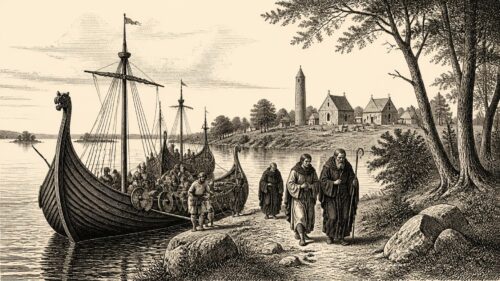
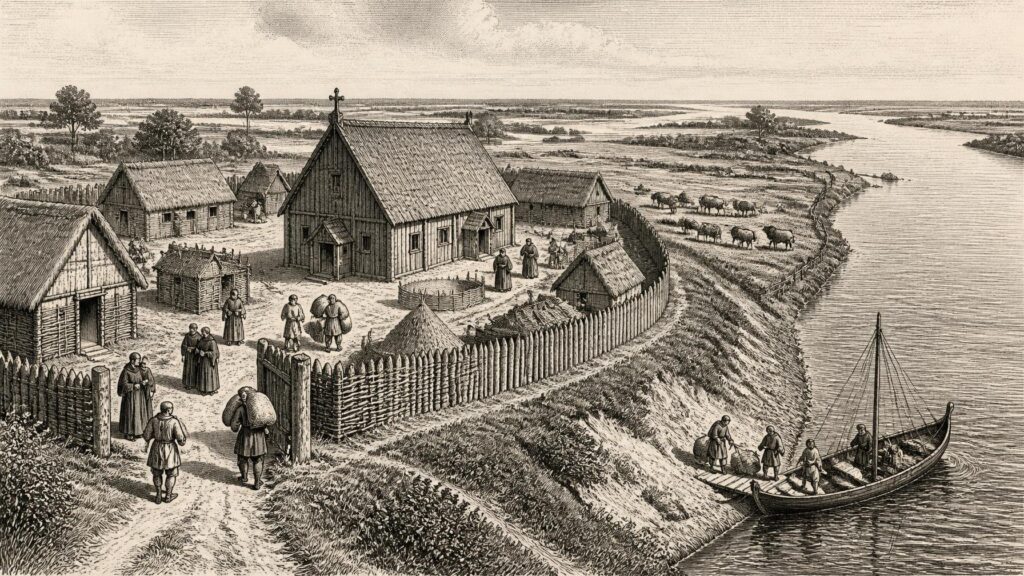
Crónán Becc headed one of the most strategically situated churches in Ireland. Clonmacnoise stood on an esker beside the Shannon, near a crossing of major north–south and east–west routes. Its geography explains much of its importance. The river was a principal artery for people and goods, while the raised gravel ridges offered comparatively dependable overland passage through surrounding bogland. The monastery also occupied a politically sensitive position between the broad spheres later described as Connacht to the west and Mide to the east.
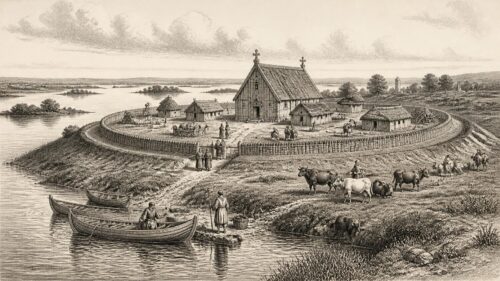
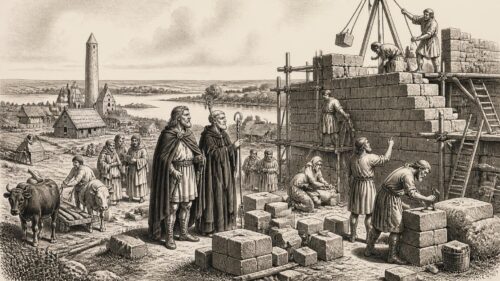
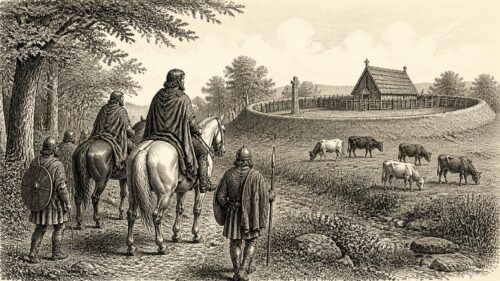
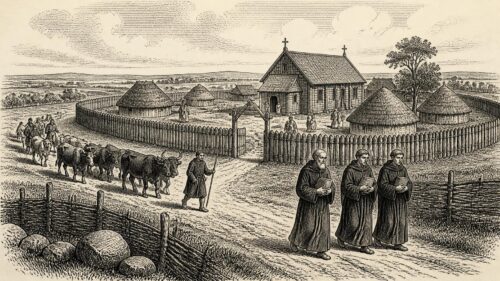
In 694, the familiar stone churches, round tower and monumental crosses visible at Clonmacnoise today did not yet define the settlement. Those are chiefly later survivals. The seventh-century community would have been largely timber-built: churches, dwellings, workshops, storage buildings and ancillary structures within an enclosure that marked sacred space and regulated movement. Archaeology and documentary evidence for early medieval Ireland indicate that prominent ecclesiastical sites accommodated far more than ordained clerics. Monks, priests, students, dependants, craftspeople, agricultural workers, travellers and pilgrims could all be present. An abbot therefore administered people and resources as well as spiritual discipline.
Crónán’s epithet, Becc, means “little”, but no physical description, achievement or cause of death accompanies the annal. His obituary instead tells us most clearly about the standing of his office. To be named as abbot of Clonmacnoise was sufficient for memorialisation in a record otherwise highly selective about the dead. The omission of a successor is equally instructive: succession was important, but the annals did not always preserve the process. We should not assume either a crisis or a smooth transfer merely because the source is silent.
Churches Beyond Clonmacnoise
Crónán was not the only religious figure associated with the year. The same annalistic material records Bishop Bec Fhola and Uidréne of Mag Bili as having “rested”, the conventional Christian language of death. Crónán of Balla, a churchman associated with Balla in present-day County Mayo, also died. These sparse notices demonstrate the density of ecclesiastical networks across Ireland: Clonmacnoise in the central Shannon region, Balla in Connacht, and Mag Bili in the north-east all appear within the year’s record.
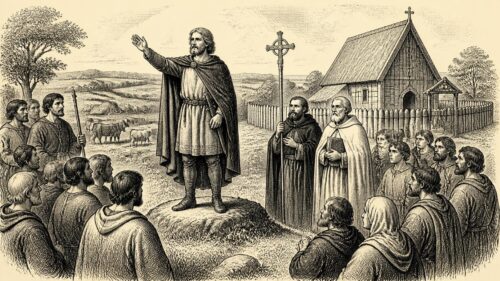
Such entries should not be mistaken for a national church administered from a single headquarters. Irish Christianity was organised through numerous locally rooted churches and federations of dependent communities. Their leaders’ authority rested on religious reputation, kin connections, landed endowment, control of churches and burial places, and relationships with secular rulers. Bishops mattered, but abbots could be especially influential in the institutions recorded by the annals. Monasteries were also places where Latin learning and the Irish language met on the page: annalists dated events through Christian time-reckoning while preserving Irish personal names, titles and places.
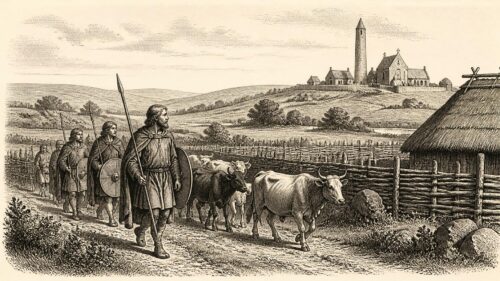
Daily life within and around such communities was demanding. Food had to be raised, animals managed, grain processed, timber cut and repaired, books copied, guests fed, and land rights defended. Cattle remained central to wealth and status in early medieval Ireland, while farming mixed livestock husbandry with cereal cultivation where soils and labour permitted. There is no evidence for a harvest failure or environmental disaster specifically in 694. It would be wrong to supply one. But the practical economy supporting Crónán’s monastery depended on seasonal work, local produce and the movement of people and supplies along the Shannon corridor.
Violence Without a National War
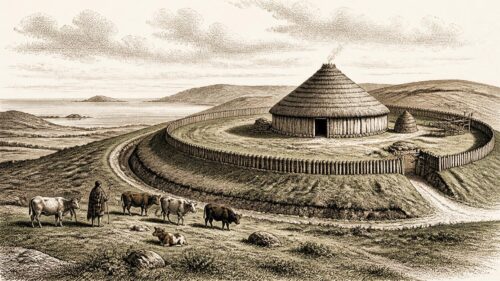
The year’s secular notices are brief but pointed. Cerball son of Máel Odar was killed; the Annals of Ulster identify him as a king of Uí Néill. A siege took place at Dún Foither, although the sources do not name the attackers, defenders, outcome or location with enough certainty to reconstruct the episode. Ferchar son of Connaed Cerr died. These are reminders that political life was conducted through rival kin-groups and overkingships, in which raids, killings, hostage-taking and the possession of fortified places could all be instruments of rule.
“Ireland” in 694 was a cultural and geographical whole, but not a unified kingdom in the modern sense. Kingship was layered and contested. A ruler might control a small people or territory, seek dominance over neighbouring groups, and acknowledge or resist a more powerful dynasty according to circumstance. The annals’ concentration on named men reflects elite priorities, yet political violence affected wider communities: hosts needed food and transport; farms could be raided; and churches might serve as places of negotiation, sanctuary or commemoration. The record does not allow us to attach Clonmacnoise directly to the siege at Dún Foither or Cerball’s death, so no such connection should be imagined.
Alt Clut and the Irish Sea
The death of Domnall son of Aun, king of Alt Clut, adds an important dimension. Alt Clut—later Dumbarton Rock—was a British kingdom on the Clyde, across the Irish Sea from northern Ireland. Its inclusion in Irish annals does not make it an Irish event, but it confirms the sea’s role as a route, not a barrier. Irish ecclesiastics, dynasties and traders maintained contacts with western Britain and with the Hebridean world. News of royal deaths, ecclesiastical affairs and conflict could move through these connected maritime and riverine networks.
This wider horizon is relevant to Clonmacnoise as well. A Shannon monastery was linked inland by boat traffic and overland tracks, but the Shannon also opened towards Atlantic and Irish Sea routes. The evidence does not show a particular voyage from Clonmacnoise in 694. Rather, it shows why the death of an abbot there and that of a Clyde king could both matter to compilers working within an interconnected Gaelic and British world.
What 694 Leaves Behind
There is no single dramatic story for 694 CE. Its historical value lies in concentration rather than spectacle: an abbot died at a major Shannon crossroads; church leaders elsewhere were commemorated; a Uí Néill king was killed; a fort was besieged; and the death of an Alt Clut ruler registered across the sea. The evidence is uneven, and the calendar requires care, but it is enough to recover the outline of a living society. Ireland was rural, politically fragmented and often violent, yet bound together by monasteries, kinship, cultivated land, waterways and shared systems of memory.
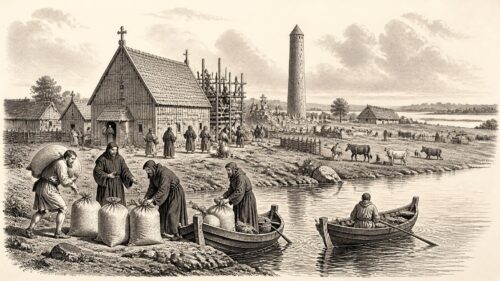
Crónán Becc’s obituary is consequently more than a line in a chronicle. It fixes Clonmacnoise within the active institutional landscape of the late seventh century, before its later stone monuments transformed its physical appearance. In that year, its authority was embodied not in ruins but in people: an abbot, a religious community, labouring dependants, visitors on the Shannon and patrons whose gifts and protection sustained the place. The annals preserve Crónán’s name because such a community mattered. Their silence about most of the people around him is a limitation of the record, but not evidence that they were absent.
Primary Sources
- The Annals of Ulster
- The Annals of Tigernach
- Fragmentary Annals of Ireland
- Annals of the Four Masters: Volume 1 English Translation
- Chronicon Scotorum
- Annals of Inisfallen
- Chronological Synchonisation of the Irish Annals
- Chronological Synchronisation of the Irish Annals: Annals Chronology
- Exploring the Irish Annals
- List of Published Texts at CELT
- Clonmacnoise Monastic Site
- Clonmacnoise Visitor Guide
- Clonmacnoise, County Offaly
- Agriculture, Settlement and Society in Early Medieval Ireland
- The Economy of Early Medieval Ireland
- Early Medieval Ireland: Archaeological Excavations, 1930–2009
- Early Medieval Ireland, AD 400–1100: The Evidence from Archaeological Excavations
- Monastic Enclosure at Clonfad
- Settlement Patterns and Socio-Economic Change in the Diocese of Tuam c. AD 400–1000
- Reassessing the Irish ‘Monastic Town’