Ogoman Clonfert662 CE
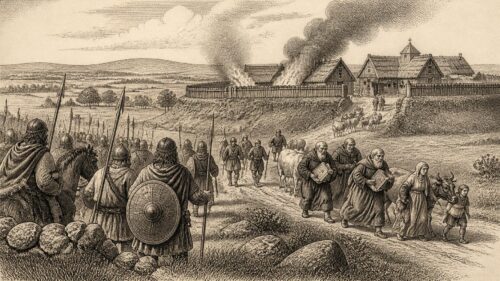
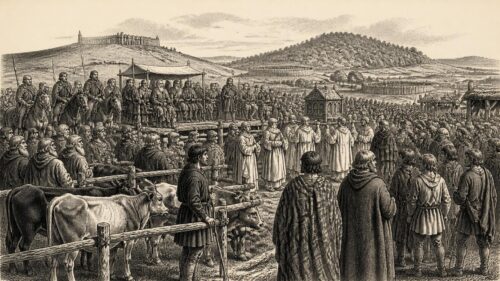
In 662, the battle of Ogoman exposed rivalry within the southern Uí Néill of Brega, killing Conaing, Ultán of the Ciannachta and Cenn Fáelad. Accounts suggest Blathmac was defeated by followers of his brother Diarmait, though the political outcome remains uncertain. The annals also record the death of Máenach, king of Munster, emphasising the importance of Eóganachta descent. Cummíne Fota of Clonfert died around 661–62 and was remembered as a distinguished scholar of the Easter controversy. These events reflect an Ireland of competing kin-groups, rural lordships and influential ecclesiastical networks.
Dateline
In 662 CE, Irish annalists associated a cluster of political deaths, a battle within the southern Uí Néill and the passing of a celebrated church scholar with this year. The evidence is unusually revealing but not perfectly uniform. The Fragmentary Annals explicitly place the battle of Ogoman, the death of King Máenach of Munster and that of Cummíne Fota in 662; other annalistic compilations place some of the same notices under adjacent year-headings. This is a familiar problem in early Irish chronology, not a reason to discard the events. It does mean that no day, season or sequence within the year can responsibly be supplied. What can be said is that 662 was remembered as a year in which rivalry at the summit of Brega, a royal death in Munster and the loss of an internationally minded cleric exposed the political and intellectual character of seventh-century Ireland.
Conflict at Ogoman
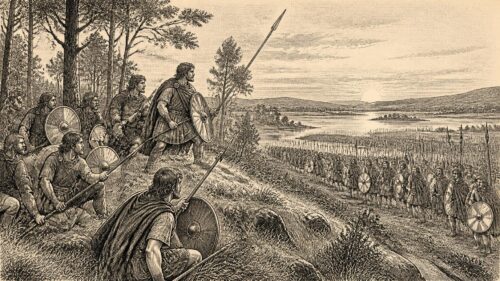
The year’s principal political event was the battle of Ogoman. The fullest annalistic notice names three men killed there: Conaing son of Congal, Ultán son of Ernaine, king of the Ciannachta, and Cenn Fáelad son of Gerthide. A related account calls Cenn Fáelad king of Ard Ciannachta and locates the battle at Cenn Corbadáin. Yet neither the scale of the fighting nor the precise location of Ogoman is securely recoverable from the surviving evidence. The annals do not describe formations, numbers, weapons, terrain or the civilian consequences. It would therefore be wrong to turn their compressed notice into a detailed battlefield narrative.
What the entries do make clear is that Ogoman was not an anonymous local affray. Conaing belonged to Síl nÁedo Sláine, the powerful southern Uí Néill dynasty that dominated Brega and supplied leading claimants to the kingship of Tara. Ultán and Cenn Fáelad represented the Ciannachta, an important people of the wider Brega region. Their presence on the same casualty list suggests that the battle joined dynastic competition to the politics of subordinate or allied groups. The Ciannachta held territory and churches in the eastern midlands and north-eastern plain; their rulers were not mere spectators when Brega’s leading kindreds quarrelled.
The immediate political meaning is debated because the texts preserve awkward and sometimes differently interpreted wording about Blathmac son of Áed Sláine and Diarmait Ruanaid, his brother. Both men are generally treated as sharing the highest level of Uí Néill power in these years. The Fragmentary Annals state that Blathmac was defeated by Diarmait’s followers, while the Annals of Ulster phrase the relationship in a way that has prompted discussion. Later annalistic material adds that, “as some say”, Ogoman marked the end of Blathmac’s reign and the beginning of Diarmait’s. That formulation is itself a warning: it records a tradition of political change, rather than offering an uncontested constitutional verdict.
A Dynasty’s Internal War
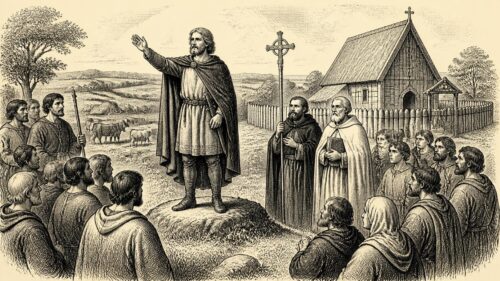
Modern historical interpretation consequently treats Ogoman as an internal struggle within Síl nÁedo Sláine, not as a war between an Irish kingdom and an outside invader. Blathmac’s defeat may indicate that Diarmait temporarily gained the stronger position among the brothers. It does not prove that either man became sole ruler of all Ireland in a modern sense. Seventh-century Irish authority was layered. Kings depended upon kin, client rulers, control of productive land and livestock, military followings, and the willingness of church communities and lesser dynasties to recognise their status. A title connected with Tara expressed exceptional prestige, but it did not create a single central state.
Conaing’s death made the contest more consequential than a personal quarrel. He was Blathmac’s nephew, and later generations knew his descendants as the Uí Chonaing, a lineage associated with Cnogba or Knowth in northern Brega. His loss did not erase that family from politics, but it removed a prominent adult figure at a volatile moment. The battle also cost the Ciannachta their king, Ultán. Another entry for the year records the killing of Máel Fuataig son of Ernaine. Since the annals do not explicitly connect Máel Fuataig’s death with Ogoman, it cannot safely be presented as another casualty of the battle; nevertheless, the concentration of named deaths conveys the instability surrounding the Ciannachta leadership.
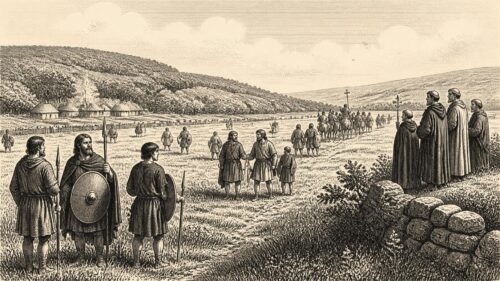
This was political violence conducted through close relationships, not impersonal warfare between fixed national blocs. Genealogy mattered because it set out claims to land, honour and office; fosterage, marriage and ecclesiastical patronage could reinforce those claims. The named dead had households, dependants and religious affiliations whose security would have been affected by a change in leadership. For farmers and herders in Brega, the effects may have included demands for food-renders, transport, cattle and fighting men. The sources do not permit a calculation of those burdens in 662, but the social importance of cattle, agricultural produce and clientship helps explain why a feud among royal houses mattered far beyond the immediate combatants.
Máenach’s Death in Munster
Far to the south, the annals record the death of Máenach son of Fíngen, king of Mumu or Munster. The pedigree attached to his notice traces him through Áed Dub, Crimthann and other ancestors to Óengus son of Nad Fraích, an emblematic forebear of the Eóganachta. Such genealogical detail was political language: it announced Máenach’s place within the ruling dynasty of Cashel as well as preserving his name. His death is securely associated with 662 in the Annals of Inisfallen and the Fragmentary Annals, although some chronological systems assign the notice to 661.
The contemporary record supplies no account of Máenach’s final illness, burial, achievements or immediate succession. It is therefore safer to say that his death created a vacancy in Munster’s kingship than to portray a particular successor as taking power at a known ceremony in 662. The silence is still significant. It illustrates the annals’ priorities: they preserve a ruler’s death and descent, but rarely describe routine administration. Munster, like Brega, was a patchwork of powerful kindreds, church federations and rural communities rather than a territorial monarchy governed from an urban capital.
Cummíne Fota’s Intellectual Afterlife
The most richly commemorated death linked with 662 was that of Cummíne Fota, “Cummíne the Tall”, associated with Clonfert and remembered as successor to St Brendan. His obit gives his age as seventy-two. The date should be treated cautiously: annalistic traditions range between 661 and 662, while a much later compilation provides a specific day. The responsible conclusion is that Cummíne died about 661–62 and was firmly memorialised in the annalistic sequence now conventionally connected with 662. He must also be distinguished from Cumméne Find, the contemporary abbot of Iona; similar names have often encouraged confusion.
Cummíne’s importance lay in learning as well as ecclesiastical office. He is probably the author of De controversia Paschali, a substantial Latin letter written around 632 to Ségéne, abbot of Iona, and the hermit Béccán. The letter argued for adopting the Easter calculation used by the wider Latin church. Its author assembled biblical, patristic and computistical authority, presenting Irish churchmen as participants in a learned Christian world extending beyond the island. The Easter dispute was not a superficial disagreement over dates: shared calculation determined when communities fasted and celebrated together, and it touched questions of tradition, authority and connections with Britain and the continent.
A lament preserved in the Fragmentary Annals calls Cummíne a beacon of Irish wisdom and imagines him worthy of standing in Gregory’s city. The poem should not be treated uncritically as a verbatim report from the year of his death, since the compilation that preserves it is later and its transmission is complicated. Even so, it is powerful evidence for the reputation later attached to him: Cummíne was remembered as both a cleric and the descendant of a ruling family, a man in whom scholarship, sanctity and aristocratic status reinforced one another.
Rural Ireland and Monastic Networks
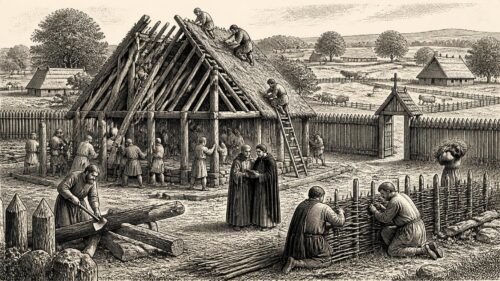
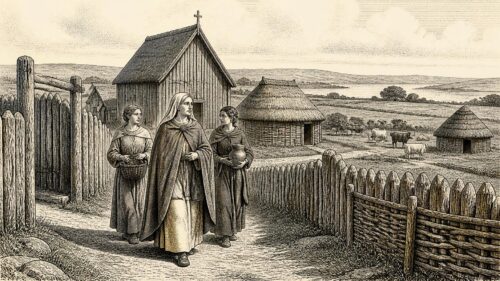
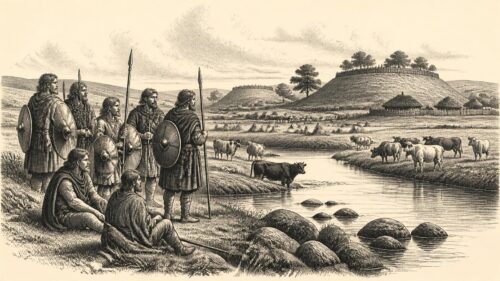
Behind the notices of kings and scholars stood a predominantly rural society. Ireland in the seventh century had no towns comparable to Roman or Frankish cities. Most people lived in dispersed farmsteads and enclosed settlements, cultivating cereals and maintaining livestock. Ringforts, crannógs and other settlement enclosures formed part of this landscape, though not every surviving site can be dated precisely to 662. Cattle were central to wealth, food, status and political exchange; grain, dairy produce, pigs, sheep and craft goods also sustained households and religious communities. Nothing in the annals authorises a claim of famine, exceptional harvest or environmental crisis for this particular year.
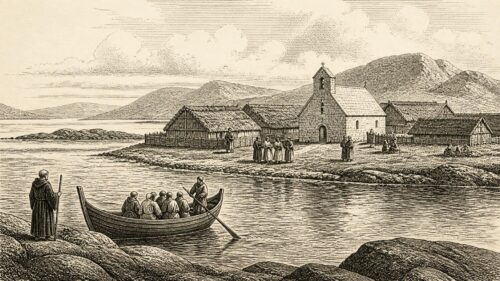
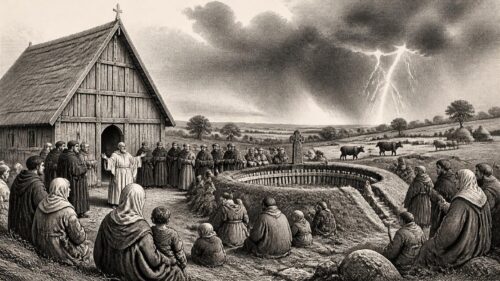
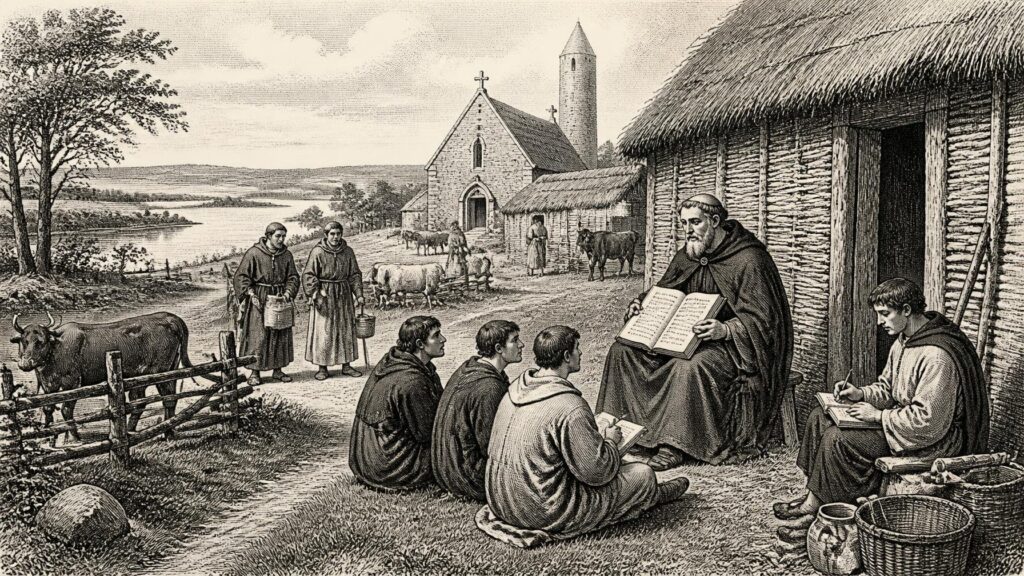
Monasteries were likewise embedded in, rather than detached from, that rural economy. Clonfert’s place in the memory of Cummíne, Lugmad’s abbot Scanlán—whose death is also entered for the year—and the Ciannachta churches of Brega point to an island linked by roads, rivers, coastal routes, kinship and literacy. Religious houses prayed, taught, copied texts, received gifts and managed lands; they also negotiated with kings and preserved the records from which later annals were fashioned. In 662, the battle of Ogoman and the death of Cummíne Fota show these worlds meeting. Political power could be violently contested, while intellectual authority was carried through books, calculation and institutional memory.
The surviving record of 662 is brief, but its concentration of notices is instructive. Ogoman shows that even a pre-eminent dynasty could fracture from within. Máenach’s obit shows how kingship in Munster remained anchored in descent. Cummíne’s commemoration demonstrates that Irish learning had horizons wider than any one kingdom. Together, these carefully bounded pieces of evidence offer a vivid view of an Ireland governed through competing kin-groups and local lordships, yet bound into durable ecclesiastical and scholarly networks.
Primary Sources
- The Annals of Ulster
- Part 232 of The Annals of Ulster
- Fragmentary Annals of Ireland
- Part 1 of Fragmentary Annals of Ireland
- Chronicon Scotorum
- Part 63 of Chronicon Scotorum
- Part 3 of Annals of Inisfallen
- The Annals of Tigernach
- De controversia Paschali
- TEI Header for De controversia Paschali
- Cummian (Cummíne, Cumméne) Foto
- Blathmac
- Diarmait Ruanaid
- Írgalach
- Chronological Synchronisation of the Irish Annals
- Contributions towards the Political History of Munster, 450–800 A.D.
- Kingship, Society, and Sacrality: Rank, Power, and Ideology in Early Medieval Ireland
- Agriculture, Settlement and Society in Early Medieval Ireland
- The Economy of Early Medieval Ireland
- Ringforts / Ráthanna
- Religion and Society in Ireland
- Early Medieval Rural Settlement Archaeology in Ireland and the Impact of Large Infrastructural Developments
- Monasterboice Conservation Study
- Kingship, Violence and Loch Dá Gabor: Royal Landscapes and the Production of Authority in Early Medieval Brega