Conflicting Annals648 CE
Notices assigned to 648 by the Annals of the Four Masters, including the death of Abbot Mainchéne and the killing of Cillíne of Uí Failge at Cúil Corra, appear under 652 in older annalistic traditions. They therefore illuminate the mid-seventh century rather than securely dating events to 648. The period saw contested Uí Néill overlordship, with Conall Cóel and Cellach’s authority uncertain, alongside politically significant regional rulers. Monasteries were major religious, economic and learned institutions, while most people lived through farming and cattle husbandry. Ireland remained a network of competing local kingdoms, kin-groups and churches, not a unified state.
Dateline
In 648 CE, Ireland was governed through many competing kingships, churches and kin-groups rather than by a single state, and the surviving evidence must be handled with unusual care. A famous cluster of notices is assigned to this year by the seventeenth-century Annals of the Four Masters: the ninth year of Conall and Cellach, the death of Maincheni, abbot of Meanadrochit, the conflict of Cúil Corra in which Cillíne son of Forannán of Uí Failge was killed, and the death of Cugamhna son of Suibne. Yet the older annalistic traditions place the same cluster several years later, under their annal for 652. Thus these are records connected with the later reckoning of 648, not events that can responsibly be asserted to have occurred in the calendar year 648 itself.
A Year Label Under Examination
This is not pedantry. Irish annals are indispensable for seventh-century history, but their year-numbers were copied, calculated and sometimes displaced over centuries. The Annals of Ulster, Annals of Tigernach and Chronicon Scotorum preserve related material ultimately deriving from earlier chronicles; their surviving manuscripts and editorial year labels are not identical. The Four Masters, compiled in the 1630s from a wide range of manuscripts, remains a monumental source, but its chronology for the early Middle Ages can diverge sharply from the kalend-based annal tradition. A modern reader should therefore resist converting an annal heading automatically into an exact modern date.
The case of Cúil Corra makes the point particularly well. The Four Masters enters it under 648. The Annals of Ulster and Chronicon Scotorum, however, group the battle with the obit of Mainchéne of Min Droichit under 652, while the medieval dating apparatus surrounding those notices has its own difficulties. Modern chronological work has shown why early Irish annal dates need synchronising against their kalends, weekday data and securely dated external events. The safest conclusion is modest: the notices are genuine evidence for a sequence of events in the middle of the seventh century, conventionally associated with the early 650s in the older annal tradition, but not firm proof that they happened during 648 CE.
That caution does not make 648 an empty year. It reveals how history was organised and remembered. A later compiler could frame a year through royal tenure, a monastic death, a local killing and the passing of a named man. Such entries are terse because they were not designed as narrative histories. They preserve what particular ecclesiastical record-keepers considered worth retaining: changes among rulers, losses within religious communities and violent disruptions of political order. The silences are equally important. There is no securely dated record for 648 of a nationwide assembly, famine, epidemic, foreign expedition or change of law.
Conall and Cellach’s Fragile Ascendancy
The royal context assigned by the Four Masters was the joint rule of Conall Cóel and Cellach, sons of Máel Coba of Cenél Conaill, a leading northern branch of the Uí Néill. Their uncle Domnall mac Áedo had died in 642. Later king-lists counted Conall and Cellach among rulers of Tara, but the contemporary annalistic tradition itself expressed doubt about who succeeded Domnall, reporting a possible “mingled rule” involving the two brothers and Diarmait and Blathmac, sons of Áed Sláine. That ambiguity is a better guide than the later language of a settled high kingship.
In practical terms, political influence was layered. Ireland contained numerous tuatha, small kingdoms whose rulers owed varying degrees of alliance, tribute or military service to more powerful neighbours. An overking’s authority depended on relationships, hostages, gifts, marriage ties, armed followers and success in war. It did not resemble a modern government with fixed territorial departments or permanent officials. Conall and Cellach possessed standing within the northern Uí Néill, but their position in the midlands was insecure. The southern Uí Néill line of Síl nÁedo Sláine, represented by Diarmait and Blathmac, was already a formidable rival.
It would be wrong, however, to turn the year 648 into a prelude to later events as though their outcome were inevitable. Conall and Cellach did not meet and defeat their cousin Óengus at Dún Cremthainn until 650, and Conall was killed by Diarmait in 654. Those firmly separate events show that the wider struggle for Tara was still unsettled, but they should not be imported into 648 as though they were already under way in a documented campaign. The annalistic formula that calls a year the ninth of the brothers’ rule is evidence for later regnal reckoning, not proof that their authority reached uniformly across Ireland.
Cúil Corra and Uí Failge
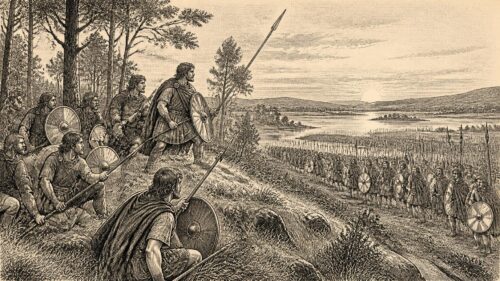
The conflict labelled Cúil Corra is the sharpest political notice attached to the Four Masters’ 648. Its wording is spare: Aeldeth, or Máel Deich in other versions, and Onchú were victors; Cillíne son of Forannán fell. The later source calls Cillíne chief of Uí Failge, while the Annals of Ulster and Chronicon Scotorum call him king. The difference is partly one of translation and rank, but it confirms his importance within Uí Failge, the dynasty whose territory lay in the central Irish midlands, broadly associated with parts of present-day Offaly and neighbouring districts.
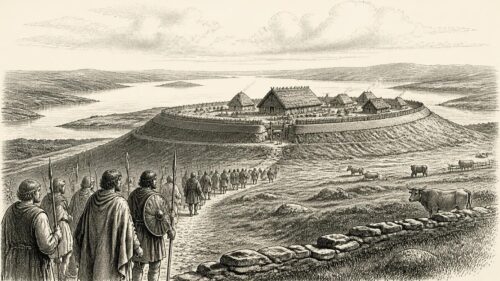
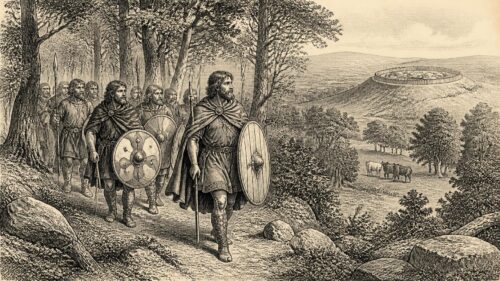
The exact location of Cúil Corra is not securely established, and neither source explains why the rivals fought, how many men were involved, or what followed immediately afterwards. It would be fanciful to picture a vast national battle. Early medieval Irish conflicts could be raids, ambushes, attacks on an inauguration site, disputes over succession or confrontations between allied warbands. The death of a local king nevertheless mattered greatly. A ruler was the point at which landholding kin, clients, church connections and military leadership met. His loss could alter the balance among neighbouring lineages even when no distant overking appears in the record.
Uí Failge’s midland position made it especially relevant to larger contests without making it merely a pawn of Tara. The region stood near routes linking the east, the Shannon basin and the southern midlands. Its rulers had their own dynastic interests, and the record of Cúil Corra should be read first as an event within that regional world. The bare naming of victors may indicate that their identities were meaningful to the annalist’s intended audience, but it does not allow their affiliations or motives to be reconstructed securely. Here, the responsible history is a precise acknowledgement of what is known and of what the sources leave unsaid.
Meanadrochit and Learned Christianity
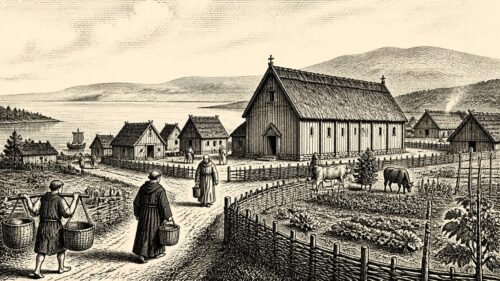
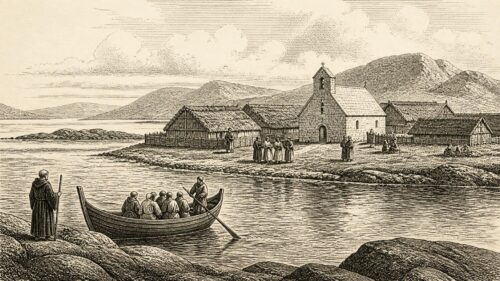
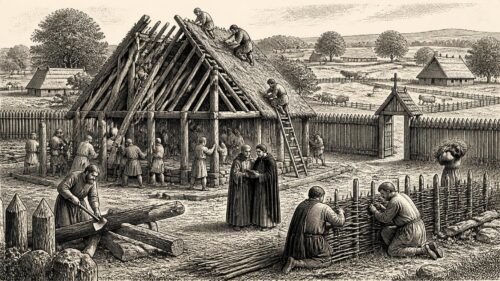
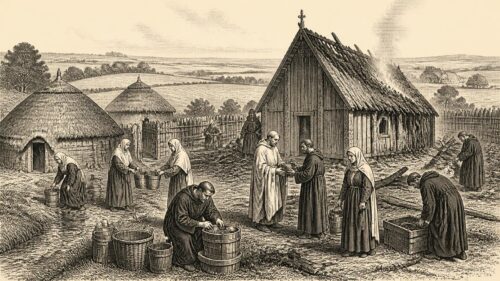
The death of Maincheni, or Mainchéne, abbot of Meanadrochit—usually identified with Min Droichit or Mondrehid in the Upper Ossory area—offers a different glimpse of the same society. The title abbot does not simply denote the head of a secluded community. Irish churches were centres of worship, burial, learning, estate management and exchange, tied to powerful families and local populations. A monastery’s fields, livestock, tenants, guests and dependants connected it to the surrounding countryside. Recording an abbot’s death therefore marked the loss of a religious figure and a manager of important social resources.
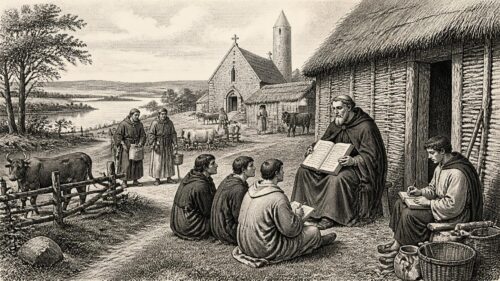
There is an attractive intellectual association here, but it requires qualification. A Latin work written in Ireland about 655, De mirabilibus sacrae scripturae, refers to a teacher named Manchianus and later notes the death of a Manchianus in its chronological calculations. Scholars have connected this learned figure with Mainchéne of Min Droichit, and the possibility would place a named abbot close to the vigorous world of Hiberno-Latin biblical study. But the identification is not beyond dispute: similar names, later manuscript transmission and differing annal dates warn against presenting it as certain biography.
What can be said confidently is that Ireland in this period possessed communities capable of sustained Latin scholarship, scriptural interpretation and complex calculation of Easter cycles. Monastic networks linked Irish institutions with Britain and the Continent through books, travellers and correspondence. The survival of names such as Mainchéne in annals is a small but valuable sign of the human institutions that supported this learning. It should not be imagined that every monastery was a school of international fame; rather, religious houses formed a varied network, and some produced or nourished exceptionally ambitious intellectual work.
Fields, Cattle and Ordinary Lives
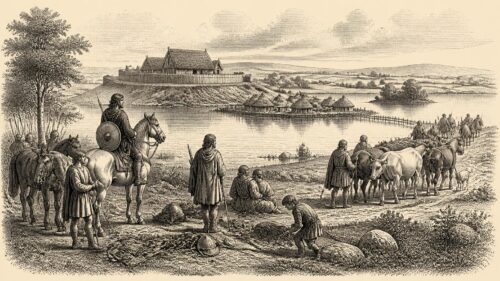
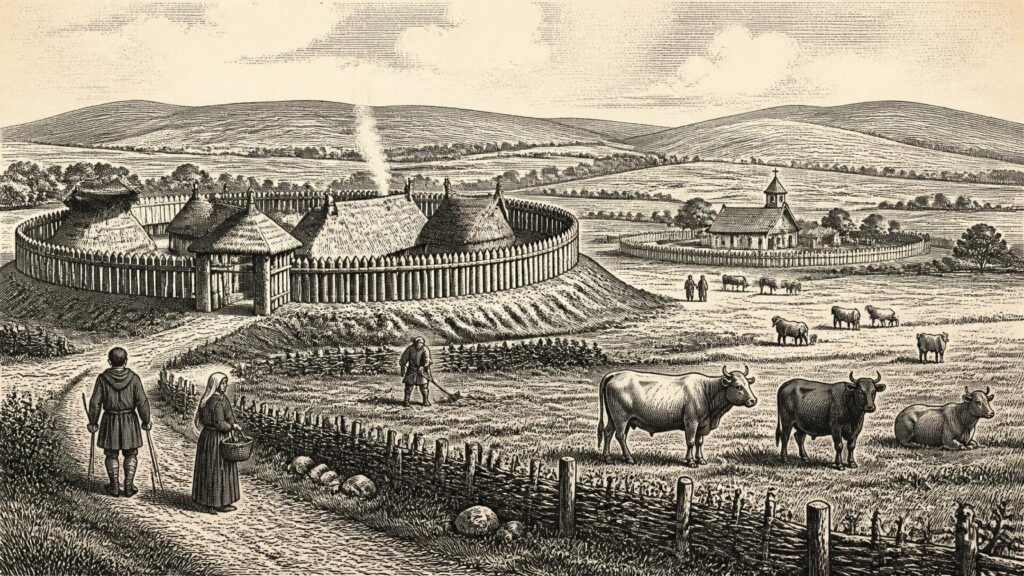
Most people in 648 lived beyond the annals’ narrow field of vision. Their world was rural and seasonal: households cultivated crops, managed cattle and pigs, gathered fuel and maintained buildings, fences and tracks. Archaeological and environmental research indicates that cattle held exceptional economic and social value in early medieval Ireland. They provided milk and dairy products, breeding stock, traction and units through which wealth, compensation and status could be expressed. Open pasture was consequently a major feature of managed landscapes, though arable plots, woodland resources and wetland margins also mattered.
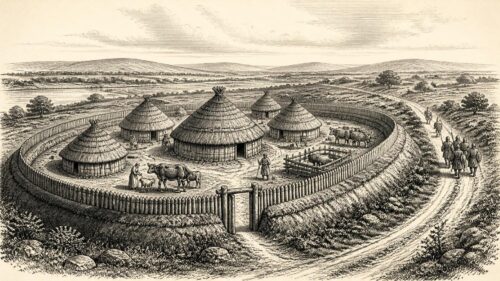
Ringforts and related enclosed settlements were characteristic settings for many farming households and local elites. Their banks and ditches were practical boundaries as well as statements of household standing, and some could help secure animals. The political violence recorded in terse annal entries was inseparable from this agricultural order: rulers required food-renders and followers; monasteries needed land and labour; cattle could be tribute, compensation or plunder. Yet no source permits us to claim a particular harvest, weather pattern or economic crisis for 648. The ordinary work of producing food is secure context, not a dated event.
What 648 Can Bear
The year is therefore best understood as a lesson in evidence as well as an interval in Irish history. The Four Masters preserved a compelling set of notices under 648: a contested royal regnal year, an abbot’s death, a midland conflict and another personal obit. Their testimony preserves real names and relationships. But comparison with the older annalistic witnesses shows that the date is unstable. Cúil Corra and Mainchéne belong responsibly to the historical landscape surrounding 648, not securely within its twelve months.
That distinction strengthens rather than weakens the picture. Around the middle of the seventh century, Uí Néill ambitions were contested, regional kings such as Cillíne mattered, monasteries were embedded in local society, and learned Latin culture was flourishing within Irish ecclesiastical networks. Ireland was neither isolated nor politically unified. Its history was made in overlapping local worlds—royal, pastoral, ecclesiastical and familial—which the annals caught only in brief flashes. For 648 CE, the clearest conclusion is that the calendar itself remains part of the historical problem.
Primary Sources
- Annals of the Four Masters, Annal M648
- The Annals of Ulster, Year U652
- The Annals of Ulster: Latin and Irish Texts
- Chronicon Scotorum, Part 61
- Annals of Tigernach, Part 9
- Annals of the Four Masters
- The Annals of Ulster
- Conall Cóel (‘the slender’)
- Manchán
- The Chronology and Sources of the Early Irish Annals
- Chronological Synchronisation of the Irish Annals
- Chronological Synchronisation of the Irish Annals: Traditional Chronology and Synchronised Chronology
- Exploring the Irish Annals
- The Irish Augustine: De mirabilibus sacrae scripturae
- De mirabilibus sacrae Scripturae
- De mirabilibus sacrae Scripturae: Latin Text
- The Irish: The Celtic Kingdoms
- Changing Human-Cattle Relationships in Ireland: A 6000-Year Isotopic Perspective
- Early Christian Irish Monasteries Survey
- Reassessing the Irish ‘Monastic Town’
- Forts and Fields: A Study of ‘Monastic Towns’ in Seventh and Eighth Century Ireland
- Fragmentary Annals of Ireland
- Lebor na Cert
- CELT Frequently Asked Questions