Scannal MacLaisre646 CE
In 646, the Annals of Ulster record the killing of Scannal son of Béc, styled king of the Cruithin, and the death of Mac Laisre, abbot of Bangor. Scannal’s violent death reflects continuing political competition in north-east Ulaid after the battle of Mag Roth, though the annals name neither his killer nor location. Mac Laisre’s obituary marks a leadership change at Bangor, an important monastery beside Belfast Lough with wider Irish Sea connections. Sparse sources reveal little else about the year, but these notices illuminate the coexistence of vulnerable secular rulership and enduring ecclesiastical institutions within a predominantly rural society.
Dateline
In 646 CE, the securely dated Irish record is exceptionally spare, but it preserves two deaths of real consequence in north-east Ireland: Scannal son of Béc son of Fiachra, styled “king of the Cruithin”, was killed; and Mac Laisre, abbot of Bennchor or Bangor, “rested”. The Annals of Ulster places both notices under its heading for 646. They do not tell us where Scannal was killed, who killed him, how Mac Laisre died, or who immediately succeeded either man. That silence is important. This was not a year that can responsibly be filled with invented battles, royal assemblies or monastic ceremonies. Instead, its surviving notices offer a narrow but revealing view of political vulnerability and ecclesiastical continuity in early medieval Ulaid.
A Year of Sparse Evidence
Early Irish annals are indispensable, but their dates must be handled carefully. They survive in manuscripts compiled centuries after 646 and preserve material from interconnected, sometimes differently ordered chronicles. A notice can appear under a different year-heading in another annal without representing a second event. Mac Laisre’s death, for example, occurs in the Annals of Inisfallen under 647, while the Annals of Tigernach places it in an entry whose internal chronology is displaced from the modern calendar. Comparative work on the annals shows that parts of their seventh-century chronological framework slipped by several years. For this article, the explicit 646 heading in the Annals of Ulster provides the firmest basis for discussing the two obituaries.
This caution rules out some tempting material. The Annals of Tigernach has an entry labelled 646 for a battle of Gabra “between the Leinstermen themselves”; its chronological position cannot safely make it an event of calendar year 646. Likewise, the much later Annals of the Four Masters places the killing of Máel Cobo, king of Ulaid, under 646, but parallel annals and modern synchronisation connect that killing with 647. Neither episode should be transferred into 646 merely to make the year seem more dramatic. The historical interest of 646 lies precisely in what its two reliable notices disclose.
Scannal, King of the Cruithin
Scannal’s obituary calls him rex Cruitne, king of the Cruithin. “Cruithin” was not simply another name for all the people of Ulster. It referred to a cluster of populations and dynasties in the north-east, among whom Dál nAraidi became particularly prominent. Their core territory lay around Mag Line, the fertile district east of Lough Neagh, but their political connections extended through a wider landscape of small kingdoms, church lands and coastal routes. The annal does not explicitly identify Scannal as king of Dál nAraidi, nor does it define the territorial reach of his authority. It is therefore safer to retain the title it gives him rather than impose a modern map of kingship upon it.
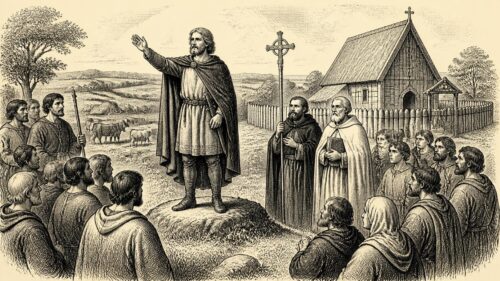
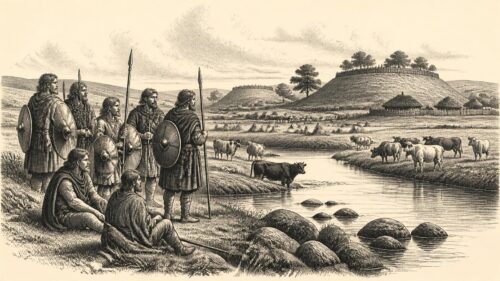
Yet the designation matters. A king of the Cruithin was a major regional figure within Ulaid, where dominance was contested among powerful kindreds, notably Dál Fiatach and the various Cruithin peoples. Scannal’s killing was not necessarily a pitched battle: the Irish word used by the annalist can cover a killing rather than a battle with named sides. But the death of a ruler by violence demonstrates the personal danger inseparable from seventh-century lordship. Rule depended on kin, military followers, fosterage, control of land and livestock, and the capacity to secure alliances. It could be abruptly disrupted by a rival branch of a dynasty or by opponents from a neighbouring people.
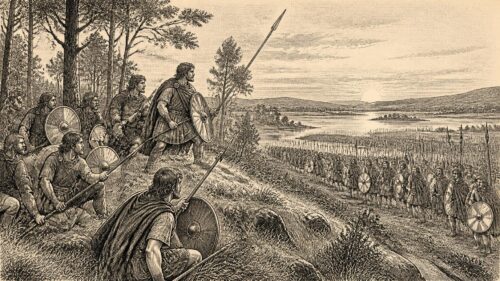
The event also belongs to the unsettled aftermath of the battle of Mag Roth in 637. There, Congal Cáech, a dominant ruler associated with Dál nAraidi and Ulaid, was defeated and killed by Domnall son of Áed of the northern Uí Néill. Mag Roth did not create a stable northern order. Domnall himself died in 642, and traditions about the kingship of Ireland in the following years speak of overlapping or joint claims by members of northern and southern Uí Néill dynasties. Such claims did not erase regional politics in Ulaid. Rather, Scannal’s death in 646 shows that the struggle to command men and resources in the north-east continued beneath any wider assertion of supremacy.
The Abbot of Bangor
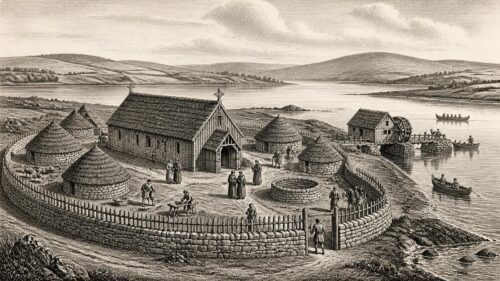
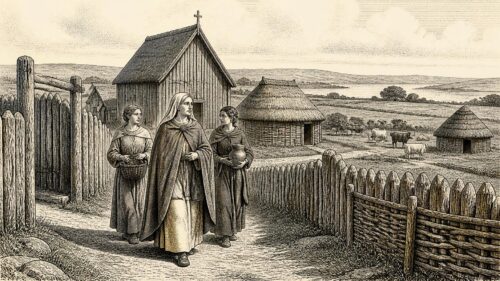
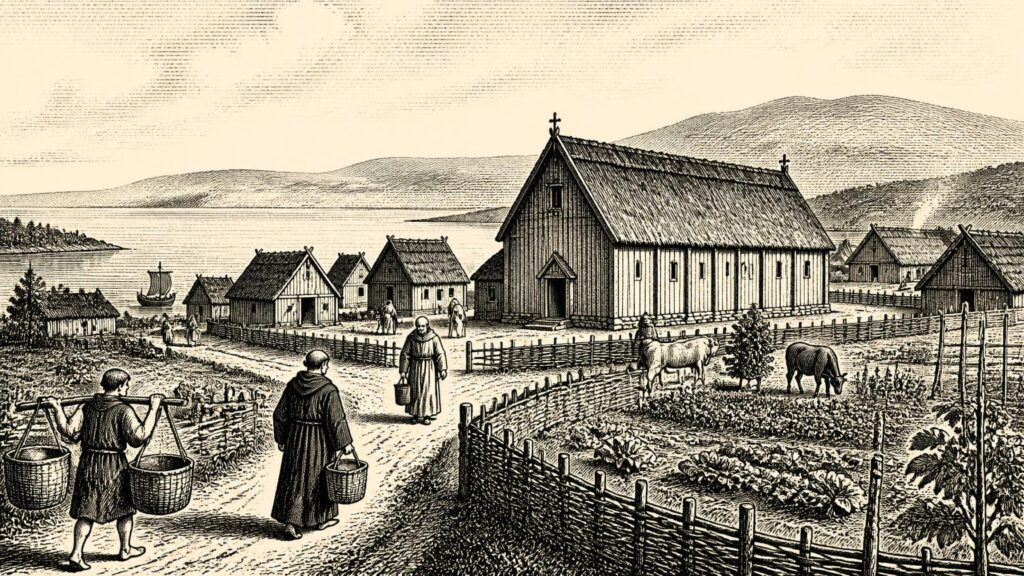
The other notice for 646 records the repose of Mac Laisre, abbot of Bangor. Bangor stood on Belfast Lough in what is now County Down, within the political orbit of north-east Ulaid. It had been founded about 558 by Comgall and, by Mac Laisre’s time, had existed for almost ninety years. Archaeological investigations around the later abbey and graveyard confirm the long-lived ecclesiastical importance of the site, even though they cannot reconstruct the appearance of Bangor in 646 or identify Mac Laisre’s own buildings.
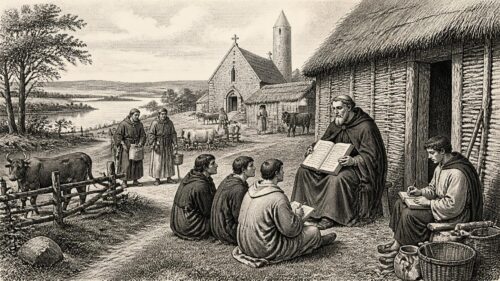
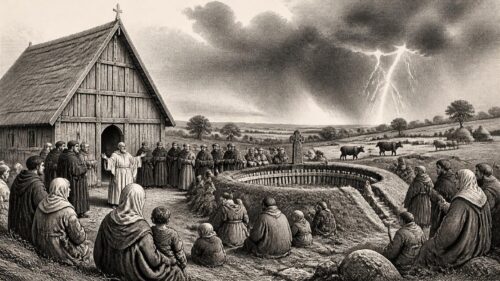
An abbot’s death was more than a private loss. Major monasteries were communities of prayer, learning, cultivation and hospitality, supported by land, labour and relations with secular patrons. Their leaders administered people and property as well as religious observance. The annal’s simple phrase “rested” follows Christian convention, presenting death as entry into peace rather than recording political violence. It should not, however, be mistaken for proof that the succession passed smoothly. No surviving entry tells us who followed Mac Laisre, whether his death occasioned disagreement, or what exact connection he had with particular ruling families.
Bangor’s importance should also be described without relying too heavily on later idealisation. Medieval tradition made it a renowned house of disciplined monks and attached very large numbers to its community. Those figures cannot be treated as a census for 646. What is clear is that Bangor was already among Ireland’s significant monastic foundations. Its founder Comgall was remembered as a leading northern saint; its later surviving liturgical book, the Antiphonary of Bangor, preserves Latin hymns, prayers and canticles from the later seventh century. Mac Laisre’s obituary therefore marks a change in leadership at an institution that participated in the literary and devotional culture of the Irish Sea world.
Work Beyond the Annals
Neither annal reports a harvest, weather event, disease outbreak or trade voyage for 646. It would be wrong to infer famine, prosperity or a particular climate from that absence. The wider evidence nevertheless indicates the ordinary framework within which Scannal’s followers and Bangor’s dependants lived. Ireland remained overwhelmingly rural. Farmsteads and enclosed settlements, often now called raths or ringforts, formed the principal domestic landscape; crannogs, fields, trackways and small ecclesiastical settlements also structured movement and work.
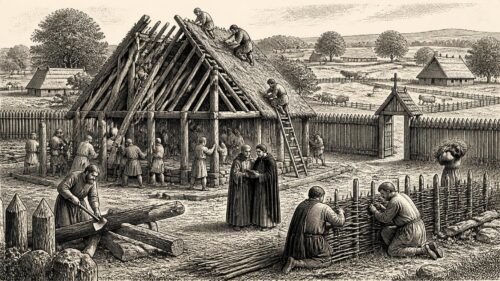
Cattle were central to wealth, status, tribute and food, but early medieval farming was not exclusively pastoral. People tended cereals, kept pigs and sheep as well as cattle, processed grain with querns and drying kilns, made dairy produce, stored food and maintained boundaries. Much labour was undertaken by people of modest or unfree status, whose names rarely entered the annals. At Bangor, as at other monasteries, religious life rested upon this material base: food had to be grown or rendered, animals tended, fuel collected, buildings repaired and visitors received. These are not activities documented for a particular day in 646; they are the securely evidenced social conditions that make the year’s two elite notices intelligible.
Sea Roads and Written Memory
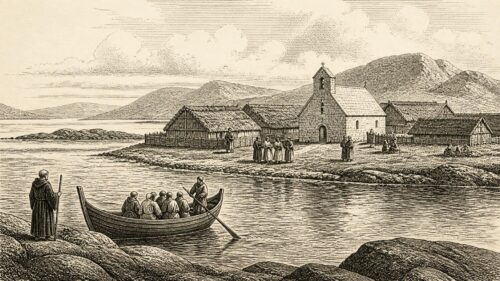
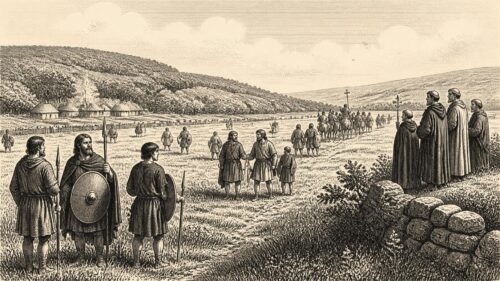
Bangor’s position beside Belfast Lough also placed it near the North Channel. The sea was a route, not an outer boundary. Monastic and kin-based contacts linked north-east Ireland with western Scotland and northern Britain, while Irish churchmen and students travelled farther into Britain and Francia. It cannot be shown that Mac Laisre himself made any voyage in 646, but his abbacy belonged to a period in which Irish religious communities were increasingly connected across the water. The movement of people, books, liturgical practices and ecclesiastical reputation made such coastal foundations more than local shrines.
The very survival of Scannal’s and Mac Laisre’s names reflects another transformation: the growth of literate record-keeping in Christian Ireland. Annals were not modern newspapers and did not aim to describe every aspect of life. Their selection favoured kings, clerics, battles, deaths and extraordinary events. Still, the paired notices reveal what contemporaries or near-contemporaries considered worth preserving: a violent loss among the Cruithin and the death of an abbot at Bangor. In a year otherwise almost silent, they show secular and ecclesiastical authority existing side by side, often in the same regional networks, but exposed to very different forms of mortality and remembrance.
What 646 Can Tell Us
646 CE was not a blank year, but it is a deliberately modest one in the historical record. Scannal’s killing points to continuing competition within the political landscape of Ulaid after Mag Roth. Mac Laisre’s repose records the passing of leadership at Bangor, a northern monastery whose influence would outlast any single abbot. Around them, most people worked a managed rural landscape of herds, crops, households and religious estates. The annals allow no fuller narrative of the year than that. Respecting their limits is the best way to preserve the significance of what they do record.
Primary Sources
- The Annals of Ulster: Year U646
- The Annals of Ulster
- The Annals of Tigernach: Part 8
- CELT Project: The Annals of Tigernach
- Annals of Inisfallen: Part 21
- Annals of Inisfallen: Original Text, Part 3
- Chronicon Scotorum
- Annals of the Four Masters: Part 48
- Chronological Synchronisation of the Irish Annals
- Chronological Synchonisation of the Irish Annals, 488–722
- Congal Cáech: (d. 637), high-king of Ireland
- Comgall
- Ireland in the Seventh Century: A Tour
- Tracing the Community of Comgall Across the North Channel
- The Monastery at Bangor
- 2011:152 – Bangor, Down
- 2007:385 – Bangor Abbey, Down
- Agriculture, Settlement and Society in Early Medieval Ireland
- The Archaeology of Livestock and Cereal Production in Early Medieval Ireland, AD 400–1100
- Early Medieval Archaeology Project: Agriculture and Economy
- Early Christian Irish Monasteries
- Technological Change in the Agrarian Economy of Early Medieval Ireland
- The Technical Development of the Horizontal Water-Wheel in the First Millennium AD
- Early Medieval Rural Settlement Archaeology in Ireland and the Impact of Large Infrastructural Developments