Clonmacnoise Obituary640 CE
In 640, Irish annals chiefly recorded the deaths of Crónán, abbot of Clonmacnoise, and Mochua of Balla in Connacht. Differences between annalistic dates show the difficulty of reconstructing seventh-century chronology, but modern synchronisation places these obituaries in this year. Crónán’s office reflects Clonmacnoise’s importance as a religious and economic centre on major travel routes. Politically, Ireland remained divided despite Domnall mac Áedo’s victory at Mag Rath in 639. Annals also noted a battle and siege involving Domnall Brecc’s followers in the wider Gaelic world. Most rural life, farming and local hardship remained unrecorded.
Dateline
In 640 CE, the clearest securely reconstructed Irish annalistic notices are not of a decisive battle within Ireland or a change of high kingship, but of deaths in the ecclesiastical world. Crónán moccu Loégde, abbot of Clonmacnoise, died, and the annals also record the death of Mochua of Balla in Connacht. These brief notices are valuable precisely because they reveal what early medieval record-keepers considered worth preserving: the passing of men who led important religious communities. They also place Ireland in a year of wider Gaelic political tension, for a battle and siege involving the following of Domnall Brecc of Dál Riata were recorded across the sea. Yet 640 should not be made to bear more history than its sources allow. It was a year marked in surviving Irish tradition chiefly by obituaries, not by a detailed narrative of events.
Dating a Sparse Year
The caution is essential because seventh-century Irish dates are difficult. The surviving annals were copied and rearranged over centuries, and their medieval year numbers do not always correspond neatly with a modern calendar. The Annals of Tigernach place Crónán’s death beneath their entry for 640; the Annals of Ulster place the same notice under a different heading; and the much later Annals of the Four Masters assign it to 637 and add a day in July. Modern chronological synchronisation, using the annals’ original kalends and weekday data, places the cluster of notices in 640 CE. That makes the year a reasonable setting for Crónán’s death, but it does not make the precise day supplied by a seventeenth-century compilation equally secure.
Different texts also preserve other, potentially confusing, notices. The Annals of Inisfallen record in their entry labelled 640 the repose of a Crónán, abbot of Cell Dara, or Kildare. That is not enough to identify him with Crónán of Clonmacnoise. Ireland had several churchmen named Crónán, and the divergent placements demonstrate why the names must not be casually merged. The responsible conclusion is modest: a reconstructed calendar year of 640 contains an obit for Crónán, abbot of Clonmacnoise, and an obit for Mochua of Balla; it also exposes the uneven transmission of early Irish historical memory.
An Abbot of Clonmacnoise
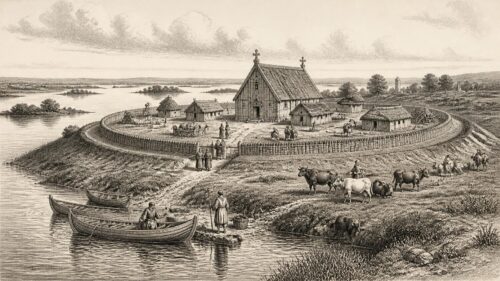
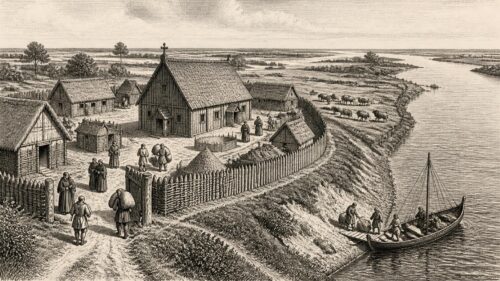
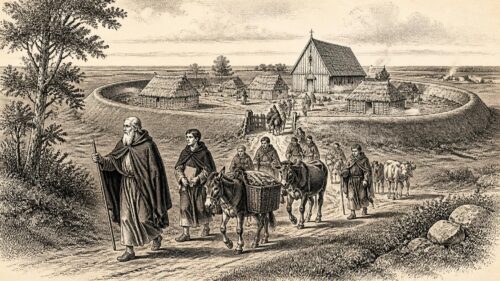
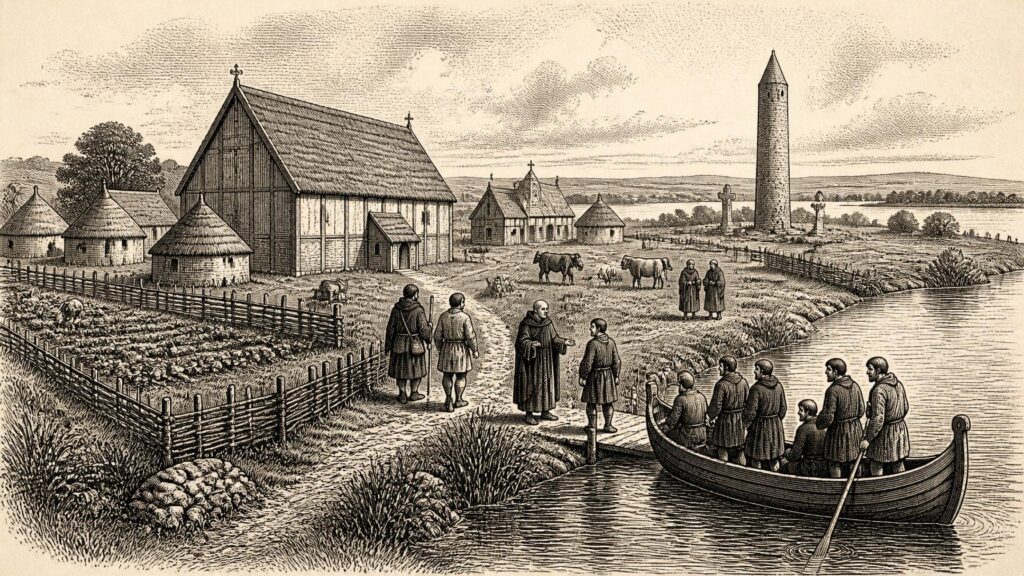
Crónán’s designation as abbot of Clonmacnoise is the firmest individual fact associated with the year. It indicates his standing at a religious settlement on the Shannon whose position gave it importance well beyond its immediate neighbourhood. Clonmacnoise lay beside a principal route between the north and south of the island and near east–west crossings through the midlands. In the seventh century, rivers were not obstacles at the edge of political life: they were arteries for travel, communication, livestock movements, goods and ecclesiastical connection. An abbot there belonged to a world in which religious communities could be centres of authority as well as worship.
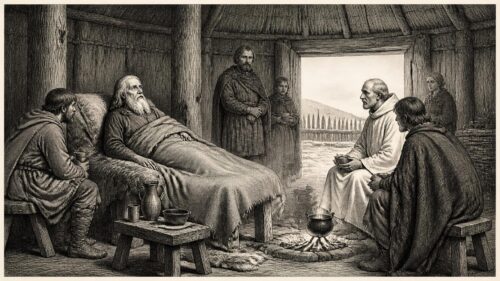
The surviving entry does not describe Crónán’s buildings, rule, writings or burial. It would therefore be unsafe to claim that he enlarged the monastery, founded a school or directed any known manuscript work in 640. Nevertheless, the wording itself matters. An abbot was not merely a secluded holy man. The office involved leadership of a community, management of land and resources, dealings with patrons and neighbours, and responsibility for worship and discipline. His death would have required succession and would have affected a settlement whose influence rested on people, property, learning and spiritual reputation. The annal’s economy of words should not disguise the institutional consequence behind the phrase “abbot of Clonmacnoise”.
Mochua of Balla, whose death is likewise entered in the synchronised annalistic record for 640, points westward to Connacht. The two obituaries should not be turned into evidence of a formal connection between Clonmacnoise and Balla in that particular year; none is stated. Together, however, they show that ecclesiastical remembrance reached across provincial boundaries. The annual record could preserve the deaths of leading clerics in the Shannon basin and in Connacht even when it offered no account of ordinary people’s lives.
After Mag Rath
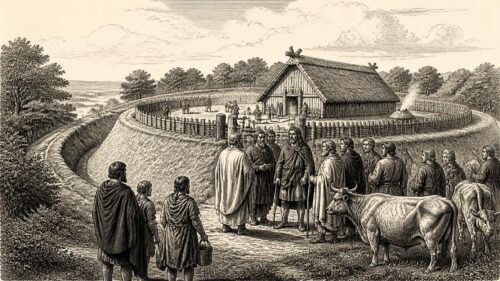
Politically, 640 fell shortly after the great conflict of Mag Rath, conventionally placed in 639. Domnall mac Áedo of Cenél Conaill, the dominant Uí Néill ruler whom later tradition styled king of Ireland, had defeated Congal Cáech of Ulaid and his allies. That victory did not create a unified Irish state with a single administration. Power remained dispersed among many overkings, lesser kings, kin-groups and ecclesiastical houses. Domnall’s supremacy depended upon alliances, military force, tribute, hostages and recognition, and could be challenged far from his own northern base.
Nothing in the securely dated record for 640 says that Domnall campaigned in Ireland, summoned an assembly or issued a law in that year. Still, the political background matters. The aftermath of Mag Rath had reshaped relations among Ulaid, northern Uí Néill branches, Leinster, Munster and Dál Riata. A leading king’s victory could remove rivals without settling every local dispute. For communities such as Clonmacnoise, the practical consequences of high politics were likely experienced through the demands and protection offered by regional rulers rather than through any distant notion of national government.
News Across the Sea
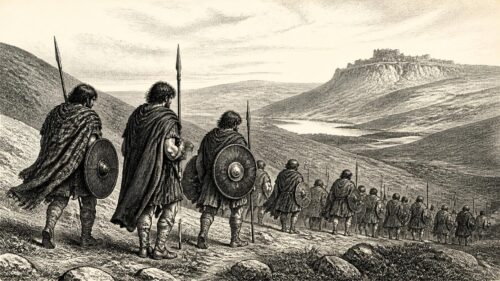
The annals’ other principal 640 notice records the battle of Glenn Mairison and a siege or investment connected with Etáin. It says that the followers of Domnall Brecc fled. The short Latin and Irish formulations do not securely identify the battlefield, explain the cause, or make fully clear whether Etáin was a person or a place under siege. What can be said is that Domnall Brecc was king of Dál Riata, a Gaelic polity spanning the sea-world between north-east Ireland and western Scotland. Events involving his followers were therefore directly relevant to Irish political horizons, even if the fighting itself was not in Ireland.
This entry is a reminder that the Irish Sea was a corridor rather than a frontier. Clerics, royal households, warriors, traders and travellers crossed it; Iona, only a short sea passage from the Irish coast, was deeply connected to Irish religious life. The record of a setback to Domnall Brecc’s men need not imply an Irish expedition, nor does it permit a detailed reconstruction of naval warfare or diplomacy in 640. Its significance lies instead in showing that Irish annalists followed developments in the shared Gaelic world of Ireland, western Britain and the islands.
Farms, Food and Local Society
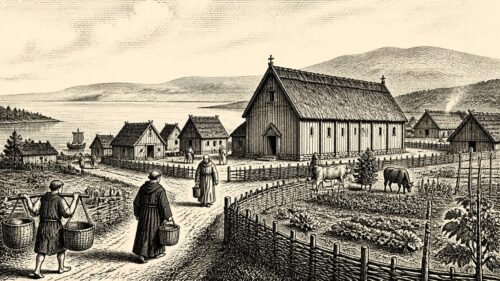
Most inhabitants of Ireland in 640 left no names in the annals. Their world was overwhelmingly rural. Families and dependants lived in dispersed farmsteads, often within circular enclosed settlements now known as ringforts or raths; stone-built cashels were more common in regions where suitable stone was abundant. These were working homesteads rather than miniature castles. Their banks, ditches, fences and walls helped manage livestock and marked household space in a society where cattle were a principal measure of wealth, compensation and status.
Mixed farming sustained daily life. Cattle were central, but sheep, pigs and crops also mattered. Archaeological evidence for querns, corn-drying kilns, mills, field systems and animal remains demonstrates that tillage and pastoralism were interdependent rather than opposed ways of living. Grain had to be stored, dried and ground; animals had to be herded, bred and protected; timber, turf and stone had to be gathered and worked. Seasonal rhythms governed much of the year. Spring calving, summer pasture, haymaking, harvesting, milling and winter fodder imposed demands more constant than the occasional named battle.
There is no reliable evidence for a famine, epidemic, exceptional weather event or island-wide economic disruption specifically in 640. It would be wrong to invent one merely because the sources are silent about ordinary prosperity. Equally, silence does not mean ease. A poor harvest, livestock disease or local raid could imperil a household with limited reserves. The built landscape of enclosed farms and church sites suggests communities attentive to security, kinship, production and access to land, but the exact experience of any particular family in this calendar year remains beyond recovery.
Churches as Communities
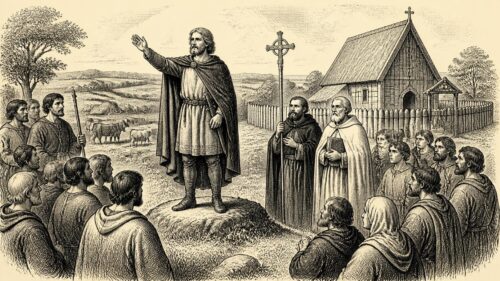
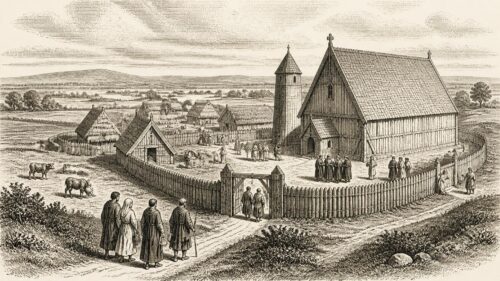
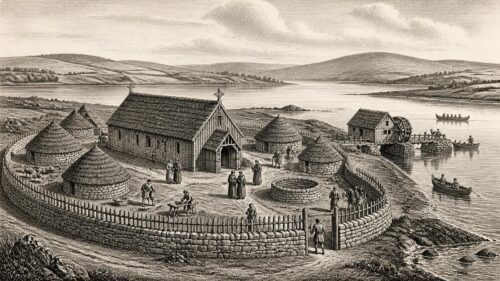
The deaths of Crónán and Mochua illuminate a Christian Ireland in which monasteries were diverse settlements, not identical institutions cut off from lay society. They could include churches, dwellings, workshops, burial grounds, cultivated land and spaces for guests, dependants and visiting worshippers. Some communities were associated with saints and their familial successors; others held regional influence through royal patronage, landed resources and their command of literacy. Their leaders could be remembered in annals because the fortunes of churches and dynasties were closely intertwined.
Kildare provides a useful contemporary comparison, though not a direct event of 640. By the later seventh century its community was represented as a major and wealthy foundation, with separate provision for monks and nuns and claims to exceptional standing. Such evidence should not be projected in every detail back onto 640, but it confirms the scale that Irish ecclesiastical institutions could attain in this generation. Clonmacnoise, Balla and Kildare belonged to a networked Christian landscape in which prayers, saints’ cults, Latin learning, property and political patronage reinforced one another.
A Year Preserved in Obituaries
For Ireland, 640 is best understood as a thinly documented but not empty year. Its most securely placed events are clerical deaths: Crónán at Clonmacnoise and Mochua at Balla. The annalistic notice of Domnall Brecc’s followers fleeing in a battle and the associated siege adds a wider Irish Sea dimension, but supplies too little detail for confident storytelling. Domnall mac Áedo’s post-Mag Rath dominance forms the political setting, not a separately recorded action of 640.
The year’s real historical value lies in that restraint. It reveals the priorities and limitations of the evidence: abbots were named, communities endured, political news crossed the sea, and rural life continued mostly unrecorded. Rather than manufacture a dramatic national episode, 640 allows a clearer view of early medieval Ireland’s texture—many local societies, powerful but interconnected churches, and a learned culture beginning to preserve selected lives and losses in the sequence of years.

Primary Sources
- The Annals of Ulster: Latin and Irish Texts, AD 431–1201
- The Annals of Tigernach, Part 8
- The Annals of Tigernach: English Translation, Part 8
- Annals of Inisfallen
- Annals of Inisfallen, Part 21
- Annals of the Four Masters, Part 47
- Chronological Synchronisation of the Irish Annals: AD 621–642
- Chronological Synchronisation of the Irish Annals
- The Chronology and Sources of the Early Irish Annals
- The Chronicle of Ireland: Then and Now
- County Kildare Urban Archaeology Survey
- Traditional Buildings: Irish Farms
- Farming and Archaeology
- European Landscape Convention: Landscape Character Assessment Training Course
- Ordinary People in Early Christian Ireland
- Early Christian Monasteries
- Churches and Ecclesiastical Enclosures
- Christian Ireland, Fifth to Eighth Centuries
- Conversion and Consolidation in Leinster's Royal Heartland
- Early Medieval Ireland, AD 400–1100: The Evidence from Archaeological Excavations
- The Primatial Claims of Armagh, Kildare and Canterbury
- Dunadd Fort: History and Stories
- Iona Abbey: History and Stories