Yearly Notices611 CE
The annalistic record for 611 CE is brief but not empty. One Irish chronicle places the year as the first year of Suibhne Meann and records the burning of the church of Beannchair Uladh. The Annals of Inisfallen also preserve a 611-dated notice, including the deaths of Colmán Daimíne and Aengus, son of Aed Sláine. A nearby Inisfallen entry assigns lightning destruction of the army of Ulaid to AU 611. These notices allow a cautious year-specific account, but not a fuller narrative.
Dateline
Dating Frame
The surviving notices place 611 CE inside annalistic year markers rather than a developed narrative. In the Annals of the Four Masters, the year appears as the Age of Christ 611 and the first year of Suibhne Meann in the sovereignty of Ireland. In the Annals of Inisfallen, the same year is represented by an entry labeled AI611.1, so the excerpt preserves a dated notice rather than a gap. [1] [2]
This frame matters because it separates what is securely dated from what is only adjacent context. The Four Masters give 611 as a named year and add one church burning. Inisfallen likewise preserves a 611 notice and, in the same visible sequence, a later AU 611 entry about lightning destroying the army of Ulaid. Nothing in these passages justifies filling the year with invented detail. [1] [2] [3]
Church Burning
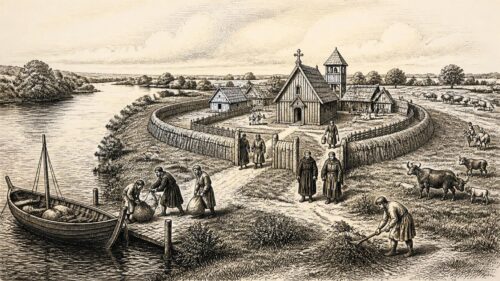
The clearest securely dated event in the Four Masters for 611 is the burning of the church of Beannchair Uladh. The notice is terse and gives no cause, no named agents, and no account of damage beyond the burning itself. Its value is chronological precision: the event belongs to 611 in that source, and the wording does not permit any broader reconstruction. [1]
The same passage also shows how little the annals often elaborate when a year is especially compressed. Nearby entries in the same source move from one death notice to another reign marker, but the 611 line itself stays limited to a single church fire. That restraint is part of the evidence. It supports an account of the notice, not a story about motive, scale, or consequence. [1]
Inisfallen Notice
The Annals of Inisfallen preserve a different sort of 611 material. One entry in the visible sequence is marked AI611.1 and records the deaths of Colmán Daimíne and Aengus, son of Aed Sláine. That is a dated notice, not a silence, and it should be read on its own terms rather than merged with entries from another annal or another year-keying system. [2]
The same source then shows another 611-related notice in the AU-linked sequence: lightning destroys the army of Ulaid. Because the excerpt also places this under AU 611, the passage gives two separate 611 references within one broader stretch of text. They are distinct entries, and the wording offers no basis for combining them into one event or treating one as the explanation of the other. [2] [3]
Army Disaster
The AU 611 notice in Inisfallen is brief but specific: lightning destroys the army of Ulaid. The event is plainly destructive, yet the excerpt gives no battlefield, no leaders, and no place-name. It is therefore best treated as a military disaster entered under the year, not as a battle narrative or as proof of a wider campaign. [3]
A nearby Inisfallen entry should not be pulled into the same year by association alone. The burning of Bennchor of Ulaid appears in the same chronicle, but it is assigned to AU 616, not AU 611. The two notices concern the same broad region, yet the year markers keep them separate. That distinction is essential for any strict account of 611. [3]
Adjacent Context
The Four Masters place the 611 notice within a short sequence that includes the previous year and the following year. In 610 they record Maelcobha’s death; in 612 they move on to Fintan of Oentrebh, Connere Connor, and a devastation of Torach by a marine fleet. These neighboring entries show the annal’s compressed style, but they do not supply missing facts for 611. [1]
In Inisfallen, the 611 material also sits among adjacent notices rather than in isolation. The same passage that marks AU 611 with lightning against the Ulaid continues toward later entries, including AU 612 notices in the same chronology. What can be observed directly is sequence, not elaboration. The excerpt preserves year-marked items, but it does not narrate their connections. [2] [3]
Chronicle Comparison
Comparing the two annals shows different levels of visible detail for 611. The Four Masters give a single year marker and one church burning. Inisfallen preserves both a 611 death notice and a separate AU 611 disaster against the Ulaid. The comparison is factual and limited: each text records something for the year, but neither offers a continuous story. [1] [2] [3]
The difference is visible in how the entries are phrased. The Four Masters identify a church and a year of sovereignty. Inisfallen identifies two named dead individuals in one 611 notice and a lightning destruction in another. These are all short notices, yet they are not the same kind of notice. Their brevity is evidence of scope, not a signal that one source is more important than the other. [1] [2] [3]
Secure Limits
A careful account of Ireland in 611 CE can therefore state only a few secure points. The Four Masters record the burning of Beannchair Uladh under 611. Inisfallen records the deaths of Colmán Daimíne and Aengus, son of Aed Sláine, under AI611.1, and separately notes lightning destroying the army of Ulaid under AU 611. Beyond those notices, the excerpts do not justify added detail. [1] [2] [3]
That limit is not a defect in the account; it is the point of working closely with the dated notices. The passages preserve specific events and specific deaths, but they do not permit claims about political purpose, causation, or larger historical significance. For 611, the secure historical picture remains brief: a church fire, a lightning disaster, and two recorded deaths. [1] [2] [3]
Historical View
The year 611 CE emerges from these annalistic notices as a year of recorded disturbance, but only in a restrained sense. One text fixes a church burning to the year. Another preserves named deaths and a separate disaster caused by lightning. The record is enough to show that the year was not empty in the annals, yet it remains too fragmentary for a fuller narrative. [1] [2] [3]
The most defensible conclusion is modest. Ireland in 611 CE is visible in the annals through separate dated notices, not through a continuous chronicle of the year. The surviving entries allow one to distinguish securely dated material from adjacent context, but they do not support filling gaps with conjecture. What remains is precise, narrow, and historically useful exactly because it stays that way. [1] [2] [3]
Source References
Hover over a number to see the source. Select it to open the source.