Éamonn Ceannt
Éamonn Ceannt was born Edward Thomas Kent in Ballymoe, County Galway, and later used the Irish form of his name. He attended the De La Salle national school in Ardee, the Christian Brothers’ school at Sunday’s Gate in Drogheda, and later the O’Connell Schools and University College, Dublin. He worked for Dublin Corporation in the rates department and later in the city treasury office. Ceannt joined the central branch of the Gaelic League in 1899 and met Patrick Pearse and Eoin MacNeill through it. He taught Irish part-time at Gaelic League branches, became a fluent Irish speaker, and played several musical instruments, especially the Irish war pipes and uileann pipes.
Dateline
Éamonn Ceannt was born Edward Thomas Kent in Ballymoe, County Galway, and later used the Irish form of his name. He attended the De La Salle national school in Ardee, the Christian Brothers’ school at Sunday’s Gate in Drogheda, and later the O’Connell Schools and University College, Dublin. He worked for Dublin Corporation in the rates department and later in the city treasury office.
Cultural Work
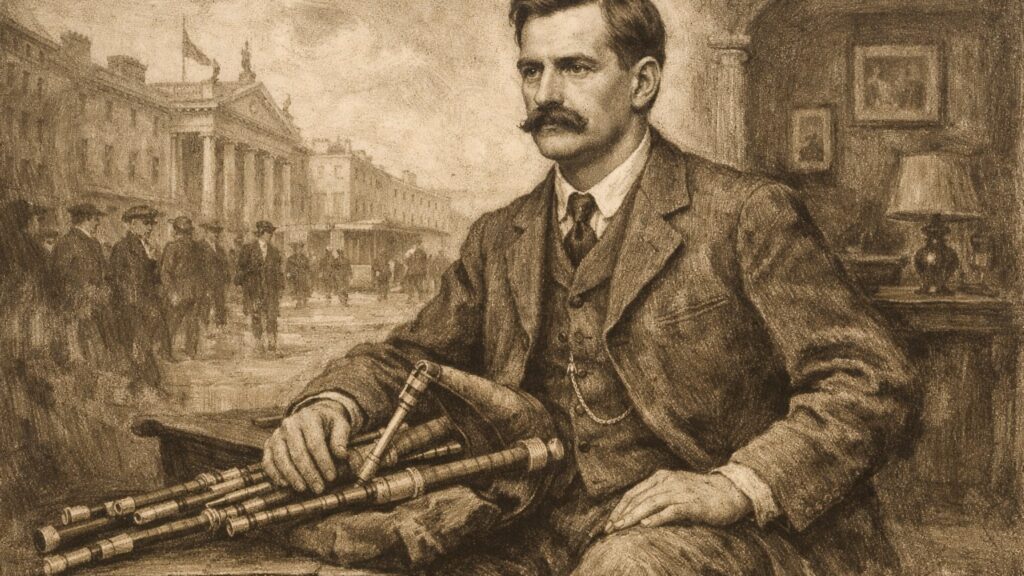
Ceannt joined the central branch of the Gaelic League in 1899 and met Patrick Pearse and Eoin MacNeill through it. He taught Irish part-time at Gaelic League branches, became a fluent Irish speaker, and played several musical instruments, especially the Irish war pipes and uileann pipes. In February 1900 he helped establish the Dublin Pipers’ Club and became its secretary. He also printed An Piobaire, whose first issue appeared on 5 July 1901. In 1908 he performed on the uileann pipes for Pope Pius X in Rome.
Political Involvement
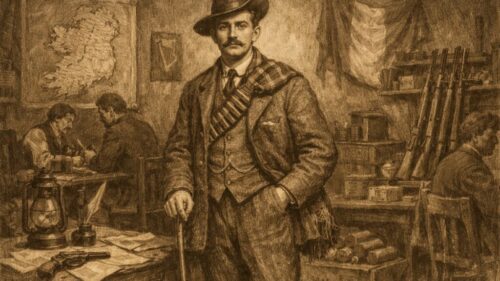
He had socialist sympathies, was involved in unionisation among fellow workers in Dublin Corporation, and became chairman of the Dublin Municipal Officers’ Association. He joined Sinn Féin in 1907 and was eventually elected to its national council. He was sworn into the Irish Republican Brotherhood by Seán MacDiarmada on 12 December 1912. He was present at both the Howth and Kilcoole importations, became commandant of the 4th Battalion of the Dublin Brigade in March 1915, and was co-opted to the IRB Military Council. Many Military Council meetings took place at his house in Dolphin’s Barn.
Easter Week
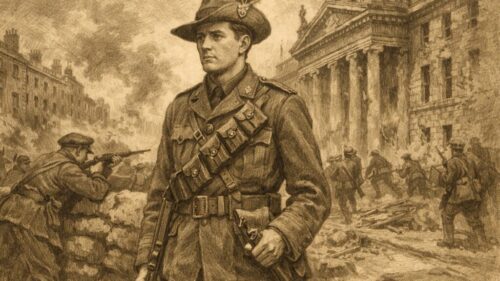
On Easter Monday 1916, Ceannt and 120 men of the 4th Battalion occupied the South Dublin Union. They held part of the complex until the general surrender the following Sunday. He was court-martialled and executed by firing squad in Kilmainham Gaol on 8 May 1916. The 1911 census return for his household at 4 Herberton Lane, New Kilmainham, was filled out in Irish and recorded his wife Áine and son Rónán.
Source References
Hover over a number to see the source. Select it to open the source.