Editorial — Mochua of Balla in Connacht — Death
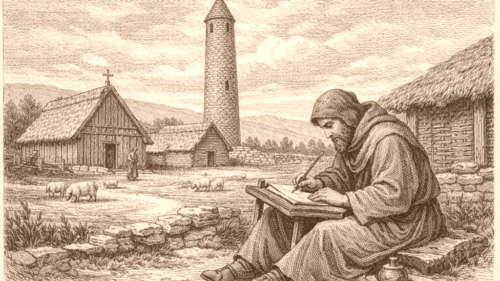
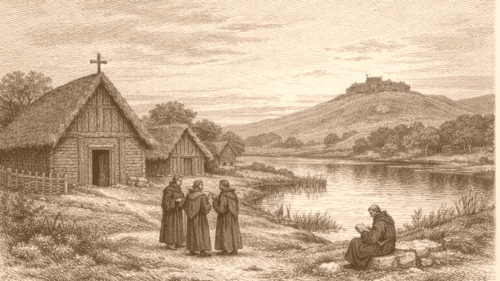
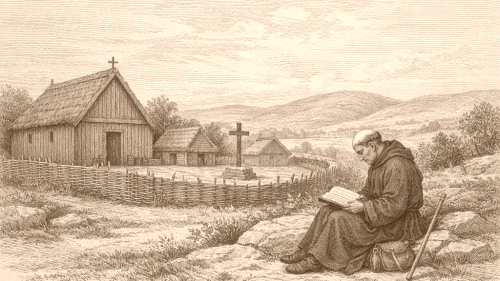
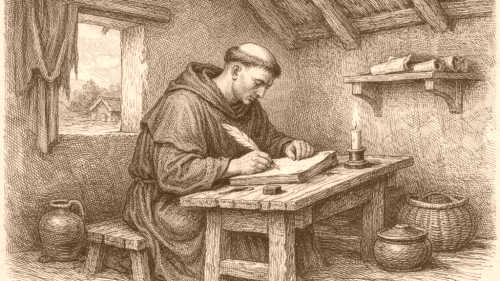
Welcome to the Emerald Archives Gazette. In today’s issue we look back at the latest additions to the archive. Clonmacnoise Obituary — In 640 CE, the clearest securely reconstructed Irish annalistic notices are not of a decisive battle within Ireland or a change of high kingship, but of deaths in the ecclesiastical world. Crónán moccu Loégde, abbot of Clonmacnoise, died, and the annals also record the death of Mochua of Balla in Connacht. These brief notices are valuable precisely because they reveal what early medieval record-keepers considered worth preserving: the passing of men who led important religious communities.
Dateline
The Day in Irish History
Welcome to the Emerald Archives Gazette. In today’s issue we look back at the latest additions to the archive.
Clonmacnoise Obituary — In 640 CE, the clearest securely reconstructed Irish annalistic notices are not of a decisive battle within Ireland or a change of high kingship, but of deaths in the ecclesiastical world. Crónán moccu Loégde, abbot of Clonmacnoise, died, and the annals also record the death of Mochua of Balla in Connacht. These brief notices are valuable precisely because they reveal what early medieval record-keepers considered worth preserving: the passing of men who led important religious communities. They also place Ireland in a year of wider Gaelic political tension, for a battle and siege involving the following of Domnall Brecc of…
Columba Sources — Columba, known in Irish as Colum Cille, belongs to the small company of early medieval figures whose remembered life cannot be confined within a modern frontier. Born into an eminent Irish kindred, trained within Irish Christian culture and long revered in Irish churches, he founded Iona in the western seas and made that island the centre of a religious network linking Ireland, Dál Riata, Pictland and, later, Northumbria. His historical importance rests not only upon missionary tradition, but upon the enduring power of an Irish monastic community that preserved his name, wrote his Life and shaped the ways in which…
Columba Evidence — Columba, or Colum Cille, belongs to the small company of early medieval Irish figures who are at once historical persons, monastic founders, literary presences and saints of enduring popular memory. His life cannot be recovered as a modern biography: the fullest surviving account was written roughly a century after his death, in a genre intended to proclaim sanctity rather than to supply a neutral chronicle. Yet the contours are clear enough. Born into a powerful northern Irish kin-group, Columba became associated with religious communities in Ireland and, above all, with Iona, the island monastery that gave his name influence across…
Áed’s Obituary — In 639 CE, the most significant Irish development that can be placed with reasonable confidence in this calendar year was the death of Áed Dub, bishop and abbot of Kildare. His obituary is brief, but it illuminates a great deal: in seventh-century Leinster, an important church could be led by a member of a ruling dynasty, and religious office could be an instrument of regional authority as well as pastoral care. The year’s surviving notices also record deaths at Nendrum and Leighlin, the killing of a man named Congal son of Dúnchad, the death of Ailill son of Áed Rón,…
Eten Besieged — In 638 CE, the clearest event linked to Irish history was not fought on the island of Ireland itself, but in the Irish Sea world to which north-east Ireland belonged. Chronicon Scotorum records a battle at Glenn Muiresan in which the followers of Domnall Brec were put to flight, followed by the besieging of Eten. Domnall Brec was king of the Cenél nGabráin, the leading kindred of Dál Riata: a Gaelic sea-kingdom whose territories and connections extended between Argyll and the coast of Antrim. The annal therefore preserves a hard, if brief, sign that the political shocks of the late…
Betha Colaim — Betha Colaim Chille, the Life of Colum Cille compiled in 1532 under the direction of Manus Ó Domhnaill, is at once a saint’s life, a treasury of Irish learning, a political statement from Gaelic Donegal, and an act of cultural preservation. Its subject was a sixth-century saint; its own historical moment was the unsettled sixteenth century. To read it merely as biography is to miss its larger achievement: it recast Colum Cille as ancestor, protector, scholar, exile, wonder-worker and patron for a community seeking authority in a changing Ireland. Names Explained The title requires some care, because closely related names…
Leabhar Breac — Leabhar Breac, conventionally rendered “the Speckled Book”, is among the most revealing survivals of late medieval Irish learning: a vellum manuscript of religious instruction, hagiography, biblical narrative, calendar lore, genealogy and occasional secular writing, assembled during the early fifteenth century. It is not simply a container for old texts. Its handwriting, decoration, marginal notes, altered arrangement and long chain of custody preserve evidence of the learned people, institutions and journeys through which Irish books were made, read, protected and reinterpreted. Material Witness The manuscript now known as Leabhar Breac is held by the Royal Irish Academy in Dublin as MS…
Sailtír Battles — In 637 CE, Ireland’s most consequential recorded development was a pair of connected battles: Mag Rath and Sailtír. Medieval annals place them on the same day and present them as a decisive victory for Domnall mac Áedo, the leading Uí Néill ruler of the north-west, over the challenge mounted by Congal Cáech, overking of Ulaid. The year also brought the death of Failbe Flann, king of Mumu, and the recorded repose of the churchman Mo-Chutu of Raithen. These notices are brief, but together they reveal a kingdom of rival dynasties, military followings and powerful churches, tied to western Scotland as…
Restoration Settlement — When Charles II returned to his thrones in 1660, Ireland did not simply resume an interrupted royal order. It entered a prolonged reckoning over conquest, land, religion and loyalty. The Restoration promised repair after two decades of rebellion, civil war and Cromwellian rule, but its most durable Irish achievement was not reconciliation: it was the legal consolidation, with limited exceptions, of a revolutionary transfer of property and political power. Royal Return The word ‘Restoration’ commonly describes the return of Charles II to the crowns of England, Scotland and Ireland in 1660, after the execution of his father, Charles I, the…
Mochuda’s Expulsion — In 636 CE, the clearest Irish event is an expulsion rather than a battle or royal accession: Carthach, better known as Mochuda or Mo Chutu, was driven from the monastery of Raithen, modern Rahan in County Offaly, at Eastertide. The terse record in the annals gives neither a speech, a march nor a legal judgement. Yet this removal of a prominent abbot from a major midland community was politically meaningful, religiously charged and consequential for the history of southern Ireland. Modern reference scholarship places the expulsion in 636, while also warning that the early annals preserve difficult and sometimes displaced…
Slater Directories — In this context, “Slater” means not a single Irish family or an occupation, but the series of commercial directories associated with Isaac Slater: printed attempts to render nineteenth-century Ireland legible through names, trades, addresses, institutions and towns. Slater’s directories were commercial publications rather than official surveys, yet they have become unusually valuable witnesses to the country they selected, organised and, often, left unrecorded. Directory Meaning Slater’s Irish directories belong to a large nineteenth-century genre of practical reference books. They helped travellers, merchants, agents, customers and officials locate places and people. In their pages, an Irish town could be made available…
Forensic Reckoning — Decision Genesis The progression toward a forensic excavation at the site of the former Mother and Baby Home in Tuam was not a linear evolution of policy but rather a complex reconciliation of humanitarian necessity with the constraints of historical site architecture. The formalisation of the excavation mandate traces its primary impetus to the March 2017 Commission statement, which confirmed the presence of two distinct structures containing human remains. Crucially, the second of these structures, containing twenty chambers, presented a profound interpretive challenge, as its original function remained historically uncertain and architecturally ambiguous. This revelation necessitated a shift from speculative…
Thank you for reading today’s Gazette. Follow any of the links above to read the full article and explore its sources.