Roads Dispute
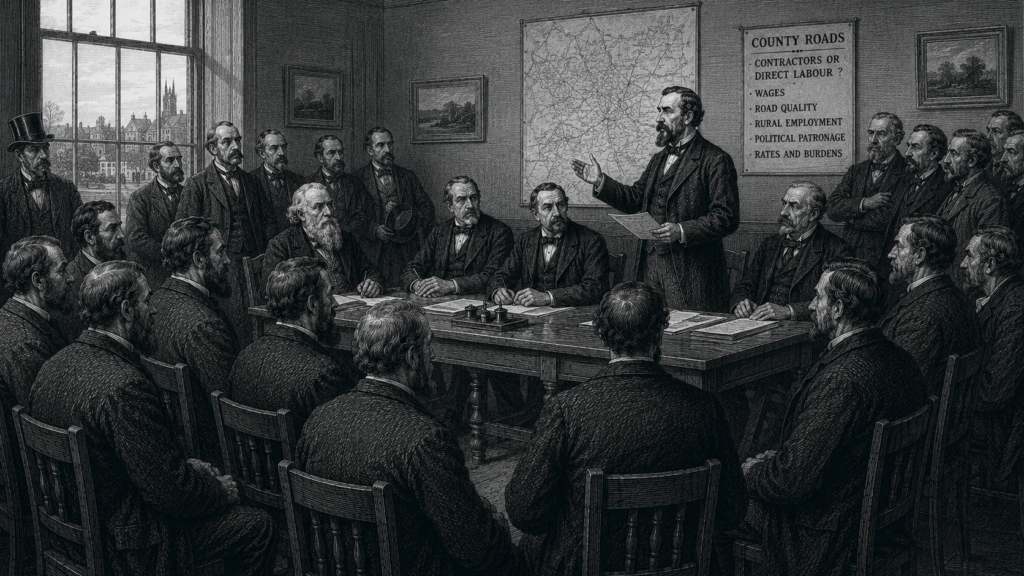
Arguments continued across County Limerick over whether public roads should be maintained through private contracts or by labourers employed directly under elected local authorities. The Munster News criticised what it regarded as Limerick County Council’s unsatisfactory handling of road tenders and the developing direct-labour question. The dispute followed the transfer of road administration from the Grand Jury system to the newly elected county and rural district councils. Councillors were now responsible for deciding how public money should be spent, who should receive employment and whether established contractors continued to offer the most economical and reliable method of keeping roads in repair.
Under the contracting system, individuals tendered to maintain particular stretches of road for an agreed period and payment. Supporters believed competition between bidders could control expenditure and place responsibility upon an identifiable contractor. Critics argued that contractors might reduce wages, employ too few labourers or preserve profit by allowing roads to deteriorate. Where no satisfactory tender was received, Limerick County Council sought authority to place roads under the County Surveyor and employ workers directly. This alternative allowed public supervision of labour and materials, but it required councillors and officials to manage staffing, wages, equipment and daily work rather than merely inspecting a contractor’s performance.
Direct labour appealed strongly to rural workers facing irregular employment, particularly during winter and periods of agricultural inactivity. Council work offered wages financed from public rates and reduced dependence upon farmers or private contractors selecting labour according to personal preference. Supporters maintained that money voted for roads should reach the men performing the work instead of contributing to a contractor’s profit. Opponents feared that elected councillors might distribute jobs among political supporters, relatives or organised pressure groups. The choice between the two systems therefore became entangled with wider arguments about fairness, patronage, democratic authority and the proper limits of council involvement in local employment.
Ratepayers also had a direct interest in the outcome. Poorly maintained roads hindered access to markets, creameries, railway stations, churches and towns, increasing costs for farmers, merchants and carriers. Excessive expenditure, however, would appear in the county rates paid by property owners and occupiers. Councillors had to compare contract prices with the actual cost of wages, stone, tools, carts and supervision under direct labour. Newspaper criticism helped expose those decisions to public scrutiny. The controversy was not simply a quarrel about administrative procedure; it concerned the balance between affordable taxation, dependable roads, decent employment and transparent control over public money.
The debate became an early test of the powers transferred by the Local Government (Ireland) Act of 1898. Elected representatives had replaced landlord-dominated Grand Juries in many areas of county administration, but democratic control brought new responsibilities and new opportunities for dispute. Limerick County Council could no longer blame an unelected system for unpopular road decisions. It was required to advertise tenders fairly, supervise direct work, account for expenditure and explain its choices to labourers and ratepayers alike. The road question demonstrated that local self-government would be judged not merely by who held office, but by the quality, economy and fairness of the services delivered.
- Munster News, January 1900, criticism of Limerick County Council’s handling of road tenders and direct labour; exact issue and page not confirmed.
- Irish Times, “Limerick County Council and the Roads,” 5 January 1900, p. 3.
- Irish Times, “The Direct Labour Question,” 18 January 1900, p. 6.
- Limerick County Council minute books, 1899–1900, Limerick Archives; exact volume and folio for the relevant tender discussions not confirmed.
- Local Government (Ireland) Act 1898, 61 & 62 Vict., c. 37.
- Local Government (Procedure of Councils) Order 1899, provisions governing council meetings, contracts and financial administration.
- Martin Walsh, Limerick Local Government 1899–1942: An Online Exhibition Commemorating the 125th Anniversary of the Local Elections, 1899, Limerick Museum and Limerick Library Service, 2024.
- Arlene Crampsie, “A Forgotten Tier of Local Government: The Impact of Rural District Councils on the Landscape of Early Twentieth-Century Ireland,” Irish Geography, vol. 47, no. 1, 2014, pp. 21–48.