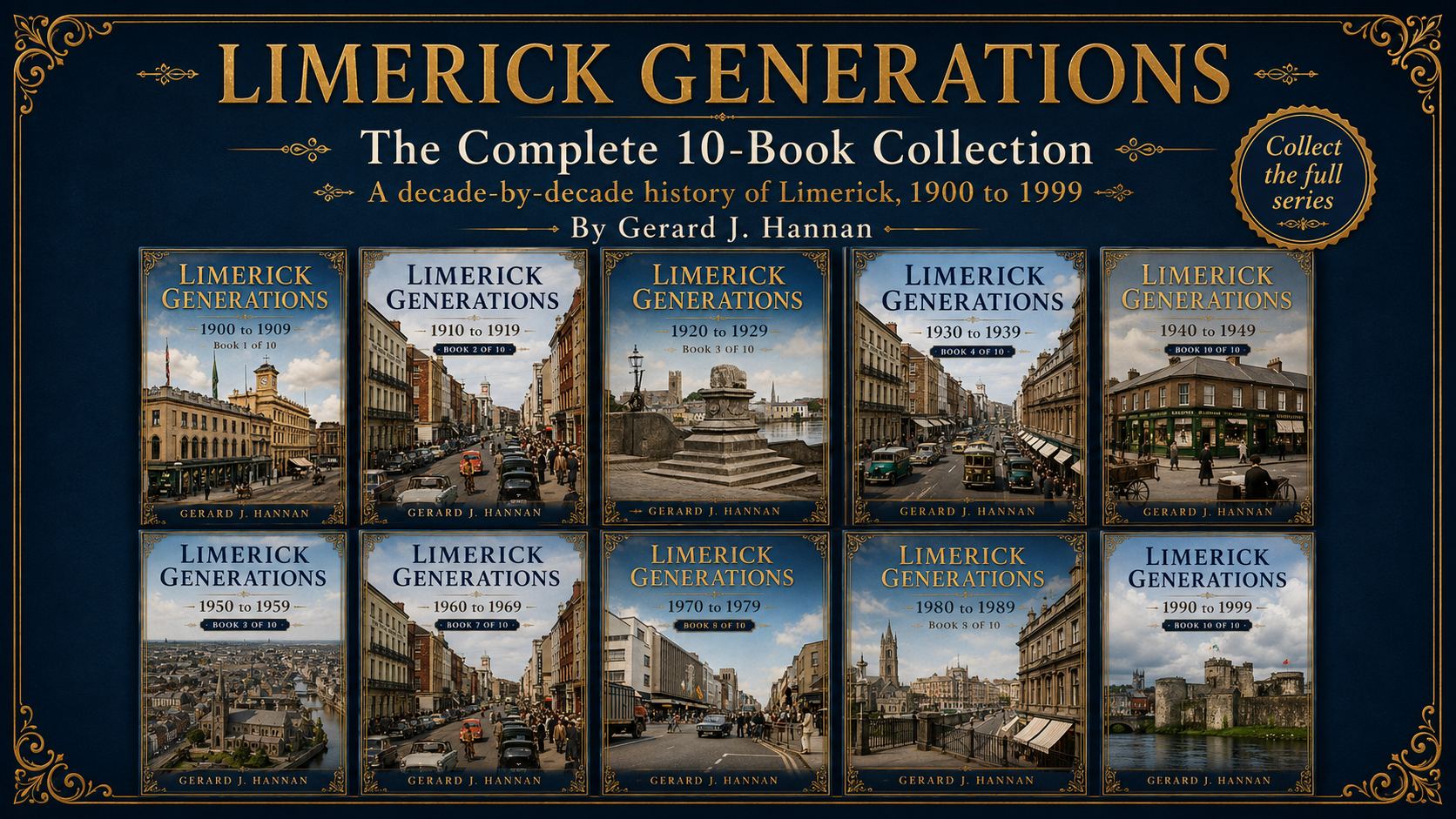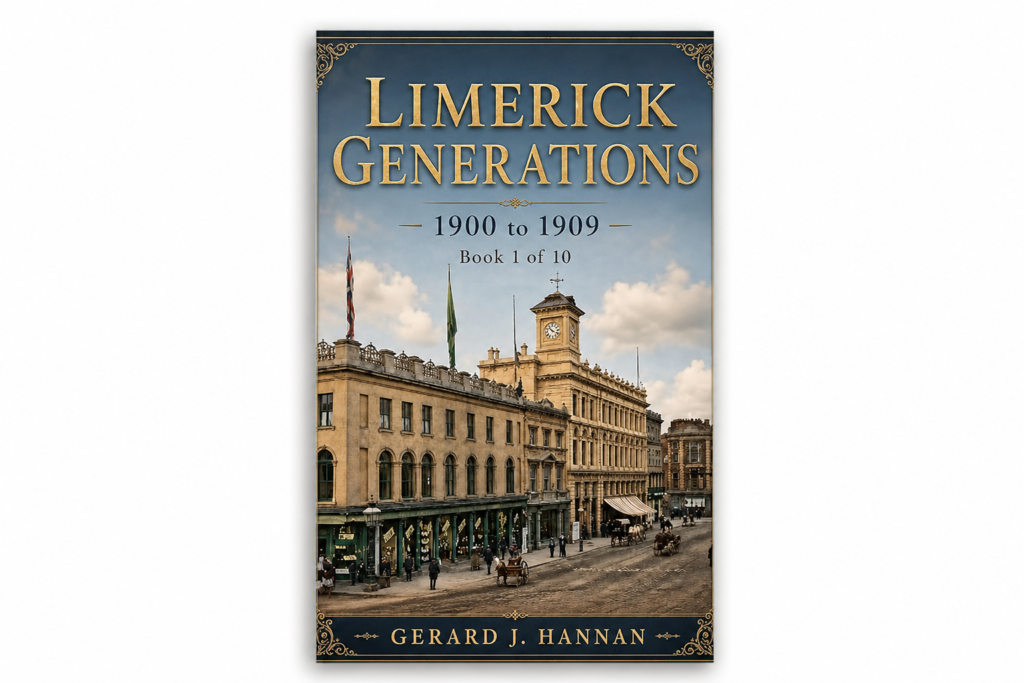
Limerick Generations 1
Book 1 of 10 : 1900 ~ 1909
Limerick Generations: 1900 to 1909 begins a ten-volume history tracing the lives of Limerick people across the twentieth century. This opening volume enters a city and county standing between inheritance and change, where old social structures remained powerful but new expectations were beginning to gather force. Political argument, religious influence, economic uncertainty and communal loyalty shaped everyday decisions. Streets, farms, workshops and markets carried memories of famine, eviction and migration, yet they also reflected resilience, ambition and practical hope. The decade emerges not simply as an introduction, but as a decisive period in which modern Limerick began taking recognisable form.
At the century’s opening, poverty remained embedded in both urban and rural life. Overcrowded housing, irregular employment, low wages and poor sanitation exposed families to insecurity, while the workhouse stood as a feared refuge for those without support. In the countryside, small farmers and labourers struggled with limited land, uncertain prices and dependence upon seasonal work. These conditions were not accepted without complaint. Campaigns for better cottages, fairer tenancy arrangements, improved drainage and stronger public health measures revealed a growing determination to challenge neglect. Reform came unevenly, but pressure from below increasingly entered council chambers, newspapers, elections and public debate.
Land remained one of the decade’s most urgent questions. For generations, ownership had shaped power, status and survival across County Limerick, leaving tenants vulnerable to rent, eviction and inherited insecurity. During these years, land purchase legislation offered growing numbers of farmers the possibility of becoming proprietors, although progress varied between districts. Negotiations, inspections and disputes could be complicated and divisive. Hope existed beside suspicion, particularly where congested holdings, grazing lands and evicted farms remained unresolved. The movement towards ownership altered more than title. It changed expectations, strengthened rural confidence and encouraged families to imagine a future rooted in the soil.
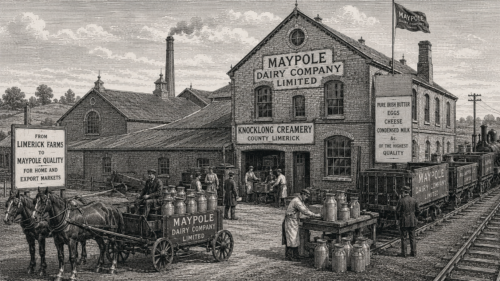
Limerick city possessed distinct energies and sharp contradictions. Commerce flowed through shops, quays, warehouses, markets and railway connections, but prosperity was distributed unevenly. Skilled workers, labourers, domestic servants, dockers and factory employees experienced the economy from different positions. Municipal leaders promoted improvement, investment and civic dignity, while poorer districts continued to endure inadequate housing and unhealthy surroundings. Newspapers reported council arguments, labour disputes, court cases and commercial developments, making public life visible to an expanding readership. Behind official speeches stood thousands of households measuring progress through rent, food prices, employment prospects, illness, credit and the weekly struggle to remain independent.
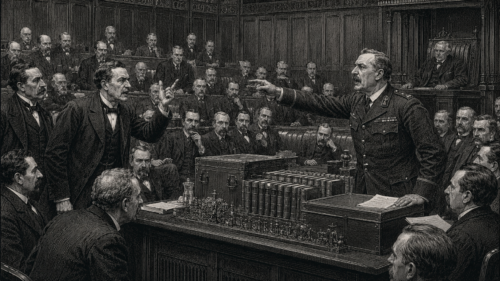
Politics increasingly entered daily life during the decade. Nationalism, local government, land reform and parliamentary division stirred meetings in halls, courthouses and public squares. Political leaders attracted attention, but organisers, priests, shopkeepers, farmers, journalists and labour representatives carried arguments into neighbourhoods and parishes. The struggle for Irish self-government remained central, yet it intersected with concerns about roads, rates, housing, schools and employment. Elections revealed loyalties but also exposed rivalries within nationalist politics. Limerick people did not experience politics as an abstract contest at Westminster. They encountered it through speeches, newspaper columns, parish influence, election campaigns and decisions affecting their communities.
Religion remained a commanding presence throughout Limerick society, shaping education, morality, welfare, family life and public behaviour. Churches organised worship, charity, schooling and discipline, while clergy influenced political and civic discussion. Religious identity offered belonging and support, yet it could also reinforce expectations concerning gender, respectability and obedience. Women often carried the burdens of faith through household management, child-rearing, attendance and care for relatives. Religious institutions provided vital services where public provision was weak, but their authority was rarely separate from broader questions of class and power. The decade therefore reveals belief as both personal devotion and a social force.
Education offered possibility, discipline and difficulty in equal measure. Schoolrooms became important arenas where children encountered literacy, religion, national identity and expectations about conduct. Attendance improved, but many families still depended upon children’s labour, particularly during harvests, domestic service or periods of financial strain. Teachers worked within restricted conditions, balancing official requirements against local realities. Educational opportunity differed according to class, gender and location, leaving some pupils better prepared for employment or advancement. At the same time, cultural revival encouraged interest in Irish history, language, music and sport. Learning increasingly carried the promise that inherited limitations might eventually be overcome.
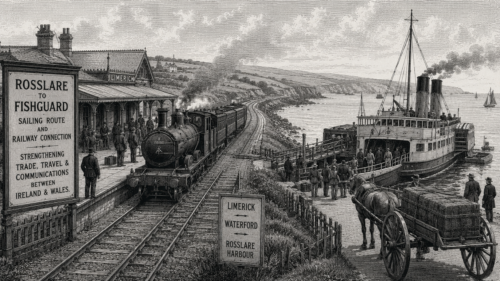
Emigration remained woven into the emotional and economic life of Limerick. Young men and women left rural homes, city streets and railway platforms for Britain, America and other destinations, carrying family hopes alongside fear. Their departures reduced pressure on struggling households and sometimes brought remittances, but they also emptied communities of energy, labour and companionship. Letters connected distant relatives to local events, while stories of opportunity competed with accounts of loneliness and hardship. Emigration was neither escape nor certain success. It represented a difficult calculation made around kitchen tables, where poverty, ambition, duty and affection met before the journey began.
Ordinary people stand at the centre of this history. Labourers waited for hiring, tenants pursued ownership, women stretched scarce household resources, and children moved between schooling and necessity. Farmers watched weather, prices and livestock, while shopkeepers extended credit and workers feared illness or unemployment. Public institutions recorded many of these lives only when hardship brought them before councils, courts, hospitals or Poor Law authorities. Yet scattered evidence allows their experiences to be recovered. Their choices reveal endurance rather than passivity, and their struggles give meaning to legislation, elections and reform. Limerick’s transformation was lived through countless private acts of persistence.
Drawn from newspapers, census returns, parliamentary papers, council minutes, directories, court proceedings, school reports, Poor Law records and land documents, this volume reconstructs a decade from many angles. Such sources reveal institutions and policies, but they also preserve fragments of individual lives, local disputes, household pressures and communal ambitions. Read together, they show a Limerick burdened by inequality yet increasingly unwilling to regard hardship as permanent. Between 1900 and 1909, reform gathered momentum, public expectations widened and forms of political and social confidence emerged. The twentieth century began not with a clean break, but with old burdens confronting new possibilities.