Limerick Generations
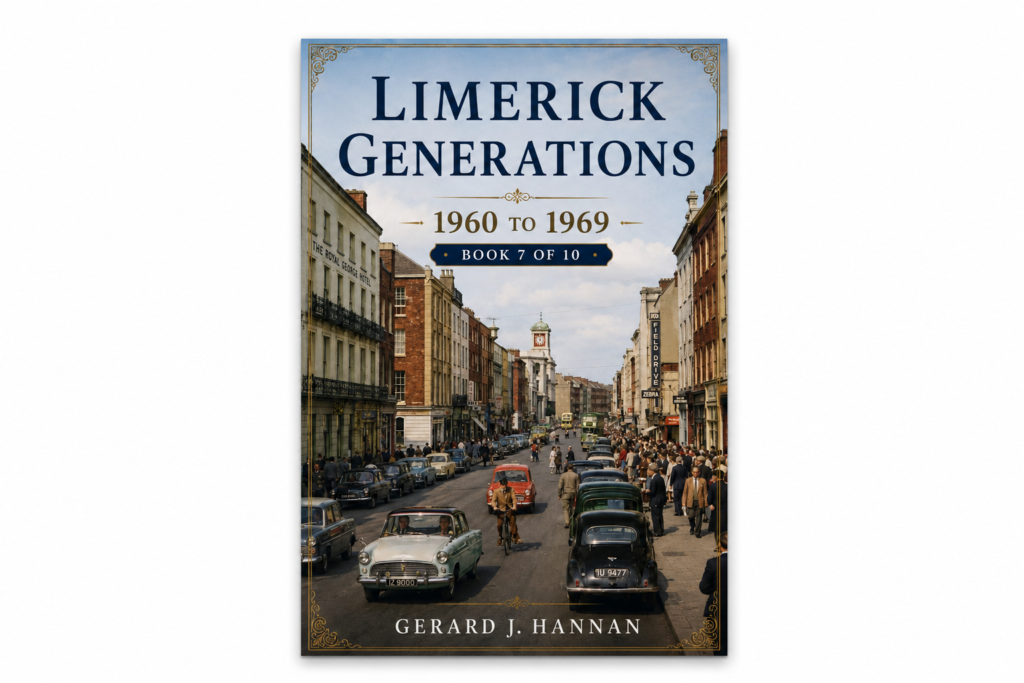
Book 7 of 10 : 1960 ~ 1969
Limerick Generations: 1960 to 1969 follows Limerick city and county through a decade of accelerating change, rising expectations and uneven prosperity. Industrial development, foreign investment and improved infrastructure created employment and encouraged confidence that emigration might no longer remain inevitable. New factories altered the rhythm of work, while roads, electricity and expanding services connected communities more closely to national and international markets. Yet progress reached people unevenly. Older industries remained vulnerable, rural districts lost population and poorer families continued facing insecure wages, inadequate housing and limited opportunity. Modernisation promised much, but it did not fully erase inherited inequalities across Limerick.
Shannon became one of the most powerful symbols of the changing mid-west. Its airport, industrial estate and free trade zone connected the region to international travel, commerce and investment. For Limerick people, Shannon offered employment, training and a new sense that opportunity could exist close to home. Roads and transport links strengthened the city’s relationship with the airport, while visiting aircraft, foreign workers and imported goods widened local awareness. The development also demonstrated the growing role of state planning in economic life. Shannon’s success encouraged optimism, although benefits were distributed unevenly between occupations, districts and social classes throughout the region.
Industry reshaped employment across Limerick during the 1960s. Foreign-owned factories and expanding domestic enterprises introduced new production methods, wage structures and workplace cultures. Young men and women who might previously have emigrated could now consider industrial employment at home, although job security varied and traditional trades sometimes declined. Factory work brought discipline, routine and opportunity, but it could also involve repetitive labour and limited advancement. Industrial estates changed the physical landscape, while new incomes affected housing, consumption and family expectations. Economic growth became visible in pay packets, household goods and bus journeys, yet unemployment and underemployment never disappeared locally completely.
Rural Limerick changed profoundly as mechanisation altered farming and reduced demand for manual labour. Tractors, milking machines and improved equipment increased productivity, but they also weakened older patterns of seasonal work and mutual dependence. Small farmers faced pressure to modernise, enlarge holdings or abandon agriculture, while younger people increasingly sought careers beyond the family farm. Better roads and transport reduced isolation, allowing rural households easier access to schools, shops and employment. Electricity transformed domestic routines and farm work. Yet modernisation brought losses as well as gains, including declining populations, disappearing customs and a growing sense that traditional life was passing.
Education became one of the decade’s most important sources of hope. The introduction of free secondary education widened access for children whose families could not previously afford fees, uniforms, books or travel. New schools and transport schemes helped extend opportunity beyond the city, although inequalities remained between districts and households. Parents viewed education as a path towards employment, advancement and escape from emigration. Teachers carried greater responsibility as classrooms filled with pupils expecting broader futures. The reform did not remove every barrier, but it altered ambition across Limerick, allowing more young people to imagine lives beyond inherited occupations and circumstances.
Women entered paid employment in growing numbers, particularly in factories, offices, shops, hospitals and public services. Their wages contributed to household income and gave some greater independence, yet inequality remained embedded in law, custom and workplace practice. Marriage bars, unequal pay and expectations surrounding motherhood restricted advancement, while domestic labour continued to fall upon women. Fashion, music and television presented modern images of femininity that often conflicted with religious teaching and social convention. Younger women encountered wider possibilities than their mothers, but freedom remained conditional. The decade widened opportunity without dismantling structures that limited women’s authority, earnings and personal choice.
Television transformed domestic life by bringing news, drama, sport, advertising and international events into Limerick homes. Families gathered around shared screens, while neighbours visited households fortunate enough to own a set. Popular music, film and fashion exposed younger audiences to British, American and European influences, weakening some older boundaries of taste and behaviour. Radio remained important, but television gave distant events an immediate visual presence. Consumer culture expanded through record players, household appliances and modern clothing. These changes encouraged daily generational tension, as young people adopted styles and attitudes that parents, teachers and clergy sometimes regarded with suspicion or disapproval.
Travel became easier and more common as improved roads, buses, cars and air connections reduced distance. Returning emigrants brought new accents, possessions and expectations, while holidays abroad introduced Limerick people to unfamiliar cultures and standards of living. Tourism also brought visitors into the city and county, supporting hotels, shops, transport and local attractions. Greater mobility changed courtship, leisure and employment, allowing people to move between home, work and entertainment more freely. Yet car ownership remained beyond many households, and rural transport could still be limited. The outward-looking decade expanded horizons, but access to mobility still continued reflecting income and location.
Economic growth did not eliminate poverty, exclusion or poor housing. Families in overcrowded or decaying dwellings watched new estates and suburban development rise beyond their reach, while unemployment and low wages continued undermining security. Public housing improved conditions for many, but demand remained high and older districts suffered from dampness, inadequate sanitation and limited space. Travellers, institutionalised people and marginalised groups encountered discrimination largely absent from celebratory accounts of progress. Health care and welfare expanded, yet access remained uneven. The modern city therefore contained sharp contrasts between new consumption, confident ambition and the persistence of hardship inherited from earlier decades.
By the decade’s end, unrest in Northern Ireland cast a growing shadow over Limerick’s new confidence. Civil rights marches, sectarian violence and the deployment of British troops revived questions about partition, nationalism and political responsibility. Newspapers and television carried disturbing images into homes, while local discussion reflected sympathy, anxiety and inherited loyalties. Limerick entered the 1970s more industrial, educated and connected than it had been ten years earlier, yet social divisions remained unresolved. The 1960s had widened opportunity and imagination, especially among the young, but they also created expectations that institutions, employers and governments would soon struggle to satisfy fully.

This Link Will Become Available Upon Publication On 22 July 2026.