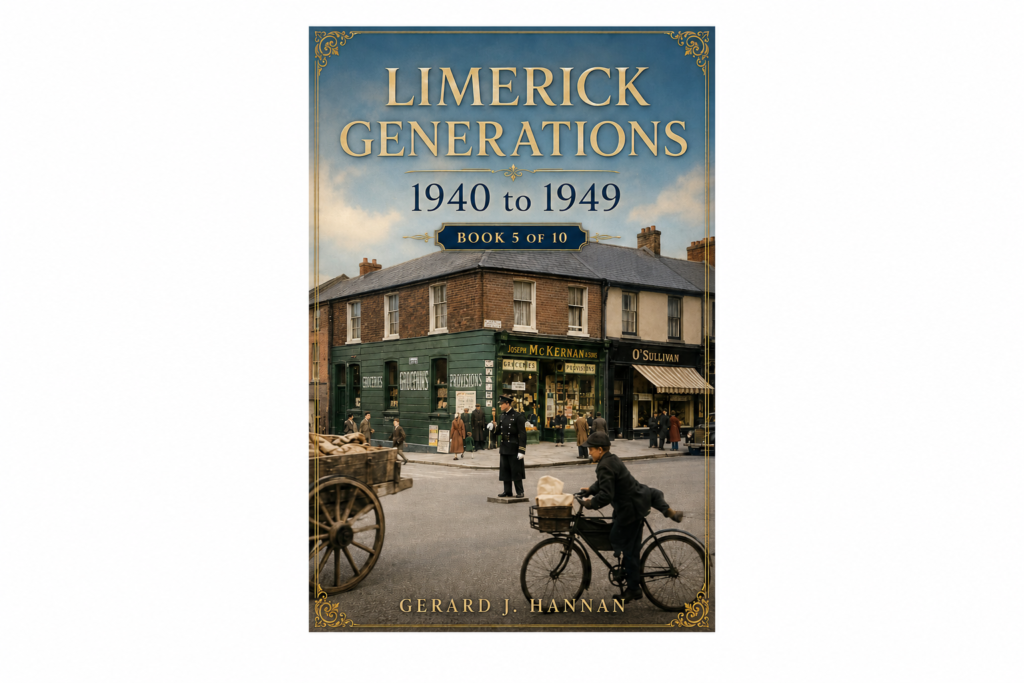
Limerick Generations 5
Book 5 of 10 : 1940 ~ 1949
Limerick Generations: 1940 to 1949 follows Limerick city and county through the Second World War and the austere years that followed. Irish neutrality protected local streets from bombardment, but it could not insulate families from fear, scarcity and economic disruption. Rationing altered meals, clothing and household routines, while shortages of fuel, tea, sugar and other essentials tested patience and ingenuity. Rumours of invasion circulated beside reports from Europe, creating anxiety within a country officially outside the conflict. Limerick endured the Emergency not as a distant observer, but as a community reshaped by restrictions, uncertainty and prolonged national vigilance throughout Limerick.
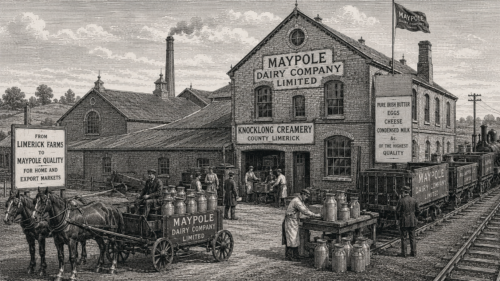
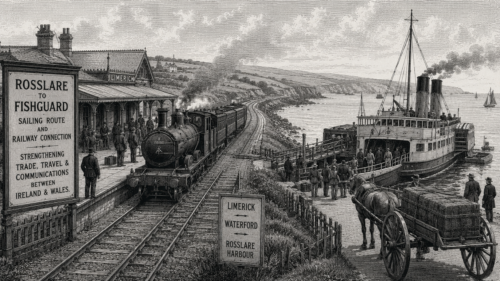
The port, railways and road networks became important as imported goods declined and transport difficulties multiplied. Coal and petrol shortages disrupted industry, trade and domestic life, forcing businesses and households to improvise. Trains carried workers, soldiers, livestock and scarce supplies, while delays and restrictions complicated movement across city and county. Limerick’s position as a commercial centre intensified the consequences of every interruption. Warehouses, shops and markets operated within tight controls, and ordinary purchases demanded planning. The wartime economy reached deeply into daily routines, determining when people travelled, what they bought, how homes were heated and which businesses could continue operating.
Agriculture carried new responsibilities during the Emergency as government policy demanded increased production. County Limerick farmers were urged to grow more tillage crops, conserve machinery and make limited supplies of fertiliser, fuel and feed stretch further. Weather, labour shortages and price controls complicated these efforts, while compulsory tillage measures sometimes provoked resentment. Markets remained vital meeting places where farmers, dealers and labourers exchanged news as well as livestock and produce. Rural households combined production for sale with efforts to feed themselves. The pressure placed upon farming revealed how national survival depended upon local fields, family labour and uncertain seasonal harvests.
Black-market trading developed wherever regulation and scarcity created opportunities for profit. Goods unavailable through ordinary channels could sometimes be obtained through personal connections, inflated prices or discreet exchanges. Authorities attempted to control hoarding, illegal slaughter, unauthorised sales and breaches of rationing rules, but enforcement was uneven. For poorer families, the black market was rarely a source of comfort, since high prices placed scarce items beyond reach. It nevertheless became part of wartime conversation and suspicion. The contrast between official equality and unequal access exposed enduring divisions of wealth, influence and opportunity across Limerick city, its suburbs and the surrounding county.
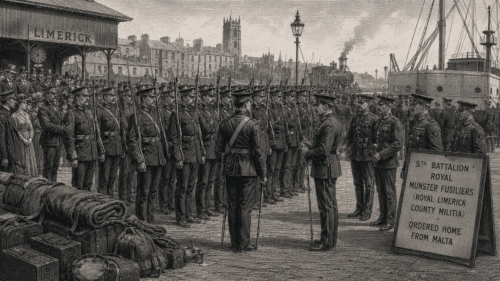
Many Limerick men and women spent the war years beyond Ireland. Some joined the British armed forces, while others travelled to Britain for employment in factories, hospitals, transport and construction. Their experiences complicated later memories of neutrality, because service abroad could be admired, concealed or politically uncomfortable. Families endured separation through letters, occasional leave and uncertain news, while money sent home supported households facing shortages. Those who returned carried stories of bombing, military discipline, industrial labour and societies transformed by war. Their absence and eventual homecoming connected neutral Limerick to a conflict that official policy had kept at arm’s length.
Women’s labour became essential to household survival and the wartime economy. They managed ration books, queued for supplies, repaired clothing, conserved fuel and adjusted meals around whatever was available. Women also worked in shops, offices, hospitals, factories, farms and voluntary organisations, often receiving less pay and recognition than men. Mothers carried particular responsibility for protecting children from hunger, illness and anxiety while maintaining domestic stability. Religious and charitable groups depended heavily upon female organisation and unpaid work. The decade revealed women not simply as dependants or helpers, but as central participants in the endurance of families, institutions and local communities.
Childhood during the 1940s was shaped by shortage, discipline and uneven opportunity. School attendance continued, but classrooms faced heating difficulties, limited materials and illnesses that spread quickly through crowded communities. Children learned about war through radio broadcasts, newspaper reports, adult conversations and the presence or absence of relatives abroad. Many also contributed to household survival by running errands, collecting fuel, helping on farms or taking employment when old enough. Play, sport and cinema offered release from adult anxieties, yet poverty remained visible in clothing, diet and housing. The decade left memories formed equally by restraint, imagination, fear and daily resilience.
Health and housing remained serious problems throughout the decade. Overcrowded dwellings, inadequate sanitation and poor nutrition increased vulnerability to tuberculosis and other infectious diseases. Hospitals, dispensaries, doctors, nurses and religious orders worked under financial and material constraints, while families often delayed seeking treatment because of cost or distance. Public housing programmes continued, but wartime shortages slowed construction and left many people waiting in unhealthy accommodation. Health care therefore reflected broader inequalities between classes and between urban and rural districts. Illness was never merely medical; it affected employment, income, schooling and family stability, sometimes pushing already vulnerable households towards lasting hardship.
Radio, cinema, religion and sport helped Limerick people endure years of restriction. Wireless broadcasts brought government announcements, news, music, drama and reports from battlefronts into domestic spaces. Cinemas offered temporary escape and visual contact with a wider world, even when wartime newsreels carried disturbing images. Churches provided worship, charity and moral guidance, maintaining strong influence over education, family life and public behaviour. Sporting fixtures strengthened local loyalties and created shared excitement and companionship despite transport difficulties and shortages. These activities did not remove hardship, but they gave rhythm to the decade, preserving sociability, imagination and communal identity during prolonged austerity.
Post-war recovery brought relief but little prosperity. Shortages continued, employment remained inadequate and poor housing still scarred both city and county. Emigration resumed with force as young people sought wages and opportunity in Britain, separating families and draining communities of labour and confidence. Political frustration grew as economic isolation appeared increasingly unable to provide secure livelihoods. Yet the decade also produced resilience, practical adaptation and sharper expectations of government responsibility. Grounded in newspapers, official reports, council records and personal evidence, this volume presents Limerick’s 1940s as years of neutrality, service, austerity, endurance and mounting dissatisfaction with the limits of independence.

This Link Will Become Available Upon Publication On 22 July 2026.