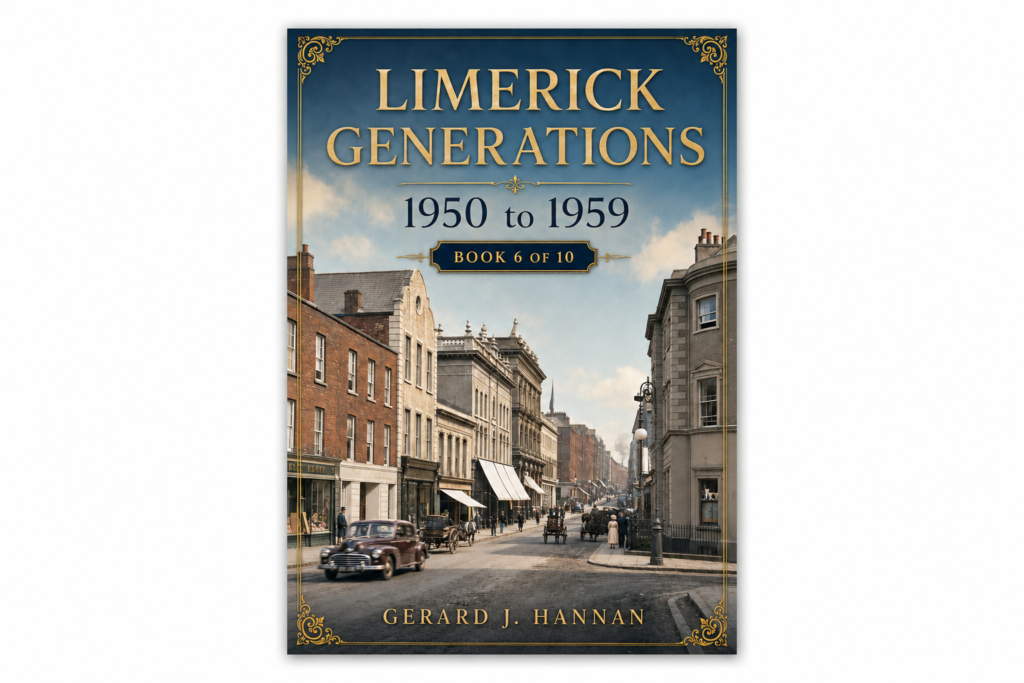
Limerick Generations
Book 6 of 10 : 1950 ~ 1959
Limerick Generations: 1950 to 1959 follows Limerick city and county through a decade of hardship, departure and hesitant renewal. Independence had not delivered secure work or prosperity for many families, and unemployment remained a constant threat. Young people looked beyond Ireland for wages, advancement and personal freedom, while parents watched households diminish around them. Streets, farms and villages carried the marks of absence as sons, daughters, neighbours and friends left in search of better lives. Yet the 1950s were not entirely static. Beneath the austerity, new technologies, returning emigrants and changing expectations began quietly unsettling established habits and assumptions slowly.
Emigration defined the decade more powerfully than any official policy. Trains carried young men and women from Limerick towards ports and airports, often with little certainty about when they would return. Britain drew the largest numbers, while America, Canada and other destinations remained part of family imagination. Departures were marked by restrained farewells, practical advice and hidden grief. Letters became lifelines for years, carrying news of work, lodgings, marriages and loneliness. Money sent home supported parents, siblings and children, easing hardship while deepening dependence upon absence. Emigration offered opportunity, but it also weakened communities and transformed family life across generations.
Traditional industries struggled to provide sufficient employment, leaving many workers dependent upon irregular wages, seasonal labour or insecure positions. Small businesses faced limited demand, while older manufacturing sectors found it difficult to modernise or compete. In rural Limerick, small farms confronted low incomes, fragmented holdings and the pressure to send children elsewhere. Agricultural work remained physically demanding, and mechanisation advanced unevenly. Markets and fairs retained importance, but they could not absorb the ambitions of a younger generation seeking independence. Economic stagnation was therefore experienced not through statistics alone, but through delayed marriages, abandoned plans, empty rooms and repeated departures overseas.
Housing conditions improved slowly, yet overcrowding and poor sanitation remained part of life for many families. New local authority estates provided safer, spacious homes, but waiting lists were long and construction could not meet demand. In older districts, dampness, inadequate heating and shared facilities continued to damage health and dignity. Rural cottages varied greatly in comfort, particularly where electricity and piped water had not yet arrived. Housing shaped family relationships, illness, privacy and opportunity. A secure home could represent progress and respectability, while inadequate accommodation reinforced poverty, limited choices and reminded residents that national independence had not guaranteed social equality.
Health care remained uneven across Limerick, divided by income, location and access to services. Hospitals, dispensaries, doctors, nurses and religious orders provided essential treatment, but families could delay seeking help because of cost, distance or fear. Tuberculosis and other illnesses remained associated with overcrowding, poor nutrition and insecure living conditions, though public health measures gradually reduced some dangers. Maternity care, childhood illness and disability placed heavy responsibilities upon women within the home. Welfare provision expanded cautiously, yet many people continued relying upon relatives, neighbours, clergy and charity. Illness could quickly destroy employment, income and household stability during these fragile years.
Education carried the promise of advancement, but opportunity remained unequal. Many children left school early to earn wages, help on farms or prepare for emigration, while access to secondary education depended upon family income and geography. Teachers worked within crowded classrooms and limited resources, attempting to widen horizons in communities where employment prospects were narrow. Schooling also reinforced religious authority, discipline and expectations concerning gender. Boys were often prepared for work or trades, while girls faced pressure towards domestic service, marriage or religious life. Education could open doors, yet for many Limerick families those doors remained painfully difficult to reach.
The Catholic Church exercised powerful influence over morality, education, welfare and family life throughout the decade. Clergy shaped public discussion, schools reinforced religious teaching and social respectability depended heavily upon conformity. Church organisations offered charity, companionship and practical assistance, but authority could also restrict personal freedom. Women experienced these limitations most sharply through expectations concerning sexuality, marriage, motherhood, employment and obedience. Opportunities outside the home remained narrow, and unmarried mothers faced especially severe judgement and isolation. Religious belief provided consolation and community for many, yet institutional power also regulated behaviour, silenced dissent and preserved social arrangements that increasingly appeared unequal.
Electricity, transport, radio and cinema gradually widened Limerick’s connection with the world beyond Ireland. Rural electrification transformed lighting, domestic work and farming, though progress varied between districts. Improved buses and roads reduced isolation, while car ownership altered movement and leisure for those who could afford it. Radio carried music, news and foreign voices into kitchens and sitting rooms, creating shared experiences across distance. Cinemas offered glamour, romance and escape, allowing audiences to imagine lives beyond local constraints. These changes did not end poverty or emigration, but they weakened isolation and encouraged new expectations among younger people throughout city and county.
Returning emigrants brought money, fashions, accents, habits and stories that challenged assumptions at home. Their clothing, confidence and experience of British or American workplaces offered visible evidence that life could be organised differently. Some returned permanently to marry, establish businesses or care for relatives, while others visited before leaving again. Their presence could inspire admiration, envy or unease, particularly where new attitudes collided with religious authority and traditional expectations. Emigration therefore changed Limerick even when migrants remained abroad. Through visits, letters, remittances and imported goods, distant cities entered local imagination, altering ambitions, relationships and definitions of success during the decade.
By the late 1950s, dissatisfaction with economic stagnation encouraged a decisive change in national policy. New strategies promoted industrial development, foreign investment, exports and closer engagement with international markets. Their immediate effects were limited, but they signalled a break with protectionism and offered hope that employment might eventually be created at home. Limerick entered this transition carrying losses from emigration, persistent inequality and communities weakened by departure. Yet new factories, improved infrastructure and expanding educational ambitions suggested possibilities. The decade ended not with prosperity, but with the beginnings of transformation and a growing belief that isolation could no longer continue.

This Link Will Become Available Upon Publication On 22 July 2026.