
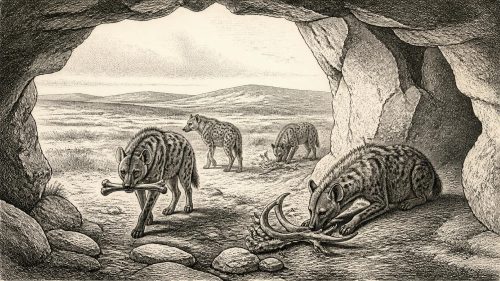
Hyaena Land, Castlepook
Castlepook Cave near Doneraile, County Cork, preserves a disturbed, important Late Pleistocene animal archive rather than evidence for a dated event in 31,920 BCE. Fossils, individually dated across approximately 45,700–19,950 years ago, include mammoth, giant deer, reindeer, bear, spotted hyaena, wolf, Arctic fox and lemmings. Gnawed bones indicate repeated hyaena use, not a local fauna. Revised dating suggests giant deer and hyaenas may have vanished locally before 40,000 years ago. A reindeer femur possibly bearing butchery marks suggests an early Upper Palaeolithic human visit, but proves neither settlement nor community. These changing landscapes supported habitats before ice-sheet advance erased evidence.
View Record
Castlepook’s Reindeer Country
Around 34,000 calibrated years BP, Ireland experienced severe climatic change before the Last Glacial Maximum. Cold open grassland, steppe and tundra supported diverse mammals, documented chiefly at Castlepook Cave, County Cork. Its disturbed, long-lived deposits contain reindeer, bears, wolves, arctic foxes, mammoths, giant deer and Ireland’s only spotted-hyaena remains, but do not represent one moment. A reindeer bone possibly cut by tools suggests human contact around 33,000 years ago, yet lacks secure context. No hearths, tools, settlements or burials confirm permanent occupation. Expanding ice later erased landscapes and deposits, leaving Castlepook crucial evidence for pre-glacial environments but unresolved human history.
View Record
Castlepook’s Hyena Galleries
About 33,900 calibrated years before present, Ireland experienced unstable MIS 3 conditions, with fluctuating ice, sea levels and open steppe-tundra habitats. Castlepook Cave, County Cork, preserves fauna including mammoth, reindeer, giant deer, hyaena, wolf and Arctic fox, although disturbed deposits and revised dates demand caution. Evidence indicates a cold-adapted animal community and carnivore activity, not a single contemporaneous landscape. A cut-marked reindeer femur plausibly suggests Upper Palaeolithic visitors butchered game, but cannot prove settlement. No associated tools, hearths or human remains exist. Later glaciation destroyed or buried evidence, leaving caves as fragile archives of possible early human presence in Ireland.
View Record
Castlepook’s Reindeer Horizon
31,923 BCE is an approximate modern label within Marine Isotope Stage 3, not a datable Irish event. Castlepook Cave in north Cork preserves disturbed pre-Last Glacial Maximum faunal remains, including reindeer, bears, wolves, Arctic foxes, lemmings, giant deer, mammoths and hyaenas. These animals indicate a fluctuating, open, cold environment rather than permanent ice cover. A reindeer femur dated to 31,000 BCE may bear a stone-tool butchery mark, potentially Ireland’s earliest human evidence. However, no associated tools, hearths or settlement survive, and the mark remains contested. The evidence suggests possible hunter-gatherer visits, not proven occupation, during a landscape transformed by glaciation.
View Record
The Castlepook Femur
Around 33,900 years ago, Ireland was a cold, changing Late Pleistocene landscape, with lower sea levels, open vegetation and advancing ice sheets. Castlepook Cave, County Cork, preserves Ireland’s richest assemblage of vertebrate remains from this period, including mammoth, giant deer, reindeer, bear and hyaena. Its deposits accumulated over millennia and cannot reconstruct a single ecosystem or event. A reindeer femur reportedly bearing a stone-tool cut mark suggests possible human butchery around 31,000 BC. However, no associated tools, hearths, dwellings or human remains confirm settlement. Ireland’s earliest possible human activity therefore remains fragmentary, while later glaciation erased or buried much evidence.
View Record
Carden’s Castlepook Interpretation
At the notional date of 31,925 BCE, Ireland lay in a cold, unstable Late Pleistocene environment preceding maximum glaciation. Open steppe, shifting coastlines, glaciers and periglacial conditions supported intermittent fauna including reindeer, mammoth, giant deer, bears, wolves, Arctic foxes and hyaenas. Castlepook Cave, County Cork, contains a reindeer femur, roughly 33,000 years old, possibly cut by a stone tool during butchery. If confirmed, this suggests transient human presence, not permanent settlement or a defined culture. Cave disturbance, incomplete early excavation, glacial erosion and drowned landscapes limit interpretation. Secure settlement appears only in Mesolithic, after deglaciation, around early eighth millennium BCE.
View Record
Cave Bone Taphonomy
Ireland around 31,926 BCE cannot be reconstructed as a calendar-year history. During later Marine Isotope Stage 3, before the Last Glacial Maximum, a cold, unstable landscape faced expanding and regionally variable ice. Cave deposits, particularly at Castlepook, preserve sparse evidence of mammoth, reindeer, giant deer, bears and hyaenas, indicating intermittently habitable open environments. A marked reindeer femur may record human butchery about 33,000 years ago, but remains contested and proves neither settlement nor continuous occupation. Disturbed early excavations complicate interpretation. No secure evidence exists for communities, artefacts, farming, politics, religion or art. Sustained settlement appears after deglaciation, around 8000 BCE.
View Record
Derryvree Freshwater Sequence
Around 31,927 BCE, Ireland lay in Marine Isotope Stage 3, before major Last Glacial Maximum ice expansion. Derryvree sediments in County Fermanagh, dated broadly to 36,900–31,700 years before present, preserve evidence of ice-free but intensely cold tundra terrain. Similar deposits indicate exposed north-central ground until about 34,000 years ago, before advancing ice transformed habitats. Cave remains demonstrate diverse Pleistocene fauna, although dates and associations require caution. No securely dated human settlement or community is known. A possibly butchered reindeer bone from Castlepook may indicate an early visit, but remains unconfirmed. The record principally documents environmental change, not conventional human history.
View Record
Midlandian Glacial Stage
Around 31,928 BCE, Ireland lay in the Midlandian glacial stage, before the Last Glacial Maximum. Cold, unstable conditions created open grassland, periglacial erosion, altered rivers and lower sea levels, while expanding ice increasingly reshaped landscapes. Later glaciation destroyed much evidence, making caves crucial archives. Castlepook Cave in County Cork preserves remains of mammoth, giant deer, reindeer, predators and small cold-adapted mammals, demonstrating a varied fauna. A possibly tool-marked reindeer bone may indicate fleeting Upper Palaeolithic human contact, but cannot prove settlement. No associated tools, hearths, dwellings or social record survive. Ireland was a marginal, changing environment, not a human homeland.
View Record
Derryvree Organic Silts
31,929 BCE is a modern label for a Late Pleistocene phase, not a recoverable Irish year. During Marine Isotope Stage 3, Ireland experienced cold, unstable conditions before the Last Glacial Maximum, with fluctuating ice margins, sea levels and landscapes. Organic silts at Derryvree, County Fermanagh, dated broadly to 36,900–31,700 cal BP, indicate locally ice-free intervals and treeless wet vegetation. Cave deposits, including Castlepook, show cold-stage mammals occurred during the wider period, though not necessarily then. No securely dated human evidence exists. Later glaciation erased much evidence; surviving sediments, landforms and fauna provide an incomplete environmental record of developing Irish glaciation.
View Record