Wolf Hall’s Red Deer30812 BCE
30,812 BCE is a modern label, not a securely dated Irish event. During unstable Marine Isotope Stage 3, Ireland was a changing cold-stage landscape, with altered shorelines, uncertain access routes and fluctuating ice margins. Castlepook Cave, County Cork, preserves diverse Late Pleistocene fauna, including reindeer, deer, mammoth, predators and Arctic species, but disturbed deposits and unreliable early dates prevent precise reconstruction. Derryvree sediments demonstrate freshwater and tundra-like environments between glacial episodes. A marked Castlepook reindeer bone may indicate human butchery around 33,000 years ago, yet no confirmed occupation evidence exists before 10,000 cal BP. Mammals and perhaps people reached Ireland.
Dateline
30,812 BCE is not a year for which Ireland possesses an annal. It is a modern calendar label, roughly 32.8 thousand years before the conventional radiocarbon reference year of AD 1950, rather than a date recoverable from an Irish deposit. No excavated layer, animal bone, hearth or human artefact can presently be assigned to that individual year. The responsible setting is the later part of Marine Isotope Stage 3 (MIS 3), a long and climatically unsettled phase of the last Ice Age, conventionally spanning about 57,000–29,000 years ago. Dates of this antiquity have substantial margins of uncertainty and must be calibrated: a radiocarbon measurement is not itself a calendar age.
A Landscape Before the Maximum
Ireland at this point was approaching, but had not yet reached, the Last Glacial Maximum, when the British–Irish Ice Sheet became much more extensive. That distinction matters. “Ice Age” does not mean that every place was continuously sealed beneath ice. The island’s glacial history involved changing ice margins, exposed ground, meltwater, frost-shattered slopes and periods in which animals could move through parts of the landscape. Exactly where ice lay in 30,812 BCE cannot be mapped from the evidence available. Reconstructions of the last ice sheet are strongest for its growth after this broad period and for its later retreat; they caution against drawing a sharp, island-wide ice boundary for one notional year.
Sea level was markedly lower than today during MIS 3, and Ireland’s shorelines were therefore very different. Yet low sea level alone does not demonstrate a simple, dry land bridge to Britain or continental Europe. The depth and form of the Irish Sea and North Channel, changing ice, coastal topography and the uncertainty of regional sea-level histories all complicate the question. Mammals plainly reached Ireland at intervals, but the particular routes they used cannot be reconstructed with confidence for this moment. It is safer to speak of a changing north-west European land-and-sea frontier than to imagine a known road into Ireland.
Castlepook’s Uneven Archive
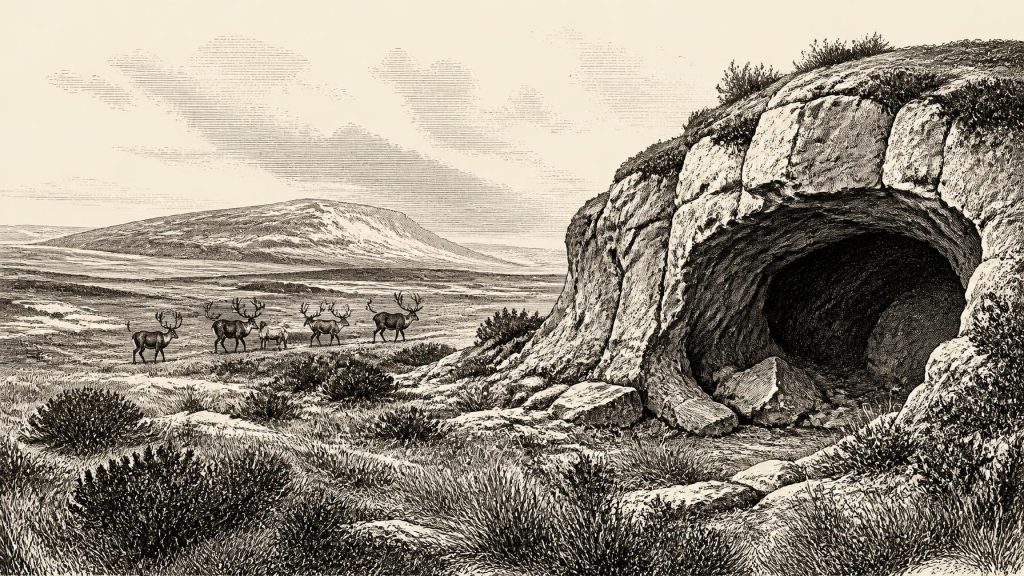
The most important Irish evidence close to this broad timespan comes from Castlepook Cave near Doneraile, County Cork. Its limestone passages, historically given names such as Wolf Hall, Hyaena Hall and Elephant Hall, yielded one of Ireland’s richest collections of Late Pleistocene vertebrate remains. More than 2,000 bones have been recovered from the system, representing a fauna far removed from modern Ireland: reindeer, red deer, giant deer, brown bear, wolf, Arctic fox, lemmings, spotted hyaena and woolly mammoth are among the animals identified from its deposits. The cave is consequently indispensable, not because it supplies a diary of one year, but because it proves that Ireland periodically supported, or was visited by, sizeable cold-stage mammals.
Its evidence must nevertheless be handled carefully. Much of Castlepook was excavated in the late nineteenth and early twentieth centuries, before modern methods of recording, sieving and micromorphological sampling. Cave sediments can be disturbed by water, burrowing animals, roof falls, carnivores and earlier digging; bones of different ages may consequently occur close together. The Irish Quaternary Fauna Project demonstrated both the value and the difficulty of these collections by directly dating selected specimens. More recent reassessment has shown that some older radiocarbon results for southern Irish MIS 3 fauna were substantially too young, probably because of contamination and the limitations of earlier pretreatment. A bone’s age, its original sedimentary position and the date of a possible human modification are therefore separate questions.
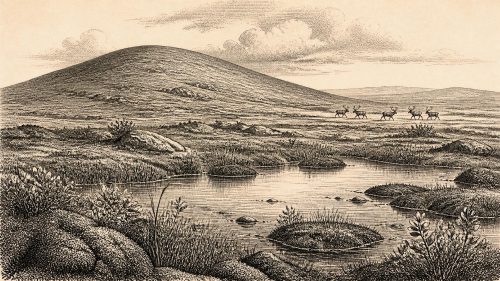
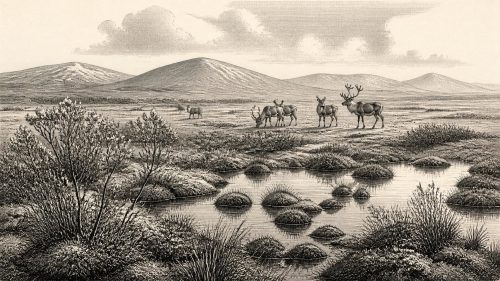
Wolf Hall provides a useful warning against false precision. A red-deer upper molar from that part of Castlepook once returned an age of 27,730 ± 380 radiocarbon years BP, while nearby cave finds include reindeer, giant deer and small Arctic-adapted mammals from differing phases of the Late Pleistocene. Such results establish broad environmental horizons, not a simultaneous herd gathered in one chamber. The animal world evoked for around 33,000 calibrated years ago is thus a mosaic assembled from deposits with varied histories. The archaeological task is to distinguish what the material demonstrates—the presence of particular species at intervals—from what it merely suggests about local habitats, seasons and movements.
Animals, Habitats and Seasonality
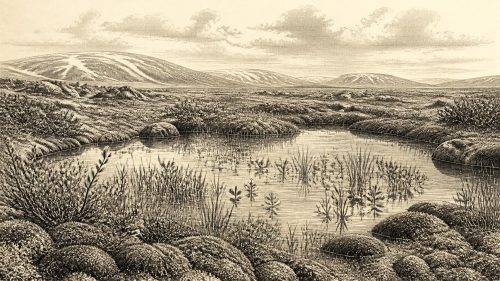
The Castlepook assemblage points towards open, cold environments rather than a closed forested island. Reindeer and lemmings are especially powerful indicators of northerly, exposed conditions; mammoth, giant deer, hyaena and wolf belong to a broader Late Pleistocene fauna capable of exploiting open grassland, herb-rich steppe, sparse scrub and ecotones around watercourses. This should not be reduced to a single “mammoth-steppe” picture. Ireland’s terrain was varied, and conditions fluctuated sharply across MIS 3. Greenland ice cores register repeated abrupt shifts between colder stadials and milder interstadials, with major effects on the North Atlantic region. What was habitable in one millennium, or in a sheltered southern district, could become far harsher in another.
Buried freshwater deposits at Derryvree near Maguiresbridge, County Fermanagh, offer a complementary but not year-specific environmental archive. Found between two tills in a drumlin, their silts and sands preserve evidence of a freshwater setting during a Middle Midlandian interval. Plant and invertebrate remains from such sites demonstrate that ice-age Ireland could include pools, marshy ground and tundra-like vegetation as well as exposed mineral soils. They do not prove that Fermanagh looked precisely the same in 30,812 BCE; rather, they show the range of non-glacial environments that existed in Ireland during the wider cold stage. The contrast between a Fermanagh wetland sequence and Cork cave fauna is a reminder that regional environments were not uniform.
The Human Question
Whether people were in Ireland at around this time remains the central and unresolved archaeological question. A reindeer bone from Castlepook has been reported as bearing a deep linear mark consistent with cutting or butchery by a sharp stone implement and has been associated with an age of roughly 33,000 years ago. If the mark is confirmed as human-made, and if its dating and association withstand further scrutiny, it could indicate a brief Upper Palaeolithic visit far earlier than Ireland’s previously accepted evidence for human activity. It would not, by itself, establish a permanent population, a settlement, a named group or a continuous ancestry to later Irish people.
The caution is substantial. No securely dated hearth, dwelling floor, stone-tool assemblage, burial or repeated occupation horizon of this age has yet been demonstrated in Ireland. The Castlepook Caves Project’s own grant reporting stresses that not a single stone or bone tool can yet be said with certainty to represent human occupation of the island before 10,000 cal BP. Recent work has located promising deposits and improved knowledge of the cave system, but prospecting for evidence is not the same thing as recovering it. For 30,812 BCE, “possible human activity” is the strongest responsible formulation; “settlement” goes beyond the evidence.
No Polities, No Trade Routes
There were no Irish kingdoms, chiefs, diplomatic ties, territorial borders or political institutions that can be documented at this depth in time. Nor is there evidence for warfare, organised religion, art, language, formal learning, trade networks or exchange goods in Ireland around this date. Those absences are not minor gaps in a fuller story: they define the limits of the record. Even if small hunter-gatherer parties reached the island, their visits may have been brief, seasonal and archaeologically slight. Comparable Upper Palaeolithic communities elsewhere in Europe hunted, processed animal carcasses, made stone tools and maintained wide social connections, but those patterns cannot simply be imported into Ireland without Irish finds to support them.
Everyday life can therefore be described only conditionally. A hypothetical visiting group would have faced intense cold, unstable weather, long winter darkness, dangerous large animals and a landscape offering uncertain resources. Caves might have provided shelter or served as carnivore dens; Castlepook’s bones do not demonstrate that people lived within its passages. Carnivores, natural deaths and water transport are alternative explanations for much of the assemblage. The most secure economy visible here is ecological rather than human: grazing and browsing herbivores exploited vegetation, while predators and scavengers followed them.
An Irish History of Fragments
The significance of 30,812 BCE lies not in an invented event but in the depth of Ireland’s recoverable past. The island was part of a mobile Late Pleistocene world in which climate changed quickly, sea and ice reshaped routes, and animal communities appeared and disappeared. South Cork caves preserve striking traces of that world, while Fermanagh sediments show that freshwater habitats could survive between glacial episodes. Castlepook’s contested marked reindeer bone makes the possibility of a very early human visit worth investigating, not treating as settled fact.
For this notional year, the strongest historical statement is also the most modest: Ireland was a changing cold-stage landscape, intermittently accessible to large mammals and perhaps, but not yet certainly, to people. Its evidence survives in cave bone, buried silt, glacial landform and calibrated date range—not in calendar-year events. Future excavation, improved radiocarbon pretreatment, microscopic study of bone surfaces and the discovery of undisturbed deposits may refine that picture. They cannot turn 30,812 BCE into a dated chapter of human affairs, but they may reveal more of the landscape through which the earliest visitors, if they came, moved.
Primary Sources
- A Reconsideration of the Radiocarbon Dating of the Marine Isotope Stage 3 Fauna from Southern Ireland
- The Irish Quaternary Fauna Project
- Castlepook Cave
- Archaeology Research Excavation Grant 2022
- Archaeology Research Excavation Grant Report: Castlepook Caves Project
- Castlepook Cave, Co. Cork, 2022
- New Insights on the Fauna of Ireland’s Younger Dryas and Early Holocene from Alice & Gwendoline Cave
- A Middle Midlandian Freshwater Series at Derryvree, Maguiresbridge, County Fermanagh, Northern Ireland
- Growth and Retreat of the Last British–Irish Ice Sheet, 31,000 to 15,000 Years Ago
- Timing and Pace of Ice-Sheet Withdrawal Across the Marine–Terrestrial Transition West of Ireland During the Last Glaciation
- Trimlines, Blockfields and the Vertical Extent of the Last Ice Sheet in Southern Ireland
- Pattern, Style and Timing of British–Irish Ice Sheet Advance and Retreat Over the Last 45,000 Years
- The IntCal20 Northern Hemisphere Radiocarbon Age Calibration Curve (0–55 cal kBP)
- A Stratigraphic Framework for Abrupt Climatic Changes During the Last Glacial Period Based on Three Synchronized Greenland Ice-Core Records
- Dansgaard–Oeschger Events in Climate Models: Review and Baseline Marine Isotope Stage 3 Protocol
- The Marine δ18O Record Overestimates Continental Ice Volume During Marine Isotope Stage 3
- The Problem of a Late Quaternary Landbridge Between Britain and Ireland
- Archaeological Heritage of County Cork: An Overview
- Ireland’s Palaeolithic Archaeology – Fleeting Footprints in a Frozen Land
- The IntCal20 Northern Hemisphere Radiocarbon Age Calibration Curve PDF