BIRM-166 and Ireland’s Cold Stage30166 BCE
Thirty thousand years BCE is not a recorded Irish event but an approximate point within Marine Isotope Stage 3, reconstructed from limited environmental evidence. Derryvree, County Fermanagh, preserves wetland sediments between tills, dated by BIRM-166 within a calibrated range. They indicate an ice-free interval with cold, open tundra vegetation, freshwater and seasonal biological activity before later glaciation. Greenland records place the period near a cold stadial, although local conditions varied. Castlepook Cave documents diverse Ice Age fauna, not a simultaneous community. Possible early human activity remains unconfirmed; no secure settlement exists. These archives depict an ecologically inhabited, repeatedly glaciated Ireland.
Dateline
“30,166 BCE” is a modern way of labelling a point roughly 32,115 calendar years before AD 1950, the reference year used for radiocarbon ages. It must not be mistaken for a date that prehistoric people in Ireland could have recognised, nor for the date of a recorded occurrence. There are no written sources, named communities, securely dated settlements or political events for this particular year. The responsible subject is therefore a broad Late Pleistocene setting: Ireland during Marine Isotope Stage 3, before the Last Glacial Maximum, reconstructed from a small and uneven body of cave bone, buried wetland sediment, plant remains, landforms and climate records.
Calendar-year precision at this depth is necessarily limited. Radiocarbon results have statistical errors, calibration curves produce ranges rather than single historical dates, and deposits may represent an interval of accumulation rather than one moment. The nearest important Irish environmental sequence is the Derryvree freshwater deposit near Maguiresbridge, County Fermanagh. Its conventional radiocarbon determination, BIRM-166, was reported as 30,500 years BP with a substantial error range; later discussion places its calibrated span broadly at about 36,900–31,700 cal BP. Thus 30,166 BCE lies within the outer part of a useful chronological window, not at an excavated annual horizon.
A Cold North Atlantic Interval
On the Greenland ice-core chronology, a date around 32.1 thousand years ago falls close to the onset of Greenland Stadial 5.2, a cold episode dated from about 32,040 to 32,500 years before AD 1950. Greenland’s record is not a thermometer buried in Irish soil: it cannot tell us the weather on any particular Irish day, or even prescribe identical local conditions. It does, however, provide a high-resolution North Atlantic framework within which to understand a generally cold, climatically volatile Ireland. The island lay on Europe’s Atlantic fringe, exposed to shifts in ice, sea, wind and temperature that could rapidly alter habitats and routes available to animals.
This was not yet the peak of the last Irish glaciation. The principal Late Midlandian expansion and maximum of the British–Irish Ice Sheet came later, though its timing and extent varied by region. Evidence from Irish landforms shows that ice-sheet growth was not a single, island-wide event occurring all at once. At the time represented by Derryvree, at least parts of inland Fermanagh supported water, sediment and vegetation before subsequent ice overrode and sealed the deposits beneath till. The record therefore corrects a simple image of a permanently frozen, wholly ice-covered Ireland.
Derryvree’s Buried Wetland
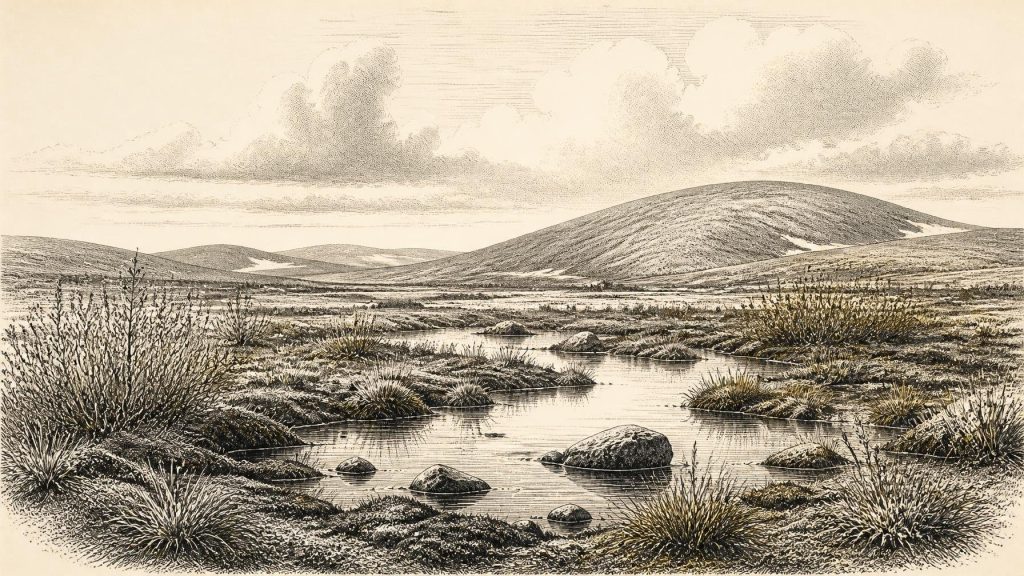
The Derryvree discovery is unusually valuable because roadworks cut through a drumlin and exposed organic silts and fine sands sandwiched between two thick till sheets. The lower and upper tills record separate episodes of glacial deposition; between them lies evidence of an ice-free interval in which freshwater and plant material accumulated. The original investigators described a flora and fauna of full-glacial aspect, indicating open tundra vegetation and a periglacial climatic regime. This is direct evidence for one local landscape, not a map of all Ireland.
The plant evidence evokes low, open ground rather than woodland: sedges and mossy wet places, shallow freshwater, and hardy plants capable of enduring short growing seasons, frost action and exposed terrain. Fossil records from Derryvree include three-leaved bogbean (Menyanthes trifoliata) and mountain avens (Dryas octopetala), while the wider assemblage has been interpreted as a treeless muskeg or tundra wetland. Such plants demonstrate that moisture and standing or slow-moving water remained important features of a cold landscape. They do not justify a picturesque certainty about every hillside, lake shore or coast.
In practical terms, this was a landscape shaped by seasonality. Frozen ground, snow cover, spring meltwater and saturated hollows would have constrained movement and vegetation. Yet the very existence of an organic freshwater layer means that the area was biologically active during at least part of the year. The later advance of ice preserved that evidence while destroying or obscuring much else. Ireland’s Pleistocene archive is consequently fragmentary: a road cutting, cave chamber or sediment pocket can carry information unavailable over many surrounding kilometres.
Animals in a Changing Island
Southern Ireland supplies a different but complementary archive. Castlepook Cave, or Mammoth Cave, near Doneraile in north County Cork, has yielded remains of a rich Ice Age fauna. Revised radiocarbon work shows that several species occupied Ireland during Marine Isotope Stage 3, long before the Last Glacial Maximum: woolly mammoth, reindeer, giant deer, brown bear, hare, Arctic fox, wolf, lemmings and spotted hyaena are among the animals represented in the cave record. The revised dates particularly suggest that giant deer and spotted hyaena had disappeared locally before about 40,000 cal BP.
That list must be read carefully. A cave bone assemblage is not a census of animals standing together on one afternoon in 30,166 BCE. Bones can enter caves through carnivore activity, scavenging, natural death, water movement and disturbance during old excavations. Individual specimens have different ages, and the animals’ ranges changed with climate. Nevertheless, the evidence decisively shows that Pleistocene Ireland was not biologically empty. Open ground and wetland supported herbivores; carcasses drew predators and scavengers; and mobile animals crossed a wider north-west European landscape whose coastlines and ice margins differed greatly from those of today.
There is no sound basis for treating this fauna as evidence of a stable human economy in Ireland. It can illuminate potential resources for any passing people—meat, fat, hide, bone and antler—but it cannot demonstrate that people hunted each listed species, managed herds, traded animal products or occupied regular hunting territories. Isotope work on Irish giant deer does, however, show how modern analysis can ask questions about animal mobility and landscape use rather than merely compiling species lists.
The Human Question
The possibility of people in Ireland at this broad time remains important but unresolved. A reindeer femur from Castlepook has been publicised as bearing a deep modification interpreted as a stone-tool cut associated with a bone dated to roughly 33,000 years ago. If microscopic and taphonomic assessment ultimately confirms that interpretation and association, it would be significant evidence that someone processed a reindeer carcass in Ireland before the Last Glacial Maximum. It would still represent a brief encounter, not proof of permanent settlement, population size, language, kinship, territory or a continuous ancestry leading to later Irish communities.
For 30,166 BCE specifically, no securely stratified hearth, stone-tool assemblage, dwelling, burial, art, food-processing floor or human bone has been published from Ireland. The better-supported evidence for Pleistocene human presence is much later: work at Alice and Gwendoline Cave in County Clare has identified an Upper Palaeolithic human signal in the terminal Pleistocene. The enormous chronological gap matters. Sophisticated hunter-gatherer societies certainly existed elsewhere in Europe during MIS 3, but their technologies and social worlds cannot responsibly be placed in Ireland without Irish archaeological evidence.
What Cannot Be Reconstructed
Accordingly, Ireland at this date has no recoverable political history. There is no evidence for chiefs, kingdoms, diplomacy, warfare, frontiers or institutions. Equally, there is no Irish evidence for religious rites, shrines, art traditions, formal learning, trade networks or settled households. These absences are not claims that no person ever set foot on the island; they are limits imposed by the surviving record. A single potentially modified bone cannot carry the weight of an entire society.
The most defensible account of everyday life is therefore ecological rather than social. In the Fermanagh evidence, hardy vegetation and freshwater persisted in a cold, open setting between glacial episodes. In the Cork cave evidence, large herbivores, smaller mammals and carnivores had reached Ireland during the wider MIS 3 period. Together, they show an island—or periodically connected western peninsula—whose environments changed markedly through time. They do not establish the exact form of a land crossing, a coast line, or the movements of any human group at this date.
An Archive Rather Than an Anniversary
The significance of 30,166 BCE lies not in an invented event but in the survival of evidence from an otherwise almost invisible age. BIRM-166 at Derryvree preserves a cold-stage wetland beneath a drumlin; Castlepook preserves a long, mixed record of Ice Age fauna; Greenland ice cores provide a wider climatic sequence against which those Irish fragments can be considered. Their combined lesson is one of a dynamic, non-uniform Pleistocene Ireland—cold, open in places, ecologically inhabited, and repeatedly transformed by ice. The history is real, but it belongs to calibrated ranges, deposits and cautious probabilities rather than to a single calendar year.
Primary Sources
- Middle Midlandian Freshwater Series at Derryvree, Maguiresbridge, County Fermanagh, Northern Ireland
- A Reconsideration of the Radiocarbon Dating of the Marine Isotope Stage 3 Fauna from Southern Ireland
- The Irish Quaternary Fauna Project
- Pleistocene Glaciations in Ireland
- Investigating Seasonal Mobility in Irish Giant Deer Megaloceros giganteus Through Strontium Isotope Analysis
- New Insights on the Fauna of Ireland's Younger Dryas and Early Holocene from Alice & Gwendoline Cave
- The Colonization of Ireland: A Human Ecology Perspective
- Trimlines, Blockfields and the Vertical Extent of the Last Ice Sheet in Southern Ireland
- Deglaciation Chronology of the Donegal Ice Centre, North-West Ireland
- Exploring Controls of the Early and Stepped Deglaciation on the Western Margin of the British-Irish Ice Sheet
- A Stratigraphic Framework for Abrupt Climatic Changes During the Last Glacial Period Based on Three Synchronized Greenland Ice-Core Records
- The IntCal20 Northern Hemisphere Radiocarbon Age Calibration Curve (0–55 cal kBP)
- IntCal Publications
- Radiocarbon Dating and Chronological Modelling
- The Problem of a Late Quaternary Landbridge Between Britain and Ireland
- Irish Pleistocene Biostratigraphy
- Quaternary Site Descriptions
- Regional Pleistocene Geology
- Menyanthes trifoliata
- Dryas octopetala