Castlepook Cave Mammals31942 BCE
Around 31,942 BCE, Ireland experienced a cold, unstable Late Pleistocene climate before the Last Glacial Maximum, with ice coverage varying regionally and open tundra-like habitats in ice-free areas. Castlepook Cave, County Cork, preserves a time-layered fauna including mammoth, reindeer, giant deer, bears, wolves, hyaenas and lemmings, demonstrating ecological connections with north-west Europe. Cave deposits cannot reconstruct a single moment, and earlier dating requires reassessment. Human occupation at this date remains unproven: a possible cut-marked reindeer bone needs further testing. Secure evidence of people in Ireland is far later, during the Younger Dryas. No societies, settlements or events can be identified.

Dateline
The label 31,942 BCE is a modern chronological convenience, not a date that can be matched to a recorded Irish event. There were no calendars, written names or year-by-year histories in Ireland at this depth of time. In archaeological terms, it is best treated as an approximate point around 33,900 calendar years before AD 1950, within the Late Pleistocene and broadly within Marine Isotope Stage 3. Radiocarbon ages must be calibrated and are normally expressed as ranges, not as single historical years. The evidence can therefore illuminate conditions in Ireland around this era, but cannot tell us what happened on one particular day, season or year.
This was long before the Last Glacial Maximum, when the British–Irish Ice Sheet reached its greatest known extent, broadly after about 27,000 years ago. Yet it was already an Ice Age world: cold, unstable and undergoing major environmental change. Ireland was not the familiar green, wooded island of later prehistory. Its coasts, ice margins, vegetation and animal populations altered over millennia, while subsequent glaciers repeatedly eroded and buried earlier landscapes. That destructive history is one reason why the archaeological record for this period is so exceptionally slight.
An Uncertain Irish Landscape
At about 33,900 years ago, Ireland lay on the north-western edge of Europe, exposed to strong climatic shifts in the North Atlantic region. It should not simply be imagined as an island uniformly sealed beneath ice. Reconstructions of the British–Irish Ice Sheet show growth was spatially complex, with local ice centres, changing marine margins and advances that did not occur everywhere at once. The great expansion that carried ice far across the continental shelf lay ahead. Around this earlier point, some districts may have been ice-covered or affected by glacier ice, while others could have supported cold-adapted plants and animals. Precision beyond that is not responsible: current evidence cannot provide a detailed island-wide map for 31,942 BCE.
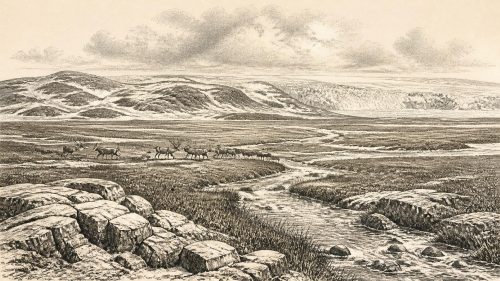
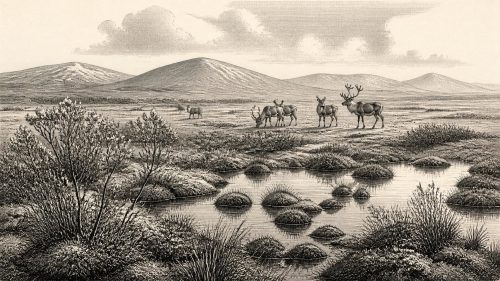
The likely visible world in ice-free areas was open rather than forested: grass, herbs, sedges and sparse low vegetation, with exposed rock, gravel, frozen or seasonally waterlogged ground and patches of snow. Such a mosaic is inferred principally from the animals represented in Irish cave deposits and from wider north-west European palaeoenvironmental evidence. It is an interpretation, not a direct snapshot. Trees may have survived locally during milder intervals, but there is no basis for picturing extensive woodland, settled clearings or a stable agricultural landscape. Farming, domestic livestock and cultivated plants were still tens of thousands of years in the future.
What the Caves Preserve
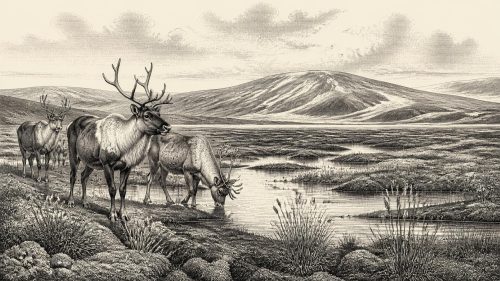
The most important Irish evidence for this broad period comes not from villages or tools, but from animal bones. Limestone caves in the south and south-east have preserved fragments of a Late Pleistocene fauna otherwise vulnerable to erosion. Castlepook Cave, near Doneraile in north County Cork, is especially significant. Its historical excavations recovered remains attributed to animals including woolly mammoth, reindeer, giant deer, brown bear, wolf, Arctic fox, fox, hare, collared lemming, Norwegian lemming and spotted hyaena. The presence of cold-adapted lemmings and reindeer, alongside large grazers and predators, supports an image of open, severe environments capable of sustaining a varied food web.
That list needs care. A cave deposit is not a census of animals standing together in one valley at one moment. Bones can enter caves through carnivore activity, natural death, water movement, collapsing sediments and human excavation. Castlepook was explored in the early twentieth century, before modern standards of stratigraphic recovery and dating. Later re-dating has shown that some older radiocarbon determinations from southern Irish caves were unreliable and that several animal remains were substantially older than previously supposed. The site remains invaluable, but it is a time-layered archive rather than a neatly sealed scene from a single occupation.
Nevertheless, the faunal record establishes an important point. Ireland was not an ecological blank before the major ice advance. Between at least about 45,000 and 20,000 years ago, a richer suite of mammals reached the island than survived into later periods. Giant deer, often misleadingly called the “Irish elk”, were large grazing browsers rather than ancestors of modern Irish deer. Stable-isotope and tooth studies from the wider north-west European record indicate that giant deer relied heavily on grasses and herbs, supplemented by browse. Mammoths and reindeer likewise indicate substantial open feeding grounds. Spotted hyaenas, wolves and bears remind us that these animals formed a living predator-and-scavenger community, not merely a parade of impressive fossils.
People: Possibility and Proof
Human presence around 31,942 BCE remains unproven by securely published archaeological evidence. There is no excavated dwelling, hearth, stone-tool assemblage, human burial, cave art panel or securely associated butchered-animal deposit in Ireland that can responsibly be assigned to this precise era. A reported cut-marked reindeer bone from Castlepook, publicised as evidence of human activity about 33,000 years ago, is potentially important. But a promising observation on a bone is not, by itself, proof of a settled population. Its wider context, the date of the animal, the origin and timing of the marks, and the absence or presence of associated artefacts all require rigorous publication and continued testing.
The distinction matters because the strongest published evidence for Pleistocene human activity in Ireland is much later. At Alice and Gwendoline Cave in County Clare, a brown-bear kneecap bears cut marks made while the bone was fresh. Radiocarbon dating places it at the beginning of the Younger Dryas, approximately 12,890–12,678 calibrated years before present. That is compelling evidence of people processing an animal carcass in Ireland late in the Ice Age; it is not evidence that people were present continuously from 34,000 years ago. The gap between the two periods is vast, and glacial conditions intervened.
It follows that the people of Ireland cannot be described for this year, because their presence cannot yet be demonstrated. Upper Palaeolithic communities elsewhere in Europe certainly made sophisticated stone, bone and antler tools, hunted large animals, travelled across wide territories and created remarkable visual culture. Those comparisons help archaeologists frame questions about possible visitors to Ireland, but they cannot fill Ireland’s evidential silence. It would be unjustified to assign a named culture, language, identity, artistic tradition or migration route to an Irish population at this date.
No Polities, No Recorded Conflict
There is no evidence for political authority, diplomacy, territorial states, chiefs or organised warfare in Ireland around 31,942 BCE. Nor is there evidence for permanent settlements, houses, cemeteries, food stores or long-distance trade networks on the island. If people did occasionally reach Ireland in this period, the scale most consistent with the wider Upper Palaeolithic world would be small, mobile groups exploiting seasonal opportunities rather than towns or kingdoms. That is a reasoned possibility, not an Irish fact established by excavation.
The same restraint applies to everyday life and belief. Animal remains prove that animals lived or died in Ireland; cut marks, where securely identified and dated, can prove carcass processing. They do not reveal family arrangements, clothing, stories, ceremonies or religious ideas. Caves can acquire later ritual meanings, but no such meaning can be projected back automatically onto an Ice Age cave deposit. There is equally no evidence for Irish mining, metallurgy, farming, maritime commerce or formal exchange at this time. Any social knowledge held by potential hunter-gatherers would have been transmitted orally and practically, but its content is irrecoverable here.
Routes, Barriers and Change
How large mammals reached Ireland remains one of the central questions posed by the Pleistocene record. Lower sea levels changed the geography of the Irish Sea basin, and shifting ice could create barriers as well as potential corridors. Yet lowered sea level should not be turned automatically into a simple, permanent land bridge from Britain or the continent. The sea floor has been altered by glaciation and rising post-glacial seas, while ice, water and land connections varied through time. Different species may have arrived by different means, and human movement, if it occurred, would have faced its own practical constraints.
Regional variation is clearest in the surviving evidence. County Cork’s Castlepook Cave is a major archive for older Late Pleistocene fauna; caves in Waterford and Clare add further fragments; much of the rest of the island has yielded little that can be securely dated to this period. This unevenness does not prove that animals, or possible people, were absent elsewhere. It reflects where caves existed, where sediments survived, where fossil recovery occurred and where modern dating programmes have been undertaken. Glacial erosion and antiquarian collecting have both shaped what can now be known.
A Precarious Deep Past
The chief development relevant to Ireland around 31,942 BCE was environmental, not political: the island stood within a cold Late Pleistocene world on the approach to more extensive glaciation. Its caves preserve evidence of a lost fauna whose members included mammoth, reindeer, giant deer and formidable carnivores. They show that Ireland had ecological links with the wider north-west European world, while leaving the exact routes and timings of colonisation unresolved.
For human history, the honest conclusion is necessarily modest. There is no secure basis for an Irish society, event or individual in this numbered year. There may be an important lead in the reported Castlepook reindeer bone, but its implications remain to be tested against the demanding standards of context, dating and publication. The enduring value of this period lies precisely in that uncertainty: museum collections, cave sediments, radiocarbon calibration and renewed excavation can still transform what is known about Ireland before the great ice advance.
Primary Sources
- The IntCal20 Northern Hemisphere Radiocarbon Age Calibration Curve (0–55 cal kBP)
- First evidence of a Late Upper Palaeolithic human presence in Ireland
- New insights on the fauna of Ireland's Younger Dryas and Early Holocene from Alice & Gwendoline Cave
- A reconsideration of the radiocarbon dating of the Marine Isotope Stage 3 fauna from southern Ireland
- The Irish Quaternary Fauna Project
- Phylogeographic, ancient DNA, fossil and morphometric analyses reveal ancient and modern introductions of a large mammal: The complex case of red deer (Cervus elaphus) in Ireland
- Growth and retreat of the last British–Irish Ice Sheet, 31,000 to 15,000 years ago: the BRITICE-CHRONO reconstruction
- Pattern and timing of retreat of the last British-Irish Ice Sheet
- Maximum extent and dynamic behaviour of the last British–Irish Ice Sheet west of Ireland
- New data for the Last Glacial Maximum in Great Britain and Ireland
- Palaeobiology of an extinct Ice Age mammal: Stable isotope and cementum analysis of giant deer teeth
- The Exploration of Castlepook Cave, County Cork, Being the Third Report from the Committee Appointed to Explore Irish Caves
- 2022:564 – Castlepook Cave, Castlepook South, Cork
- Occurrence of mammalia relicts at site Castlepook Cave
- Ireland’s Earliest Settlers: Evidence for an Irish Palaeolithic
- Outreach and Education Resources
- Quaternary Site Descriptions
- The Mesolithic in Ireland: when was it?
- The Ice Age in Ireland
- Heritage Artefacts of County Cork