Castlepook’s Mammoth Galleries31702 BCE
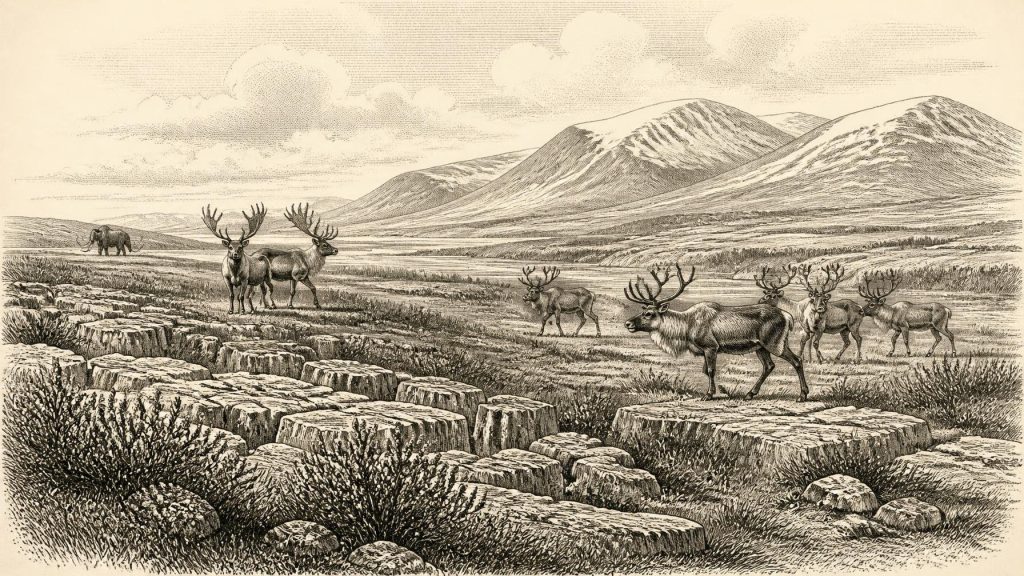
At the notional date of 31,702 BCE, Ireland lay within the climatically volatile Late Pleistocene, approaching extensive glaciation. Precise dating and ice coverage are impossible to establish, since later ice destroyed or buried much evidence. Castlepook Cave in County Cork preserves mixed MIS 3 deposits containing mammoth, reindeer, giant deer, bears, wolves, Arctic foxes, lemmings and spotted hyaenas, indicating cold, open habitats and links with European fauna. Carnivore activity complicates interpretation. A possibly cut-marked reindeer bone offers disputed evidence of human presence, but no securely dated settlements, tools or human remains exist. Castlepook demonstrates environmental change, habitation possibilities, and uncertainty.
Dateline
Modern calendar-year precision cannot responsibly be claimed for Ireland in 31,702 BCE. The numbered year is a useful point on a modern retrospective timeline, but no Irish deposit, animal bone, landscape surface or human trace can be assigned to that single year. In terms of calendar years before present, it lies roughly 33.6 thousand years ago, within the Late Pleistocene and Marine Isotope Stage 3 (MIS 3). Dates from this depth of time are normally expressed as ranges, especially after radiocarbon calibration; they are not annual historical dates. The evidence therefore illuminates broad intervals around this point, rather than an event that happened in Ireland in “31,702 BCE”.
A Landscape Before the Ice Peak
This was an Ice Age world, but not yet simply the fully ice-covered Ireland often imagined for the Last Glacial Maximum. The British–Irish Ice Sheet grew and changed unevenly, with different sectors advancing and retreating at different times. Recent reconstructions place major expansion across the wider ice sheet between about 31,000 and 22,000 years before present, with maximum ice volume later, around 23,000 years ago. Thus, around 33.6 ka BP, Ireland was moving towards a colder and more unstable phase, but the precise extent of glacier ice in every Irish region cannot be recovered.
That uncertainty matters. Later glaciers scoured, buried and rearranged much of the older ground surface. Their tills and meltwaters destroyed or concealed campsites, soils and riverbanks where people or animals might once have left evidence. Caves and sediments protected beneath glacial deposits are consequently disproportionately important. They do not offer a complete map of Ireland; rather, they are rare windows into particular places and episodes. The absence of a site in much of the island is not proof that no life existed there.
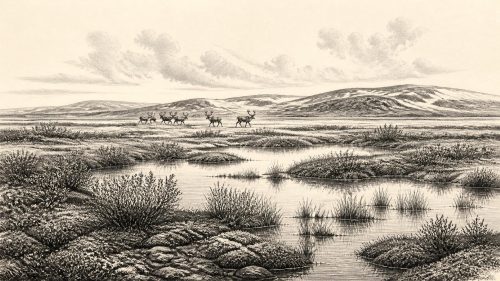
Climate proxies from Greenland ice cores show that MIS 3 was marked by abrupt shifts between relatively milder interstadial phases and severe stadials. These records cannot be converted directly into a daily forecast for Ireland, but they establish the larger North Atlantic setting: conditions could alter sharply over comparatively short geological timescales. Open ground, sparse vegetation, exposed mineral soils, wetlands and patches of low scrub are more defensible images than woodland. Yet there was no single uniform “Irish tundra” stretching unchanged from Cork to Donegal. Altitude, coast, drainage, ice margins and the changing Atlantic climate would all have shaped local habitats.
What Castlepook Can Tell Us
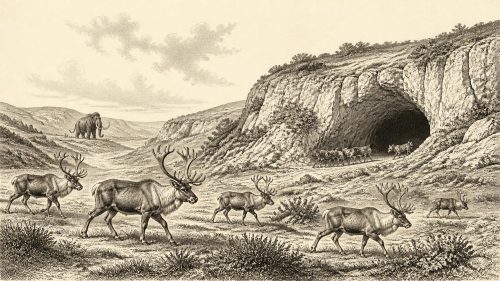
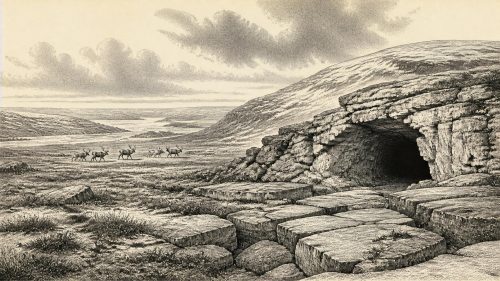
The best-known Irish evidence relevant to this broader period comes from Castlepook Cave, also called Mammoth Cave or Doneraile Cave, in the limestone landscape of the Awbeg Valley in north County Cork. Excavations directed by the naturalist Richard J. Ussher in the early twentieth century recovered a remarkably large bone collection. Later examination identified a cold-stage fauna including woolly mammoth, reindeer, giant deer, brown bear, wolf, Arctic fox, mountain hare, lemmings and spotted hyaena. Not every species belongs to precisely the same moment, however. The material derives from different cave chambers, deposits and collecting episodes, and it accumulated over a long span.
Radiocarbon re-dating has made this caution still more important. Better chemical pretreatment of bone samples has produced substantially older results than some earlier measurements and has shown that parts of the southern Irish cave fauna belong to MIS 3, well before the Last Glacial Maximum. Some Castlepook specimens have conventional radiocarbon ages in the broad range of roughly 32,000 to more than 38,000 radiocarbon years before present; their calibrated calendar equivalents are older and carry statistical ranges. Such results show that animals inhabited or reached southern Ireland in different phases of the Late Pleistocene. They do not turn the cave into a photograph of the island in one calendrical year.
Nonetheless, Castlepook changes the scale of the question. The presence of reindeer, mammoth and lemmings supports the interpretation of cold, open environments with substantial grazing or browsing resources. Giant deer, Megaloceros giganteus, were not an exotic symbol invented by later Irish tradition but real animals of Pleistocene Ireland, though the familiar name “Irish elk” is misleading: they were giant deer, not elk. Brown bears and wolves indicate large carnivores within the wider food web. Most strikingly, Castlepook remains Ireland’s key evidence for spotted hyaena. Hyaenas could transport carcass parts, gnaw bones and use sheltered cavities as dens, making the cave both a biological archive and a difficult archaeological context.
Animals, Caves and Food Webs
The animal assemblage permits secure conclusions about ecological possibility, not exact population counts. Reindeer suggest cold-adapted herds capable of moving seasonally across open terrain. Mammoths imply access to extensive forage, while lemmings and Arctic fox point towards environments markedly different from modern Ireland. Hyaena bones and tooth-modified remains show that scavenging and predation, as well as natural deaths, helped form the cave deposit. A bone found in a cave may therefore record an animal killed elsewhere, carried in by a carnivore, moved by water or disturbed long after its burial.
For everyday life, the responsible answer is largely that no human everyday life is securely known from Ireland at this exact point. There are no excavated hearths, houses, tool-making floors, burials, ornaments or art that can be confidently placed in 31,702 BCE. Nor is there evidence for agriculture, domesticated animals, pottery, metalworking, permanent villages or managed fields. Terms such as Irish “tribes”, chiefs, territories and religions would impose far later concepts on a fragmentary Pleistocene record.
There is, however, one important and debated clue. A reindeer femur from Castlepook bears a deep incision that Ruth Carden has interpreted as a cut made with a sharp stone tool during carcass processing. If that interpretation is upheld, it is evidence that people handled a reindeer in Ireland during an earlier part of the Late Pleistocene than previously recognised. It is not proof of a permanent settlement at Castlepook, continuous occupation of the island, a named population or a date-specific hunting party. The bone’s date is the date of the animal’s death within a calibrated probability range; it does not automatically date the incision, the cave’s use, or every other bone beside it.
People at the Edge of the Record
Any people who visited Ireland during favourable intervals would have been Palaeolithic hunter-gatherers, part of the wider European world of mobile Homo sapiens. Across north-west Europe, such groups made sophisticated stone and organic technologies, hunted and scavenged large animals, shared raw materials and sustained cultural traditions over wide areas. But this continental context must not be mistaken for direct Irish evidence. No securely dated Palaeolithic lithic assemblage of this age has yet been recovered from Castlepook, and no human remains are known from the site.
Movement into Ireland is also an inference rather than a documented route. Lower sea levels altered the outlines of the Irish Sea basin and expanded coastal lowlands, but ice, water channels, estuaries and shifting shorelines created practical barriers as well as opportunities. People may have travelled over exposed terrain, followed animal movements, crossed water, or never entered particular regions at all. The present evidence cannot choose confidently between these possibilities. It can only show that Ireland was not ecologically isolated from the wider Pleistocene fauna of western Europe.
There is no evidence for political affairs, formal diplomacy or organised conflict in the historical sense. If people did enter the island, their most consequential relationships would have been social ties within small mobile groups and ecological relationships with prey, predators, weather and terrain. Competition over carcasses or shelter is conceivable, particularly in a landscape used by hyaenas and bears, but it is not demonstrable. Likewise, exchange may have linked hunter-gatherer communities beyond Ireland, yet no Irish object of this date securely documents trade.
Culture Without Written Memory
Religion, learning and culture are almost invisible here because the material evidence is so thin. It would be unreasonable to claim shrines, ancestral ceremonies, gods, languages or myths for Ireland in this period. Palaeolithic societies elsewhere in Europe made art and transmitted complex knowledge, including close observation of animal behaviour and seasons. That comparison reminds us of what human communities were capable of; it does not demonstrate that equivalent practices occurred in Ireland. Archaeology must preserve that difference between possibility and evidence.
The later history of Irish settlement should not be projected backwards either. The first substantial and sustained archaeological record of people in Ireland belongs much later, in the Mesolithic after the ice had retreated. The Pleistocene indications from Castlepook instead raise a more limited but profound prospect: Ireland may have received short-lived human visits, or perhaps small populations, during earlier habitable intervals that were subsequently erased by climatic deterioration and glaciation. The record is too incomplete to say whether those visitors endured, departed or died out locally.
The Meaning of an Empty Map
Around the notional date of 31,702 BCE, the most important Irish development was environmental rather than political: an inhabited-by-animals, climatically volatile landscape was approaching the much harsher glacial conditions that would later transform the island. Southern limestone caves preserve evidence that Ireland could support or receive a surprisingly varied Ice Age fauna. They also preserve a tantalising possibility of human action. Neither point authorises a detailed narrative of a community in this particular year.
Castlepook’s galleries therefore stand for both discovery and restraint. Their bones demonstrate reindeer, mammoth, giant deer, bears and hyaenas in Ireland during portions of MIS 3. Their mixed deposits warn against compressing thousands of years into one scene. The careful history of Ireland at this depth of time is not a tale of kings or settlements, but of a changing northern landscape, intermittent biological connections with Europe, and rare remains that survived the ice.
Primary Sources
- A Reconsideration of the Radiocarbon Dating of the Marine Isotope Stage 3 Fauna from Southern Ireland
- The Irish Quaternary Fauna Project
- Castlepook Cave, County Geological Site Report
- The Geological Heritage of Cork: An Audit of County Geological Sites in Cork City and County
- Castlepook Cave, Castlepook South, County Cork: Excavation Report 2022
- The Subdivision of the Quaternary Period in Ireland
- Growth and Retreat of the Last British–Irish Ice Sheet, 31,000 to 15,000 Years Ago: The BRITICE-CHRONO Reconstruction
- Pattern and Timing of Retreat of the Last British-Irish Ice Sheet
- Growth and Retreat of the Last British–Irish Ice Sheet, 31,000 to 15,000 Years Ago: The BRITICE-CHRONO Reconstruction
- The IntCal20 Northern Hemisphere Radiocarbon Age Calibration Curve (0–55 cal kBP)
- IntCal Publications
- NGRIP and Greenland Ice-Core Data
- New Insights on the Fauna of Ireland’s Younger Dryas and Early Holocene from Alice & Gwendoline Cave
- New Insights on the Fauna of Ireland’s Younger Dryas and Early Holocene from Alice & Gwendoline Cave
- Our Ancient Landscapes: Hunter-Gatherers in Ireland
- Ireland’s Palaeolithic Archaeology – Fleeting Footprints in a Frozen Land
- Mammoth Cave, County Cork
- Pleistocene Vertebrates in the British Isles
- Biogeography of Ireland: Past, Present, and Future
- The Phylogenetic Position of the ‘Giant Deer’ Megaloceros giganteus
- Ancient Hybridization and an Irish Origin for the Modern Polar Bear Matriline
- The Last Scottish Ice Sheet
- Marine Isotope Stage 4 (71–57 ka) on the Western European Margin: Insights to the Drainage and Dynamics of the Western European Ice Sheet