Membership is completely free, giving members unlimited access to all available resources, services, features, and benefits without any restrictions or fees.
Welcome back. Sign in to continue enjoying unlimited access to all available resources, services, features, and member benefits at no cost.
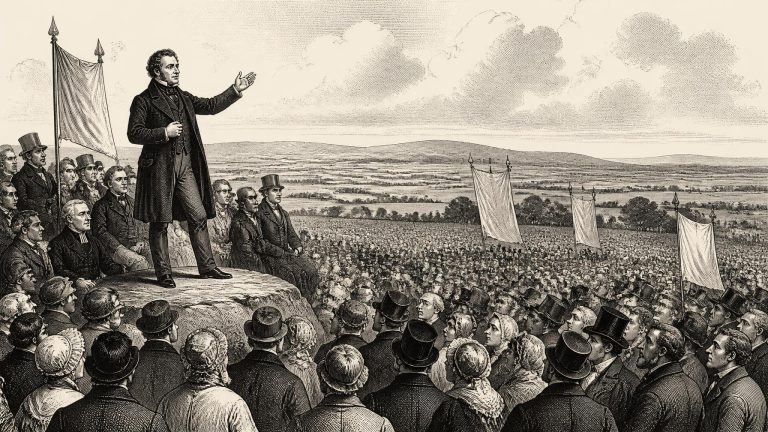
O’Connell was already the most formidable Irish popular politician of his age. His earlier mass campaign had helped secure Catholic Emancipation in 1829; now he argued that Ireland needed domestic self-government rather than piecemeal concessions from Westminster. Repeal, as he presented it, did not mean separation from the Crown. Ireland would share the monarch but recover a parliament in Dublin, capable of addressing Irish taxation, industry, land and social conditions.
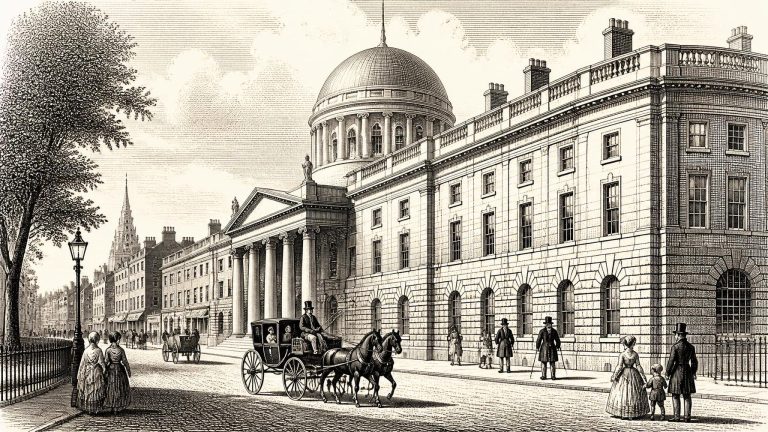
The most eloquent architectural symbol came at College Green. In June, the Bank of Ireland opened its banking hall in the former Irish Houses of Parliament. The bank had acquired the building in 1803; its public opening as a bank in 1808 transformed the working home of the pre-Union legislature into a financial institution. The change did not erase the building’s political associations. Its great chambers, designed for Lords and Commons, continued to proclaim the scale and confidence of the eighteenth-century parliament that had disappeared in 1801. But their new purpose demonstrated a hard fact of the Union: Dublin’s former national legislature had no legislative successor within Ireland.
The immediate international setting was decisive. Peace with France, secured at Amiens in 1802, had collapsed; Britain declared war on France again on 18 May 1803. The prospect of renewed French invasion made Ireland strategically important and sharpened official anxieties about surviving United Irish networks. For radical veterans of the 1790s, French war also revived a possibility that had shaped earlier plans: an insurrection in Ireland might coincide with, or prepare the ground for, a French expedition.
Political life in 1802 was conducted under the new Union settlement. Ireland now sent 100 members to the House of Commons at Westminster: two for each of the 32 counties, members for selected boroughs and cities, and one for Trinity College Dublin. The arrangement sharply reduced the number of Irish borough seats compared with the old Dublin parliament, while preserving a political system in which land, property, patronage and established interests carried immense weight.
On 1 January 1801, the legislative Union of Great Britain and Ireland came into legal effect. The Kingdom of Ireland, which had shared a monarch with Great Britain but retained its own parliament, became part of the United Kingdom of Great Britain and Ireland. Ireland’s parliament at College Green had already passed the necessary legislation in 1800; 1801 was the year in which its abolition became an operating fact. This was not an event that altered every parish or household overnight, but it transformed the constitutional setting in which Irish politics, religion, taxation and trade would henceforth be argued. Ireland no longer possessed a domestic legislature capable of making or withholding laws for the kingdom.
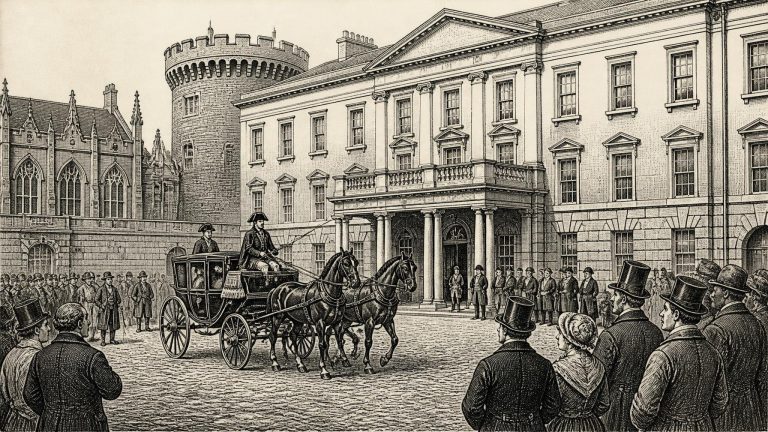
The final parliamentary struggle began when the Irish parliament reassembled on 15 January. The previous year’s ministerial attempt to secure support for a union had failed. The government returned with greater preparation, led in Ireland by Lord Cornwallis, the lord lieutenant, and by the chief secretary, Lord Castlereagh. Their task was to persuade – and, critics charged, to purchase – sufficient support among peers and members of the Commons for a measure that would abolish their own legislature.