
Year by Year
Explore Year by Year articles from the most modern historical year back to the oldest.
3,294 Articles Archived
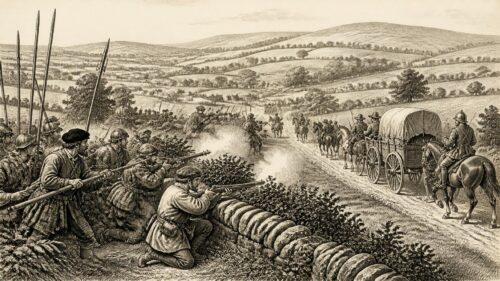
Clontibret Battle
Archived: 17 October 2026
In 1595, the Nine Years’ War became an open challenge to Elizabeth I’s rule as Hugh O’Neill and Hugh Roe O’Donnell expanded resistance across Ulster and beyond. After the Blackwater fort’s seizure, Crown attempts to sustain exposed garrisons faltered. At Clontibret, O’Neill’s forces badly mauled Sir Henry Bagenal’s returning convoy through disciplined firearms, fieldworks and mobile warfare, though they did not destroy it. O’Donnell’s campaigns destabilised Connacht, using raids, hostages and alliances to extend influence. Fighting also ravaged Wicklow and civilian communities. Despite negotiation and continued Crown control of towns, 1595 established a broader, organised and destructive conflict in Ireland.
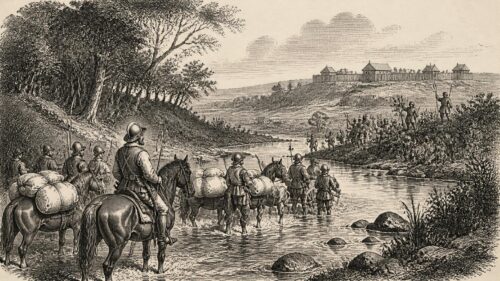
Enniskillen Conflict
Archived: 17 October 2026
In 1594, fighting around Enniskillen demonstrated the dangers of extending crown government into Fermanagh through garrisons and military supply. Hugh Maguire resisted threats to his lordship from sheriffs, fortified positions and prospective land settlement. Allies included Hugh Roe O’Donnell and men associated with Hugh O’Neill, linking local resistance to Ulster networks. Crown capture of Enniskillen created a vulnerable position that required reinforcement. Irish success at the Arney River exposed the weaknesses of that strategy. Often treated as the opening year of the Nine Years’ War, 1594 reveals a conflict whose immediate causes remained rooted in regional power and contested jurisdiction.

Maguire’s Rising
Archived: 17 October 2026
In 1593, resistance to the English appointment of Captain Humphrey Willis as sheriff of Fermanagh brought Hugh Maguire into conflict with crown authority. Supported by Cormac MacBaron O’Neill, Hugh Roe O’Donnell and Brian Óg O’Rourke, Maguire’s rising spread through Ulster and Connacht amid disputes over rents, cattle and jurisdiction. Meanwhile, Hugh O’Neill assumed effective rule of Tír Eoghain while maintaining loyalty to Elizabeth I. Catholic hopes of Spanish intervention accompanied the unrest, although no force arrived. Sir Henry Bagenal’s October expedition defeated Maguire at Erne Ford and devastated Fermanagh, but failed to establish lasting control, foreshadowing the Nine Years’ War.

O’Donnell’s Escape
Archived: 17 October 2026
In 1592 Hugh Roe O’Donnell escaped Dublin Castle, where he had been held to restrain Ulster alliances, and returned to Tír Chonaill. Supported by his mother Iníon Dubh, Scottish connections and Hugh O’Neill, he became The O’Donnell, resisted garrisons and negotiated a fragile submission at Dundalk. His revival intensified conflicts within Ulster and exposed limits of crown authority. In Dublin, Elizabeth I chartered the College of the Holy and Undivided Trinity on the former All Hallows priory, to educate Protestant clergy and officials. Meanwhile, Catholic diplomacy with Spain heightened anxieties. These developments foreshadowed wider political, religious and military confrontation ahead.

O’Rourke’s Execution
Archived: 17 October 2026
In 1591, Tudor authority pressed unevenly upon Gaelic Ireland through military, legal and administrative measures. Brian na Múrtha O’Rourke, lord of West Bréifne, fled to Scotland after invasion, was surrendered to England, tried for treason and executed at Tyburn, demonstrating the crown’s expanding reach. Monaghan’s contested settlement and mass pardons revealed efforts to reorganise lordship and land. Hugh O’Neill’s marriage to Mabel Bagenal intensified Ulster rivalries. Catholic appointments and continental contacts sustained religious networks and official fears of foreign intervention. Annalistic deaths and praise for lords preserved Gaelic values. Although no rebellion began, distrust and dispossession sharpened conditions preceding war.

MacMahon’s Execution
Archived: 17 October 2026
In 1590, Hugh Roe MacMahon’s execution after a manipulated Monaghan trial signalled the Tudor government’s determination to replace Gaelic lordship with courts, garrisons and Crown-controlled landholding. Sir Richard Bingham’s campaigns in Connacht and Breifne secured hostages, devastated O’Rourke territory and established a strategic fort, though resistance revived. In Tyrconnell, Donnell O’Donnell’s death at Doire Leathan strengthened Hugh Roe’s eventual claim while he remained imprisoned. Sorley Boy MacDonnell died, prompting renewed territorial conflict, and Hugh O’Neill eliminated a dynastic rival. Despite warfare, learned culture and commercial development persisted. Ireland remained politically fragmented, as Crown expansion encountered resilient local powers across Ireland.
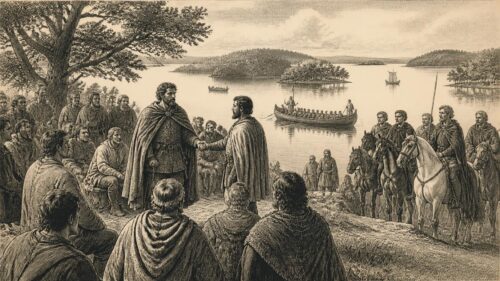
Maguire Succession
Archived: 17 October 2026
In 1589, Cú Chonnacht Óg Maguire’s death triggered a Fermanagh succession contest, resolved at Sciath Ghabhra when Donnell O’Donnell backed his son Hugh, reinforcing north-western alliances. MacMahon succession rivalry in Monaghan invited intervention by Lord Deputy Sir William Fitzwilliam, while Hugh O’Neill consolidated his position. In Connacht, opposition to Sir Richard Bingham’s Composition produced raids, government defeat, reprisals, an inquiry, Bingham’s acquittal and renewed campaigning. Munster commissioners assessed the incomplete plantation of confiscated Desmond lands. Ecclesiastical appointments and annalistic obituaries reflected enduring Catholic, Gaelic learned and social traditions. Together, these events exposed conflicts over lordship, land, royal administration and authority.
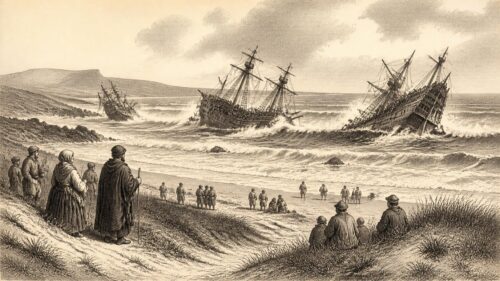
Spanish Armada
Archived: 17 October 2026
In 1588, remnants of Philip II’s Spanish Armada, driven around Scotland after defeat, wrecked along Ireland’s Atlantic and northern coasts. Survivors encountered drowning, plunder, shelter, negotiation and execution, depending on locality and political interest. Accounts by Francisco de Cuéllar, English officials and Irish annalists reveal perspectives. Lord Deputy William Fitzwilliam and Connacht president Richard Bingham feared Spanish aid to Irish resistance and ordered reprisals. Lords including Brian O’Rourke aided survivors, while others manoeuvred between Crown and Spanish interests. Fitzwilliam’s Connacht campaign linked shipwrecks to repression. Despite a plentiful harvest, 1588 deepened distrust, exposed authority, and heightened fears of Spanish intervention.

O’Donnell’s Captivity
Archived: 17 October 2026
In 1587, Hugh Roe O’Donnell, heir to Tír Chonaill, was lured aboard a trading vessel at Rathmullan and imprisoned in Dublin Castle, giving the Tudor government a valuable hostage amid Ulster’s unstable rivalries. Elsewhere, parliament confirmed the Desmond attainder, enabling redistribution and plantation of Munster lands, though implementation remained uneven. In Connacht, the composition system replaced traditional exactions with fixed revenues, provoking resistance and controversy over Sir Richard Bingham’s harsh rule. Wet weather and poor corn heightened rural insecurity. These measures extended Crown authority through captivity, law, land and revenue, but deepened grievances, exposed weak enforcement, and shaped later conflict.
Ardnaree Battle
Archived: 17 October 2026
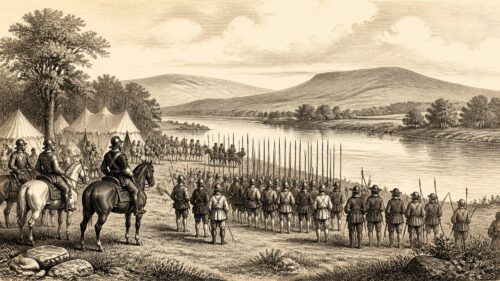
In 1586, the Battle of Ardnaree exposed the entanglement of Connacht rivalries, Scottish military migration and expanding Tudor authority. On 23 September, Richard Bingham surprised and defeated Scottish mercenaries and Irish allies beside the River Moy near modern Ballina. The encounter formed part of a wider campaign to enforce government through sheriffs, courts, rents and military pressure. Bingham’s position as provincial governor connected local conflict to Dublin’s claims of sovereignty. The victory weakened his opponents without resolving the underlying tensions. Ardnaree illustrates how Gaelic lordship, external armed support and crown administration shaped one another within an contested regional political order.
Some records do not yet have a verified historical year and are awaiting chronological placement.