Folklorist Dies(c.1840s)

William Larminie, poet, scholar and collector of traditional Irish stories, died from pneumonia at his home in Bray, County Wicklow, on 19 January. He was fifty years old. Born in Castlebar, County Mayo, in 1849, Larminie had devoted much of his later life to literature, philosophy and the preservation of oral storytelling. His death removed an important figure from the developing Irish cultural revival at a time when scholars and writers were turning increasingly towards the Irish language, mythology and folklore. He was survived by his elderly mother and was buried in the churchyard at Enniskerry.
Larminie was educated at Kingstown School before entering Trinity College Dublin, where he studied classics and graduated in 1871. He later moved to London and worked for the British India Office between 1873 and 1887. Retirement from government employment allowed him to return to Ireland and concentrate upon writing and research. Settling in Bray, he produced poetry influenced by Irish legend while pursuing wider interests in philosophy and language. His life combined the disciplined habits of a civil servant with the imagination of a poet and the patience required to listen carefully to stories preserved through generations of spoken tradition.
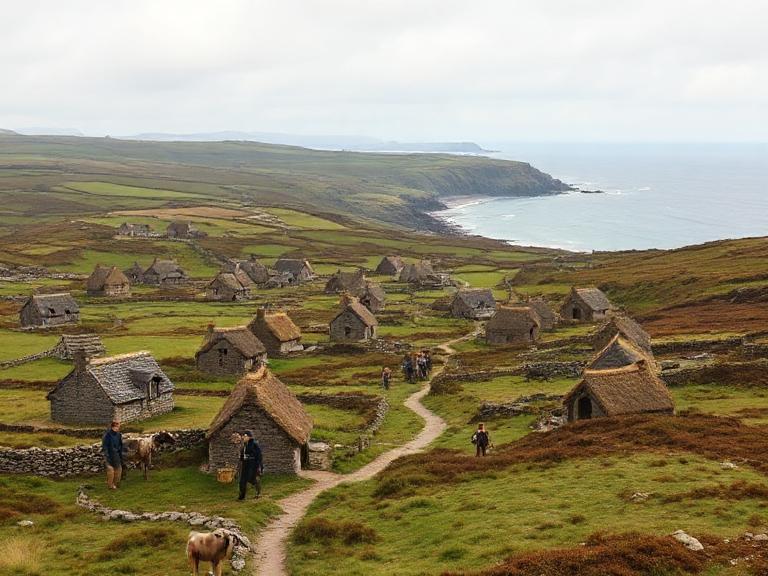
His most enduring achievement was West Irish Folk-Tales and Romances, published in 1893. Larminie gathered the stories from Irish-speaking narrators in counties Mayo, Galway and Donegal, recording tales of enchanted kingdoms, heroic journeys, supernatural encounters and dangerous transformations. He translated the narratives into English while also preserving examples of the original Irish in phonetic form. At a time when the Irish language was declining rapidly, his method helped retain not merely the plots of the stories but traces of the voices and speech patterns through which they had been transmitted. The collection later became an important source for folklorists.
Larminie also published two volumes of poetry, Glanlua and Other Poems in 1889 and Fand and Other Poems in 1892. Drawing upon mythology, landscape and traditional forms, he experimented with assonance and other features associated with Irish-language verse. Like several writers connected with the emerging literary revival, he believed that Ireland’s inherited stories could provide material for modern literature. His work appeared before folklore collecting became a fully organised academic discipline, and he often travelled personally to meet storytellers. These journeys required linguistic knowledge, trust and an ability to preserve material without stripping it of its local character.
During his final years, Larminie worked upon an English translation of De divisione naturae by the ninth-century Irish philosopher John Scotus Eriugena. The translation remained unpublished, but it reflected the breadth of his intellectual interests and his determination to connect Ireland’s philosophical and literary inheritance with contemporary readers. Larminie did not achieve the public fame later enjoyed by some figures of the Irish revival, yet his careful collections preserved stories that might otherwise have disappeared. His death in Bray closed a career devoted to poetry, thought and the spoken imagination of the western Irish countryside.
Primary Sources
- Dictionary of Irish Biography, Royal Irish Academy, “Larminie, William,” recording his birth, education, literary career, death from pneumonia in Bray on 19 January 1900 and burial at Enniskerry.
- William Larminie, West Irish Folk-Tales and Romances, London, Elliot Stock, 1893.
- William Larminie, Glanlua and Other Poems, London, Kegan Paul, Trench & Company, 1889.
- William Larminie, Fand and Other Poems, London, Kegan Paul, Trench, Trübner & Company, 1892.
- National Library of Ireland, William Larminie manuscripts, including his unpublished translation of John Scotus Eriugena’s De divisione naturae.