Nationalist Reunion(c.1900s)
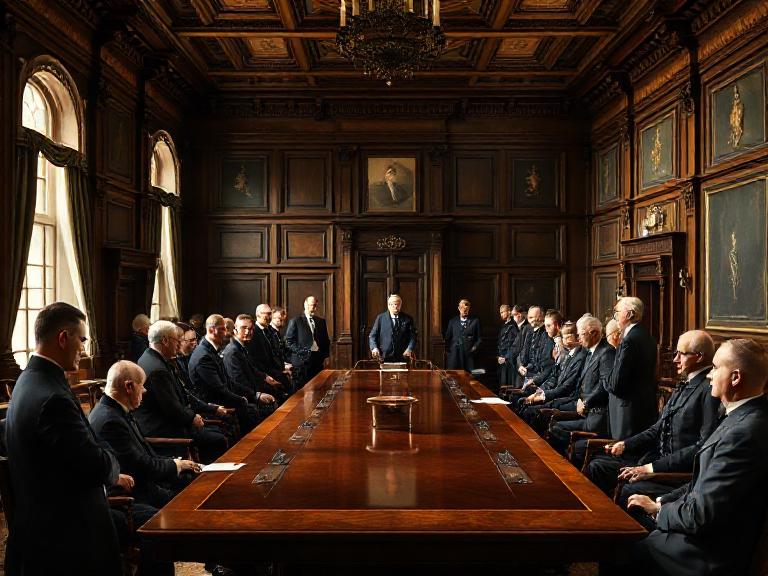
Representatives of Ireland’s divided nationalist factions assembled in the Oak Room of Dublin’s Mansion House on 17 January in an attempt to restore political unity after nearly a decade of bitterness. The split created by the fall of Charles Stewart Parnell had weakened nationalist organisation, divided parliamentary representatives and produced competing loyalties throughout the country. Those entering the oak-panelled civic chamber carried memories of denunciation, broken alliances and election contests fought between men who claimed to serve the same national cause. Their immediate purpose was to determine whether cooperation could replace factional rivalry before the divisions inflicted further damage upon the Home Rule movement.
The gathering brought together figures associated with the Parnellite and anti-Parnellite traditions, including supporters of John Redmond, John Dillon and Timothy Healy. Agreement was difficult because the dispute had become personal as well as political. Rival newspapers, local organisations and parliamentary groups had sustained the quarrel long after Parnell’s death in 1891. Many nationalists nevertheless feared that continued separation would leave Ireland’s representation at Westminster ineffective. The Mansion House discussions therefore required delegates to distinguish between grievances they considered matters of principle and those that could be set aside for the sake of coordinated political action.
Pressure for reunion had increased through the rapid expansion of William O’Brien’s United Irish League. Founded in 1898, the organisation mobilised tenant farmers, local activists and supporters of land reform while presenting itself as a national movement rooted beyond the parliamentary factions. Its growing influence demonstrated that ordinary nationalist voters were becoming impatient with leadership disputes. The League’s campaign against large grazing farms and its demand for broader land purchase gave political organisation an urgent social purpose. Parliamentary representatives understood that unless they reunited, the popular movement developing outside Westminster might dictate the future direction of Irish nationalism without them.
The choice of the Mansion House carried considerable symbolic weight. Dublin’s official mayoral residence had long served as a setting for civic receptions, political gatherings and expressions of national opinion. The Oak Room, lined with historic panelling and portraits, offered a formal environment in which former opponents could meet without appearing to surrender completely to one another. No single conference could erase the anger produced by the Parnell split, but the assembly allowed competing groups to explore terms for cooperation. Its significance rested less upon immediate declarations than upon the willingness of previously hostile representatives to occupy the same room and negotiate.
The meeting helped prepare the way for the formal reunion of the nationalist organisations in February, when John Redmond was selected as compromise chairman of a reunited Irish Parliamentary Party. Unity did not remove every disagreement, nor did it guarantee lasting harmony among ambitious and strongly opinionated leaders. It did, however, restore a recognisable parliamentary organisation before the approaching general election and reconnect elected representatives with the expanding United Irish League. The Oak Room gathering marked an important stage in the recovery of constitutional nationalism, demonstrating that political necessity and pressure from supporters throughout Ireland could compel divided leaders to seek common ground.
- Freeman’s Journal, 18 January 1900, report of the conference involving the nationalist parliamentary factions at Dublin’s Mansion House.
- Irish Independent, January 1900 editions, reports and commentary concerning negotiations for nationalist reunion.
- United Irish League, resolutions, reports and organisational records concerning the movement for national unity, 1899–1900.
- John Redmond Papers, National Library of Ireland, correspondence and political material relating to the reunion of the Irish Parliamentary Party.
- F. S. L. Lyons, The Irish Parliamentary Party, 1890–1910, London, 1951, discussion of the Mansion House negotiations, the United Irish League and the restoration of party unity.