Reunion Advances(c.1900s)
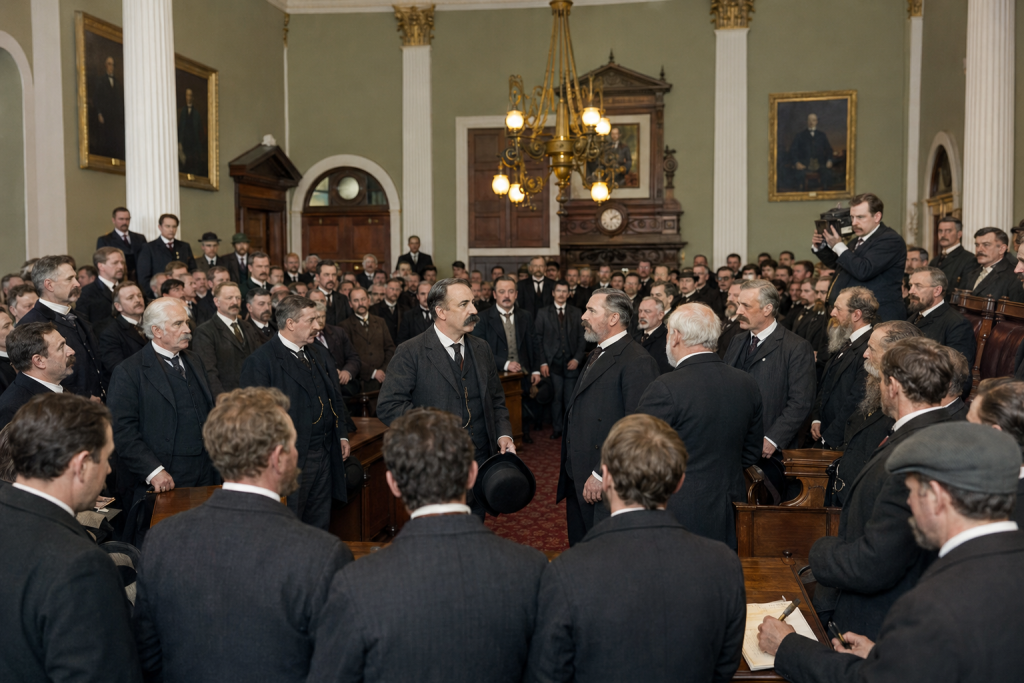
Negotiations to reunite Ireland’s divided nationalist parliamentarians advanced formally during the Mansion House conference held on 17 January. Representatives associated with the rival factions created by the fall of Charles Stewart Parnell met in Dublin to consider practical terms for restoring a single parliamentary organisation. Nearly a decade of internal conflict had weakened nationalist influence at Westminster and exhausted many supporters throughout Ireland. The conference did not instantly remove the personal distrust, political grievances and competing ambitions that had accumulated since 1890, but it transformed informal appeals for reconciliation into a structured negotiation between recognised representatives of the opposing groups.
The divisions had originated when Parnell’s leadership became untenable following the divorce crisis involving Katharine O’Shea. Nationalist members divided into Parnellite and anti-Parnellite camps, while rival organisations, newspapers and candidates continued the quarrel after Parnell’s death in 1891. John Redmond emerged as the principal parliamentary leader of the Parnellites, while John Dillon and other prominent figures exercised influence among their former opponents. By the beginning of 1900, many voters regarded the continuing feud as an obstacle to Home Rule, land reform and effective representation. The Mansion House discussions reflected mounting pressure upon the factions to subordinate old resentments to common political objectives.
William O’Brien’s United Irish League provided much of the momentum behind the movement towards reunion. Founded in 1898, the League organised tenant farmers, local activists and nationalist supporters around land redistribution and the revival of disciplined political organisation. Its rapid expansion demonstrated that popular nationalism was no longer prepared to wait indefinitely for parliamentary leaders to resolve their differences. Local branches supplied energy, membership and a programme capable of reconnecting constitutional politics with everyday rural grievances. The parliamentary factions therefore entered the conference knowing that failure to reunite could allow the League and its organisers to exercise increasing authority over nationalist strategy throughout Ireland.
The negotiations required more than expressions of goodwill. Representatives had to consider leadership, parliamentary discipline, relations with the United Irish League and the treatment of organisations created during the split. Each side feared that reunion might involve surrender to former opponents or the abandonment of loyal supporters. The formal progress made at the Mansion House indicated that these difficulties were no longer considered insurmountable. Delegates recognised that a reunited party could contest elections more effectively, speak with greater authority at Westminster and prevent three rival nationalist candidates from weakening one another in constituencies where the broader electorate supported Home Rule.
The conference helped establish the conditions for the formal reunion of the Irish Parliamentary Party later that month, when John Redmond was chosen to lead the combined parliamentary body. Unity did not erase ideological differences or personal hostility, and later disputes would reveal the limits of the settlement. Nevertheless, the negotiations of 17 January restored a framework within which nationalists could act collectively after years of fragmentation. The proceedings represented an important recovery for constitutional nationalism, strengthened the relationship between parliamentary representatives and the United Irish League, and prepared the movement to enter the new century with a recognisable leadership and renewed organisational purpose.
- Freeman’s Journal, 18 January 1900, reporting the nationalist conference and reunion negotiations held at Dublin’s Mansion House on the previous day.
- Irish Daily Independent, January 1900 editions, reports and political commentary concerning negotiations among the nationalist parliamentary factions.
- John Redmond Papers, National Library of Ireland, correspondence and political material relating to the reunion of the Irish Parliamentary Party in January 1900.
- Philip Bull, “The United Irish League and the Reunion of the Irish Parliamentary Party, 1898–1900,” Irish Historical Studies, volume 26, number 101, May 1988, pages 51–78.
- F. S. L. Lyons, The Irish Parliamentary Party, 1890–1910, London, 1951, chapters concerning the Parnell split, the United Irish League and the restoration of parliamentary unity.