
Cork Cave Reindeer Femur31285 BCE
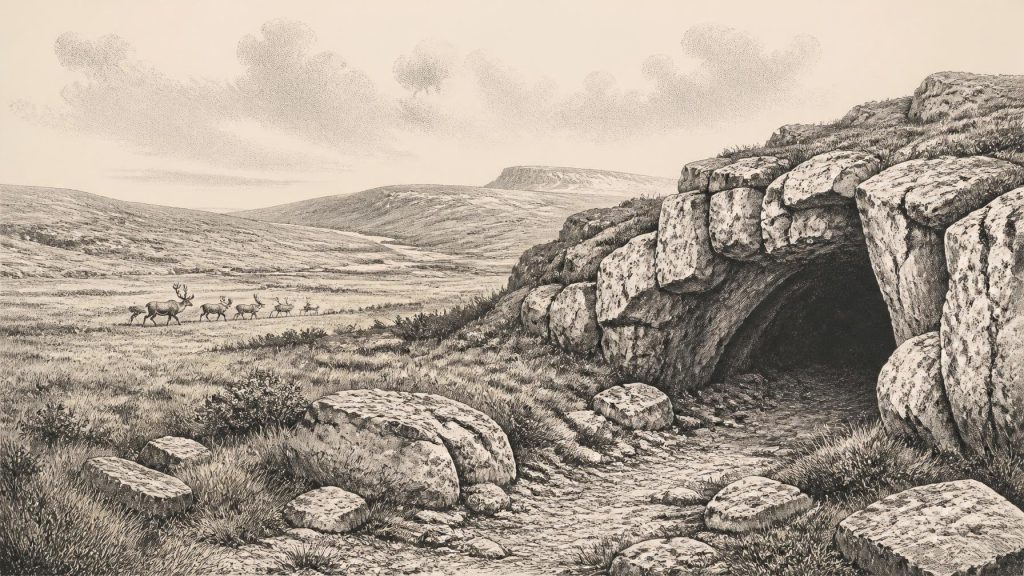
Around 31,285 BCE, Ireland lay within the fluctuating cold conditions of Marine Isotope Stage 3, before the Last Glacial Maximum. Southern landscapes probably comprised open tundra and steppe supporting reindeer, mammoth, giant deer, predators and smaller mammals. Castlepook Cave, County Cork, preserves a disturbed, repeatedly accumulated fauna rather than a single contemporary scene. A reindeer femur, dated approximately 31,000 BCE, bears a mark interpreted as possible stone-tool butchery, potentially Ireland’s earliest evidence of human activity. Yet no sealed occupation, tools, hearths or human remains confirm settlement. Later glaciation and sea-level change destroyed evidence; further dating and excavation remain especially essential.
Dateline
31,285 BCE is a useful modern label for placing a remote point in deep time, but it was not a year that anyone in prehistoric Ireland could have named, counted or recorded. There are no annals, settlements or securely dated human artefacts from a single calendar year this far back. The responsible history of Ireland at this point must therefore be written in broad calibrated ranges, geological stages and carefully qualified archaeological evidence. In calendar terms, the requested date falls roughly 33,200 years before the 1950 “present” convention used in radiocarbon science, within the later part of Marine Isotope Stage 3 (MIS 3), a fluctuating cold phase of the Pleistocene.
A Landscape Before the Maximum Ice
Ireland was then within the Midlandian cold stage, the Irish expression for the last glacial cycle. It was not yet at the Last Glacial Maximum, the later interval when the British–Irish Ice Sheet expanded to its greatest known extent, broadly after about 26,000 calibrated years before present. That distinction is important. It would be wrong to picture all of Ireland in 31,285 BCE as a uniform, continent-wide ice cap. Equally, it would be wrong to imagine a mild, wooded island resembling the modern countryside. Conditions changed repeatedly and sharply across north-west Europe, while the extent of ice in different Irish regions remains a subject of active reconstruction.
The strongest evidence suggests that parts of southern Ireland supported land animals during portions of MIS 3. Such evidence does not provide a weather report for one notional year, but it establishes that Ice Age habitats existed here before the later glacial maximum. Open, cold-adapted country is the most defensible general picture: grassland, herb-rich tundra or steppe-tundra, patches of low scrub in favourable places, exposed soils, seasonal wetlands and little or no closed forest. Summers may have permitted a brief but productive growing season; winters were severe, with frost, snow, strong winds and a landscape vulnerable to periglacial processes such as freeze-thaw cracking and soil movement.
Sea level was much lower than today because immense quantities of water were stored in northern ice sheets. The outlines of coasts, river valleys and lowlands were consequently different, and some landscapes now beneath the Atlantic or Irish Sea were dry land. Yet lowered sea level alone does not prove a particular route into Ireland. Whether a person or animal could pass between Britain and Ireland depended on local topography, ice, water, season and the changing configuration of the Irish Sea basin. No excavated route, crossing place or boat from this period has been found in Ireland.
Castlepook’s Mixed Archive
The central Irish locality for this period is Castlepook Cave, also known historically as Mammoth Cave, near Doneraile in north County Cork. It lies in limestone country above the Awbeg Valley, below the Ballyhoura Hills and within the wider Blackwater catchment. Excavations conducted chiefly in the early twentieth century recovered a remarkably rich collection of animal bones. Later study, including improved accelerator radiocarbon dating and modern pretreatment of bone collagen, has shown both how valuable and how difficult this archive is.
Castlepook and other southern Irish caves have produced remains attributed to reindeer, woolly mammoth, giant deer, brown bear, wolf, Arctic fox, hare, lemmings and spotted hyaena. The presence of these species demonstrates that Ireland was, at least intermittently, part of a wider north-west European world of cold-stage mammals. Large herbivores required extensive forage; predators and scavengers exploited them; caves could serve as dens, shelters, traps for bone or places where animals dragged carcass parts. This is a richer ecological setting than the modern Irish fauna might lead one to expect.
However, Castlepook is not a single sealed deposit preserving one moment in time. Much of its material was recovered before modern excavation standards, from a complex cave system where deposits had been disturbed by carnivores, water, earlier digging and later movement. Direct re-dating has revised some old determinations substantially, in certain cases by thousands of radiocarbon years. The species list must not be turned into a literal tableau in which every animal stood together in north Cork in 31,285 BCE. It instead records repeated episodes within a long pre-Last Glacial Maximum interval, alongside later Pleistocene material.
The Reindeer Femur Question
A fragment of reindeer femur from Castlepook gives this approximate date unusual historical importance. County Cork heritage publications describe it as Palaeolithic, about 31,000 BCE, and zooarchaeologist Ruth Carden has interpreted a deep linear mark on the bone as damage caused when fresh tissue was cut or chopped with a sharp stone tool. If that identification is sustained, the object is potentially the earliest evidence that people handled an animal in Ireland: not a legend of first settlement, but a material trace of carcass processing in the Upper Palaeolithic.
Its implications need careful limits. The published public account supplies an approximate calendar age for the animal bone, rather than a fully reported calibrated range tied to the particular marked specimen. A radiocarbon date records when the animal died, not automatically the instant when the surface mark was made. Most significantly, the femur derives from an old cave collection, not from a modern, sealed occupation floor. No securely associated stone-tool assemblage, hearth, dwelling, burial, food store, human bone or concentration of butchered remains has yet demonstrated a camp or a resident population at Castlepook around this horizon.
The mark may reasonably invite further investigation because its form has been interpreted as consistent with stone-tool butchery. But a single marked bone cannot establish whether people killed the reindeer, scavenged a carcass, visited briefly, followed herds seasonally, travelled from Britain or another region, or left descendants in Ireland. Nor can it establish that butchery occurred inside the cave. Hyaenas and other carnivores can carry bones into caves, while water and sediment movement can complicate their final resting places. The strongest conclusion is deliberately narrow: Ireland may preserve evidence of human activity in the broad period around 31,285 BCE, but durable occupation has not been demonstrated.
Everyday Life Beyond Recovery
If people did reach Ireland at this time, they would have been highly mobile Upper Palaeolithic hunter-gatherers, dependent on knowledge of animal behaviour, shelter, firewood, stone and seasonal danger. Reindeer could potentially supply meat, fat, marrow, hide, sinew and bone. Such uses are well established in wider Eurasian Palaeolithic contexts, but they remain an inference here rather than a documented Irish practice. Ireland has not yielded a contemporaneous house, tent ring, hearth, flint-working floor or bone tool through which a particular group’s daily routines can be reconstructed.
There is still less basis for describing political affairs. No evidence identifies leaders, territories, alliances, diplomacy, warfare or organised conflict in Ireland at this date. There were no states, written laws or historical institutions that archaeology can name. Likewise, there is no Irish evidence from around 31,285 BCE for religion, ritual places, formal burial, language, music, visual art or systems of learning. This silence should not be mistaken for proof that any visitors lacked culture, social bonds or knowledge. Upper Palaeolithic communities elsewhere in Europe possessed sophisticated technologies and social worlds. It means only that the Irish record cannot responsibly specify them.
Trade is equally beyond demonstration. No imported raw material, exchange good or regular communication network has been securely identified in Ireland from this period. The island’s economy, insofar as it can be discussed, was primarily an ecological one: short-season vegetation feeding grazing animals; large herbivores and smaller mammals moving through open terrain; predators competing for carcasses; and people, if present, seeking opportunities within that demanding system. A reindeer femur can suggest a moment of practical engagement with that landscape; it cannot reveal a market, a polity or a permanent settlement.
Loss, Ice and Survival of Evidence
The later advance of the Irish Ice Sheet is crucial to understanding the scarcity of evidence. Glaciers eroded bedrock and superficial deposits, reworked sediments and altered drainage systems across much of the island. Rising seas after the Ice Age then drowned extensive former coastal plains. These processes may help explain why ephemeral camps, tracks and open-air kill sites from MIS 3 are so difficult to find. They do not, however, licence the invention of a lost Palaeolithic population. Absence of surviving evidence is not proof of absence, but it cannot become proof of a settlement either.
For Ireland around 31,285 BCE, the most important development is therefore not a known reign, battle or migration, but the possibility preserved in a difficult cave archive. Castlepook shows that cold-stage animals occupied at least some Irish landscapes before the ice reached its later maximum. Its reindeer femur raises the prospect that people also entered that world. Future work on intact cave sediments, direct dating, microscopic study of bone surfaces and the recovery of artefacts may strengthen, qualify or overturn that interpretation. At present, deep Irish history begins here not with certainty, but with a carefully examined incision on bone.
Primary Sources
- A reconsideration of the radiocarbon dating of the Marine Isotope Stage 3 fauna from southern Ireland
- The Irish Quaternary Fauna Project
- Quaternary deposits and glacial stratigraphy in Ireland
- Late Pleistocene chronostratigraphy and ice sheet limits, southern Ireland
- Last Glacial Maximum cirque glaciation in Ireland and implications for reconstructions of the Irish Ice Sheet
- Early deglaciation of the western sector of the Irish Ice Sheet
- Character of advance and retreat of the southwest sector of the British-Irish Ice Sheet during the last glaciation
- The evolution of the terrestrial-terminating Irish Sea glacier during the last glaciation
- Stratigraphic and palaeo-geomorphological evidence for the glacial-deglacial history of the last British-Irish Ice Sheet in the north-western Irish Sea
- Advances in Irish Quaternary Studies
- Our Ancient Landscapes: Hunter-Gatherers in Ireland
- Heritage Artefacts of County Cork
- Archaeological Heritage of County Cork
- 2022:564 – Castlepook Cave, Castlepook South, Cork
- Archaeology Research Excavation Grant 2022: Castlepook Caves Project Final Report
- First evidence of a Late Upper Palaeolithic human presence in Ireland
- New insights on the fauna of Ireland's Younger Dryas and Early Holocene from Alice & Gwendoline Cave
- The IntCal20 Northern Hemisphere radiocarbon age calibration curve (0–55 cal kBP)
- A stratigraphic framework for abrupt climatic changes during the Last Glacial period based on three synchronized Greenland ice-core records
- The Last Glacial Maximum
- The Archaeology of Caves in Ireland