Marine Isotope Stage Three31972 BCE
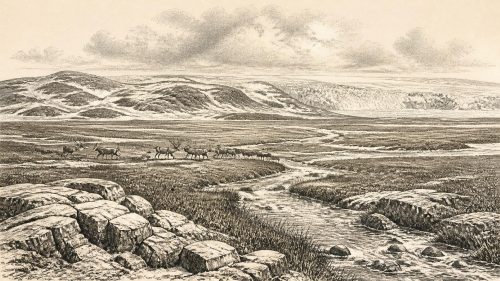
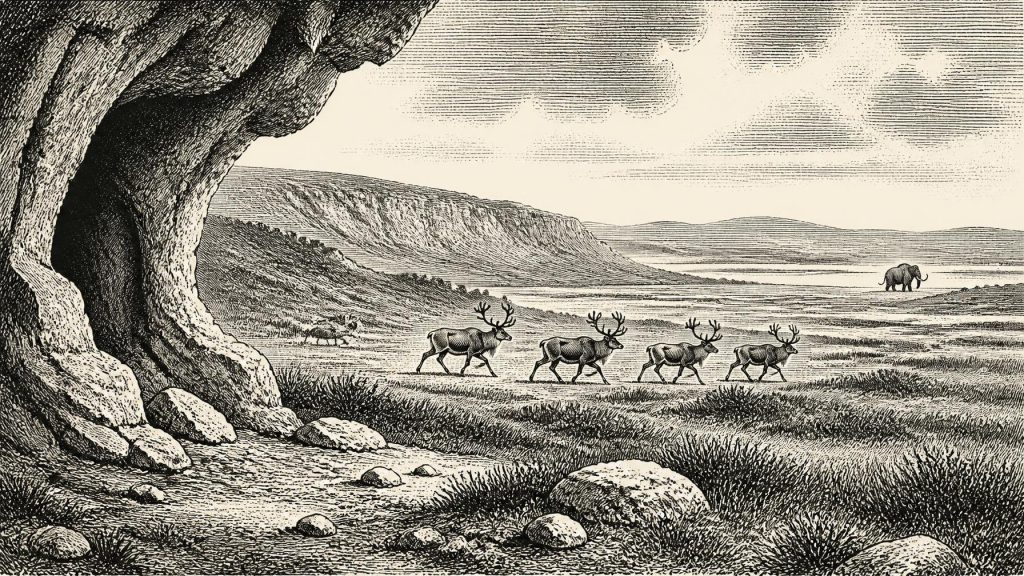
Around 31,972 BCE, approximately 33,900 cal BP, Ireland lay in the later Marine Isotope Stage 3, as climate deteriorated before the Last Glacial Maximum. Lower sea levels altered coasts and potential connections with Britain and Europe, while open tundra-steppe supported diverse Ice Age fauna. Castlepook Cave preserves remains including mammoth, giant deer, reindeer, hyaena and Arctic fox, though redeposition and revised dating prevent precise reconstruction. No securely dated human site exists from this period. Possible cut marks on a Castlepook reindeer bone may indicate an early visit, but remain unconfirmed. Later glaciation destroyed or obscured much evidence, leaving caves archives.
Dateline
“31,972 BCE” is a useful modern label, not a date that people or landscapes in prehistoric Ireland could have recognised. No annual chronicle, settlement sequence or event can be assigned responsibly to this particular year. In calibrated archaeological terms, it corresponds only approximately to 33,900 years before present (cal BP, where ‘present’ is conventionally AD 1950). At this depth of time, radiocarbon results are expressed as probability ranges, deposits may have been disturbed, and the distinction between a fossil’s age and the date at which it entered a cave matters greatly. What can be described is Ireland during the later part of Marine Isotope Stage 3: a cold Ice Age world, before the fullest expansion of the last British–Irish Ice Sheet.
A Landscape in a Changing Ice Age
Ireland was entering a period of profound climatic deterioration. The Last Glacial Maximum itself lay ahead, conventionally placed at roughly 26,000–19,000 cal BP, but ice sheets were already growing across the north-west European margin. Reconstructions differ over precisely when particular Irish districts became ice-covered and how far ice extended at successive stages. That uncertainty is important: it rules out a single, confident map for 31,972 BCE. Nevertheless, the broad sequence is secure. Ireland was not yet the wholly ice-dominated land it would become later in the glaciation, while the advancing cold was reshaping habitats, river systems, coastlines and routes of animal movement.
Sea level was far lower than today because immense quantities of water were stored in continental ice sheets. Ireland therefore did not have its modern coastal outline, and the Irish Sea basin was a very different physical barrier. Connections between Ireland, Britain and the European mainland varied with sea level, ice extent and local topography. It is safest not to call this simply a permanent ‘land bridge’: some routes may have been dry, others ice-covered, wet, or difficult to cross. For mobile animals—and potentially for people—the western edge of Europe was more connected than the island geography familiar today, but it was also climatically harsh and unstable.
The vegetation was not the green, wooded Ireland of later prehistory. Cold-stage environments supported open, treeless or sparsely vegetated landscapes, often described in broad terms as tundra-steppe or mammoth-steppe. Grasses, sedges, herbs, dwarf shrubs and patches of hardy scrub would have mattered more than forest. Wind, frost and seasonal scarcity were fundamental forces. Glaciers and periglacial processes later scoured, buried and reworked large areas, helping to explain why this early record is so fragmentary. The drumlins, corries, U-shaped valleys and spreads of glacial sediment visible in Ireland today are, in part, legacies of these later ice advances and retreats rather than a direct snapshot of this one moment.
Animals in the Fossil Record
The strongest Irish evidence for this general period comes from animal remains, especially those recovered from limestone caves. Castlepook Cave, near Doneraile in north County Cork, is particularly significant. Antiquarian excavations there produced a remarkable assemblage that includes remains attributed to mammoth, giant deer, reindeer, brown bear, wolf, Arctic fox, mountain hare, lemmings and spotted hyaena. The species list conveys an Ice Age ecosystem far richer in large mammals than modern Ireland. It also cautions against imagining a uniform Arctic wasteland: the presence of animals with differing ecological requirements reflects change through time, varied microhabitats and a record accumulated over many episodes.
Recent redating has transformed the chronological discussion. Improved collagen pretreatment and accelerator mass spectrometry have shown that some older radiocarbon determinations from southern Irish caves were too young. Work on Castlepook places important parts of its fauna in Marine Isotope Stage 3, before the Last Glacial Maximum; the revised evidence indicates that species such as giant deer and spotted hyaena may have disappeared locally before the glacial peak. These findings make the cave central to understanding the Irish Pleistocene, but they do not mean every bone was deposited in the same season, century or even millennium.
Caves are both precious archives and difficult ones. Carnivores can drag prey into them; water can wash bones through fissures; sediment can slump; and early excavations rarely recorded layers to modern standards. At Castlepook, some deposits were disturbed and much original contextual information was lost. A mammoth bone demonstrates that mammoths occurred in Ireland during the relevant broad phase; it does not prove that a herd stood outside the cave in 31,972 BCE. Likewise, the coexistence of reindeer and hyaena in a collection need not establish a single local food web at one exact date. Responsible interpretation begins with those limits.
The Question of Human Presence
There is no securely dated campsite, hearth, stone-tool assemblage or human burial in Ireland that can be assigned to around 33,900 cal BP. Consequently, there is no basis for describing an Irish community’s leaders, households, languages, religious practices or territory at this time. The long-standing position of the National Museum of Ireland—that clear evidence for a Palaeolithic human presence has not yet emerged—captures the necessary caution.
There is, however, an important developing question. Examination of a reindeer bone from Castlepook has identified marks interpreted by some researchers as possible stone-tool cut marks, and its reported age is broadly close to the period represented by this article. If that interpretation is confirmed through full publication, taphonomic analysis and securely contextualised evidence, it could indicate a very early human visit to Ireland before the Last Glacial Maximum. It would be a major discovery. At present, though, the bone is not equivalent to proof of sustained settlement. Natural damage, carnivore activity, excavation history and the absence of an associated tool assemblage all require restraint.
The distinction is more than academic. The earliest widely accepted direct evidence for human activity in Ireland is much later: cut marks on a brown-bear patella from Alice and Gwendoline Cave, County Clare, dated to approximately 12,810–12,590 cal BP. More enduring settlement is documented later still, in the Mesolithic, including Mount Sandel in County Londonderry. These later discoveries demonstrate that people eventually reached and used Ireland, but they must not be projected backwards to fill the deep Pleistocene gap.
No Polities, but a Wider Human World
It would be misleading to manufacture political history for Ireland in 31,972 BCE. There is no evidence for kingdoms, diplomacy, warfare, formal trade routes, monuments, farming or organised religion on the island at this date. Nor are there Irish artefacts from which to infer everyday dress, food preparation or learning. If people did enter Ireland, they would have belonged to highly mobile Upper Palaeolithic hunter-gatherer societies known elsewhere in Europe, equipped with sophisticated knowledge of animals, seasons and stone technology. Yet that is a continental comparison, not evidence that such a group lived permanently in Ireland.
The economy that can be observed is ecological rather than human: grazing and browsing animals converting sparse vegetation into biomass; predators and scavengers following them; and caves occasionally preserving the traces. Any human movement, if it occurred, would probably have been tied to the same seasonal geography of game, shelter and safe passage. That remains an interpretation, not a demonstrated Irish lifeway.
Why This Distant Moment Matters
Around 31,972 BCE, Ireland was on the threshold of an environmental transformation that would erase much of what came before it. The later advance of the British–Irish Ice Sheet removed or deeply altered many potential open-air archaeological deposits. The scarcity of finds is therefore not proof that no person ever arrived; it is evidence that survival, discovery and interpretation are exceptionally difficult. Caves such as Castlepook, museum collections, improved radiocarbon methods and renewed fieldwork offer the best prospects for refining the story.
The responsible picture is thus compelling precisely because it is incomplete. Ireland was a cold, open and changing part of the north-west European world, inhabited by Ice Age animals and approaching much more severe glaciation. A human presence near this point in time is possible, perhaps even suggested by one contested line of evidence, but it is not yet securely demonstrated. The history of this year is not a tale of named people or events; it is the deep precondition for every later Irish landscape, ecosystem and settlement.
Primary Sources
- A Reconsideration of the Radiocarbon Dating of the Marine Isotope Stage 3 Fauna from Southern Ireland
- The Irish Quaternary Fauna Project
- New Insights on the Fauna of Ireland's Younger Dryas and Early Holocene from Alice & Gwendoline Cave
- The Colonization of Ireland: A Human Ecology Perspective
- Growth and Retreat of the Last British–Irish Ice Sheet, 31,000 to 15,000 Years Ago: the BRITICE-CHRONO Reconstruction
- Stratigraphic and Palaeo-geomorphological Evidence for the Glacial-deglacial History of the Last British-Irish Ice Sheet in the North-western Irish Sea
- Maximum Extent and Dynamic Behaviour of the Last British–Irish Ice Sheet West of Ireland
- Early Deglaciation of the British-Irish Ice Sheet on the Atlantic Shelf
- New Age Constraints for the Maximum Extent of the Last British-Irish Ice Sheet (NW Sector)
- Last Glacial Maximum Cirque Glaciation in Ireland and Implications for Reconstructions of the Irish Ice Sheet
- Dimensions and Chronology of the Last Ice Sheet in Western Ireland
- Geology of Ireland
- Ireland Through Geological Time
- Prehistoric Details: Mell Flint Flake
- Ice Age Ireland – Cool Fossils
- Ice Age Ireland: Did Woolly Mammoths Walk in Wicklow?
- 2022:564 – Castlepook Cave, Castlepook South, Cork
- The IntCal20 Northern Hemisphere Radiocarbon Age Calibration Curve (0–55 cal kBP)
- IntCal Data
- Recent Developments in Calibration for Archaeological and Environmental Samples
- Hydrographic Survey Data Uncovers Preserved Glacial Landscape
- The Archaeology of Caves in Ireland
- Quaternary Geology