Castlepook’s Marked Reindeer Femur31973 BCE
Around 31,973 BCE, Ireland was part of a climatically unstable, open Ice Age landscape, with changing coastlines, ice conditions and access routes. Cave faunas show that reindeer, mammoths, giant deer, bears, wolves, hyaenas and smaller cold-adapted animals occupied the island intermittently. At Castlepook Cave, County Cork, a reindeer femur bears a deep mark possibly made by a stone tool during butchery, potentially indicating an early human visit. However, disturbed deposits, uncertain dating and absence of associated tools, hearths or settlements prevent confirmation of occupation. The find prompts further research into Ireland’s earliest, fragile evidence of human presence in deep prehistory.

Dateline
A Date Beyond the Annals
31,973 BCE is not a year that can be recovered in the manner of a historical year. No written record, named individual, settlement, tool assemblage or securely dated event permits a calendar-date narrative for Ireland at this depth of time. The number is a modern convention: expressed against the archaeological timescale, it falls at roughly 33,900 calendar years before present (where “present” conventionally means 1950), within Marine Isotope Stage 3, a long and climatically unstable part of the last Ice Age. Radiocarbon results from this era must be calibrated, and even calibrated ranges commonly span centuries or more. The responsible subject, therefore, is Ireland around this point, not an imagined occurrence on a particular day or in a particular year.
This was Upper Palaeolithic Europe, but it was not yet an “Ireland” of peoples, polities or inherited traditions. There were no Irish kingdoms, borders, diplomacy, towns, farms, monuments, writing or known religious institutions. Indeed, the evidence does not demonstrate a permanent human population on the island. What it does reveal is a changing north-west European landscape in which large mammals reached the Irish landmass, caves accumulated bones, and a small but consequential piece of evidence from County Cork may record a human encounter with a reindeer.
An Altered Land and Sea
During this part of the last glacial cycle, sea level was far lower than today because substantial quantities of water were locked in continental ice. The present Irish Sea, Celtic Sea and western continental shelf therefore looked very different. Ireland lay within a broader, exposed or shallow-water north-west European zone, although the exact routes, coastlines and barriers altered repeatedly as climate, ice and sea level changed. It would be misleading to picture a simple, permanent land bridge linking Ireland to Britain or mainland Europe. Connections could be broad, broken, marshy, estuarine, coastal or ice-influenced; their practical usefulness to people and animals is still debated.
Glacial research makes one caution especially important. The British–Irish Ice Sheet did not behave as a static white blanket that either wholly covered Ireland or wholly vanished. It grew and contracted through successive cold phases. Its maximum expansion belongs later, broadly between about 26,500 and 19,000 calibrated years before present, and geological reconstructions show major advances affecting the Irish margins after the time considered here. Yet evidence for earlier ice growth and retreat during Marine Isotope Stage 3 remains complex and, in places, contested. Around 31,973 BCE, parts of Ireland may have offered habitable, open environments while other districts and routes were constrained by severe cold, glaciers, permafrost and unstable coastlines. Resolution is not fine enough to draw a precise national map for this notional year.
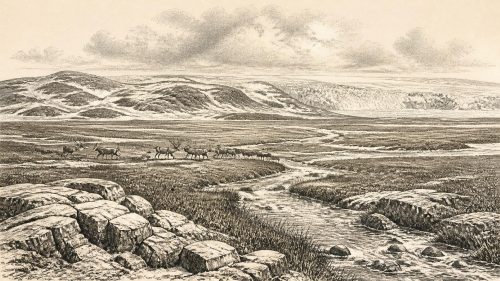
The likely landscape was markedly more open than the later wooded island familiar from the Holocene. The animal evidence points to a mosaic of grassland, herb-rich steppe-tundra, scrub and sparse vegetation rather than continuous forest. Such settings could sustain grazing herds, but they were harsh and seasonally exacting. Wind exposure, short growing seasons and rapid climatic shifts would have structured every animal movement and any human journey.
Castlepook Cave’s Fragile Clue
The most directly relevant evidence comes from Castlepook Cave, also called Mammoth Cave, near Doneraile in north County Cork. Excavations there in the early twentieth century produced a remarkable collection of Ice Age animal remains, now principally associated with the National Museum of Ireland. Later work showed that the cave deposits contained material from more than one period. That richness is an opportunity, but also a warning: antiquarian excavation methods, disturbed sediments, reworking within caves and incomplete recording mean that bones cannot automatically be treated as having been deposited together.
A fragment of reindeer femur from the Castlepook collection has been reported as bearing a deep mark interpreted by zooarchaeologist Ruth Carden as having been made by a sharp stone tool during butchery. It has been publicised as dating to around 33,000 BCE, close to the present article’s conventional target. County Cork’s heritage publication identifies it as a Palaeolithic reindeer bone from Castlepook and suggests that, if the interpretation is right, hunters processed the animal elsewhere before its remains reached the cave—perhaps carried in by carnivores or scavengers rather than brought there by people.
This is potentially Ireland’s earliest evidence of human activity, not proof of a settled community. No securely associated Palaeolithic stone toolkit, hearth, dwelling floor, human bone, artwork or burial has yet been recovered from Castlepook for this episode. Nor has the reported reindeer-bone evidence appeared as a full, peer-reviewed site report with a published calibrated confidence interval and an undisturbed archaeological context. Recent fieldwork at the cave has sought precisely the evidence needed to test such possibilities: stratified deposits, more modified bone, charcoal, lithics and a fuller reconstruction of how sediments and bones entered the chambers. Until that work produces decisive results, the fairest wording is that the bone offers a serious, provocative indication of a brief human presence or visit, rather than a demonstrated colonisation of Ireland.
A Fauna of Cold-Stage Ireland
Even without accepting the human interpretation, Castlepook and other southern Irish caves illuminate the ecological world. Radiocarbon programmes and subsequent re-dating have shown that mammals occupied Ireland during Marine Isotope Stage 3, though dates must always be assessed specimen by specimen. The wider Pleistocene fauna from Castlepook includes reindeer, woolly mammoth, giant deer, brown bear, wolf, spotted hyaena, Arctic fox, mountain hare and lemmings. Other Irish cave sites, including Shandon Cave in County Waterford, have produced remains of mammoth, reindeer, horse, bear, wolf and hare. Not every species was necessarily present at the same moment, nor in every locality; cave collections represent accumulations through time.
Nevertheless, the overall pattern is clear: Ireland was not biologically empty before the Last Glacial Maximum. Reindeer were suited to open, cold landscapes and could have moved in herds across wide northern territories. Giant deer, often misleadingly called “Irish elk”, were not uniquely Irish, but were a conspicuous Eurasian species. Mammoths and hyaenas demonstrate that at least some episodes supported an unexpectedly varied large-mammal community. Carnivores also explain much of the archaeological record. A cave can be a den, a death trap, a shelter, a sediment trap or a place into which bones were washed or dragged. Tooth marks, breakage, bone weathering and location within a cave matter as much as species names.
At Castlepook, the historic label “Mammoth Cave” reflects the discovery of mammoth remains, but that name should not encourage a cinematic scene of people hunting mammoths in Cork. There is no direct Irish evidence for such a hunt at this date. The most defensible picture is one of animal populations moving through changing habitats, with predators and scavengers accumulating bones in limestone caverns. If people reached the area, reindeer would have been a practical source of meat, fat, hide, sinew, antler and bone; that is a reasonable inference from hunter-gatherer economies elsewhere in Upper Palaeolithic Europe, not an excavated Castlepook campsite.
People: Possibility Rather Than Population
By roughly 34,000 calendar years before present, Homo sapiens groups were widespread in parts of western and central Europe. Their material cultures included sophisticated stone-blade technologies, hunting equipment, ornaments and, in some regions, cave art. None of this allows an Irish attribution. The absence of diagnostic tools means that Ireland’s possible visitors cannot responsibly be labelled Aurignacian, Gravettian or by any other cultural tradition. Nor can their language, ancestry, appearance, beliefs, social organisation or route of travel be reconstructed from one modified bone.
If the Castlepook mark is anthropogenic, the most restrained interpretation is of a small, mobile hunting party making a short incursion into the Irish region during a favourable interval. Such people may have followed animal movements, explored newly accessible ground or exploited a seasonal resource. They need not have lived in the cave, and there is no basis for estimating their number. Their journey may have involved crossings over exposed coastal plains, crossings of channels, or routes that changed with sea level and ice. This possibility is historically important because it shifts the question from “when was Ireland first permanently settled?” to “how often, how early and under what environmental conditions did people reach it?”
Permanent settlement is a much stronger claim. It implies repeated occupation, social reproduction, reliable access to food and fuel, knowledge of local seasons, and material traces across more than one site. Ireland’s presently secure archaeological record does not provide that case for 31,973 BCE. The later, well-documented Mesolithic settlement of the early Holocene should not be projected backwards. A fleeting Upper Palaeolithic footprint, if confirmed, may have left almost nothing after millennia of erosion, glaciation, changing sea levels and limited early excavation.
Society, Culture and the Limits of Evidence
Political affairs, diplomacy and organised conflict cannot be described for Ireland around this date because no evidence identifies communities, leaders, territories or encounters between groups. Equally, there is no Irish evidence for ritual practice, formal burial, art, teaching, music or symbolic objects in this period. Caves have powerful associations in later prehistory, but it would be an error to turn Castlepook into a shrine merely because it is a cave. Its demonstrated importance is palaeontological; any human cultural role remains unproven.
Economy and trade must be treated with the same restraint. A visiting foraging group would have possessed knowledge, tools and social connections acquired beyond Ireland, but no traded object or imported raw material has been identified in a secure Irish context of this age. The only economy that can be discussed directly is that of the ecosystem: grazing animals converting sparse vegetation into biomass, predators and scavengers exploiting carcasses, and caves preserving fragments of that web. For potential human visitors, subsistence probably centred on hunting and careful carcass processing, but that remains an interpretation supported by the reindeer bone rather than a known Irish way of life.
What This Year Means
The significance of 31,973 BCE lies in uncertainty honestly handled. Ireland at this point was a glacial-age land within a wider European environmental system, inhabited at least intermittently by a varied cold-stage fauna. Castlepook Cave preserves one tantalising possible sign that humans entered that world far earlier than the traditionally accepted post-glacial settlement horizon. But the evidence is neither a village nor a people’s history in the ordinary sense. It is a bone, a mark, a date reported at broad scale, and a programme of research still testing its implications.
That modest record has large consequences. It encourages archaeologists to re-examine museum collections, date individual bones with improved techniques, distinguish cut marks from natural damage, and investigate undisturbed cave sediments. In this deep past, the most compelling story is not a fabricated first Irish family or a presumed prehistoric event. It is the patient movement from possibility to proof: a reindeer bone from north Cork, an Ice Age fauna, and an island whose earliest human traces may be far older—and far more fragile—than once believed.
Primary Sources
- The IntCal20 Northern Hemisphere Radiocarbon Age Calibration Curve (0–55 cal kBP)
- A Reconsideration of the Radiocarbon Dating of the Marine Isotope Stage 3 Fauna from Southern Ireland
- The Irish Quaternary Fauna Project
- Distribution and Range Expansion of Deer in Ireland
- Heritage Artefacts of County Cork
- 2022:564 – Castlepook Cave, Castlepook South, Cork
- Archaeology Research Excavation Grant 2022: Castlepook Cave Final Report
- Prehistoric Details
- Late Pleistocene Chronostratigraphy and Ice Sheet Limits, Southern Ireland
- Growth and Retreat of the Last British–Irish Ice Sheet, 31,000 to 15,000 Years Ago: the BRITICE-CHRONO Reconstruction
- BRITICE-CHRONO Maps and GIS Data of the Last British-Irish Ice Sheet 31 to 15 ka
- Stratigraphic and Palaeo-Geomorphological Evidence for the Glacial-Deglacial History of the Last British-Irish Ice Sheet in the North-Western Irish Sea
- The Timing and Magnitude of the British–Irish Ice Sheet Between Marine Isotope Stages 5d and 2
- Maximum Extent and Dynamic Behaviour of the Last British–Irish Ice Sheet West of Ireland
- Radiocarbon Constraints on the Age of the Maximum Advance of the British–Irish Ice Sheet in the Celtic Sea
- First Evidence of a Late Upper Palaeolithic Human Presence in Ireland
- Revisiting Alice and Gwendoline Cave, Co. Clare: New Light on the 1902 Excavations
- New Insights on the Fauna of Ireland’s Younger Dryas and Early Holocene from Alice & Gwendoline Cave
- Irish Cave Exploration
- Castlepook Caves
- Occurrence of Mammalia Relicts at Site Castlepook Cave
- What Was on the Menu in Prehistoric Ireland?