Ice-Age Ireland31971 BCE
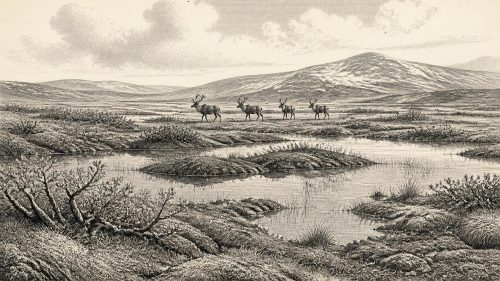
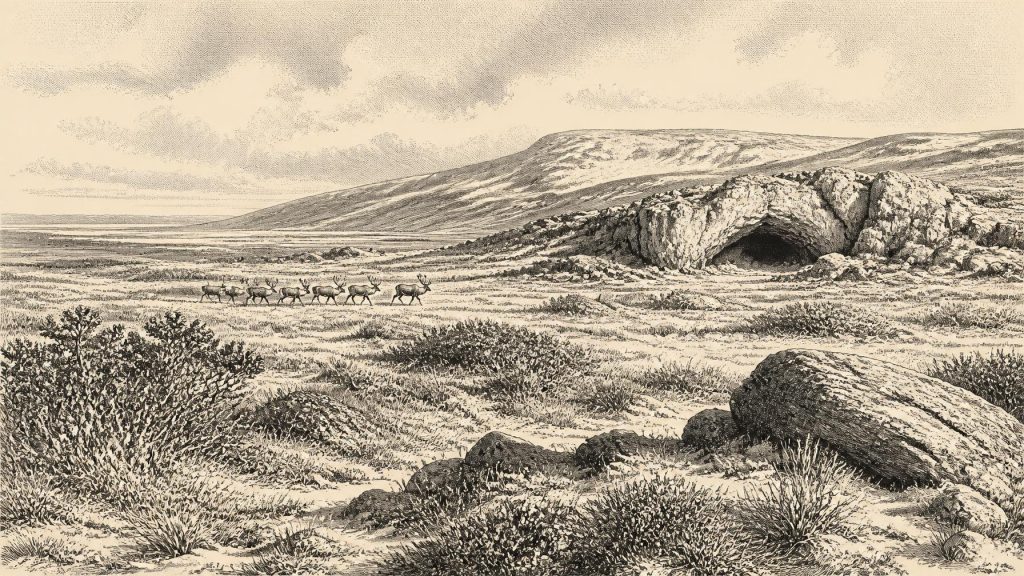
Around 33,900 years ago, Ireland lay within a cold, unstable Late Pleistocene landscape, with regionally variable ice cover preceding the Last Glacial Maximum. Lower sea levels altered coastlines and potential animal routes. Open tundra-steppe habitats supported mammoth, giant deer, reindeer, bears and predators, evidenced especially at Castlepook Cave, County Cork. A cut-marked reindeer femur there provides limited evidence that Upper Palaeolithic hunters may briefly have visited or crossed Ireland. It does not demonstrate settlement, population continuity, polities or cultural practices. Subsequent ice expansion destroyed or obscured much evidence, leaving caves as selective archives. Post-glacial Mesolithic settlement occurred many millennia later.
Dateline
The label 31,971 BCE creates an impression of precision that the evidence cannot sustain. Nobody in Pleistocene Ireland used a numbered calendar, and neither archaeology, radiocarbon dating nor glacial geology can identify an event in one modern year so far back. In the radiocarbon convention of “before present”, where present is AD 1950, the label falls broadly around 33,900 years ago. The responsible frame is therefore a multi-millennial interval within the Late Pleistocene, Marine Isotope Stage 3, and the Middle Upper Palaeolithic of north-west Europe—not a dated Irish “year”.
A Landscape Before the Ice Maximum
This was not yet the climatic climax commonly called the Last Glacial Maximum. That later phase is generally placed at roughly 26,000–19,000 years before present, when the Irish Ice Sheet covered most, and perhaps at times nearly all, of the island. Around 33,900 years ago, conditions were already cold, unstable and profoundly unlike those of modern Ireland, but the geological evidence indicates that substantial areas remained free of the expanding ice sheet. The precise extent of glacier ice changed through time and remains debated by region; it should not be imagined either as a wholly green island or as a country uniformly buried beneath ice.
Two dated sequences in County Fermanagh help set the limits of what can be said. Organic sediments at Derryvree have been calibrated to approximately 36,900–31,700 years ago, while deposits beneath till at Greenagho have yielded a range of about 37,200–35,700 years ago. Together, with other marine and terrestrial evidence, they indicate ice-free conditions in north-central Ireland until at least about 34,000 years ago, before the last Irish Ice Sheet substantially expanded. The conventional date used here lies close to that threshold, so it is better to speak of a changing, regionally varied cold landscape than to claim that a definite ice margin stood at any particular modern place in 31,971 BCE.
Sea level was far lower than today because so much water was locked in northern ice sheets. Ireland’s coastlines therefore lay beyond their modern positions, and the Irish Sea basin had a geography very different from the familiar map. Connections, barriers, exposed lowlands, glacier-fed waters and changing shorelines all mattered to animal movement. Yet the exact routes available at one moment cannot be mapped securely. “Land bridge” is useful shorthand only if it does not conceal the complexity of cold-climate terrain, shifting sea levels and, later, ice occupying parts of the route.
Cold Open Country
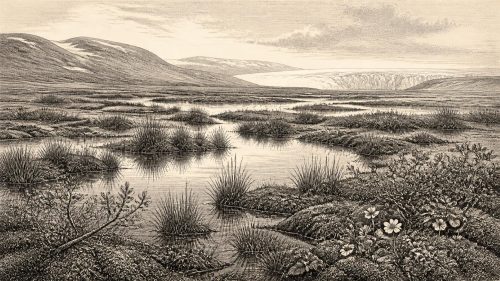
The Irish evidence is too fragmentary to reconstruct a single national vegetation map for this moment. Nevertheless, the faunal and geological record points to open, treeless or sparsely wooded cold-stage environments rather than the dense temperate woodland of much later prehistory. Exposed mineral ground, grassland and herb-rich tundra-steppe vegetation would have offered forage in favourable areas. Wind, frost, seasonal snow and rapidly changing conditions shaped the land. Rivers carried sediment, slopes suffered frost action, and caves accumulated bones, sediment and material washed in from outside.
Irish caves are exceptionally important because later glaciers eroded or buried many open-air Pleistocene landscapes. Castlepook Cave, near Doneraile in north County Cork, is the richest known Irish site for vertebrate evidence from the period leading towards the Last Glacial Maximum. Its assemblage includes woolly mammoth, giant deer, reindeer, brown bear and spotted hyena, alongside smaller cold-adapted animals recorded in cave deposits. Such lists do not mean that every species shared the same valley in the same season, or that all remains are precisely contemporary. Cave sediments can be mixed by water, carnivores, excavation and later disturbance. They do, however, demonstrate that Ireland formed part of a wider north-west European world in which large grazing mammals and their predators could reach suitable habitats.
Predators are especially instructive. Spotted hyenas used caves as dens or accumulated bones there through scavenging and transport; wolves and other carnivores could also alter an assemblage. A bone found in a cave is consequently not simple proof of where an animal died, much less of where people lived. Mammoth and giant deer evoke dramatic Ice-Age imagery, but reindeer are the species most directly relevant to the strongest present suggestion of human activity near this broad date. Any reconstruction must begin with this distinction between animal presence, carnivore behaviour and human action.
A Fleeting Human Trace
At Castlepook, a reindeer femur bears a cut-mark judged to have been made with a sharp stone implement during butchery. Heritage accounts place it at around 31,000 BCE, and it has been presented as the earliest known indication of human activity in Ireland. It is an important discovery, but it is not evidence for an established Irish population, a village or a named hunting people. No securely associated Palaeolithic stone-tool assemblage, hearth, dwelling floor, burial or human skeleton has been recovered from Ireland for this early phase. The bone itself was recovered from a cave context affected by natural processes, and the animal may have been butchered elsewhere before remains entered the cave.
The most cautious interpretation is that one or more Upper Palaeolithic hunters may have entered, crossed or briefly used part of Ireland during a relatively hospitable interval, exploiting reindeer and perhaps other large game. They may have travelled in small, mobile groups already familiar with the changing landscapes of Britain and continental Europe. That proposition is plausible because Homo sapiens were established elsewhere in north-west Europe and because the cut-mark is consistent with carcass processing. It remains an interpretation, however, not a demonstrated migration, settlement or continuous occupation. The archaeological record cannot tell us whether the visit lasted hours, days or seasons, nor whether it had any descendants in Ireland.
This distinction matters because later archaeological periods can too easily be projected backwards. The more substantial evidence for hunter-gatherer settlement in Ireland belongs to the post-glacial Mesolithic, many thousands of years later. The well-known butchered brown-bear bone from Alice and Gwendoline Cave in County Clare dates to the terminal Pleistocene, approximately 12,890–12,678 calibrated years before present, not to this much earlier interval. It confirms another episode of human presence in a radically different late-glacial Ireland; it cannot fill the immense evidential gap between Castlepook’s early hint and later settlement.
No Polities, No Recorded Beliefs
There is no basis for describing political affairs, diplomacy, leaders, tribes, warfare or territorial boundaries in Ireland at this time. Such institutions may be relevant questions for later prehistoric societies, but no Irish evidence from around 33,900 years ago identifies them. Equally, there are no Irish artworks, ritual deposits, graves, monuments, inscriptions or structures from which religion, language, learning or formal cultural traditions can responsibly be recovered. Upper Palaeolithic peoples elsewhere in Europe made sophisticated tools, ornaments, images and burial places, but those discoveries belong to their own archaeological contexts. They must not be treated as evidence that identical practices occurred in Ireland.
The same caution applies to everyday life. If people did visit Ireland, their economy was almost certainly based on foraging, hunting and the skilled processing of animal resources rather than farming, herding, metalworking or trade in the later sense. The cut-marked reindeer bone makes carcass butchery a reasonable inference; it does not reveal cooking methods, clothing, shelter design, kinship, seasonal schedules or exchange networks. A portable stone toolkit is likely in principle, since the mark implies a sharp edge, but none has yet been securely tied to the Castlepook event. The absence of evidence is partly a result of preservation and discovery, yet it still limits what historians may claim.
Ice, Erasure and Regional Change
The crucial long-term development was environmental rather than political. After this period the last Irish Ice Sheet grew and expanded, eventually reworking much of the terrain and removing, displacing or sealing earlier deposits. Geological studies suggest that the bulk of this ice sheet developed from initially ice-free conditions around 34,000 years ago and that inland ice did not reach Ireland’s south coast until after about 24,000 years ago. The timing and thickness of ice varied between western mountains, central lowlands, the Irish Sea basin and southern Ireland. This is why apparently simple statements that Ireland “was” or “was not” glaciated can mislead when applied to a single early date.
For human history, the result is a severe archival loss. A transient hunting camp on exposed ground could have been destroyed by ice, rivers, solifluction and later soil formation. The lack of campsites does not prove that no people ever came. Conversely, it does not permit an imagined society to replace missing evidence. Caves such as Castlepook preserve an unusually valuable but selective record: bones, cave processes and rare signs of encounter rather than a full social landscape. Continued re-examination of museum collections, improved radiocarbon pretreatment, ancient biomolecular work and carefully controlled cave excavation may yet refine the picture.
What This Date Can Mean
Ireland around the conventional date of 31,971 BCE was a cold, changing frontier at the north-west edge of Upper Palaeolithic Europe. Large mammals moved through suitable open habitats; predators left their own signature in caves; glacier ice was building towards a later maximum but had not simply engulfed every region at once. A cut-marked reindeer bone from County Cork offers a compelling, still limited indication that people may have reached this landscape. It does not yield an Irish nation, a settlement history or an event calendar. Its real importance lies in showing how a single carefully studied fragment can widen the known horizon of human contact with Ireland, while also reminding us how much of the earliest record has been lost.
Primary Sources
- A reconsideration of the radiocarbon dating of the Marine Isotope Stage 3 fauna from southern Ireland
- The Irish Quaternary Fauna Project
- Castlepook Cave County Geological Site Report
- Heritage Artefacts of County Cork
- New insights on the fauna of Ireland's Younger Dryas and Early Holocene from Alice & Gwendoline Cave
- First evidence of a Late Upper Palaeolithic human presence in Ireland
- Trimlines, blockfields and the vertical extent of the last ice sheet in southern Ireland
- Late Pleistocene chronostratigraphy and ice sheet limits, southern Ireland
- Dimensions and chronology of the last ice sheet in Western Ireland
- Last Glacial Maximum cirque glaciation in Ireland and implications for reconstructions of the Irish Ice Sheet
- Early deglaciation of western Ireland
- The colonization of Ireland: A human ecology perspective
- Anthropogenic changes to the Holocene nitrogen cycle in Ireland
- The Mesolithic in Ireland: when was it?
- Prehistoric Ireland
- Reconstruction and 36Cl based geochronology of the deglaciation of central Ireland
- Evidence for high-frequency late Glacial to mid-Holocene climate variability from oxygen isotope values of Lough Inchiquin, Ireland
- The Irish Caves Database: Castlepook Cave
- Excavations at Alice and Gwendoline Cave, County Clare, 2019
- Excavations at Castlepook Cave, County Cork, 2022
- Occurrence of mammalia relicts at site Castlepook Cave
- Landscapes and environments of the last glacial-interglacial transition: a time of amazingly rapid change in Ireland