Castlepook Cave Deposits31970 BCE
About 31,970 BCE, Ireland lay in the unstable later Marine Isotope Stage 3, with advancing but uneven ice cover, lower sea levels and changing routes for animals. Castlepook Cave, County Cork, preserves over 2,000 vertebrate remains, including mammoth, reindeer, giant deer, bear and hyaena, indicating open, varied cold-climate habitats. Cave processes, water disturbance and old excavations complicate interpretation, however. No dated human settlement, tools or burial belongs to this period. A possibly butchered reindeer bone suggests a tentative Upper Palaeolithic visit, but requires further testing. Later glaciation destroyed much evidence; future dating, DNA and offshore research may refine Ireland’s history.
Dateline
The label 31,970 BCE is a modern chronological convenience, not a date that can be isolated in Ireland’s archaeological record. In simple calendar arithmetic it lies about 33,920 years before AD 1950, the conventional reference point for ‘before present’ (BP). Yet radiocarbon measurements, calibration curves, depositional disturbance and the limits of surviving evidence make year-by-year precision impossible. The responsible frame is therefore a broad interval around 34,000 calendar years ago, in the later part of Marine Isotope Stage 3 (MIS 3), before the fullest expansion of the last British–Irish Ice Sheet.
At this depth of time, Ireland has no written record, no named communities and no securely dated settlement surface from which to describe a particular year. What can be reconstructed comes chiefly from cave bones, cave sediments, glacial landforms, marine evidence and the later absence or survival of species. These sources illuminate changing landscapes and animal populations far better than individual human lives. They also demand caution: cave assemblages may have been accumulated by carnivores, water, roof-fall and nineteenth- or twentieth-century excavation, rather than by people.
A Changing Ice-Age Island
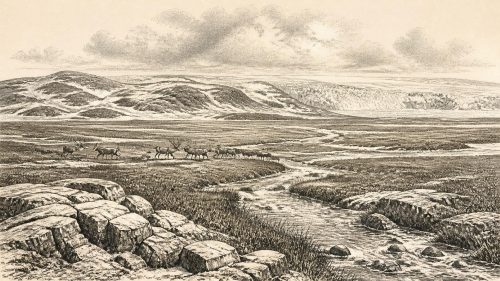
Ireland was within the last glacial period, but it should not simply be pictured as a country buried continuously beneath ice. The scale, timing and regional pattern of ice growth remain active subjects of research. Some evidence indicates that north-central Ireland retained ice-free ground until at least about 34 ka, while reworked marine shells suggest open water off north-western Ireland during portions of the preceding millennia. Other work argues for more extensive ice-sheet growth during the wider last cold stage. The most secure conclusion is that this was a transitional, climatically unstable world: ice was advancing in some sectors, but the island’s cover was neither uniform nor fixed at a single moment.
Later, during the Last Glacial Maximum, roughly 26,500–19,000 calibrated years BP, ice became vastly more extensive. Large glaciers scoured bedrock, reworked sediments and transformed drainage systems, while ice flowing through the Irish Sea was connected to the wider British–Irish Ice Sheet. The resulting erosion helps explain why a very early archaeological record is so slight. Any camps on exposed ground, river terraces or coasts were vulnerable to destruction, burial or removal. Much of the landscape that people or animals might have used is now concealed beneath glacial deposits, altered by subsequent erosion, or lies beneath the sea.
Sea level was substantially lower than today, and Ireland’s coastline was correspondingly different. This did not necessarily make movement from Britain or continental Europe simple or continuous. The geography of the Irish Sea basin, ice margins, meltwater and changing channels mattered as much as a general fall in global sea level. Fauna evidently reached Ireland during favourable phases, but the precise routes and timings varied by species. For human movement, any claim of a dry, uncomplicated land bridge at this particular point would exceed the evidence.
Open Country and Ice-Age Fauna
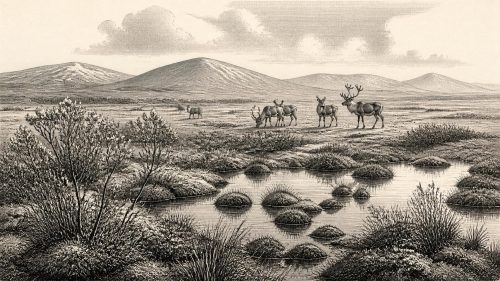
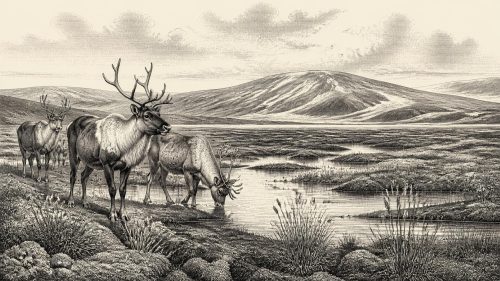
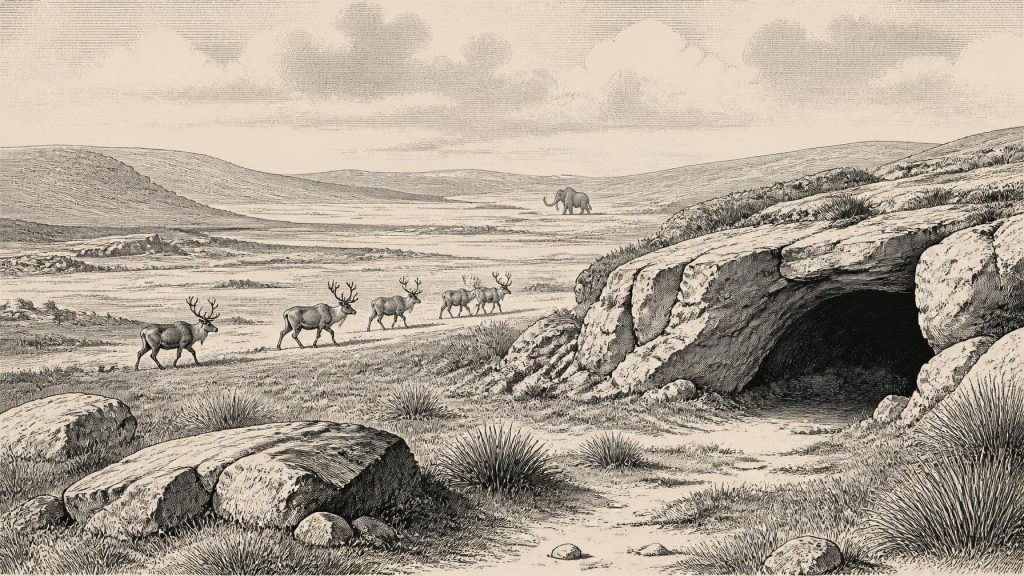
The strongest local evidence for conditions broadly relevant to this date comes from southern Irish cave deposits, especially Castlepook Cave near Doneraile, County Cork. Geological Survey Ireland describes it as the island’s richest known site for vertebrate fauna leading up to the Last Glacial Maximum. More than 2,000 bones have been recovered there. The assemblage includes woolly mammoth, giant deer, reindeer, brown bear and spotted hyaena, as well as smaller cold-adapted animals such as Arctic fox, lemmings and mountain hare in later Ice-Age levels.
These remains establish that parts of Ireland could support substantial mammals during MIS 3. They do not demonstrate that all these species shared precisely the same landscape in 31,970 BCE, nor that each lived together at one time. Individual bones have different dates, and cave deposits may combine material gathered over thousands of years. Nonetheless, reindeer and mammoth point to broad, open habitats with abundant grasses, herbs and sedges; giant deer and red deer indicate that vegetation and shelter varied locally. In a cold North Atlantic setting, Ireland was likely a mosaic of exposed grassland, dwarf-shrub tundra, wet ground, rocky limestone country and, where climate and topography allowed, more sheltered patches of scrub or woodland.
Carnivores were part of that ecology and part of the archaeological problem. Spotted hyaenas could drag carcass parts into caves, gnaw bone and leave accumulations that can superficially resemble human food waste. Brown bears might use caves, while water could wash bones and sediment through fissures. Castlepook is therefore more than a list of spectacular Ice-Age animals: it is a lesson in taphonomy, the study of how remains reached a site and changed after deposition. The cave’s old excavations and water disturbance mean that each specimen must be assessed before it is turned into a historical story.
Were People Present?
No permanent human occupation of Ireland is securely documented for around 31,970 BCE. Nor is there a recognised settlement, hearth, stone-tool assemblage or human burial that can be assigned to this narrow interval. The National Museum of Ireland accordingly stresses the long-standing absence of clear evidence for Palaeolithic human presence, while later discoveries have shown that the question is more complicated than it once appeared. The prudent conclusion is not that people certainly were absent, but that their presence at this point remains unproven.
There is, however, a reason to keep the question open. A reindeer femur from Castlepook Cave has been reported as bearing deep marks consistent with butchery by a stone tool and as dating to around 33,000 years ago. If securely demonstrated through direct dating, detailed microscopic analysis and firm contextual publication, such evidence would make an Upper Palaeolithic human visit to Ireland plausible within the broad time horizon of this entry. It would not prove an established population, a village or a continuous tradition. A single modified animal bone could represent a brief hunting or scavenging episode by a very small mobile group.
The claim must remain provisional. Reassessment of Irish MIS 3 cave fauna has shown that several older radiocarbon determinations from Castlepook and comparable caves are unreliable by modern standards of bone pretreatment and can be thousands of radiocarbon years too young. Current research has therefore shifted some supposedly late fauna further back in time. This is an important advance, but it also means that eye-catching dates from old collections require re-testing. At 31,970 BCE, the difference between a bone’s uncalibrated radiocarbon age, its calibrated range and its archaeological context is decisive.
The best-confirmed direct evidence for people in Ireland is much later. A brown-bear kneecap from Alice and Gwendoline Cave, County Clare, bears cut marks and has two radiocarbon determinations calibrating to about 12,810–12,590 and 12,810–12,685 BP. Even that terminal-Pleistocene evidence is interpreted as a small-scale human incursion rather than proof of dense or enduring settlement. Substantial evidence for hunter-gatherer communities belongs later again, in the Mesolithic after the ice had retreated and new ecosystems had developed.
No Polities, No Proven Diplomacy
There is no basis for describing kingdoms, chiefs, laws, diplomacy, territorial borders or organised warfare in Ireland at this date. There are likewise no Irish monuments, artworks, languages, rituals or teaching traditions that can responsibly be attributed to 31,970 BCE. It would be misleading to project later Gaelic society, Celtic identities, farming communities, megalithic tomb builders or even the better-known Mesolithic hunters back into this far earlier setting.
If people did reach Ireland during this part of MIS 3, they would have belonged to highly mobile Upper Palaeolithic foraging societies known elsewhere in north-west Europe. Their livelihoods would probably have depended on close knowledge of animal movements, weather, raw materials and temporary shelter. That is a comparative interpretation, not direct evidence from Ireland. The island has not yet yielded the tools, structures or repeated activity areas needed to reconstruct food-sharing, kinship, seasonal rounds, spiritual practice or exchange networks here. The only responsible ‘political history’ is the acknowledgement that none is recoverable.
Regional Connections and Future Evidence
The fauna nevertheless shows that Ireland was not ecologically isolated. Mammals had entered during earlier windows of favourable connection, whether across exposed terrain, ice-linked routes or water gaps. Ireland’s biological history was shaped by repeated dispersal, local extinction and later recolonisation as climate, ice and sea level changed. This changing connectivity is the most meaningful form of regional history available for 31,970 BCE.
Future work may sharpen the picture. Re-excavation of undisturbed cave deposits, direct accelerator mass spectrometry dating with rigorous collagen screening, ancient DNA, sedimentary DNA, stable-isotope study and microscopic analysis of bone modifications can test old assumptions. Offshore survey may also identify submerged landscapes that once lay closer to coasts, rivers and travelling routes. For now, 31,970 BCE stands not as a year of a recorded Irish event, but as a carefully bounded glimpse of a cold, changing land: one occupied securely by Ice-Age animals, increasingly affected by expanding ice, and only tentatively placed within the outer horizon of human activity.
Primary Sources
- Prehistoric Details
- Castlepook Cave, County Geological Site Report
- The Irish Quaternary Fauna Project
- A Reconsideration of the Radiocarbon Dating of the Marine Isotope Stage 3 Fauna from Southern Ireland
- Growth and Retreat of the Last British–Irish Ice Sheet, 31,000 to 15,000 Years Ago: The BRITICE-CHRONO Reconstruction
- Growth and Retreat of the Last British–Irish Ice Sheet, 31,000 to 15,000 Years Ago: The BRITICE-CHRONO Reconstruction
- Trimlines, Blockfields and the Vertical Extent of the Last Ice Sheet in Southern Ireland
- The Timing and Magnitude of the British–Irish Ice Sheet Between Marine Isotope Stages 5d and 2
- The Deglaciation of the Western Sector of the Irish Ice Sheet from the Inner Continental Shelf to its Terrestrial Margin
- Oscillating Retreat of the Last British-Irish Ice Sheet on the Continental Shelf Offshore Galway Bay, Western Ireland
- The Colonization of Ireland: A Human Ecology Perspective
- Ireland: Submerged Prehistoric Sites and Landscapes
- The Mesolithic in Ireland: When Was It?
- First Evidence of a Late Upper Palaeolithic Human Presence in Ireland
- First Evidence of a Late Upper Palaeolithic Human Presence in Ireland
- New Insights on the Fauna of Ireland's Younger Dryas and Early Holocene from Alice & Gwendoline Cave
- Phylogeographic, Ancient DNA, Fossil and Morphometric Analyses Reveal Ancient and Modern Introductions of a Large Mammal: The Complex Case of Red Deer (Cervus elaphus) in Ireland
- Could Brown Bears (Ursus arctos) Have Survived in Ireland During the Last Glacial Maximum?
- Anthropogenic Changes to the Holocene Nitrogen Cycle in Ireland
- Occurrence of Mammalia Relicts at Site Castlepook Cave