Castlepook’s Glacial Fauna31969 BCE
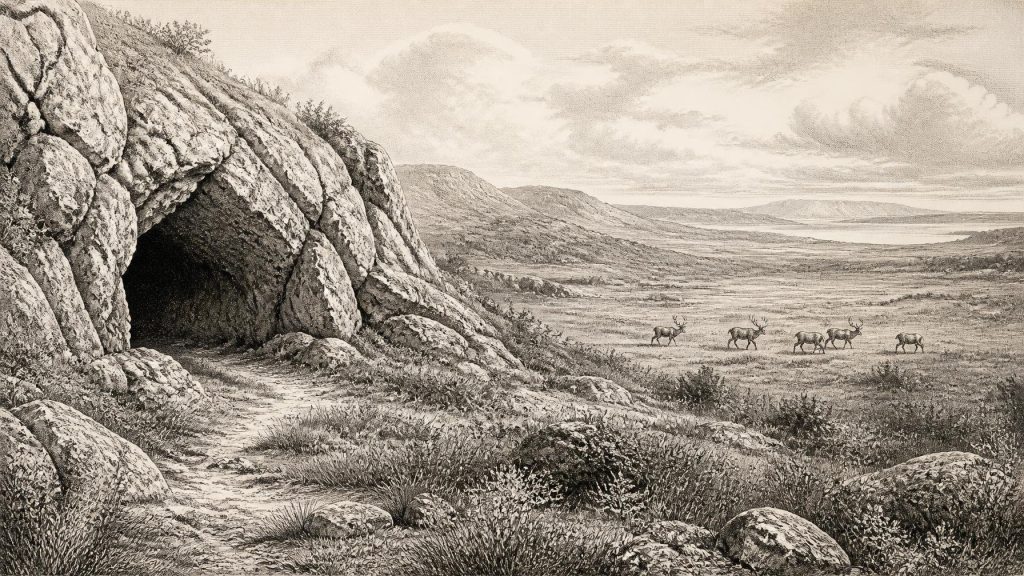
31,969 BCE is a modern label rather than a recoverable Irish historical date, belonging to later Marine Isotope Stage 3 before the Last Glacial Maximum. Ireland experienced fluctuating cold conditions, regional ice growth and open habitats. Castlepook Cave, County Cork, preserves over 2,000 bones accumulated across millennia, including mammoth, reindeer, giant deer, bear and hyena, demonstrating complex Ice Age ecosystems. Its disturbed reindeer femur may bear stone-tool marks and suggest an early human visit, but remains unconfirmed. No securely dated settlements, occupations or cultural practices establish people in Ireland then. Later glaciation and dating uncertainties limit conclusions about human activity.
Dateline
31,969 BCE is not a date that can be recovered from the Irish archaeological record as a particular year. It is a modern calendar label, placed almost 34,000 years before AD 1950 by simple arithmetic. At this depth of time, archaeologists work with broad phases, radiocarbon determinations and calibrated probability ranges, not anniversaries. The most responsible setting is therefore later Marine Isotope Stage 3, within the Upper Palaeolithic and before the fullest expansion of the last Irish Ice Sheet. The evidence illuminates a changing Ice Age Ireland, but it cannot identify an event, ruler, settlement or season in this numbered year.
A Landscape in Transition
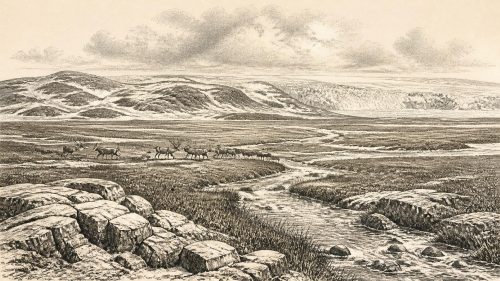
The island lay within the long cold interval commonly called the Midlandian glaciation in Ireland, part of the wider last glacial cycle of north-west Europe. Yet it would be misleading to picture 31,969 BCE simply as the height of an unbroken, island-wide ice cap. The conventional Last Glacial Maximum came later, roughly 27,000–23,000 calibrated years before present in Irish reconstructions, when ice covered Ireland and extended across much of its continental shelf. Evidence for the preceding phase is more difficult to date and interpret. Recent syntheses recognise ice-sheet growth, retreat and renewed advance during Marine Isotope Stage 3, but also stress that securely dated glacial deposits for this earlier interval remain scarce.
That uncertainty matters. At a point conventionally represented by 31,969 BCE, some Irish uplands and regions may already have experienced substantial local or regional ice, while other areas were available to cold-adapted animals. No single map can responsibly portray the entire island on one precise day. The physical processes that later transformed the landscape were nevertheless under way: glaciers eroded bedrock, shifted vast loads of sediment and depressed the land beneath their weight. The familiar outlines of valleys, lakes and lowlands were not yet the settled, vegetated scenery known from later prehistory.
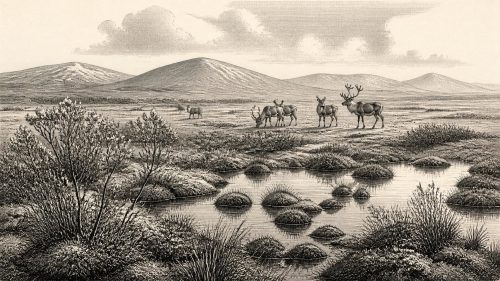
Climate was harsh, but not static. Greenland ice-core sequences and North Atlantic records show pronounced millennial-scale fluctuations during this part of the last glacial period. Irish evidence is too fragmentary to reconstruct the weather of a particular generation, let alone this nominal year. It does support a broader picture of a largely open, treeless or sparsely wooded environment, with grassland, herbs, dwarf shrubs and exposed ground varying according to local shelter, altitude and climate. Wind, frost action and seasonal snow would have shaped surfaces that later ice sometimes reworked or removed entirely.
What the Caves Preserve
The chief evidence for Ireland at this depth of time comes not from villages but from caves, especially Castlepook Cave near Doneraile in north County Cork. A relict limestone maze, excavated chiefly in the early twentieth century, has produced more than 2,000 animal bones. Geological Survey Ireland describes it as Ireland’s richest vertebrate-fauna site for the period leading towards the Last Glacial Maximum. Direct radiocarbon dates on individual bones span a very long interval, approximately 45,700 to 19,950 radiocarbon years before present. That range does not mean that all its animals lived together, nor that the cave was continuously occupied. It means that, over many millennia, its passages accumulated remains from successive Ice Age environments.
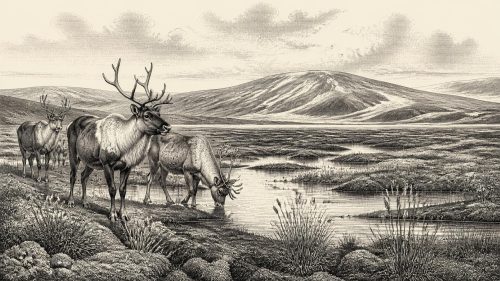
The assemblage establishes that Ireland supported, or was repeatedly reached by, a striking range of large and small mammals before the Last Glacial Maximum. Woolly mammoth, reindeer, giant deer, brown bear and spotted hyena are represented at Castlepook; later Ice Age deposits also include Arctic fox, wolf and lemmings. The cave’s fauna offers powerful evidence that the island was not simply a sterile expanse throughout the glacial cycle. Reindeer and mammoth suggest open, productive cold-country habitats, while predators and scavengers indicate food webs more complex than any image of empty frozen wilderness permits.
But cave bone collections demand caution. Many were recovered by antiquarian excavators, before modern excavation standards, and have been disturbed by water, animal activity and earlier digging. A bone’s date records the death of that animal, not necessarily the date when it entered the cave or the date of every associated find. Hyenas may themselves have transported carcass parts into Castlepook. Accordingly, the fauna supports regional ecological possibilities, not a neat census of animals standing together in County Cork in 31,969 BCE.
The Question of People
Human presence is the most important and the most uncertain issue. Ireland has no securely excavated house, hearth, burial, stone-tool workshop or occupation surface dating to around this calendar label. The well-published butchered brown-bear patella from Alice and Gwendoline Cave, County Clare, is much later: two independent determinations place it around 12,810–12,590 calibrated years before present. It demonstrates a terminal Pleistocene human presence, not an occupation 20,000 years earlier.
A re-examined reindeer femur from Castlepook Cave has been reported as bearing marks consistent with cutting or chopping by a stone tool and as dating to roughly 33,000 radiocarbon years ago. If the modification is confirmed and its context can be better established, it would be important evidence that Upper Palaeolithic people reached Ireland far earlier than the previously accepted record. It must not, however, be turned into a story of permanent settlement. The object derives from an old, disturbed cave collection, and a full peer-reviewed technical publication establishing its taphonomy, tool-mark diagnosis and calibrated age has not yet furnished a wider archaeological assemblage around it.
There is also a chronological trap. A radiocarbon age expressed in “years BP” is not identical to a calendar age or to a BCE date. Atmospheric carbon varied over time, so determinations require calibration against curves such as IntCal20. At c. 30,000–40,000 years ago, the calibrated ranges can be broad. Thus an animal bone publicised as “33,000 years old” cannot honestly be pinned to 31,969 BCE. It is best treated as a potentially relevant indication of human activity during the broader later Upper Palaeolithic, rather than evidence for an event in this exact year.
Society Without a Settlement Record
If people did enter Ireland during this interval, they were hunter-gatherers using mobile technologies and living within a demanding northern environment. A cut-marked reindeer bone, if anthropogenic, would show carcass processing and the use of sharp stone-edged tools; it would not reveal whether hunters killed the animal, scavenged it, camped nearby or made only a brief visit. It cannot tell us their language, identity, population size, kinship system or route of arrival. Nor is there direct Irish evidence for clothing, boats, dogs, art, music or seasonal round at this time, although such practices are known elsewhere in Upper Palaeolithic Europe.
For the same reason, there are no political affairs to narrate. No chiefdoms, territories, diplomatic exchanges, wars or treaties can be identified. “Ireland” itself is used here only as a geographical convenience: there was no Irish polity, nation or historical community with that name. Nor can trade be demonstrated. Lower sea levels exposed parts of the seabed around north-west Europe, but changing ice loads, sea level and topography made connections between Ireland and Britain complex. Researchers continue to model possible land bridges and ice routes; whether a particular journey required dry ground, travel beside ice, short water crossings or some combination cannot be established for 31,969 BCE.
Belief, Culture and the Limits of Inference
There is no Irish evidence for religious practice in this period. Caves can later acquire sacred associations, but a bone assemblage alone does not prove ritual, burial or ceremonial hunting. Similarly, the splendour of Upper Palaeolithic cave art and personal ornaments on the European mainland should not be projected across the Irish Sea. It provides cultural context for what contemporaries elsewhere could make and know, not proof that equivalent art was created in Ireland. The absence is partly archaeological: later glaciation could scour away open-air sites, and any coastal camps now lie beneath changed shorelines or marine sediments. Yet possible loss is not evidence of what was lost.
The most significant development represented by 31,969 BCE is therefore environmental and evidential rather than political. Ireland was part of the mobile ecological world of Ice Age north-west Europe, inhabited at different times by formidable mammals and increasingly affected by the growth of the British–Irish Ice Sheet. Castlepook Cave preserves a rare archive from that world. Its reindeer bone raises the possibility of very early human visits, while its disturbed context explains why the claim remains provisional. The record asks for curiosity, not certainty: before later ice advances remade much of the island, a cold and open Ireland may have offered fleeting opportunities to animals—and perhaps to people—for whom no enduring settlement has yet been found.
Primary Sources
- IntCal Publications
- The IntCal20 Northern Hemisphere Radiocarbon Age Calibration Curve (0–55 cal kBP)
- The Irish Quaternary Fauna Project
- Castlepook Cave, County Geological Site Report
- First Evidence of a Late Upper Palaeolithic Human Presence in Ireland
- New Insights on the Fauna of Ireland’s Younger Dryas and Early Holocene from Alice & Gwendoline Cave
- Our Ancient Landscapes: Hunter-Gatherers in Ireland
- Quaternary Site Descriptions
- Growth and Retreat of the Last British–Irish Ice Sheet, 31,000 to 15,000 Years Ago: The BRITICE-CHRONO Reconstruction
- The Timing and Magnitude of the British–Irish Ice Sheet Between Marine Isotope Stages 5d and 2
- Pattern and Timing of Retreat of the Last British-Irish Ice Sheet
- Late Pleistocene Chronostratigraphy and Ice Sheet Limits, Southern Ireland
- Last Glacial Maximum Cirque Glaciation in Ireland and Implications for Reconstructions of the Irish Ice Sheet
- Dimensions and Chronology of the Last Ice Sheet in Western Ireland
- Trimlines, Blockfields and the Vertical Extent of the Last Ice Sheet in Southern Ireland
- Stratigraphic and Palaeo-Geomorphological Evidence for the Glacial-Deglacial History of the Last British-Irish Ice Sheet in the North-Western Irish Sea
- The Problem of a Late Quaternary Landbridge Between Britain and Ireland
- Deglaciation, Earth Crustal Behaviour and Sea-Level Changes in the Determination of Insularity: A Perspective from Ireland
- Ireland: Submerged Prehistoric Sites and Landscapes
- On the Postglacial Isostatic Adjustment of the British Isles and the Shallow Viscoelastic Structure of the Earth
- CV17040 Irish Sea Palaeolandscape Investigation Survey