Castlepook’s Mammoth Fauna31986 BCE
Circa 31,986 BCE, Ireland was undergoing environmental transition during Marine Isotope Stage 3, before the Last Glacial Maximum. Evidence from Fermanagh sediments and Kerry speleothems indicates that some regions remained ice-free, though climate, coastlines and access routes changed rapidly. Castlepook Cave in County Cork preserves a diverse cold-stage fauna, including mammoth, reindeer, giant deer, carnivores and Arctic mammals, but its deposits represent long-term ecological change rather than a single date. No secure evidence demonstrates permanent human settlement or polity at this time. Expanding British-Irish ice reshaped landscapes, deposits and habitats, determining conditions faced by later post-glacial colonists in subsequent millennia.
Dateline
31,986 BCE cannot be treated as a date in the ordinary historical sense. No written record, settlement layer, ruler, battle or ceremony can be assigned to that calendar year in Ireland. The number is a modern backward-counting convention, not a date used by Ice Age people. In archaeological terms it equates only approximately to 33.9 thousand years before AD 1950 (c. 33.9 ka BP). Even this translation must be handled cautiously: the evidence is dated in calibrated ranges, with margins of error, and cannot resolve a single year. The responsible subject is therefore Ireland during the later part of Marine Isotope Stage 3, before the fullest expansion of the last British–Irish Ice Sheet.
At this point, Ireland was in a world of sharp climatic instability. It lay far from the mild, wooded island familiar today and close to the advancing northern ice masses of the last glacial cycle. Yet it was not simply a featureless land buried permanently beneath ice. Geological, cave and fossil evidence indicates that conditions varied greatly between regions and through time. The principal historical fact of this moment is uncertainty: Ireland was entering a profound environmental transformation whose later ice sheets would erase, disturb or bury much of the evidence that might once have recorded animals and people.
Dating an Undatable Year
The phrase “around 31,986 BCE” should be read as a broad chronological marker, not as an anniversary. Archaeologists normally employ radiocarbon years, calibrated calendar ranges, uranium-series dates and other scientific chronologies. Their time-scales have different reference points and uncertainties. The conversion to a numbered BCE year may be useful for a year-by-year series, but it creates an illusion of precision that the record cannot sustain.
For Ireland, the relevant framework is the Late Pleistocene, conventionally called the Midlandian glaciation in much Irish literature and broadly equivalent to the Late Devensian terminology used elsewhere in Britain and Ireland. The later Last Glacial Maximum is generally placed much later, roughly 26–20 ka BP in global terms, while Irish and offshore reconstructions show complex advances and retreats rather than one simple moment when every part of the island froze. At c. 34 ka BP, Ireland was in the long prelude to that maximum: glaciers and ice caps were developing, but the extent, timing and thickness of ice differed across the island and remain subjects of research.
An Island in Environmental Transition
The best evidence suggests that substantial areas of Ireland remained capable of supporting terrestrial life around this broad period. In north-central Ireland, organic sediments beneath later tills at Derryvree and Greenagho in County Fermanagh indicate ice-free conditions until at least about 34 ka BP. In the south-west, uranium-series dating of speleothems from Crag Cave, County Kerry, records phases of calcite growth between roughly 38–34 ka and again around 32–30 ka. Because stalagmites need infiltrating water and a cave system not overridden by glacier ice, they provide important evidence that southern Ireland was not continuously sealed beneath an ice sheet during these intervals.
That conclusion does not license a detailed weather report for 31,986 BCE. A cave record from Kerry cannot describe every valley, coast or upland, nor can it prove that any particular day was mild. What it does support is a more nuanced picture than an all-ice Ireland. There were periods and places with unfrozen ground, seasonal water circulation and animal habitat. At the same time, climate in the North Atlantic was liable to abrupt shifts. A cold, open and windy landscape, with sparse plant cover in exposed districts and more sheltered refuges elsewhere, is a reasonable broad interpretation; continuous forest, farmland or a settled rural landscape is not.
The geographical map was also unlike the modern one. Global sea level was lower because immense quantities of water were locked in continental ice sheets. The Irish Sea basin and Atlantic shelf had different coastlines, while connections between Ireland, Britain and continental Europe were shaped by changing sea level, channels, ice and local topography. It is unsafe to imagine a simple permanent land bridge by which people or herds could stroll from the continent to Ireland. Rather, accessibility changed through time, and any crossings would have depended upon real, local conditions that are still being reconstructed from offshore sediments and sea-floor landforms.
Caves, Bones and a Lost Fauna
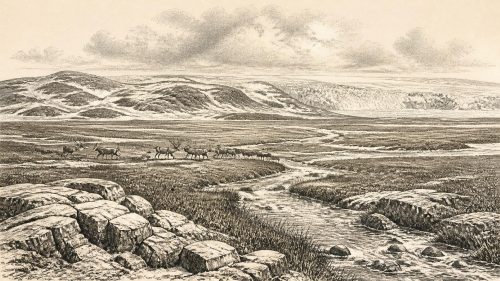
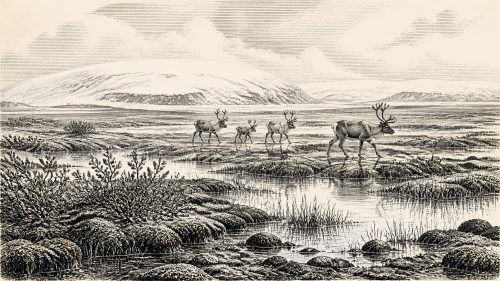
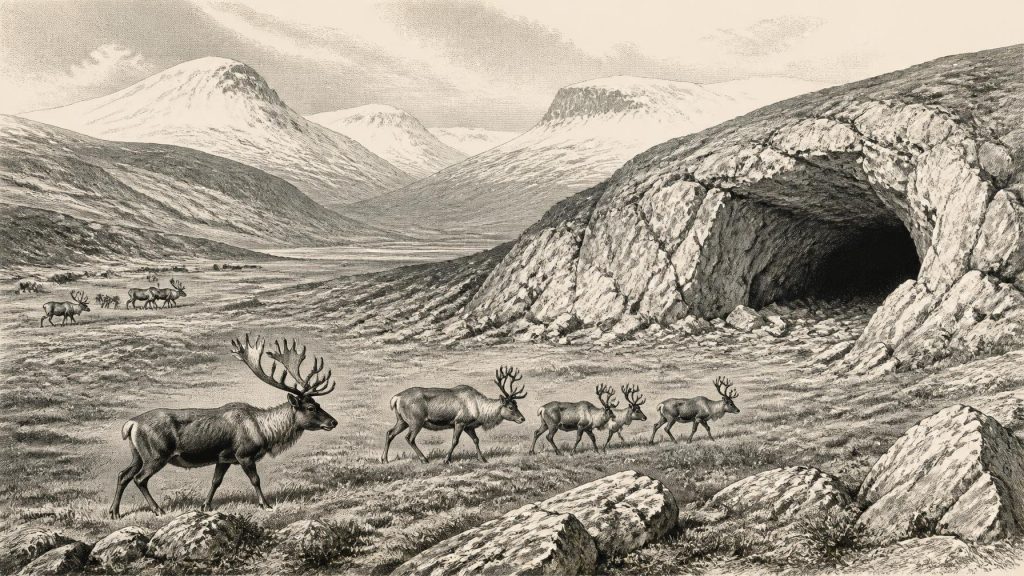
The strongest direct window on Ireland near this date comes from Pleistocene animal remains, particularly in limestone caves. Castlepook Cave near Doneraile in north Cork is especially significant. Its deposits have produced evidence for a cold-stage fauna including woolly mammoth, reindeer, giant deer, brown bear, wolf, fox, Arctic fox, mountain hare, lemmings and spotted hyaena. Older cave collections were often excavated before modern stratigraphic standards, however, and later re-dating has shown why individual specimens cannot automatically be treated as belonging to one event or one brief phase of occupation. The cave is evidence for a changing ecosystem across a long span, not a census taken in 31,986 BCE.
Nevertheless, the fauna is historically powerful. Mammoth and reindeer indicate the potential for a productive but severe grazing environment; giant deer, Megaloceros giganteus, recalls that the animal commonly called the “Irish elk” was neither exclusively Irish nor an elk. Carnivores such as wolf and spotted hyaena reveal a food web with competition, scavenging and predation. The presence of Arctic-adapted small mammals points towards cold conditions, while bears and other species show that the ecological picture cannot be reduced to one stereotyped “mammoth steppe”. Ireland’s Pleistocene fauna was diverse, but it was also less completely known than that of neighbouring Britain because later glaciation, rising seas, acidic soils and the uneven survival of cave deposits have left a fragmentary record.
These animals were not resources in an Irish economy unless humans were present to exploit them, and the evidence does not allow that assumption. They were parts of a natural economy: herbivores converting vegetation into meat and bone; predators and scavengers following carcasses; caves serving at different times as dens, traps, shelters or repositories for sediments washed in from outside. A gnawed bone, a tooth or a skull may illuminate animal behaviour and local conditions, but it does not by itself establish a human camp.
The Human Question
There is no securely documented permanent human settlement in Ireland that can responsibly be assigned to c. 33.9 ka BP. There are no known houses, hearths, tool-making floors, graves, artworks, named communities or surviving political institutions from this date. Accordingly, there can be no evidence-based account of Irish government, diplomacy, warfare, social rank, religion, learning, trade routes or everyday domestic life in the usual historical sense. To invent any would turn silence into false history.
This does not mean that human presence is impossible. Anatomically modern humans were living in parts of western Europe during the Upper Palaeolithic, and the mammals preserved in Irish caves demonstrate that Ireland could at times offer prey and shelter within a wider north-west European world. But a viable visit, a repeated seasonal presence and an enduring population are different propositions. The archaeological record requires securely dated humanly made artefacts or unambiguous modifications in reliable context before any of them can be claimed.
The distinction matters because Irish Palaeolithic research is developing. The dated butchered brown-bear bone from Alice and Gwendoline Cave in County Clare provides evidence of human activity in the terminal Pleistocene, far later than the period considered here. Meanwhile, reassessment of Castlepook and other cave collections continues to refine the dating and identification of fauna. Such work may alter the future picture, but it does not presently justify writing a settled human story for 31,986 BCE. The later Mesolithic hunter-gatherers, who left much clearer evidence after the final deglaciation, must not be projected backwards into this earlier and radically different landscape.
No Polities, but Regional Change
Political affairs are therefore absent not because they were peaceful, but because there is no demonstrable human polity in Ireland to which the term can be applied. Conflict and diplomacy cannot be recovered. Nor can religion or formal culture be inferred from caves merely because caves later acquired ritual and symbolic importance. The cultural history of this date is chiefly geological and ecological: ice was accumulating across the wider British–Irish region, sea and land boundaries were changing, and animal communities were moving, contracting or disappearing as habitats altered.
Recent large-scale reconstruction of the British–Irish Ice Sheet depicts rapid growth after about 31 ka BP, with expanding ice centres in Ireland and Scotland and increasingly marine-terminating margins. Other site-specific evidence shows that some Irish regions remained ice-free into the broad c. 34 ka interval. These findings are not mutually useless; they demonstrate why a national generalisation must be cautious. Ice-sheet growth was dynamic, asynchronous and regional. Around the requested date, southern Irish cave evidence and northern Irish organic deposits illuminate survivable landscapes, while the wider reconstruction signals the approach of ice conditions that would soon become much more extensive.
What This Moment Means
The history of Ireland around 31,986 BCE is thus not a tale of kings, monuments or tribes. It is the history of a land on the threshold of major glaciation, inhabited certainly by Ice Age animals during the broader period and possibly visited by people, but without evidence for an enduring human community. The most responsible image is not an imagined village but a changing cold-world environment: limestone caves collecting bones and mineral deposits; grazing animals moving through exposed country; predators using the same landscapes; snowfields and growing glaciers in the wider uplands and seas.
Its long-term importance is immense. The expansion and retreat of the last ice sheet reshaped drainage, soils and landforms, influenced the survival of older deposits and helped determine the ecological obstacles faced by later colonists. When humans did establish themselves in post-glacial Ireland, they entered a country whose physical setting had been remade by the processes already under way in this remote, unresolvable “year”.
Primary Sources
- Growth and retreat of the last British–Irish Ice Sheet, 31,000 to 15,000 years ago: the BRITICE-CHRONO reconstruction
- Growth and retreat of the last British–Irish Ice Sheet, 31,000 to 15,000 years ago: the BRITICE-CHRONO reconstruction
- Trimlines, blockfields and the vertical extent of the last ice sheet in southern Ireland
- Trimlines, blockfields and the vertical extent of the last ice sheet in southern Ireland
- Maximum extent and dynamic behaviour of the last British–Irish Ice Sheet west of Ireland
- Stratigraphic and palaeo-geomorphological evidence for the glacial-deglacial history of the last British-Irish Ice Sheet in the north-western Irish Sea
- Pattern and timing of retreat of the last British-Irish Ice Sheet
- New data for the Last Glacial Maximum in Great Britain and Ireland
- Landform modification by palaeo-ice streams in east-central Ireland
- Rapid response of climatic conditions during the last glacial: evidence from U-series dated Irish speleothems
- Episodic speleothem deposition tracks the terrestrial impact of millennial-scale North Atlantic climate variability during MIS3
- The Irish Quaternary Fauna Project
- A reconsideration of the radiocarbon dating of the Marine Isotope Stage 3 fauna from southern Ireland
- Occurrence of mammalia relicts at site Castlepook Cave
- Pleistocene vertebrates in the British Isles
- Palaeobiology of an extinct Ice Age mammal: Stable isotope and cementum analysis of giant deer teeth
- Could brown bears (Ursus arctos) have survived in Ireland during the Last Glacial Maximum?
- First evidence of a Late Upper Palaeolithic human presence in Ireland
- First evidence of a Late Upper Palaeolithic human presence in Ireland
- New insights on the fauna of Ireland's Younger Dryas and Early Holocene from Alice & Gwendoline Cave
- The colonization of Ireland: A human ecology perspective
- The Mesolithic in Ireland: when was it?
- Advice to the Public: Caves and Archaeology
- The Antiquity of Man in Ireland
- The Recession of the Last Ice-Sheets