Butchery Marks at Castlepook31985 BCE
Around 31,985 BCE, Ireland lay within the unstable, cold conditions of Marine Isotope Stage 3, with changing ice, sea levels and possible routes from Britain. Glaciation and later inundation destroyed much evidence. Castlepook Cave, County Cork, yielded a reindeer femur reportedly marked by stone-tool butchery, perhaps dating to about 33,000 years ago. If human-made, it indicates a brief Upper Palaeolithic visit, not permanent settlement. Cave fauna, including reindeer, mammoth and predators, reflects cold open habitats but spans different periods. No associated tools, dwellings, art or burials are securely known. Later ice erased traces; human evidence appears near the Pleistocene’s end.

Dateline
A Date Beyond Calendars
31,985 BCE is a useful modern label, not a date that people in prehistoric Ireland could have recognised. No Irish written chronology, ruler list or event record exists for this remote point in time. Archaeologists instead work with imperfect scientific dates: radiocarbon years, calibrated calendar-year ranges, sediment sequences and the changing record of ice. The assigned year lies roughly 34,000 years before the 1950 ‘present’ used in radiocarbon convention, within the later part of Marine Isotope Stage 3, a fluctuating phase of the last Ice Age. It cannot responsibly be narrowed to a particular season, generation or occurrence.
The best way to approach Ireland at this point is therefore through a broad window of several millennia, especially about 45,000–30,000 years ago. This was the Middle Devensian, often called the Midlandian in Ireland: a cold world, but not one that was uniformly frozen or environmentally unchanged. Temperatures, ice extent, sea level, vegetation and animal ranges all altered abruptly and repeatedly. What is known comes chiefly from caves, animal bones, glacial landforms, offshore sediments and modern reassessment of older collections.
An Unstable Ice-Age Island
Ireland’s familiar shape and coastlines did not define the landscape. Global sea levels were lower than today because much water was locked in northern ice sheets, exposing parts of the continental shelf. Yet a low sea was not automatically a simple land bridge. The Irish Sea basin, local sea level, glaciers and changing shorelines created barriers and possible routes that varied through time. Research on Irish palaeogeography cautions against imagining a permanent walkable connection with Britain. Any movement by animals or people would have depended on conditions that cannot be reconstructed year by year.
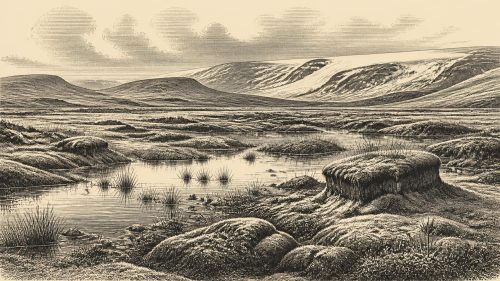
Nor should the island be pictured as either wholly ice-covered or wholly open at precisely 31,985 BCE. The British–Irish Ice Sheet was growing during the wider period around 31,000–30,000 years ago, but the exact timing and thickness of ice differed markedly between regions, and evidence for its early advance across Ireland is sparse. Later, at the Last Glacial Maximum, approximately 27,000–23,000 calibrated years before present, ice covered Ireland and extended across the surrounding shelf. Around the date considered here, parts of Ireland may still have provided ice-free or seasonally accessible ground, while ice masses expanded in uplands and across adjacent seas. This is a reconstructed environmental situation, not a map precise enough to locate a camp.
The eventual ice cover is central to the historical problem. Moving ice eroded landscapes, reworked sediments and destroyed or buried many traces that an earlier human presence might have left. Subsequent sea-level rise drowned other potential landscapes. The shortage of Palaeolithic sites in Ireland does not demonstrate that nobody ever came; equally, it cannot be used as evidence for a populous or continuous settlement. Survival of evidence has shaped the story.
Castlepook and a Tentative Human Trace
The most directly relevant evidence comes from Castlepook Cave, near Doneraile in north County Cork. This limestone cave complex produced an exceptional collection of Ice Age animal bone during excavations between 1904 and 1912, and further work has resumed in recent years. A reindeer femur fragment in the National Museum of Ireland’s natural-history collection has been reported as bearing deep marks consistent with stone-tool butchery on fresh bone. The object has been presented as dating to about 33,000 years ago and, in a local heritage publication, approximately 31,000 BCE. It is the reason that a date such as 31,985 BCE can be meaningfully discussed in Irish prehistory.
Its importance must be matched by caution. The bone is not an excavated hearth, a house floor, a stone-tool assemblage or a burial. Castlepook’s deposits were investigated using early twentieth-century methods, and bones were recovered from complicated cave sediments affected by water, carnivores and later disturbance. Much of the collection lacks the secure, fine-grained context expected of a modern excavation. The published reassessment of southern Irish Marine Isotope Stage 3 fauna also shows why renewed radiocarbon measurement and careful identification matter: some older results have required revision.
If the modification is correctly identified as human-made, the reindeer bone establishes a brief episode of human activity in Ireland during the Upper Palaeolithic, far earlier than the island’s previously secure late-glacial evidence. It does not establish a permanent community in Cork, an uninterrupted population, or a particular named cultural group. A reasonable interpretation is that mobile hunter-gatherers encountered and butchered a reindeer, perhaps during a short visit. Even that episode may not have occurred inside the cave: carnivores could have carried discarded or scavenged remains into their den. The evidence is powerful precisely because it is so rare, but it remains a single line of evidence requiring corroboration from securely excavated material.
A Fauna of Cold Open Country
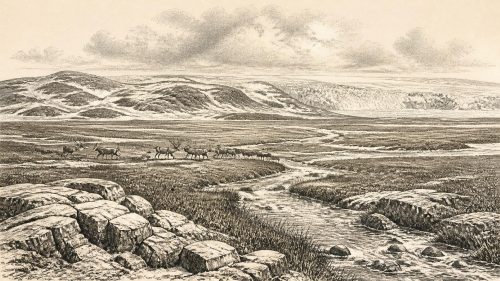
Castlepook nevertheless makes clear that Ireland could support a striking Ice Age fauna during parts of Marine Isotope Stage 3. Mammoth, reindeer, giant deer, brown bear, wolf, Arctic fox, mountain hare, lemmings and spotted hyaena are among animals represented in the cave collection. Shandon Cave in County Waterford has also yielded cold-stage faunal material, including horse in association with mammoth and reindeer. These finds point towards landscapes that, at favourable times, included open, cold grassland, herb-rich tundra or steppe-tundra rather than the later wooded island often associated with Irish prehistory.
Yet the animal list should not be turned into a single tableau. Cave assemblages can accumulate over long periods, and a predator’s prey remains need not represent animals living together in one season. Re-dating has indicated that some species in southern Irish caves belonged to substantially different episodes within MIS 3; giant deer and spotted hyaena may have disappeared locally before about 40,000 calibrated years ago. Thus mammoth, hyaena and reindeer demonstrate the breadth of the regional faunal record, but they do not prove that every species was present beside Castlepook in 31,985 BCE.
The cold-country animals do, however, help explain why a human visit is conceivable. Reindeer move in herds and can be a major, predictable resource for hunter-gatherers: meat, marrow, hide, sinew, antler and bone were valuable materials. In continental north-west Europe, Upper Palaeolithic groups used sophisticated stone technologies and often followed seasonal resources across large territories. It is plausible that people reaching Ireland belonged to such wider networks. It is not possible to assign them an ethnicity, language, religion, artistic tradition or political identity from one modified bone.
Society Without Institutions
There is no evidence at this date for Irish chiefs, kingdoms, diplomatic agreements, organised warfare, farms, villages or monuments. Those categories belong to much later periods. If people entered Ireland around this time, their social world was likely composed of small, highly mobile kin groups whose survival rested on knowledge of animal behaviour, weather, raw materials and safe routes. Such a statement is an inference from Upper Palaeolithic hunter-gatherer lifeways elsewhere in Europe, not a direct observation of a Cork camp.
Everyday life, if there was a human presence, would have been constrained by cold, exposure and mobility. Clothing and shelter made from skins, wood and other perishable materials could leave little trace, especially after glaciation. Fire, stone tools and butchered bones are the forms of evidence archaeologists would hope to find. No securely associated toolkit has yet been recovered in Ireland for the possible Castlepook episode. The absence makes claims about hunting weapons, cooking, domestic arrangements or seasonal residence premature.
Culture, Belief and Knowledge
The Upper Palaeolithic elsewhere in Europe produced cave art, engraved bone and antler, personal ornaments, music and elaborate treatment of animal materials. Those achievements show the intellectual capacities of contemporary Homo sapiens, but none can presently be attributed to Ireland in 31,985 BCE. No cave art, ornament, ceremonial deposit or human burial of this age is securely known from the island. It would be misleading to populate Irish caves with paintings or rituals simply because such practices are known abroad.
That silence is historically meaningful. It tells us less about whether transient visitors had beliefs than about the small and damaged archaeological sample. Caves preserve bone better than most Irish soils, but they also mix materials through water flow, animal activity and excavation history. The distinction between evidence and interpretation is especially important here: an animal bone bearing possible butchery marks is evidence for an encounter; a story of a settled Ice Age people is not.
After the Window Closed
Whatever happened during this warmer or less severely glaciated interval did not create an easily traceable ancestral population. The advancing ice sheet transformed Ireland, and later deglaciation reshaped its surface once more. Definitive evidence for human activity becomes much clearer only near the end of the Pleistocene, including the cut-marked brown-bear bone from Alice and Gwendoline Cave in County Clare, dated to approximately 12,810–12,590 calibrated years before present. More substantial settlement evidence belongs to the Mesolithic, after the ice had retreated.
For 31,985 BCE, then, Ireland should be understood as a changing north-western edge of Ice Age Europe: inhabited confidently by cold-adapted animals, affected by an expanding ice sheet, and perhaps visited by a very small number of hunter-gatherers. Castlepook offers an arresting possibility rather than a complete origin story. Future excavation, refined dating, microscopic study of bone surfaces and investigation of submerged landscapes may strengthen, alter or overturn elements of that interpretation. At present, intellectual honesty requires leaving much of the scene open.
Primary Sources
- Growth and retreat of the last British–Irish Ice Sheet, 31,000 to 15,000 years ago: the BRITICE-CHRONO reconstruction
- A reconsideration of the radiocarbon dating of the Marine Isotope Stage 3 fauna from southern Ireland
- The Irish Quaternary Fauna Project
- Trimlines, blockfields and the vertical extent of the last ice sheet in southern Ireland
- Deglaciation chronology of the Donegal Ice Centre, north-west Ireland
- Stratigraphic and palaeo-geomorphological evidence for the glacial-deglacial history of the last British-Irish Ice Sheet in the north-western Irish Sea
- Ireland: Submerged Prehistoric Sites and Landscapes
- The Problem of a Late Quaternary Landbridge between Britain and Ireland
- Deglaciation, Earth Crustal Behaviour and Sea-Level Changes in the Determination of Insularity: A Perspective from Ireland
- Castlepook Cave, County Cork: Geological Site Report
- Heritage Artefacts of County Cork 2021
- 2022:564 – Castlepook Cave, Castlepook South, Cork
- Irish Caves Database: Mammoth Cave, Castlepook
- Quaternary Geology of Ireland
- Geology of Ireland
- The Mesolithic in Ireland: When Was It?
- First Evidence of a Late Upper Palaeolithic Human Presence in Ireland
- New Insights on the Fauna of Ireland's Younger Dryas and Early Holocene from Alice & Gwendoline Cave
- Episodic Speleothem Deposition Tracks the Terrestrial Impact of Millennial-Scale Last Glacial Climate Variability in SW Ireland
- Dimensions and Chronology of the Last Ice Sheet in Western Ireland
- Late Pleistocene Chronostratigraphy and Ice Sheet Limits, Southern Ireland
- The Timing and Magnitude of the British-Irish Ice Sheet between Marine Isotope Stages 5d and 2