Uneven Ice-Sheet Advance31939 BCE
Around 31,939 BCE, Ireland was experiencing unstable Late Pleistocene conditions near the expansion of the last Irish Ice Sheet, rather than a single uniformly glaciated landscape. Glacial, sedimentary and cave evidence indicates cold open habitats supporting reindeer, mammoth, giant deer, bears, wolves, Arctic foxes, lemmings and hyaenas, especially in southern caves. Castlepook Cave’s dated reindeer femur, possibly cut-marked by a stone tool, raises the prospect of brief Upper Palaeolithic human activity. Nevertheless, disturbed deposits and absent tools, hearths or settlements preclude proof of permanent occupation. No social, cultural or political reconstruction is justified. Secure Irish settlement appears after 8000 BCE.

Dateline
31,939 BCE is not a year that can be recovered from the Irish archaeological record as a dated event. It is a modern, proleptic calendar label applied to a time before writing, named polities or calendars in Ireland. Archaeologists instead work with radiocarbon determinations, calibrated ranges and geological sequences. In those terms, this notional year falls broadly around 34,000 years before AD 1950, within the Late Pleistocene and Marine Isotope Stage 3: an unstable interval of the last Ice Age, preceding the fullest expansion of the last Irish Ice Sheet. The appropriate history is therefore not a list of happenings in one year, but a carefully bounded reconstruction of what the evidence can, and cannot, say about Ireland in the early thirties of millennia BCE.
A Landscape Before Maximum Glaciation
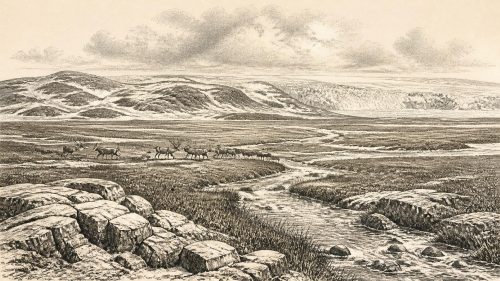
At this point Ireland was not yet necessarily the wholly ice-covered land familiar from reconstructions of the Last Glacial Maximum. Syntheses of glacial evidence suggest that much of Ireland remained largely ice-free until roughly 32,000 years ago, after which the last Irish Ice Sheet expanded and thickened. Its advance was not instantaneous or uniform. Different sectors of the ice sheet reached their maximum offshore limits at different times, with the western and southern shelves occupied later than some northern areas. A date around 31,939 BCE therefore belongs close to a major environmental transition rather than securely within one simple, island-wide condition.
This qualification matters. It would be misleading to picture all of Ireland as either a green, habitable island or a single unbroken glacier. Climate fluctuated sharply during Marine Isotope Stage 3, and the extent of ice, snow cover, permafrost, open ground and vegetation varied through time and from region to region. The evidence comes chiefly from landforms, sediment layers, cave deposits, fossil bones and scientific dating, not from contemporary descriptions. It can show broad processes and approximate sequences, but rarely reconstruct a particular valley, season or year with confidence.
Even where land was exposed, it would have been a severe world. Lower global sea levels altered coastlines and exposed parts of the continental shelf, although ice, changing sea level and the Irish Sea still made any route between Ireland and Britain contingent and difficult. Modern coastlines should not be projected backwards. Much of the land that would later become shore lay differently in relation to sea and ice, while places now inland could have experienced a colder, more continental climate than modern Ireland. The glaciation that followed would also erode, bury or disperse many older surfaces, severely limiting the survival of open-air evidence.
Animals in Southern Irish Caves
The strongest direct evidence for Ireland around this broad period is environmental and faunal, especially from limestone caves in the south. Castlepook Cave near Doneraile, County Cork, is particularly important. Its historic excavations produced a large collection of Pleistocene animal remains, later reassessed through modern zooarchaeology and radiocarbon dating. Re-dating has shown that some Irish cave fauna belongs to Marine Isotope Stage 3, long before the maximum phase of the last glaciation. This revision is significant because old collections can preserve material of great age even when their original excavation records are incomplete by modern standards.
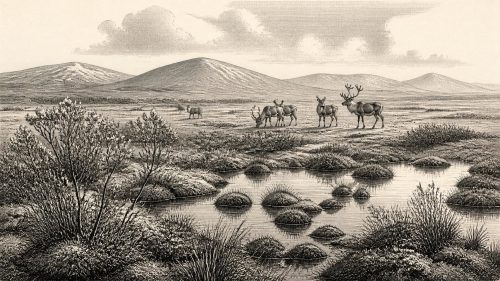
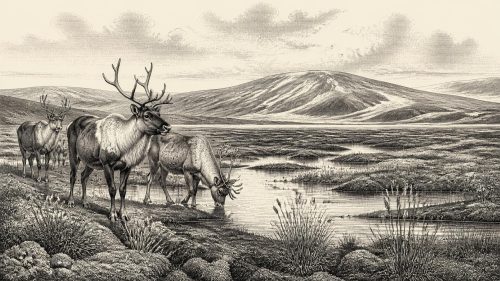
The cave record indicates that Ireland, at intervals during this earlier Ice Age phase, supported a cold-adapted large-mammal community. Reindeer are central to the picture; other remains from southern Irish caves include woolly mammoth, giant deer, brown bear, wolf, Arctic fox, lemmings and spotted hyaena. These finds do not prove that every species occupied every part of the island at the same time, nor that their populations were large or continuous. But together they indicate habitats capable of sustaining grazing and browsing animals, predators and scavengers. The likely landscape included open grassland, herb-rich steppe-tundra and patchy vegetation rather than the dense temperate woodland of later post-glacial Ireland.
Such animals were not symbols of an imagined “lost Ireland”; they are dated biological evidence. Reindeer suggest cool, open environments and seasonal movement across broad landscapes. Mammoth and giant deer imply substantial forage in at least some periods. Hyaenas are especially valuable evidence because cave carnivores can accumulate bones in dens or scavenging places. Yet that same process complicates interpretation. A cave assemblage may contain animals brought in by predators, bones moved by water or sediment, and remains deposited at widely separated times. It is a record of ecological possibility and changing environments, not a snapshot of one living herd outside a cave entrance.
The Castlepook Human Question
This period has unusual importance because of a reindeer femur from Castlepook Cave that has been publicised as dating to approximately 31,000 BCE and bearing a mark interpreted as the result of butchery with a sharp stone tool. If that reading is upheld, it would provide evidence that one or more Upper Palaeolithic people processed a reindeer in Ireland broadly near the era represented by this article. It would push possible human activity on the island many millennia earlier than the long-accepted Late Glacial evidence and would make Castlepook one of the most consequential sites in Irish Palaeolithic research.
However, the claim must be expressed cautiously. The scientific date is an estimate for the animal bone, not a calendar entry for a hunt. Radiocarbon measurements require calibration because atmospheric carbon levels changed through time; calibration produces ranges rather than an exact historical anniversary. Nor does a mark on a bone, by itself, establish the location of killing, the duration of a visit, the number of people involved or a settled population. Castlepook’s early excavations disturbed and removed deposits, and its caves were used by natural agencies as well as animals. No securely associated stone-tool assemblage, hearth, dwelling floor, burial, human bone or artwork has yet demonstrated an established Irish community of this age.
The most responsible interpretation is consequently modest but important: a short episode of human presence or carcass processing in Ireland is possible, perhaps by mobile hunters following reindeer or exploiting a favourable local opportunity. Permanent occupation remains unproven. This distinction is not pedantry. A small hunting party, a seasonal visit and a population living continuously on the island are radically different historical propositions. The National Museum of Ireland has continued to characterise clear Palaeolithic human presence as unproven, while the Castlepook material points to a research question of exceptional promise rather than a settled conclusion.
Society Without a Recorded Society
There is no evidence from Ireland at this date for a kingdom, chiefdom, tribe with a recorded name, law, diplomacy or organised warfare. It is equally unsupported to assign a language, ethnicity or later Irish identity to any people who may have visited the island. Terms such as “Irish”, “Celtic” and “Gaelic” belong to enormously later historical contexts and should not be carried back into the Upper Palaeolithic. Even the designation “hunter” is an inference from the possible cut-marked reindeer bone and the wider European setting, not a documented social identity.
Comparison with contemporary Homo sapiens groups elsewhere in north-west Europe can provide context, but not substitute for Irish evidence. People on the continent made sophisticated stone, bone and antler equipment; they maintained wide social contacts and, in some regions, created cave art and portable art. None of this demonstrates equivalent technologies, trade routes, rituals or artistic traditions in Ireland around 31,939 BCE. There are no Irish monuments, ritual deposits, formal graves or images securely attributable to this period. Religion, learning and culture cannot responsibly be reconstructed beyond the universal observation that any human visitors would have possessed knowledge, skills and social relationships necessary to travel and survive in difficult environments.
Economy, Movement and Survival
If people did reach Ireland during this broad phase, their economy would most plausibly have involved mobile foraging, especially the pursuit or processing of large game. Reindeer meat, fat, hides, sinew, bone and antler could all have been valuable resources to Upper Palaeolithic communities. But that is an interpretation based on ecological context and analogies, not proof that Castlepook hunters used every part of an animal or camped nearby. There is no demonstrated local quarrying, craft production, exchange network, farming or maritime trade at this date.
Movement would have been shaped by terrain and climate. Open habitats could facilitate travel over exposed ground, while ice margins, cold rivers, snowfields and changing sea passages imposed formidable constraints. The Irish Sea region was part of a wider, changing north-west European landscape, not a modern island world with fixed coastlines. Whether a particular human group crossed from Britain, travelled through periodically exposed coastal terrain, or arrived by another route cannot be answered from the present evidence. The absence of known tools and camps means that even a plausible route remains hypothetical.
The Deep-Time Record
What matters most about Ireland around 31,939 BCE is not a named event but the narrowness of the evidence and the scale of the question. Geological research places the island near the onset of the last major ice-sheet expansion. Cave faunas reveal a much richer Ice Age ecology than modern Ireland possesses. The Castlepook reindeer femur raises the possibility that people briefly entered this landscape far earlier than formerly accepted. Yet the record does not presently support a narrative of villages, political communities or a continuous ancestral population.
The later history of Ireland makes the gap especially striking. Secure, substantial evidence for settlement belongs to the Mesolithic, from about 8000 BCE, after the ice had retreated and post-glacial environments had transformed. Between the possible early Upper Palaeolithic trace and those later hunter-gatherer communities lies a vast span of climatic upheaval, glaciation, sea-level change and archaeological loss. For 31,939 BCE, uncertainty is itself the historical fact: Ireland was a changing Ice Age landscape, rich enough at times for remarkable fauna and perhaps visited by people, but still only faintly visible through the surviving record.
Primary Sources
- Prehistoric Details
- Stone Age
- Ireland through geological time
- Quaternary
- HERITAGE ARTEFACTS of County Cork
- Archaeological Heritage of County Cork
- 2022:564 – CASTLEPOOK CAVE, Castlepook South, Cork
- A reconsideration of the radiocarbon dating of the Marine Isotope Stage 3 fauna from southern Ireland
- The Irish quaternary fauna project
- The Last Irish Ice Sheet: Extent and Chronology
- The deglaciation of the western sector of the Irish Ice Sheet from the inner continental shelf to its terrestrial margin
- Late Pleistocene chronostratigraphy and ice sheet limits, southern Ireland
- Dimensions and chronology of the last ice sheet in Western Ireland
- Trimlines, blockfields and the vertical extent of the last ice sheet in southern Ireland
- Maximum extent and dynamic behaviour of the last British-Irish Ice Sheet west of Ireland
- Oscillating retreat of the last British-Irish Ice Sheet on the continental shelf offshore Galway Bay, western Ireland
- Ireland: Submerged Prehistoric Sites and Landscapes
- The Mesolithic in Ireland: when was it?
- Mesolithic – Iron Age
- Ice Age Ireland
- The IntCal20 Northern Hemisphere Radiocarbon Age Calibration Curve (0–55 cal kBP)
- IntCal – Publications